
Hire by Technology
SERVICES

SOC 2 compliance has a reputation for being both essential and slightly mysterious, especially for engineering leaders who inherit the responsibility without much context.
You probably know you need a set of SOC 2 controls that satisfy the trust service criteria. You probably also know a SOC 2 audit is waiting on the other end.
What's less obvious is how to engineer those controls in a way that fits the rhythm of your actual development workflow.
It may help to reframe SOC 2 as a long-term systems problem, not a one-time documentation exercise.
Controls are living mechanisms. They shape how your team writes code, handles customer data, responds to security incidents, and even coordinates deployments.
When those systems evolve, your controls must evolve with them. That's the part that trips up a lot of companies on their first SOC 2 compliance journey.
Engineering-centered SOC 2 implementation avoids that problem by focusing on how controls behave in real life rather than how they look on paper.
That approach also tends to reduce audit friction.
Auditors usually care less about eloquent policy language and more about whether your controls are designed to ensure that people actually follow them.
If you take a moment to look at how fintech companies handle compliance, the strongest teams treat SOC 2 as an extension of their development discipline.
Trio, for example, works with fintech platforms that operate in heavily regulated environments, so our engineers arrive fluent in security expectations and financial data flows.
That makes building controls into product systems much easier because the talent already understands the stakes.
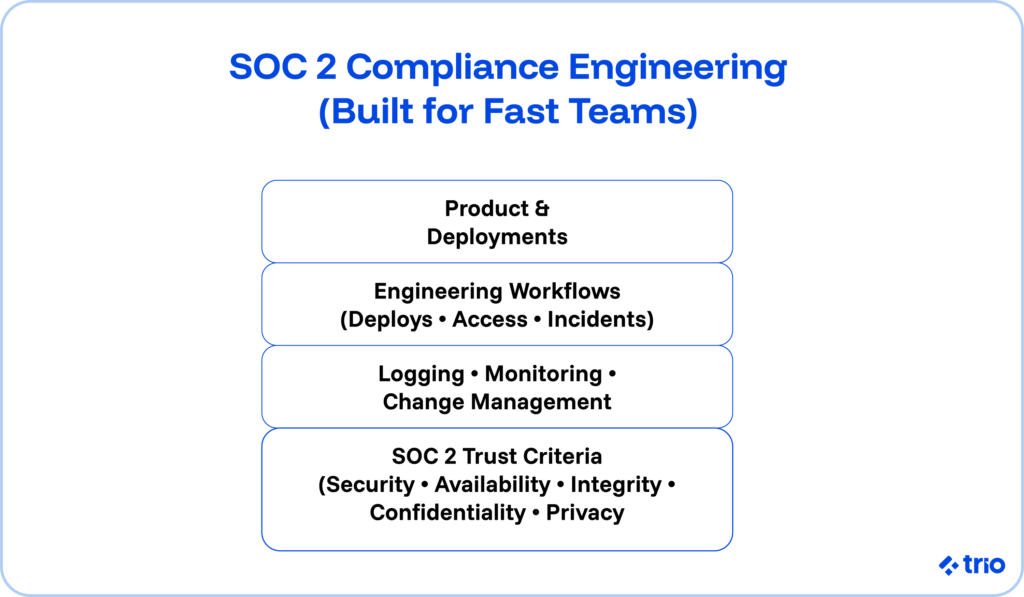
SOC 2 is a framework developed to help service organizations prove they have controls in place to protect customer data.
Rather than dictating a one-size-fits-all list of security controls, it lets you design controls that align with your environment as long as they satisfy the trust service criteria.
These criteria cover security, availability, confidentiality, processing integrity, and privacy.
Even if you choose only the security criteria for your audit scope, you will still find yourself addressing topics like:
Most engineers eventually realize that SOC 2 focuses on whether your systems behave securely by default.
If your controls are too manual, too fragile, or too dependent on tribal knowledge, the SOC 2 audit will reveal gaps.
The auditor is going to look at your security practices, review whether your information security policies match your actual workflow, and evaluate whether your organization's control environment holds up under scrutiny.
A SOC 2 Type 1 report evaluates controls at a specific moment.
A SOC 2 Type 2 report evaluates the effectiveness of controls over time.
Companies aiming to achieve SOC 2 compliance in a credible way usually pursue a SOC 2 Type 2 report because customers tend to ask for it once they reach a certain scale.
You might hear people suggest doing Type 1 first to "get it out of the way," but that can create false confidence. Controls that appear solid at a single point in time often behave differently when tested over months of engineering activity.
There's a subtle trap in SOC 2 compliance: because the framework allows customization, teams sometimes over-customize.
They design elaborate systems on paper that don't survive practical use. Or they copy a giant SOC 2 controls list from a template and assume an auditor will accept it as long as it's written correctly.
That rarely works.
To meet SOC 2 requirements in a sustainable way, you need controls that match how your engineers work today and how they're likely to work a year from now.
Controls are operating inside your CI pipelines, your deployment systems, your infrastructure, your identity provider, and everywhere customer data moves.
A control that sounds good but never gets tested in real conditions isn't going to pass a SOC 2 examination.
You may notice that the trust service criteria are intentionally broad. Process integrity, for instance, may point to your build pipeline, but the criteria leave you to determine how strict the checks must be.
That flexibility is helpful, though it also creates more decisions.
Whether your controls are operating effectively is still the central question behind every SOC 2 audit.
That's also why companies in regulated industries often rely on partners familiar with compliance expectations.
Trio's engineers, for instance, work inside fintech stack environments where requirements around change management, data security, and customer data flows are already part of the engineering routine.
That existing fluency helps teams move toward SOC 2 compliance without losing momentum.
SOC 2 scope is a deceptively simple concept. It defines which systems, data flows, environments, and processes your audit will cover.
A vague scope can create a heavy maintenance burden later because you may accidentally include systems that don't need controls or exclude ones that do.
A strong SOC 2 scope considers:
This phase may feel slow, but scoping incorrectly is one of the main reasons companies face surprises during a SOC 2 Type 2 audit.
If you migrate infrastructure, shift your deployment model, or adopt new external integrations, you may change whether your controls still meet SOC 2 requirements and controls expectations.
Auditors will ask whether your controls are still designed to ensure safety after the change.
There's also the distinction between SOC 2 Type 1 and SOC 2 Type 2. A SOC 2 Type 1 report gives you a snapshot and can be useful early on, but it doesn't confirm the effectiveness of controls.
A SOC 2 Type 2 report, or SOC 2 Type 2 compliance, examines behavior over time. That makes scope even more important because a poorly scoped control environment gradually amplifies its weaknesses.
A lot of teams imagine SOC 2 implementation as a heavy compliance overlay, but it tends to work better when engineering leads see it as an architectural constraint.
Just like you plan for scalability or observability, you can plan for controls that protect customer data without blocking development.
Instead of introducing standalone compliance steps, look for leverage points where engineers already touch sensitive systems.
A few examples appear repeatedly in SOC 2 compliant environments:
If your access management relies on multiple disconnected platforms, you'll struggle to produce evidence during a SOC 2 audit.
Controls that protect production access should come from one source of truth.
Your auditor may ask to review how you provision and deprovision accounts, how often you review unused access, and how strictly you manage privileged roles.
Teams often treat change management as a ticketing exercise, but it can be more natural if it lives inside your CI/CD process.
Automated checks that require peer review, logging, and approval tend to survive audit windows better than manual reviews that depend on individual memory.
Your logs should tell a coherent story.
If customer data moves across environments, the auditor will check whether those movements are logged, whether alerts fire appropriately, and whether your incident response process shows maturity.
Nobody enjoys writing policies, but your security criteria require them.
The important part is ensuring your policies match execution. If your organization promises encryption everywhere data is stored, the auditor will ask for proof.
When teams do this well, they often treat SOC 2 controls like part of their engineering culture rather than external pressure.
That mindset shift tends to reduce the number of missing controls discovered late in the audit process.
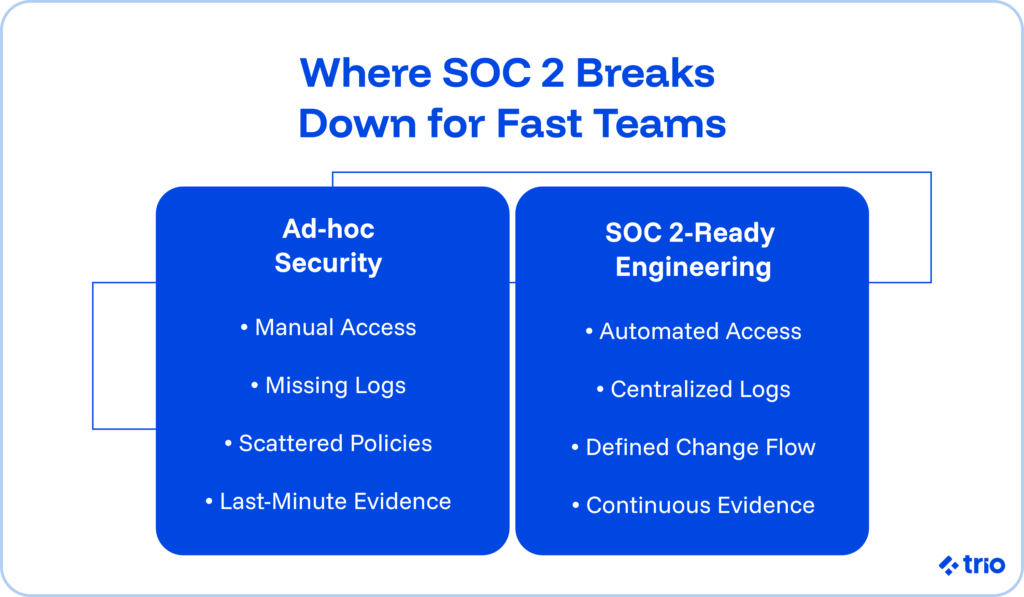
Manual controls may appear easier early on, but they become difficult to scale.
Automated evidence collection, automated access reviews, automated deployment checks, and automated alerting can dramatically reduce the effort of maintaining compliance.
Automation also helps with the type 2 report period, when auditors review historical data.
Evidence that comes from API logs and automated workflows tends to be more consistent than screenshots created retroactively.
Automation doesn't eliminate the human side, though. People still need to review alerts, oversee exception processes, and tune controls that aren't functioning as expected.
A common SOC 2 failure mode is overengineering. The team creates too many layers of checks, and engineers eventually route around them. A control is only effective if it's consistently followed.
SOC 2 criteria give you the freedom to design controls that align with your environment.
If a lightweight process meets SOC 2 standards and reduces risk, auditors usually accept it as long as the evidence holds up and it controls access appropriately.
Every SOC 2 audit relies on real artifacts: logs, approvals, onboarding and offboarding records, incident reports, policy updates, infrastructure diagrams, and more.
These artifacts reflect whether your controls are operating day to day. Maintaining them shouldn't feel like a scramble.
SOC 2 compliance works best when you make it part of your regular engineering rhythm.
That might mean scheduling recurring access reviews, aligning incident response drills with deployment cycles, or reviewing policy updates alongside roadmap adjustments.
And because SOC 2 is an ongoing system, having experienced engineers who already know how regulated environments operate can shorten the learning curve dramatically.
Many fintech teams partner with Trio for this reason: the engineers arrive fluent in the compliance context, which eliminates ramp time and lowers the risk of incorrect assumptions during implementation.
A SOC 2 audit can feel intimidating if you haven't been through one before.
The auditor will review whether your controls are operating effectively, whether your evidence supports your claims, and whether any gaps require remediation.
A few parts of the audit tend to surprise teams:
Whether your controls protect production systems, whether your offboarding happens promptly, and whether privileged accounts follow strict requirements often becomes central to the audit conversation.
Access control tends to absorb more time than any other category because it's tied directly to risk.
Auditors don't rely on your intentions. They rely on data.
If your evidence shows that security incidents were handled consistently, your change management process worked as expected, and your internal control structure didn't drift, the audit tends to move smoothly.
If you claim to follow security best practices or meet SOC 2 requirements, your controls must reflect those statements.
For instance, if your documentation states that encryption is enforced everywhere, auditors will test that claim.
A Type 1 report is relatively brief. A Type 2 report spans months. The auditor might check whether your controls were operating in February, then again in June, and again later.
This is why automation is helpful and why organizations struggle when they treat compliance as a race instead of a practice.
There is no universal list of controls that fits every product. You can think of SOC 2 as a framework that expects you to choose controls that align with your environment.
Controls that protect a data warehouse may not apply to a small microservice. Controls that work in a fintech environment may require additional privacy controls or more rigorous monitoring.
This is also why companies often ask whether they should use a traditional SOC 2 controls list.
Lists can be helpful, especially during early scoping, but they aren't enough to satisfy an auditor. Your actual systems matter more than generic examples.
If you want to implement SOC 2 controls without slowing down your roadmap, try to build around the areas auditors focus on most:
A SOC 2 audit report will eventually summarize whether your controls align with the trust service criteria. Strong engineering teams build controls that reduce risk even outside the audit.
When you step back and look at the entire SOC 2 journey, the through line is clarity.
Teams that understand their systems tend to meet SOC 2 standards more easily than teams that rely on templates alone. Implementation of controls is fundamentally an engineering problem, and the best practices for SOC 2 reflect that reality.
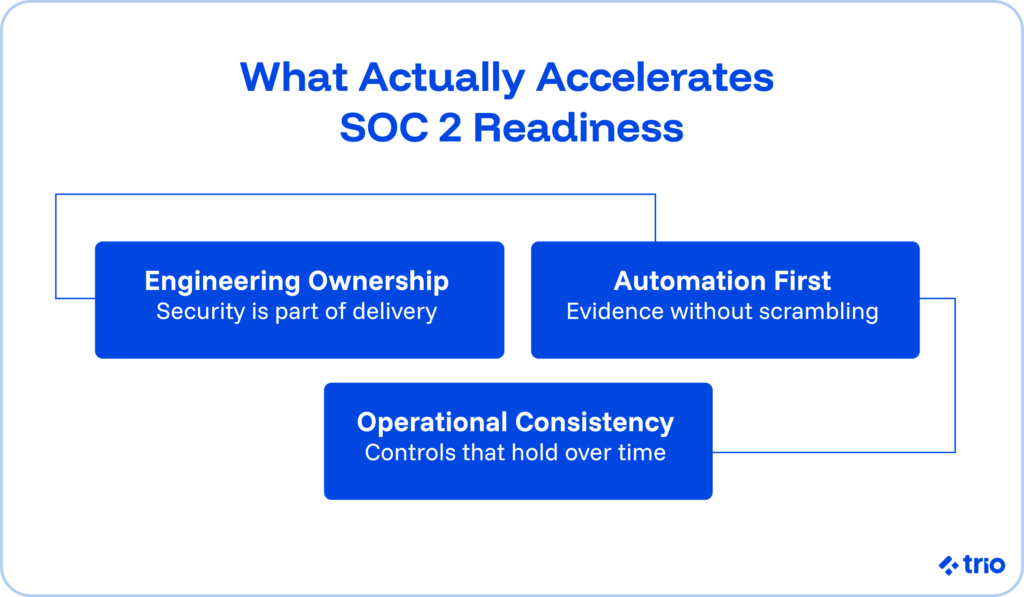
If you approach SOC 2 as an ongoing discipline, not an obligation, you build a healthier security posture.
Your service organization gains a clearer picture of how customer data moves. Your developers become more aware of risk. Your systems become more predictable. And yes, you also earn the SOC 2 badge that customers look for.
Fintech teams in particular benefit from engineering partners who understand both product and compliance.
Trio's entire model is built around providing vetted engineers who can slot into complex regulated environments and help teams ship confidently.
That blend of technical depth and compliance fluency tends to remove friction for teams working toward SOC 2 because it keeps security and delivery aligned from day one.
If you want support from engineers who understand both code and compliance, get in touch.
A SOC 2 control is essentially the mechanism you use to meet the SOC 2 control expectations, and it helps show auditors that your systems behave securely and consistently.
Achieving SOC 2 compliance usually takes a few months because the timeline depends on how quickly your team can implement controls and gather consistent evidence.
The difference between SOC 2 Type 1 and SOC 2 Type 2 is that Type 1 looks at controls at a moment in time, while Type 2 evaluates how those controls operate over an extended period.
Startups often need SOC 2 because customers increasingly expect proof that their data is handled safely, long before the company reaches large scale.
The number of SOC 2 controls you need to implement depends on your environment, but most organizations design only the controls required to satisfy their chosen trust service criteria.
A SOC 2 auditor looks for evidence that your controls function the way you describe them and that they support the commitments you make to customers.
SOC 2 does not guarantee data security, but it verifies that your controls are built to reduce risk and consistently protect sensitive information.
Automating SOC 2 evidence collection is common because automation reduces manual effort and helps keep control activity accurate over long audit periods.
SOC 2 is not the same as SOC 1, since SOC 1 focuses on financial reporting controls and SOC 2 evaluates how you protect customer data and system integrity.
You do not strictly need external help to pass SOC 2, but experienced guidance often speeds up implementation and reduces costly rework later.