
Hire by Technology
SERVICES


Scalable payment infrastructure is a high-availability, cloud-native payment backend that keeps authorization rates high and latency low as transaction volumes, currencies, and markets grow.
It can be the difference between capturing growth and watching revenue slip away.
Businesses are processing millions of transactions across multiple geographies and currencies. When systems fail, the cost is steep. In 2025 alone, for example, improper payments cost the United States an incredible $186 billion.
The problem is that legacy infrastructure wasn’t built for this pace.
In our time in the industry, we’ve seen downtime, rigid integrations, and compliance risks frustrate customers and strangle growth.
Every payment failure not only slows cash flow but also erodes trust, damages your brand, and creates openings for competitors who can offer smoother experiences.
The solution is a modern, cloud-native, and orchestrated payment infrastructure.
By adopting multi-processor strategies, high-availability patterns, and global-ready architectures, you can achieve reliability, scalability, and compliance at the same time.
At Trio, we connect companies with the people to make this possible. Our fintech specialists can help you build scalable systems, integrate the latest fintech tools, and ensure payments don’t become a bottleneck to growth.
Legacy infrastructure wasn’t designed to handle today’s transaction volumes, meet regulatory standards, or adapt to the evolving fraud landscape.
Firstly, if you aren't set up for growth, then every integration with a payment processor requires custom engineering. Adding local payment methods, supporting multiple currencies, or entering new markets becomes very difficult, and costs more than it would otherwise.
If there is a spike in traffic, it could end up as downtime, which can get incredibly expensive.
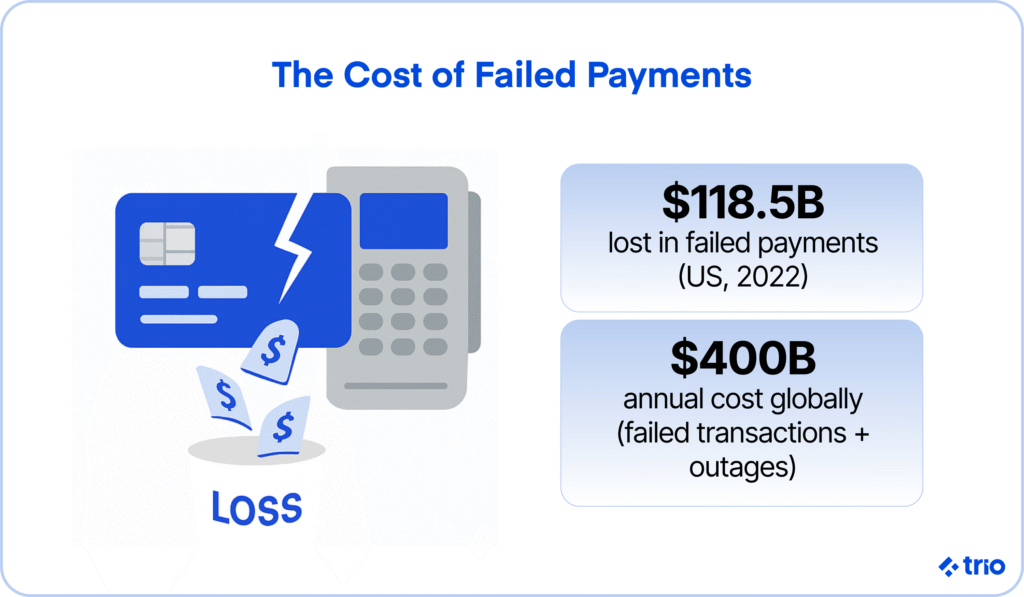
Research shows that failed transactions and outages cost businesses over $400 billion each year. That doesn’t even include the reputational hit when customers can’t complete a purchase.
Outside of total failure, security is another concern.
Without modern defenses like fraud detection, tokenization, and updated compliance measures such as 3DS v2.2, you could be exposing yourself to fines, chargebacks, and higher fraud losses.
With the customer's best interests at heart, providers like Mastercard now require higher standards of compliance to keep merchants and customers protected.
Failing to comply means that you can't use their services.
Scaling payment infrastructure is essentially about creating a system that adapts as your business grows. That’s where a modern payment platform with orchestration comes in.
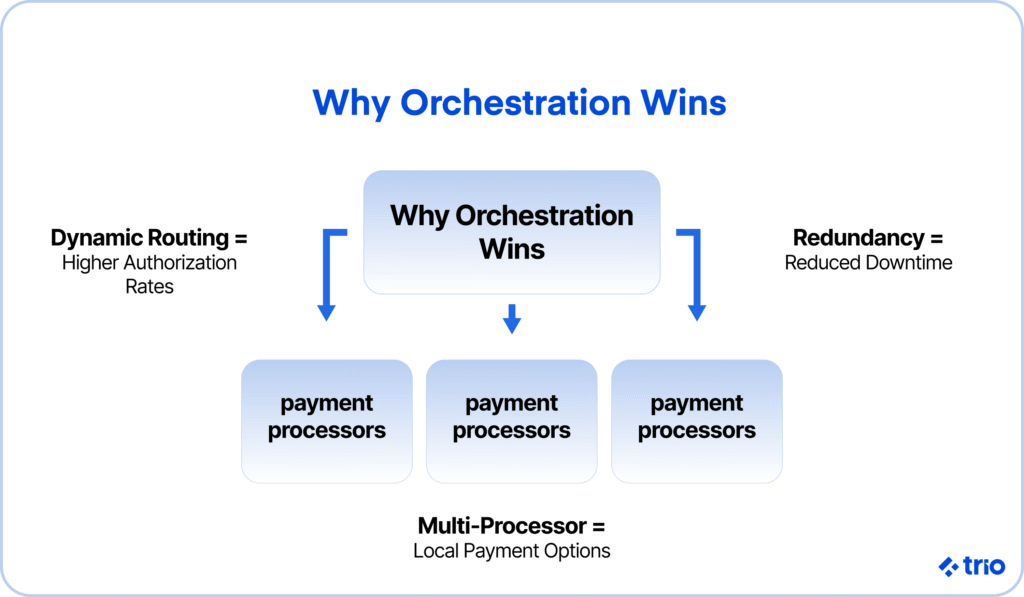
Payment orchestration platforms connect multiple processors, acquirers, and payment methods through a single layer.
Instead of depending on one PSP, orchestration enables dynamic routing, improves authorization rates, and adds redundancy when one processor fails.
In our experience, most enterprises already juggle multiple providers in an effort to avoid bottlenecks. Orchestration turns that complexity into an advantage. It allows businesses to cut costs, reduce downtime, and localize payments without reengineering their entire infrastructure.
You can either build an orchestration layer in-house or partner with a specialist.
Building internally offers complete control, but it demands significant engineering and compliance resources. At Trio, we can connect you with the relevant talent, giving you peace of mind knowing you have experienced developers on your team.
Partnering accelerates speed-to-market, brings proven expertise, and reduces operational overhead.
Legacy payment systems often come from a time that didn't require the global scale, multi-currency transactions, or the sophisticated fraud prevention required today.
Modern platforms, on the other hand, are designed for scale and are capable of handling massive transaction volumes without downtime. They are also usually built for flexibility, with the ability to integrate seamlessly with a wide range of processors and payment methods.
High availability is particularly important these days, with modern systems using active-active, multi-region architectures, automated failover, and rigorous disaster recovery testing to achieve four-nines uptime (≥99.99%).
Techniques like retries, circuit breakers, and idempotency keys can help you ensure that, even when part of the network stumbles, the transaction still goes through.
Most teams also need to implement tokenization to minimize PCI scope, and they adopt 3DS v2.2 with SCA exemptions to reduce fraud risk without creating customer friction.
To make modernization actionable, teams need a clear checklist to keep progress on track.
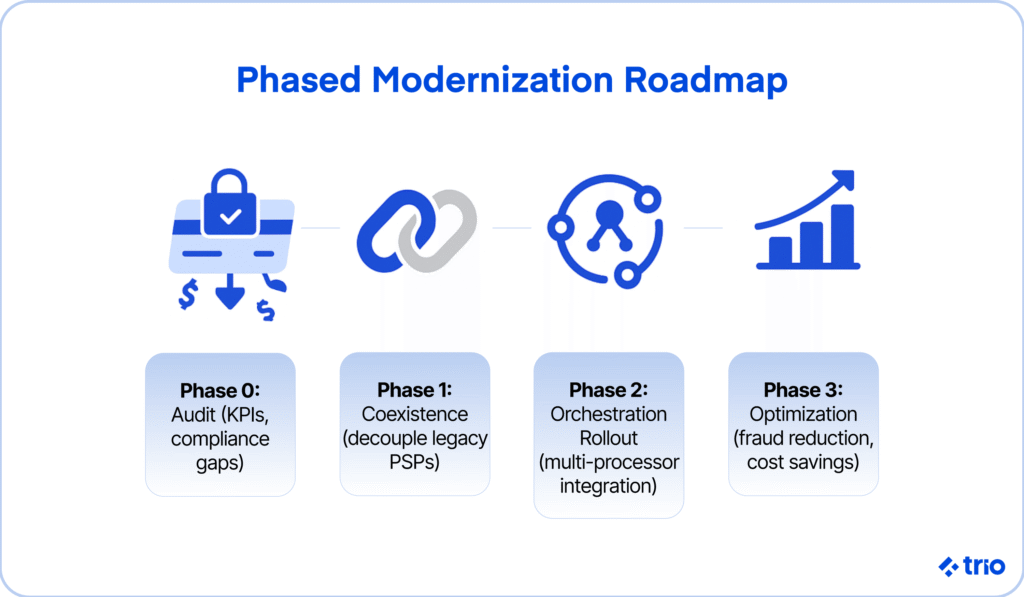
The most successful companies take a phased approach, modernizing step by step while managing risk and tracking outcomes.
Phase 0 - Assess: Everything starts with visibility. Audit existing systems for uptime, latency, and authorization rates. Document compliance gaps and fraud exposure. Establish baseline KPIs to measure whether the new infrastructure is delivering results.
Phase 1 - Coexistence: Begin decoupling from legacy PSPs with an abstraction layer or gateway. Tokenize customer data to prevent it from being locked to a single provider. Run sandbox parity tests to ensure that new systems can match existing performance.
Phase 2 - Orchestration Rollout: Once the foundation is in place, expand by integrating multiple processors and acquirers. Dynamic routing, A/B testing across providers, and smart retries that recover failed transactions all drive higher success rates.
Phase 3 - Optimization: ML-driven risk scoring reduces false declines. 3DS v2.2 exemptions reduce friction in compliant regions. Routing logic can be tuned to save costs and boost approval rates.
At every stage, you can tie technical decisions to measurable business outcomes like higher authorization lift, reduced latency, fewer fraud losses, or more substantial uptime percentages.
Scaling payments is about both scaling in customer volume and scaling in the regions where you offer your services.
Global expansion brings its own set of challenges, and the proper infrastructure can mean the difference between seamless growth and frustration.
In many markets, cards aren’t the default. In others, there are no other options.
The point is that customers expect to pay with local options, whether that’s iDEAL in the Netherlands, Pix in Brazil, or mobile wallets like Apple Pay in North America and Europe.
Meeting those expectations directly impacts conversion rates and can help you build long-term trust.
Relying on a single cross-border acquirer often means you'll probably have to settle for higher costs and lower approval rates.
Local acquiring, on the other hand, reduces friction, satisfies domestic compliance requirements, and boosts acceptance.
Payment orchestration makes this easier, since it allows businesses to plug in local acquirers without re-architecting their entire stack.
For global businesses, multi-currency support isn’t optional.
Customers want to see prices in their own currency, and they want that process to happen automatically. Doing so improves conversion rates.
Behind the scenes, treasury teams need the right tools to manage FX costs and reduce exposure.
As businesses add payment partners, complexity multiplies along with their risks and vulnerabilities.
Automated reconciliation across acquirers, currencies, and methods gives finance teams real-time visibility into cash flow. That visibility is crucial for making fast, confident decisions in a global market.
Ultimately, the ability to adapt payment flows to each market is what turns scaling into a business advantage.
The scaling playbook shifts by fintech vertical.
Investment firms, for example, need low-latency, idempotent flows and airtight reconciliation for high-value transfers.
Lending platforms scale around disbursement and repayment workflows, where retries and settlement timing matter most.
Merchants prioritize authorization rates and local payment methods to protect checkout conversion.
Regardless of the specific vertical you are dealing with, orchestration lets you tune routing and
Scaling payment infrastructure sets you up for future growth.
Legacy systems may have carried your business and many others this far, but they can’t deliver the speed, security, or adaptability that customers demand today.
The way forward rests on three pillars: orchestration to reduce dependency on any single PSP, cloud-native infrastructure to deliver resilience at scale, and a phased modernization roadmap that balances innovation with risk management.
At Trio, we’ve seen firsthand how organizations accelerate once payment solutions stop being a bottleneck.
If you’re ready to modernize your payment technologies and scale with confidence, we are here to help.
Reach out to connect with the right people as soon as possible and start building the infrastructure that will support your growth!