

 Read Client Stories




 Alex Kugell
 Key Takeaways
- Most API security incidents can be traced back to authentication weaknesses, overly permissive access controls, or undocumented shadow APIs.
- BOLA (Broken Object Level Authorization) is one of the top vulnerabilities in the OWASP API Security Top 10. It allows attackers to access other users’ data by manipulating object identifiers in API requests.
- FAPI 2.0 (Financial-grade API) has become the authentication standard that serious open banking implementations converge on.
- RFC 9700, published in January 2025, updated best current practices for OAuth 2.0 security based on lessons from open banking deployments globally.
- Rate limiting and throttling protect APIs against denial of service attacks and credential stuffing.
- PCI DSS v4.0 Section 6.2.4 requires automated application vulnerability security testing of public-facing APIs.
With an expanding open banking ecosystem where APIs carry account data, payment instructions, identity credentials, and transaction histories across dozens of integrations simultaneously, fintech API security is more essential than ever.
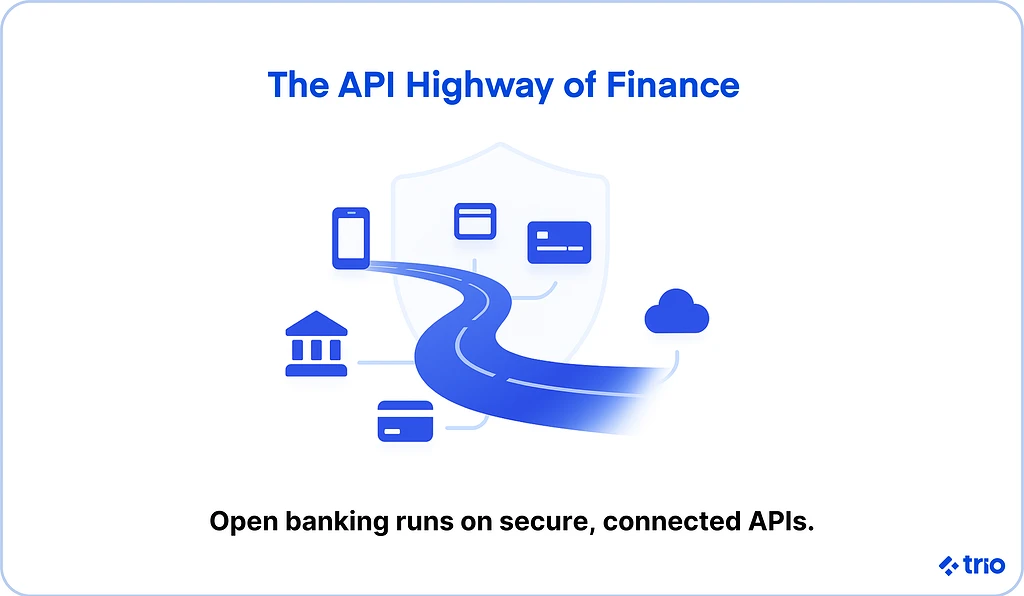
Application programming interfaces (APIs) serve as the hidden highways of modern financial services, connecting banks, payment providers, wallets, and third-party apps. But it is very easy for those highways to become target zones.
Let’s take a closer look at some of the most common API attacks, and the 7 best practices for fintech firms to ensure security, including:
- Implement FAPI 2.0 and Strong Authentication and Authorization
- Encrypt Data at Rest and in Transit, and Manage Keys Properly
- Implement Rate Limiting, Throttling, and API Gateway Controls
- Discover and Monitor Shadow APIs Continuously
- Monitor and Detect in Real Time
- Test for Business Logic Flaws and Conduct Regular Security Audits
- Adopt a Zero-Trust Architecture for Fintech API Security
Our fintech developers have helped prevent countless data breaches by understanding the requirements behind modern security practices and building security into their code from the ground up.
They have real-world experience in the financial technology industry and understand exactly what it takes to keep your products safe.
Book a security-ready consult.
Understanding Fintech API Security in Open Banking
Fintech API security refers to the practices, controls, and processes designed to protect the APIs that enable systems to exchange financial data safely.
It’s important in all software development, but becomes even more serious in fintech APIs because they contain things like user account information, payment requests, transaction histories, or identity verification data.
The interconnected financial services model that open banking depends on means that a security failure in one API can lead to a chain reaction across every integration downstream.
This means that a single misconfigured API can have serious results that end up destroying customer trust, exposing sensitive payment data, or violating regulations.
The practical consequences are financial, in the form of regulatory penalties, remediation costs, and reputational damage.
Common API Attacks and Security Threats Facing Fintech APIs
There are a couple of different attacks that we see occurring more often than others. Knowing how these occur can help you to prevent them.
Broken Object Level Authorization (BOLA) and Broken Authentication
BOLA tops the OWASP API Security Top 10 for good reason.
An attacker who discovers that a request to /accounts/12345/transactions returns data can simply try /accounts/12346/transactions and see whether the API enforces authorization at the object level.
Broken authentication is a very similar and equally common problem. Usually, we see this caused by stolen API keys, reused credentials across services, or overly permissive roles that give third-party integrations more access than they actually need.
Standards such as FAPI 2.0 build on OAuth 2.0 and OpenID Connect to add stronger protections around authorization flows, including mutual TLS and proof-of-possession mechanisms that bind tokens to specific clients.
Data Exposure, SQL Injection, and Injection Flaws
If you aren’t careful, your Fintech APIs may unintentionally return too much data, produce overly broad responses, or fail to validate input properly.
SQL injection attacks exploit insufficient input validation to run unauthorized database queries through API parameters.
If you have a payment API that passes user-supplied values directly into a database query without sanitizing them, you could potentially allow an attacker to extract sensitive customer data or manipulate records.
Input validation at every API endpoint is the best defense we have seen here.
Denial of Service, Rate Abuse, and Credential Stuffing
Without rate limits, an attacker can flood API endpoints or use credential stuffing to probe services at scale.
Denial of service attacks target API availability, aiming to paralyze payment processing or authentication flows during high-traffic periods.
Credential stuffing takes username-password combinations from previous data breaches and tests them against fintech login APIs automatically, relying on the fact that many users reuse passwords across services.
Rate limiting and throttling are able to counter both of these issues by setting maximum request frequencies per client, per endpoint, or per IP.
Usually, this requires some past experience to calibrate effectively from the get-go. However, you should continue to adjust and optimize, as thresholds that are too low block legitimate users during high-volume periods, while higher ones aren’t effective.
Business Logic Vulnerabilities
Unlike injection attacks or authentication failures, business logic flaws exploit the rules of the application itself. They can happen even if you don’t have any technical weaknesses in the code.
One of the more common examples we see of this in the fintech industry is someone submitting a payment request with a negative amount to trigger a credit.
Since there is no technical issue, they often survive penetration tests.
Instead, to test for these flaws in your payment APIs, you are going to need people who understand both security and how the specific financial workflow is supposed to operate.
Shadow APIs and Third-Party Vulnerabilities
Many data breaches trace back to trusted partners or internal users who received excessive access.
These accesses might not get normally catalogued, which leads to your losing track of them long-term, and they eventually end up giving attackers a surface that your security monitoring may not even know exists.
Finance ecosystems are massive and include banks, fintechs, aggregators, and vendors. This means that cataloguing endpoints can be very difficult and requires a culture of security.
Man-in-the-Middle (MitM) Attacks and Token Replay
MitM attacks get mitigated by correct transport-layer encryption and token-binding techniques. FAPI 2.0’s DPoP (Demonstrating Proof of Possession) mechanism binds access tokens to the specific client that requested them.
This leads to an intercepted token becoming useless to an attacker who can’t also prove possession of the client’s private key.
Best Practices for Fintech API Security
There are some practical steps that every single fintech team needs to take. These steps are very quickly becoming the bare minimum for servicing clients at any scale.
1. Implement FAPI 2.0 and Strong Authentication and Authorization
You should be using OAuth 2.0 with the January 2025 RFC 9700 best current practices as your baseline. We also strongly recommend that our clients consider FAPI 2.0 for any open banking or payment API that carries sensitive financial data.
FAPI 2.0 adds mutual TLS (mTLS) for client authentication, DPoP for token binding, and stricter authorization code flow requirements that close several attack vectors that might otherwise be left open.
Short-lived tokens, proof-of-possession methods, and tightly scoped access reduce risk significantly compared to long-lived API keys that can get stolen and reused, as we have already discussed above.
Role-based access control (RBAC) and the principle of least privilege should be in place from the very start.
2. Encrypt Data at Rest and in Transit, and Manage Keys Properly
Transport Layer Security version 1.3 (TLS 1.3) encryption will provide you with streamlined cipher suites and mandatory forward secrecy.
If you are working with AWS and major cloud providers, they require at least TLS 1.2, and may soon require TLS 1.3.
For stored data, you need to apply end-to-end encryption and tokenization, especially when handling payment data or personal identifiers.
Also, make sure that you store keys in a dedicated system like an HSM or a cloud KMS service, enforce regular rotation, and audit key access logs. Hardcoding them is a very common mistake we come across.
3. Implement Rate Limiting, Throttling, and API Gateway Controls
Rate limiting, as we mentioned, controls the frequency of requests per client, per endpoint, and per IP address.
You should see it as your primary defense against denial of service attacks, credential stuffing, and API abuse patterns. Without it, there are issues that would only surface in billing anomalies or support complaints.
API gateways centralize the enforcement for each endpoint, rather than requiring each service to implement its own controls independently.
You should base these limits on legitimate usage patterns from your analytics, as each will have different volume profiles than one that serves transaction history lookups.
4. Discover and Monitor Shadow APIs Continuously
Protecting APIs you don’t know exist requires continuous discovery.
Automated API discovery tools are essential here, and help you find even shadow APIs that emerge from version migrations, third-party SDK updates, or integration work.
API traffic analytics also help here.
Unusual geo patterns, odd request volumes, or API calls from newly registered client apps can signal an attack before it escalates into a confirmed data breach.
5. Monitor and Detect in Real Time
It is very quickly becoming expected by regulators that you deploy real-time logging and SIEM tools alongside anomaly detection to monitor API traffic, authentication attempts, and unusual patterns.
AI-enhanced anomaly detection can surface subtle attack patterns that humans would never have been able to pick up.
By combining fraud-detection engines and AML integration, you create extensive coverage.
6. Test for Business Logic Flaws and Conduct Regular Security Audits
Regular vulnerability assessments, penetration tests, and red-team exercises prove invaluable for uncovering weaknesses before attackers do.
Standard automated scanners are a good way to find injection flaws and authentication misconfigurations reliably.
You should also automate scans during code deployment, embedding security testing into the development lifecycle.
PCI DSS v4.0 Section 6.2.4, effective March 31, 2025, requires automated application vulnerability security testing of public-facing APIs for any fintech handling card data.
7. Adopt a Zero-Trust Architecture for Fintech API Security
In a zero-trust model, you treat every system, request, and user as untrusted until verified.
For fintech APIs, this means segmenting services, using API gateways to enforce policies, verifying each request and device, and isolating access via micro-segmentation.
Policy engines like OPA (Open Policy Agent) with Rego can centralize access decisions across your API ecosystem, evaluating authorization rules consistently rather than relying on each service to implement its own checks independently.
Open Banking API Security: Regulatory Context and Implications
Open banking has brought enormous opportunity, but also additional responsibility.
Financial Regulations and Compliance Requirements
Regulations such as the European PSD2, Australia’s Consumer Data Right (CDR), and the US CFPB’s open banking mandate require secure data sharing, consent workflows, and safe third-party access.
PCI DSS v4.0 introduced over 50 new requirements with a March 2025 implementation deadline.
DORA in the EU adds ICT risk management and operational resilience requirements.
The FFIEC (Federal Financial Institutions Examination Council) provides security guidance for US financial institutions that shapes regulatory expectations around API security risk assessments, monitoring, and security controls.
Security Challenges in Open Banking API Ecosystems
With open fintech APIs comes a wider attack surface. More endpoints, more integrations, more data flows.
Fintechs must manage user consent, protect financial data, and ensure third parties are properly vetted.
Mis-scoped access and vulnerabilities in consent management add serious risk.
On top of that, a third-party application that receives broader data access than the user intended, because consent scopes weren’t properly implemented at the API level, can create both compliance exposure and customer trust damage.
API Gateway and API Management as Security Infrastructure
Beyond routing requests, a well-configured gateway can enforce authentication policies, apply rate limiting, log every API call for audit purposes, validate request schemas, and block known malicious patterns before they reach application services.
Deploying an API gateway early prevents high re-architecture costs later.
For established fintech companies managing dozens of integrations, API management platforms that provide centralized visibility into API usage, anomaly alerts, and endpoint cataloguing tend to pay for themselves in reduced incident response time.
The combination of API gateway enforcement and continuous API discovery covers two of the most common fintech API security gaps simultaneously: controls that don’t apply consistently across all endpoints, and shadow APIs that sit outside any monitoring scope.
Emerging Technologies and Future Trends in Fintech API Security
We’re seeing a massive increase in monitoring systems using machine learning to detect anomalies in API traffic.
These signals help detect subtle attacks earlier and reduce false positives from benign anomalies.
On top of that, FAPI 2.0 adoption appears to be accelerating among financial institutions serious about open banking API security.
Decentralised identity (DID) is also starting to play a growing role.
Conclusion
Modern fintech applications rely on open fintech APIs for everything from payments to account access. Since they deal with so much sensitive information, it’s essential that those APIs are secured accordingly.
Best practices like strong authentication, encryption, monitoring, and zero-trust design are essential for you to protect sensitive data and meet ever-changing regulatory requirements.
With expert talent on your team, you can ensure that all of your fintech API security is compliant and continues to evolve with your application.
To get pre-vetted developers on your team, placed within as little as 3-5 days, talk to an expert to see if we have the right people for you.