


 Read Client Stories




 Lace Brunsden

 Key Takeaways
- Financial crime investigation, KYC review, and regulatory monitoring have the most production deployments and the clearest results.
- "Using" and "running in production" are different. Cambridge's 2026 survey put 21% of financial services firms with agents in production and 52% piloting or beyond.
- Fintechs are ahead of banks, with 57% to 45% on active adoption, mostly because of data architecture rather than appetite.
- Greenlite AI is now Bretton AI, following a $75M Series B in February 2026.
- Most agents stop short of final decisions. The common pattern is autonomous investigation and documentation with human adjudication, which is a governance choice rather than a technical limit.
- Production deployment typically takes three to four months after signing, and considerably longer if your data layer is not ready.
AI can do a lot for financial services; that’s a pretty well-established fact at this point. So let’s take a closer look at which agents are actually running, inside which institutions, and what those agents are doing.
Knowing this can help you better understand what the market looks like practically, and how your fintech should proceed.
Specifically, we’ll look at AI agents actively deployed in fintech and banking operations right now, grouped by the part of the business each one owns, with funding and deployment evidence where it exists.
At Trio, our senior fintech developers have production experience working on and alongside AI agents just like these, in heavily regulated markets.
What are AI agents in fintech?
Instead of just producing an output that a human then needs to act on, AI agents plan and execute multi-step workflows using tools and data sources.
The distinction matters because agents actually touch live systems.
A generative AI tool drafts a suspicious activity report, while an agent pulls the transaction history, screens against sanctions and PEP lists, checks adverse media, assembles the case file, writes the narrative, and routes it for approval.
The second one, as you can probably tell, needs audit trails, permission scoping, and tested human override.
Almost every production deployment sits at what one framework calls Level 2 to Level 3 autonomy: the agent handles investigation and documentation end to end, while final adjudication stays with a person.
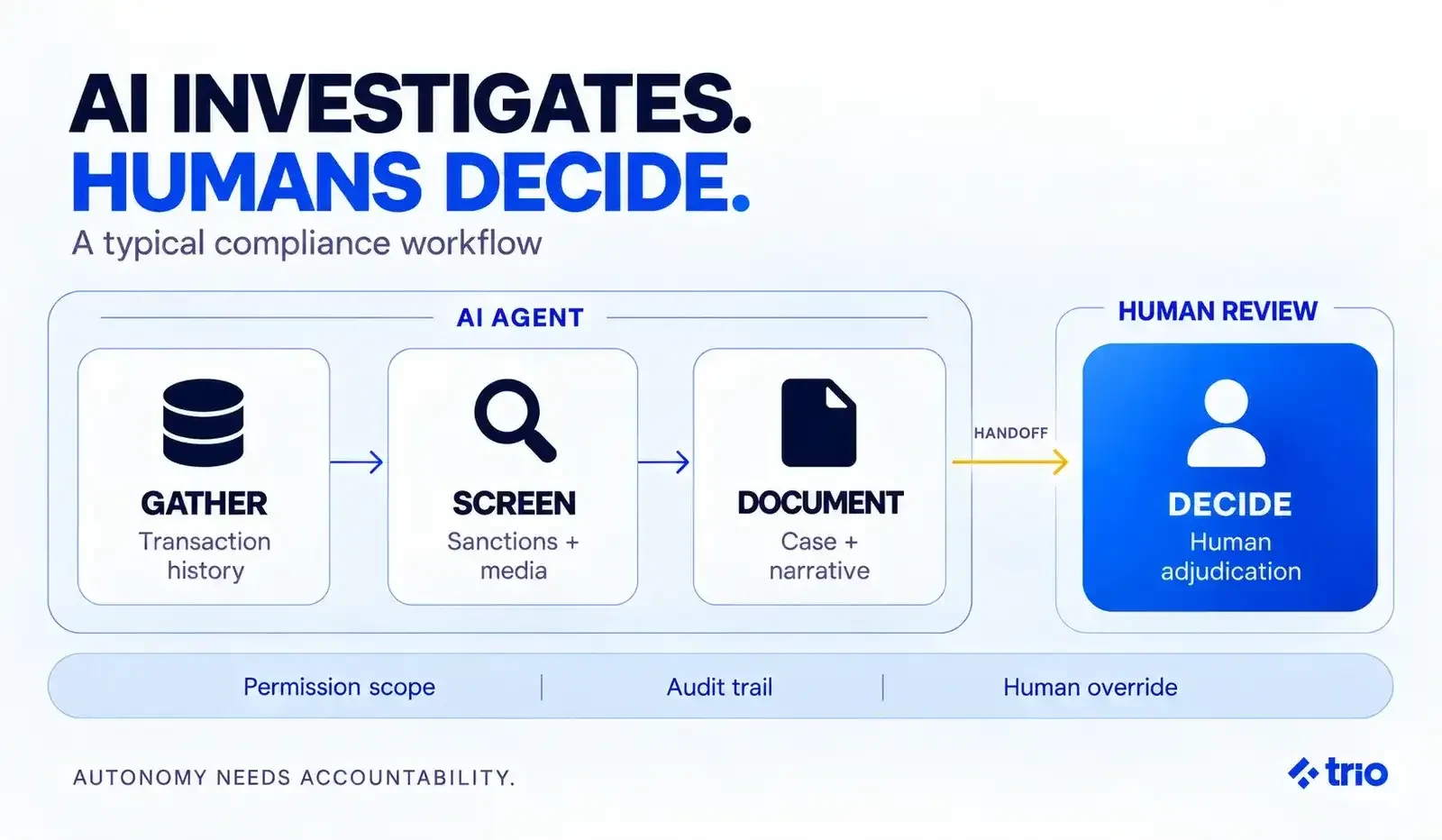
Usually, that is a deliberate governance position rather than a capability ceiling.
Related Reading: Fintechs Building Agentic Commerce Infrastructure
How many of these are actually in production?
We see a lot of numbers circulating, and a lot of the values are inconsistent. It’s worth understanding what’s actually happening in production.
What it measures | Figure | Source |
Projected agentic AI use by 2026 | 44% | |
Deployed into production | 21% | |
Piloting or beyond | 52% | |
Banking executives actively deploying | 16% | |
Piloting/deployed in production | 34% / 23% |
While these vary a lot, none of these contradict each other.
These values measure experimentation, piloting and production as though the words were interchangeable.
The Cambridge Centre for Alternative Finance figures are the most carefully constructed, and are very useful in that they tell us that about half of companies have something live, and about half are experimenting.
Financial crime and compliance agents
1. Bretton AI
Greenlite AI rebranded to Bretton AI in February 2026 alongside a $75 million Series B led by Sapphire Ventures, bringing total funding past $90 million.
Its agents handle AML alert triage, KYC and KYB review, sanctions and adverse media screening, and ongoing transaction monitoring, with model risk management expectations and transaction monitoring obligations built into the agent foundations rather than bolted on.
The results speak for themselves too. The federally regulated bank cut enhanced due diligence review time by 70%, a fintech reduced routine alert handling by 90%, and a Fortune 500 financial firm expanded into twelve markets without proportional headcount.
What stands out here specifically is that customers include Robinhood, Mercury, Gusto, and Lead Bank.
Best for: fintechs and banks whose compliance headcount is the constraint on growth.
2. Norm AI
Norm AI takes an entirely different angle, offering compliance-as-code. The platform translates regulatory text, internal policy, and supervisory guidance into rules an agent can continuously check operations against.
We’ve found that this works much better than a policy document, which nobody reopens after go-live.
The even bigger appeal here is that it addresses the drift problem.
Policies written at launch diverge from practice, and the divergence is usually discovered during an examination. An agent checking continuously finds it sooner.
Best for: compliance and legal teams operationalizing regulation across multiple jurisdictions.
3. Parcha
Parcha focuses on document collection, verification steps, and structured case progression within onboarding and compliance workflows.
This means that agents automate discrete verification tasks while final decisioning and edge case analysis stay with the compliance team.
While it’s a much narrower product than Bretton or Norm Ai, that's the point. It slots into an existing workflow rather than asking you to restructure one.
Best for: teams with a defined onboarding process wanting to remove manual document handling.
4. Lucinity
Lucinity has taken an AML-focused approach, with explainability as the organizing principle.
We’re seeing this matter more and more in European deployments where supervisors expect institutions to justify automated decisions. Its agents support investigation and case building rather than autonomous filing.
Worth evaluating alongside Hawk AI, Sardine, and Unit21, which are companies using AI for fraud detection in fintech.
Lending and underwriting agents
5. Uptiq
Uptiq builds agents that automate document-heavy workflows inside banks and credit unions, connecting to core systems and document repositories.
The company was able to raise a $25 million Series B in February 2026 and reports more than 140 financial institutions live, including Broadridge, Orion and TransPecos Bank.
Its agents cover application intake, client onboarding, compliance documentation, commercial underwriting, covenant monitoring and loan servicing.
Underneath all of that sits its Qore orchestration layer, and the company sells it to fintechs wanting to build their own agents on the infrastructure.
Timelines here are important to take into account, since full production deployments typically take three to four months after contract signing.
Best for: banks and credit unions with document-heavy commercial lending operations.
6. Casca
Casca deals with lending-specific agents, handling application processing, document collection, and borrower communication, aimed particularly at SBA and commercial lending where the paperwork burden is heaviest and the process notoriously slow.
Best for: lenders where application throughput rather than credit modeling is the bottleneck.
7. Parlay
Parlay works on loan application preparation and pre-qualification, improving the quality of applications reaching underwriters rather than automating the underwriting itself.
The biggest difference between Parlay and Casca is that it offers a far narrower implementation, and one that avoids the regulatory load that comes with automated credit decisions.
Worth noting: credit scoring for individuals is classified as high-risk under the EU AI Act, which is why lending agents cluster around preparation and servicing rather than decisioning.
Customer-facing agents
8. Erica (Bank of America)
Bank of America’s Erica is one of the largest deployed banking assistants by interaction volume, with the bank reporting more than 3 billion interactions.
What’s unique here is that Erica is built in-house rather than bought as a vendor product.
It demonstrates what sustained investment produces at scale, and sets the benchmark any purchased alternative gets measured against inside large institutions.
9. Kasisto (KAI)
KAI works on conversational banking, built on banking-specific natural language understanding rather than a general-purpose model with a finance prompt.
We most often see it used to handle account servicing, transaction queries, and product questions.
Integration here runs to months because it connects to core banking, which is the recurring theme across every customer-facing deployment on this list.
Best for: retail banks wanting a banking-trained assistant without building Erica.
10. Personetics
Focuses on proactive financial guidance rather than reactive answers: analyzing transaction patterns to surface insights, nudges, and personalized recommendations inside banking apps.
The engineering requirement is real-time access to transaction data with clean lineage, which is why deployments take months and why institutions with modern data platforms move faster.
Enterprise orchestration
11. Eliza (BNY)
Eliza is actually an orchestrator whose best-documented workflow coordinates around thirteen specialized agents to negotiate a single product recommendation, and BNY has since scaled Eliza into a platform its CEO says powers more than 125 AI solutions bank-wide, giving sales and client service teams instant access to synthesized information across systems.
It’s another in-house build, and one of the clearest public examples of multi-agent orchestration running in a large institution.
The structural lesson is that the orchestration layer is itself a system requiring governance. It falls within model risk management scope rather than sitting outside it, which teams building their own frequently miss.
12. Agentforce Financial Services (Salesforce)
Salesforce’s Agentforce takes the platform play.
Rather than a single agent, it provides infrastructure for financial institutions to build and deploy their own across service, onboarding, and relationship management, grounded in existing CRM data.
Best for: institutions already on Salesforce wanting to build rather than buy individual agents, and willing to own the governance that comes with it.
How do you choose between them?
There are a couple of things you need to think about when choosing an AI agent for your product:
Which function is actually your constraint? Compliance headcount, loan processing throughput, and customer service volume need different agents.
What autonomy level do you need, and what will your risk function accept? Most production systems run investigation-autonomous with human adjudication.
Is your data layer ready? Agents need fast, governed access to customer and transaction data with clear lineage.
Does the vendor understand your regulator? Agents built with OCC, NYDFS, or EBA guidance in their foundations are a different proposition from a general AI product with a finance landing page.
What does the audit trail look like? Every action, tool call, escalation, and human override needs logging in a form a supervisor can follow.
How long to production, honestly? Three to four months is realistic for a well-scoped deployment on ready infrastructure, longer if the data work comes first.
What do these agents still get wrong?
Worth stating, since nobody selling them will.
Governance maturity lags deployment.
EY’s 2026 survey of AI decision-makers found that roughly half of organizations deploying agentic AI have not updated their governance frameworks for agentic-specific risks, and most could not name a single group accountable for overseeing agents after deployment.
Explainability is genuinely hard.
A supervisor asking why a decision was made needs a trace through tool calls and data access, not a model output.
Building hierarchical explainability, with business logic for executives and transaction-level trails for regulators, is real engineering.
Drift is continuous
Agents interacting with live operational data change behavior over time.
Periodic validation misses this, so make sure that you keep a continuous eye on your models to make sure no biases form.
Liability frameworks have not caught up.
Rules on chargebacks, consumer protection, and fair lending assume human decisions.
Where an agent acts wrongly, who answers remains unsettled in several jurisdictions, so you need to be very careful here.
People are the bottleneck more often than models.
Staff moving from doing work to supervising systems that do it need different skills. We have noticed that deployments stall on this more than on accuracy.
Building and integrating agents
Once you’ve bought the agent, your next problem is connecting it to core systems, building the permission architecture, instrumenting audit logging that satisfies a supervisor, and designing the human override path.
All of this lands on your engineering team.
That work needs applied ML alongside payments or lending domain knowledge and enough regulatory literacy to ask the right questions before architecture gets fixed.
At Trio, we place AI developers, fintech engineers, KYC and AML developers, and fraud detection engineers with production experience inside regulated institutions.
Hiring options include staff augmentation, dedicated teams, or our fintech engineering practice.
See how we work or request a consult.