
Hire by Technology
SERVICES



Having separate languages across your front-end and back-end can become inconvenient quickly. You’ll struggle to find full-stack developers who can code in both languages, and your back-end and front-end teams will probably struggle to communicate.
This is a recipe for costly mistakes and long-term performance issues. The solution is to use the same language for both, and to find a runtime environment that facilitates that.
Node.js is a JavaScript runtime environment that allows developers to perform both front-end and back-end web development. From what we have seen, it’s one of the most-used web technologies among professional developers.
You’ll want to use Node.js if you need to simplify the development of flexible and scalable servers while also enabling fast and lightweight JavaScript processing on the front end.
Many companies that we have worked with also use Node.js for scalable APIs, real-time web application infrastructure, microservices, and applications such as chat platforms that need to support thousands of concurrent connections without major performance slowdowns.
In fintech, those same properties make Node.js a natural fit for payment processing pipelines, real-time fraud detection services, open banking API layers, and the kind of high-throughput transaction infrastructure that financial products depend on.
But an increase in popularity leads to an increase in competition when it comes to hiring Node.js developers, especially those with genuine fintech production experience. Going through a firm like Trio, which does all the sourcing and vetting on your behalf, is a strategic move.
Let’s look at how to hire Node.js developers for fintech, from designing a Node developer job description to where you need to look and even how much you can expect to spend.
Node.js lets you build real-time web applications that work seamlessly across devices. It is open-source, allows fast and flexible server-side development, and meshes well with JavaScript on the client side.
But, beyond that, there are a couple of things that give Node an edge over other backend web frameworks.
From what we have seen, Node.js is the preferred option for a lot of startup teams because it means that they can keep smaller engineering teams who can move faster, thanks to their frontend and backend developers sharing the same JavaScript ecosystem.
Enterprise teams, on the other hand, also like to use the runtime environment, but instead of their choice being based on speed, they often lean toward Node.js development for scalable backend services and microservices.
The overarching responsibility of Node.js developers is building and maintaining network applications with Node.js.
If you break this down to effectively look for a new hire, this could include daily tasks like:
If you have a bigger team of backend developers, you don’t have to go for senior developers who are able to do all of this. You just need to make sure that you are covering all of this with the entire team.
If you have a smaller project, you might also be able to go with more junior developers since the stakes are lower. In an MVP, for example, you might be able to get away with this.
However, fintech platforms, SaaS products, or healthcare systems usually benefit from experienced developers.
The experience these developers have gained in the field helps them to understand scalability, deployment reliability, security concerns, user expectations, and regulatory requirements from the start.
Node.js Expertise: Of course, if you are hiring a Node developer, then you need to make sure they have experience with the framework in their portfolios.
Knowledge of Node.js Frameworks: Express.js tends to appear on most job descriptions, but we’ve seen NestJS grow significantly in enterprise environments because of its TypeScript-first architecture. Make sure you know what you need before you hire.
HTML and CSS Expertise: Familiarity with HTML and CSS is not optional when designing back-end programs that need integration with front-end applications.
TypeScript Proficiency: A growing share of production Node.js codebases now rely on TypeScript for added type safety, especially in fintech and enterprise environments.
Asynchronous Programming: Node.js developers should have considerable expertise in asynchronous programming, including callbacks, Promises, and async/await patterns.
Proficiency in RESTful APIs: Knowledge of RESTful APIs allows developers to handle communication between multiple applications. Familiarity with GraphQL is increasingly common, too. Experience in consuming and building APIs that handle financial data is invaluable.
Cloud and Deployment Awareness: As many as 94% of organizations are expected to use cloud platforms like AWS, Azure, or GCP this year. Look for devs who have worked with Lambda functions, environment variables across deployment stages, or Docker containers.
Problem-Solving Skills: Debugging is just as important as writing new code. It doesn’t help to push forward if you can’t fix the simplest mistakes.
Teamwork and Communication: Strong communication keeps client-facing interactions smooth and ensures peers feel comfortable voicing concerns.
Database experience: Strong Node.js developers often work closely with PostgreSQL, MySQL, MongoDB, or Redis, depending on the backend architecture.
Security and Compliance Awareness: Developers who understand authentication patterns like OAuth 2.0, token management, secrets handling, and PCI-DSS data handling requirements are valuable in fintech contexts.
You’ll probably also need developers with a solid understanding of microservices, deployment workflows, code quality standards, and Agile development practices if your product roadmap involves long-term scaling, which most tend to.
Full-Time Employment is the most typical hiring model that companies consider. It gives you continuity and team cohesion.
But the trade-off is that you need to spend the resources and time (sometimes months) to find and onboard those developers, and you are responsible for additional costs like equipment and benefits.
That timeline is often not feasible for fintechs dealing with compliance timelines or investor pressures around product launches.
Freelance or contract developers are essentially the opposite.
They can start faster, but probably work for multiple clients, and you can’t guarantee that they will be with you long-term. This makes them great for short-term projects.
From what we have seen in the market in the last few months, it’s safe to assume that US-based freelancers typically charge $55 to $90 per hour, with senior specialists reaching $100 to $150.
Staff Augmentation is a great medium. External developers work alongside your existing team under your processes and direction. They are usually full-time employees with another company, so you increase the chances of having them available long-term.
Rates generally fall between $40 and $120 per hour, depending on location and seniority. Our nearshore LATAM staff augmentation is particularly great due to US timezone overlap, and at Trio, these developers go for between $40 and $90, depending on what you need.
For fintech teams that need developers who can integrate with existing compliance workflows without a lengthy handover period, staff augmentation through an industry-specific partner that pre-vets developers tends to reduce onboarding friction significantly.
Alternatively, you could consult a Node.js Development Agency, which will be able to provide a full team, including project management and QA. You typically pay more, but reduce coordination overhead. The tradeoff here is that you have little to no control once the development starts.
Most companies prefer to hire remote Node.js developers through nearshore outsourcing partners or agencies because onboarding tends to move faster while communication stays relatively seamless across overlapping time zones.
Offshore developers, like those in Africa, are a great option if you need someone working alternate hours or if you just want a finished product with little to no communication.
Just be aware of the different regulations in these regions around IP ownership and data handling.
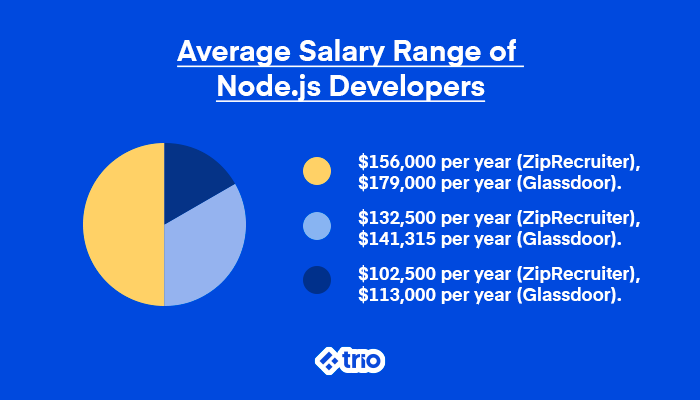
Average salary range for Node.js developers from various sources, including ZipRecruiter and Glassdoor.
The average salary for Node.js developers ranges from $102,500 to $179,000 per year, based on data from ZipRecruiter and Glassdoor.
According to Glassdoor, the typical pay range for a Node.js developer in the United States falls between $154,000 and $230,000 per year.
Factors like experience, location, and specialized skills influence the cost.
For example, a developer with 10 years of experience in Node, who lives in California and has additional cloud certifications, is going to cost more than someone who has done it for two years and lives in Mississippi.
Fintech experience adds another premium. But getting a developer with a track record in regulated fintech environments is often worth it. The cost of retrofitting compliance later is often a lot more than the additional cost of the right developer from the start.
When you are hiring internationally, different countries also have different costs.
| Region | Senior Developer (Annual) | 6-Month Project |
| United States | $154,000–$230,000 | ~$67,500 |
| South America / LATAM | $37,000–$100,000 | ~$48,500 |
| Eastern Europe | ~$100,000 | ~$55,000 |
| Asia | Lower | ~$35,000 |
Many companies associate the lower costs of these regions with a lower quality of code, but this is not always the case.
Some vetted Node.js developers in LATAM and Eastern Europe bring deep technical expertise while still costing significantly less than equivalent US hires, simply because the cost of living in those regions is lower.
You should also account for hidden hiring costs like onboarding delays, failed hires, technical debt remediation, and lost engineering time during lengthy recruiting cycles, since sometimes advertised costs don’t include those.
At Trio, you just pay the hourly rate of $40-$90 per hour, depending on your requirements. Everything is included in that pricing.
If you have decided that hiring a Node.js developer is the right move for you, you’ll need to put together a job description.
We recommend that you figure this out, even if you are considering hiring an agency, since it gives them a better understanding of your requirements, and it will allow you to measure results.
The key is to be as specific as possible. Here’s an example of what that might look like for a fintech product.
We are looking for a Node.js developer with experience in financial services or regulated environments for a client-server project.
You will be responsible for developing the server-side of the application, designing the application logic, and maintaining the databases. You will manage the interchange of data between the server and the users and ensure high performance and responsiveness to requests from the front end.
You will also be responsible for integrating the front-end elements built by your co-workers into the application. Therefore, a basic understanding of front-end technologies is necessary.
Our ideal Node.js developer combines backend engineering skills with practical deployment awareness and experience building scalable APIs or modern web applications.
Experience working in fintech, payments, lending, or other compliance-heavy environments is a strong advantage.
Once you start processing applicants, you’ll want to interview them. Of course, the best thing you can do is tailor the questions to your project specifically. But if you have no idea what to look for, these questions will give you a good place to start.
If you are looking for a full-time employee or a long-term freelancer, then LinkedIn is a good option. It provides access to a large global candidate pool.
Just keep in mind that filtering from high applicant volume is time-consuming before you get to interviews.
Filtering by past employers in financial services, payments, or banking can help narrow results to candidates who have already worked in the kind of environment you are hiring for.
Job boards like Indeed and Monster are also a great option, and help you multiply your visibility across hundreds of thousands of job seekers.
But again, filtering and interview stages can quickly become costly because of the sheer number of applicants.
Freelancing platforms like Upwork, Fiverr, and Freelancer work particularly well if you just need someone for short-term or clearly scoped projects. Vetting still falls on you, and hourly rates for senior specialists can approach US market rates, even for non-US developers.
Outsourcing and staff augmentation agencies like Trio are the way to go if you need to streamline hiring from start to finish. We connect you with skilled developers who are not only already vetted but hand-picked for your specific situation.
Our developers are specifically vetted for fintech production experience, which most general platforms don't screen for at all.
The result has been a 97% placement success rate, reducing not only the amount of resources you need to invest in the hiring process, but also your overall risk.
Some companies also search for Node.js developers through GitHub communities, JavaScript meetups, Discord groups, and open-source projects because those channels give you access to people who aren’t looking for work outright.
These platforms also let you find people who are actively contributing to projects that are similar to your own.
Related Reading: Top Places to Find Developers for Your Company
Hiring Node.js developers can become a lengthy and costly process, from designing job descriptions to interviewing and hiring candidates.
Trio simplifies this process and helps you connect seamlessly with developers who have been hand-picked for your project.
The hiring market for Node.js developers, especially for senior backend engineers with cloud infrastructure and scalability experience, has become quite competitive, and the additional requirement of fintech experience only makes this worse.
Companies that move slowly through onboarding or rely on vague hiring requirements often lose qualified developers before offers reach the finish line.
Whether you hire in-house, use outsourcing, or prefer to hire remote Node.js developers through a staff augmentation partner, the strongest hiring outcomes usually result from extensive vetting for technical skills and industry experience.
We do all of this for you, so you can get senior Node developers placed in as little as 3-5 days.
If you are ready to start hiring, book a discovery call!