

Hire by Technology
SERVICES


At its core, IT outsourcing means working with an external partner to deliver technology solutions. That might look like staff augmentation, project outsourcing, or fully managed services.
Companies choose to outsource software engineers for several reasons. Sometimes it's to reduce costs. Other times, it's to access skills and expertise that are not available through your in-house team.
Working with an outsourced team carries risks. But once you learn how to mitigate them, you can benefit from productive collaboration with a remote team.
Let’s take a deeper look at IT outsourcing and how you can use it successfully, even in highly competitive, compliance-heavy industries like financial services.
At Trio, we provide outsourcing with skilled developers from regions like LATAM. Each of our developers is hand-picked, based on your requirements.
If you’d like to explore options, book a call.
Outsourcing occurs when a business uses an outside supplier to obtain goods or resources, rather than relying on internal support.
A lot of people associate it with things like call centers, which focus on reducing costs for large corporations. But companies in the tech industry often outsource software engineers to gain an extra set of skills.
It helps to understand the terminology, since these terms get used interchangeably even though they describe different arrangements:
There are gains and losses that come along with outsourcing. Being careful about your partnership can make it more likely that you experience the benefits while mitigating those risks.
Cost reduction drives most outsourcing decisions. Smaller companies, in particular, often lack the infrastructure, resources, and budget to develop their own IT solutions.
Offshore countries also typically have lower costs of living, so the overall price for outsourcing will be lower than that of outsourcing locally.
If you don’t have the skills to assess developers, it can be risky to hire them on your own.
When it comes to actual development, too, outsourcing with Trio means you don’t have to provide the tools and resources developers will need.
External partners bring in-demand skills in areas like FinTech, cloud migration, cybersecurity, AI integration, and DevOps.
With the right partner, you can adopt new technologies and innovate faster than you could by relying solely on internal resources.
Outsourcing provides the ability to adjust quickly.
Instead of committing to long-term hires, you can scale your team up or down depending on project needs.
This flexibility helps meet deadlines and budgets without the overhead of permanent staffing, keeping your business agile in a fast-changing market.
The disadvantages of outsourcing generally involve difficulties that result from cultural and locational separation. But, as already mentioned, these can often be mitigated if you are aware of them.
Offshoring can lead to communication difficulties due to language barriers and cultural differences.
To work around this issue, many companies choose nearshore outsourcing as neighboring countries tend to share languages and cultural traditions.
At Trio, English proficiency is the bare minimum, and most of our developers have worked on international teams. Ensuring your partner has this experience is a great way to mitigate potential communication risks.
Since you're not sourcing your hires internally, they may not understand the full context of your vision or project.
That said, we make the extra effort to integrate with your internal team closely, providing onboarding assistance so our developers can understand your project just as well as you do, ensuring continuity.
Vague agreements often lead to hidden costs, such as scope creep, unplanned change requests, or extra fees for project management and communication tools.
The safeguard here comes through detailed contracts and strong SLAs, which help prevent surprises and keep costs predictable.
Sharing sensitive company or customer data with a third party always introduces risk.
Compliance frameworks like GDPR or HIPAA leave little margin for error, especially in industries like FinTech, with very strong regulatory scrutiny, where weak data governance practices can expose your business to fines or reputational damage.
Working with partners who demonstrate strong cybersecurity and compliance processes has become non-negotiable.
Relying too heavily on one provider can create long-term dependency.
Your provider's team accumulates knowledge about your edge cases, your integration quirks, and your undocumented legacy behavior.
Switching vendors then means a knowledge transfer that takes months.
Businesses can avoid lock-in by diversifying providers where possible, or by insisting on transparent, well-documented processes from the start.
Here is a clearer picture of the cost categories that actually determine whether outsourcing saves money or simply moves money around. You will see that the hourly cost is only the tip of the iceberg.
While all figures are estimated, they are based on our real-world observations.
| Cost Category | Staff Augmentation / Local | Offshore Outsourcing |
| Developer hourly rate | $75–$130/hr (contract) | $25–$50/hr |
| Vendor management overhead | Minimal | 0.5–1 FTE locally ($80K–$140K/yr) |
| Rework and revision cycles | 10–15% of the project cost | 20–40% of the project cost |
| Transition and knowledge transfer | 1–2 weeks | 4–12 weeks |
| Legal and compliance | Standard employment terms | $10K–$50K+ for cross-border contracts and IP protection |
| Security and data protection | Internal controls | Audit costs, monitoring, insurance; avg. breach cost $4.88M (IBM, 2024) |
IT outsourcing works best if you want to save costs without sacrificing quality.
While there are a bunch of factors you need to consider, IT outsourcing tends to deliver when:
It is definitely not for you if you are doing work that requires deep institutional knowledge, when compliance requirements are strict, or when the requirements shift frequently enough to generate constant change orders with the vendor.
When outsourcing, one of the first decisions involves how to structure payment. The right pricing model depends on the type of project and how much flexibility you need.
This model works best for projects with clearly defined requirements, timelines, and deliverables.
Because everything gets scoped upfront, costs remain predictable and easier to budget for. The trade-off comes down to flexibility: if requirements change midstream, renegotiation usually follows.
Time and materials (T&M) works well for projects that evolve as they progress. Instead of paying for a fixed scope, you pay for the actual hours worked and resources used.
This gives you flexibility to adjust requirements, experiment with features, and pivot if priorities shift.
The downside involves less predictability in cost, so it's important to track progress closely. T&M appears frequently in Agile development environments where iteration tends to be expected.
A dedicated team model gives you a stable, long-term extension of your in-house team. You're essentially paying for a group of engineers who focus solely on your projects.
While not strictly outsourcing in every case, this setup suits businesses with ongoing development needs, complex roadmaps, or products that require continuous improvement.
When connecting with a potential outsourcing partner, there are a few ways forward.
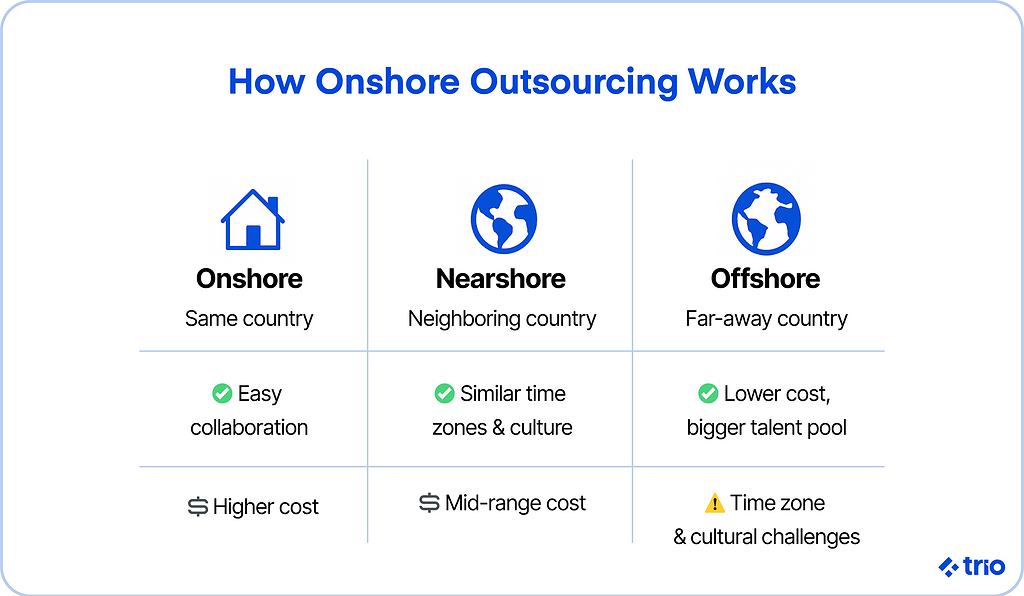
Typically, the outsourcing industry gets organized in terms of proximity and location. There are three main types of outsourcing you should be familiar with: offshore, nearshore, and onshore outsourcing.
Offshore outsourcing describes hiring external parties in a different country than your own to help with business operations. Usually, these are quite far geographically, like when a US company outsources to a company in India or China.
Nearshore outsourcing is technically a type of offshoring, as it involves outsourcing to a country other than your own, but it’s used when the country you're outsourcing to sits relatively close to your own and there aren't significant time zone differences.
For US-based companies, this is usually Latin America.
Onshore outsourcing, as the name suggests, means outsourcing within your own country.
We’ve also seen this referred to as domestic outsourcing.
As a general rule, offshore outsourcing is the cheapest option, but you need to deal with massive time zone differences and potential language barriers. Nearshoring will get you better timezone overlap, but you have a more limited pool, so you may end up paying more.
Onshore outsourcing is the simplest in terms of legality, and you’ll remove language-based communication barriers. However, there really isn’t going to be much cost savings.
Understanding the risks associated with outsourcing software engineers can help you better identify your specific needs and determine the best fit for your business.
Most of the time, these risks align with what you would experience with an in-house team anyway, with only a couple of exceptions:
IT outsourcing is a great strategy to minimize costs and get quality products on the market, but only if you are careful about who you partner with and ensure that you do some research.
At Trio, we specialize in financial technology, connecting companies with developers who have real-world fintech experience and understand the intricacies of the industry in terms of security and regulatory compliance.
Since we have developers on hand, pre-vetted, we just need to place them, and can provide portfolios within as little as 48 hours. Our primary engagement model is staff augmentation, but outsourcing and dedicated teams models are also available.
For more information, book a call.
Common risks of outsourcing IT work include poor communication, hidden costs, inadequate technical skills, and security issues. But you can work around all of these with the right efforts.
To choose the right outsourcing provider, you need to start by defining your goals, budget, and expectations. Once you've done that, evaluate potential providers based on their technical expertise and their experience on similar past projects.
Yes, small businesses can benefit from IT outsourcing as it allows them to access advanced technologies, including cloud services, and compete with larger companies that have more resources.
The best way to outsource enterprise software engineering is to define the scope clearly and choose a partner experienced with complex systems. Dedicated teams or staff augmentation work best at enterprise scale.
Outsourcing IT projects successfully requires setting clear requirements and choosing a proven partner. Consistent communication and defined milestones keep delivery on track.
The pitfalls of outsourcing programmers include unclear expectations and inconsistent code quality. You avoid them with strong documentation, code standards, and regular reviews.
Outsourcing developers is cost-effective because you pay only for the expertise you need. It cuts hiring costs while giving you access to specialized skills quickly.
The difference between outsourcing IT and outsourcing developers is the scope involved. IT outsourcing covers full operations, while developer outsourcing focuses on software engineering talent.
You protect your IP by using NDAs, secure repositories, and clear ownership terms. Reputable partners also follow strict data and access controls.