


 Read Client Stories





 Lace Brunsden

 Key Takeaways
- Separate processor replacement from billing-platform replacement before setting migration steps.
- Verify customer identity, renewal terms, payment configuration, and collection history before releasing any cohort.
- Assign charging ownership to one specific obligation and service period, with evidence that rules out competing collection.
- Hold missing mappings, changed subscriptions, and uncertain charges for individual review. Don't clear them with the rest of the batch.
- Test repeated imports, concurrent collection attempts, and recovery paths. Provider guarantees aren't a substitute.
A payment processor migration often fails weeks after the project has concluded, when a customer spots two charges for the same renewal, and your support queue finds out before engineering does.
Running the old and new systems in parallel buys a safety margin, but it also opens a window where both can try to collect the same obligation.
The fix is deciding, cohort by cohort, which system owns the next charge, and proving the other one can't reach it. That discipline is what separates a controlled recurring billing cutover from a risky one.
This guide walks through that verification process: building cohorts around renewal readiness, confirming subscription customer mapping before release, assigning charging ownership per obligation, and turning the result into a cutover brief your engineering team can act on.
Trio's fintech engineers have run processor and billing-platform cutovers like this one in production, including the cohort verification and exception handling this guide walks through.
Decide what changes in your payment processor migration
A migration touches three distinct systems, and scoping it correctly starts with telling them apart.
Separate the processor from the billing engine.
Start by separating payment processing from subscription billing. In most cases, the processor executes payments.
The billing engine maintains subscription terms and determines what becomes due.
Make sure that you state your migration scope plainly here. Does the billing engine stay, or does recurring billing migration also mean subscriptions move to a replacement billing platform?
Payment processor, billing engine, and merchant of record are different systems.
A payment processor, a billing engine, and a merchant of record (or PayFac) solve different problems, and treating them as interchangeable is a common scoping mistake our developers see.
You'll need to understand those differences to make sure your developers are working on the right thing, and also to consider a buy-versus-build framework for infrastructure layers that go beyond just the processor.
If you're keeping the billing engine.
If the billing engine stays, you need to preserve its subscription identity where applicable and identify its supported mechanism for switching processors.
Verify how that mechanism handles payment references, outstanding invoices, and scheduled retries.
We often find that destination subscription creation can be unnecessary here.
A retained billing engine is often the oldest system in the stack, which raises its own modernization questions separate from this migration.
If you're also replacing the billing platform
If the billing platform also changes, verify replacement subscription records alongside customer and payment references.
Stripe's subscription migration documentation requires mapping the source customer ID to the new Stripe customer ID.
That instruction concerns migration into Stripe Billing specifically. It doesn't prescribe the switching mechanism for a retained billing engine.
Define your terms: cohort and charging owner.
A cohort means customers sharing a cutover condition, such as verified ordinary renewals or unresolved payment mappings.
A charging owner means the system authorized to initiate collection for a specified obligation.
Where a billing engine is retained, ownership can stay with that engine while its permitted processor route changes. Record both the initiating system and the permitted route.
Keep adapter design and routing implementation in the integration workstream. The cutover brief itself should establish which customer records can use the new arrangement and what evidence permits that change.
Build cohorts around renewal readiness.
Let's look at a hypothetical SaaS migration that replaces both processor and billing platform.
Assume fixed-price monthly subscriptions, unchanged commercial terms, a supported payment-data transfer path, and a destination configuration that allows preparation without premature collection.
Three cohorts, three different readiness states
Cohort A: ordinary renewals with verified mappings.
Cohort B: an unresolved payment mapping.
Cohort C: a subscription with a pending cancellation request whose effective date still needs confirmation.
The same renewal date doesn't give these cohorts the same readiness.
Cohort A can move toward handover once collection ownership is verified. Cohort B needs mapping evidence. Cohort C needs a current billing decision before anyone can authorize its next renewal.
Holds block release; they don't decide ownership.
We have always found that it's best to treat a hold as a block on destination release, not an automatic cancellation of the source subscription or an automatic authorization to keep billing there.
Record whether the source remains permitted to collect, given current customer instructions and subscription status. An unresolved migration should never silently decide that question for you.
Choose release boundaries around the actual renewal workload and your capacity to investigate exceptions. If a source renewal is approaching while its outcome or handover remains unresolved, keep destination collection blocked until the team establishes the obligation's state.
Skip the universal cutover schedule since it ignores customer-specific evidence that a cohort-based one doesn't.
Verify subscription customer mapping before release.
Payment-data mapping connects identifiers, but it is renewal verification that establishes what those records should do.
Subscription customer mapping is the foundation the rest of this fixture depends on: if you get the identity match wrong, every downstream check inherits that error.
Stripe's payment-data import documentation describes mappings between the current processor's IDs and imported Stripe object IDs.
Its migration overview separately instructs teams to parse the mapping file and update their database.
Build a verification fixture.
We always recommend that our clients consider a verification fixture. This is a saved set of expected values and evidence used to test a customer's readiness.
The fixture below contains invented identifiers and terms for one representative customer in each hypothetical cohort. Evidence labels refer to proposed internal records.
Verification field | Cohort A: ordinary renewal | Cohort B: unresolved mapping | Cohort C: pending change |
|---|---|---|---|
Application customer ID | app_A | app_B | app_C |
Source/destination customer | src_A / dst_A, verified | src_B / dst_B, identity verified | src_C / dst_C, verified |
Source/destination subscription | src_sub_A / dst_sub_A | src_sub_B / dst_sub_B | src_sub_C / dst_sub_C |
Expected amount and currency | USD 100 per month | USD 100 per month | USD 100 per month before cancellation decision |
Item and quantity | Standard plan, quantity 1 | Standard plan, quantity 1 | Standard plan, quantity 1 |
Discount and tax configuration | No discount; no tax in this example | No discount; no tax in this example | No discount; no tax in this example |
Next renewal | 2026-10-20 09:00 UTC | 2026-10-20 09:00 UTC | 2026-10-20 09:00 UTC, subject to cancellation |
Last collected service period | 2026-09-20 09:00 to 2026-10-20 09:00 UTC | Same period, collection verified | Same period, collection verified |
Effective payment configuration | Intended payment method and automatic collection verified | Imported payment reference not verified against intended customer | Configuration verified; cancellation decision unresolved |
Current charging owner | Source | Source, subject to current authorization | Source, subject to cancellation decision |
Proposed ownership boundary | Destination for period beginning October 20, only after handover passes | No destination release | No destination release until terms are revalidated |
Verification timestamp | 2026-10-15 13:00 UTC; recheck required before release | 2026-10-15 13:00 UTC | 2026-10-15 13:00 UTC; invalidated by subsequent change |
Evidence reference | Fixture A: terms comparison, payment check, collection record; handover pending | Fixture B: identity match and unresolved payment exception | Fixture C: subscription snapshot and pending cancellation request |
Exception disposition | Await ownership evidence | Hold affected record | Hold and resolve effective cancellation date |
What to compare before release
You should compare the intended item, quantity, amount, currency, renewal timestamp, and applicable discounts and tax configuration.
Preserve the time-zone context behind the renewal date: a matching calendar day isn't enough if the two systems interpret it as different instants.
Any unexplained difference should fail verification until resolved.
Check payment configuration, not just presence.
Check the effective payment configuration rather than testing only whether a field is populated.
Stripe's Subscription object documentation states that a subscription's default payment method must belong to its customer.
The same documentation also describes customer-level payment defaults when subscription-level defaults are absent.
A nullable subscription field needs interpretation; an imported credential still needs ownership and collection checks.
Adapting the fixture for a retained billing engine
For a retained billing engine, you can adapt this fixture by preserving the engine's subscription reference and marking destination subscription creation as not applicable.
Add evidence of the supported processor-switch operation, and make sure that you keep provider-specific implementation instructions out of the runbook until that mechanism is identified.
In practice, this shrinks the fixture rather than replacing it.
The subscription ID, customer ID, renewal timestamp, and amount stay exactly what the billing engine already records.
What changes is the payment reference, including the token or payment-method identifier the engine hands to the processor at collection time, and which retry schedule owns a failed attempt.
Verify those two fields against the new processor's equivalents, and leave the rest of the fixture unmarked rather than re-verifying data the migration never touched.
Assign charging ownership for each cohort.
Use three operational states: source-owned, held for verification, and destination-owned.
Preparation can happen while the source remains owner.
A held record can't acquire destination charging permission through a cohort-wide switch.
Destination-owned means the handover evidence permits destination collection for the named obligation.
Tie ownership to a service period.
Tie ownership to an exact service period and invoice or obligation reference.
In Cohort A above, the source has collected the period beginning September 20. The destination obligation begins October 20. The verification record must distinguish that future renewal from any unpaid historical invoice, adjustment, or source retry.
For its documented billing migration path, Stripe's subscription migration toolkit guidance says: "After creating new subscriptions, cancel old subscriptions before they charge so you don't double-bill."
Apply that sequence against your actual migration configuration and current collection state.
Prove competing collection paths are excluded.
Before releasing Cohort A, require observable evidence that the source can't collect its October 20 renewal.
Check scheduled renewals, retry jobs, and any manual collection path that could reach that obligation. A destination authorization flag only helps if the competing source paths are controlled too.
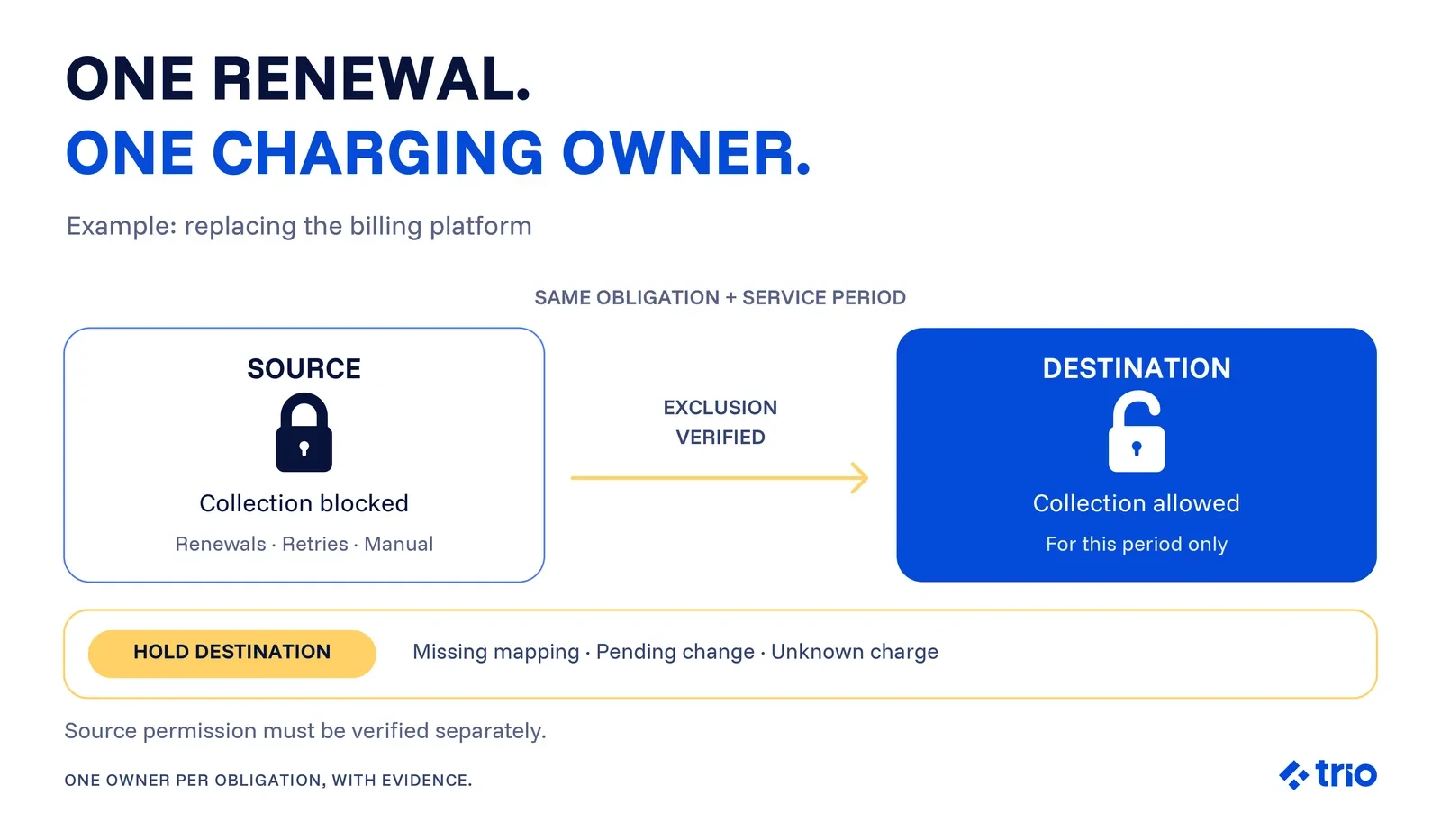
Where both charging systems can consult an application-owned permission check, test that check against concurrent attempts, the same way payment APIs use idempotency keys to catch a duplicate transfer request before it executes twice.
Where an autonomous provider scheduler can't consult your permission check, establish exclusion through that provider's supported controls and verify the resulting state. If the team can't demonstrate exclusion, the cohort stays blocked.
Cohort B and C stay held
Cohort B remains held while its mapping is unresolved. Cohort C remains held until its cancellation decision is reflected in the fixture.
Neither inherits Cohort A's destination permission.
Make sure to assign an evidence owner to each exception so a hold has a clear resolution path.
Rehearse changes, repeated imports, and uncertain charges
At this point, you need to turn the fixture into observable acceptance tests.
For this design, a test passes only when stored records and charging behavior match the expected outcome.
A successful import response alone doesn't demonstrate that the customer has one intended subscription or that collection is correctly excluded elsewhere.
Five acceptance tests to run
Repeat Cohort A's migration input: Require reuse of the intended destination record, or safe rejection, with no additional active subscription or collection instruction.
Remove or misassign Cohort B's payment mapping: Require the affected record to stay blocked even if other cohort members pass.
On October 16, confirm Cohort C's cancellation effective at the October 20 boundary: Require invalidation of the old fixture and no destination renewal for the canceled period.
Change an amount, currency, quantity, or renewal timestamp: Require a failed comparison and explicit resolution before release.
Simulate an uncertain source charge, plus concurrent source and destination collection attempts: Require investigation of the uncertain outcome and exclusion of the competing collection path.
What the repeated-import and uncertain-charge tests check
The repeated-import test verifies your implementation, but it doesn't assume the provider automatically deduplicates imports.
Check resulting subscriptions and collection instructions, including records created before a failed migration job resumed. An import log that only holds the final successful response can miss earlier partial work.
For the uncertain-charge test, suppose the source renewal request times out. Keep destination collection blocked while the team queries the source and examines its transaction records.
Record the verified result against the same obligation before deciding whether another collection attempt makes sense.
Refresh the fixture when facts change, not on a schedule
Instead of working on a fixed schedule, it's best to refresh the fixture whenever its underlying facts change.
A new mapping confirmation, a cancellation decision, or a changed renewal amount each invalidates the active fixture version, the same way Cohort C's did when its cancellation was confirmed on October 16.
Route that invalidation to the cohort's assigned evidence owner as a notification, not a silent overwrite, so the person who approved the prior version knows a decision needs re-checking before release.
Dedup inside one system doesn't prove exclusion in another
A deduplication result inside one provider doesn't demonstrate exclusion in another system, especially once source and destination run as independent services rather than one monolith.
That's the same cross-system coordination problem a microservices architecture has to solve explicitly elsewhere in a fintech stack.
Test the actual handover boundary, including schedulers that operate independently of your application.
Subscription migration checklist: the go-live gate
Before releasing any cohort to the new processor, confirm every item below. A cohort that fails one item stays on hold. It doesn't get released on a partial pass.
Customer and subscription identifiers matched between source and destination, with the match evidenced rather than assumed.
Renewal amount, currency, item, quantity, and discount or tax configuration compared line by line against the source record.
Renewal timestamp compared in the same time zone on both systems, not just on the same calendar day.
Effective payment configuration verified, including which customer record owns the default payment method.
Current charging owner recorded, naming the exact obligation and service period it applies to.
Competing collection paths checked and excluded: scheduled renewals, retry jobs, and any manual collection route still live on the source system.
Exceptions, missing mappings, changed subscriptions, uncertain charges, assigned to a named owner for individual resolution rather than cleared with the batch.
Repeated-import and concurrent-collection acceptance tests passed against the actual handover boundary, not just against the import response.
Release, observe, and recover by service period.
Immediately before release, revalidate changes since the snapshot and renew the ownership evidence.
Record the effective boundary, the responsible operator or process, and the fixture version used.
After handover: reconcile expected against actual
After handover, compare expected renewals with actual collection records from both systems.
Investigate missing renewals, wrong terms, unexpected source attempts, and overlapping collection.
Keep the expected service period visible so an operator can tell a missing renewal apart from one that was already collected.
Treat a missing webhook as incomplete evidence. Query the relevant system before authorizing another charge.
Once collection is confirmed, close that obligation to repeat collection in the proposed control.
Keep refunds, disputes, and adjustments linked to their original transaction records, and handle them through their own separate workflows.
Unresolved holds have a deadline.
Unresolved holds carry a real deadline.
If Cohort B's mapping or Cohort C's cancellation decision stays open as the next renewal approaches, both systems remain blocked by design, which means that obligation collects nowhere this cycle.
Escalate to the exception's assigned evidence owner before that boundary, not after, and treat a renewal that passes with no collection as a dunning or customer-communication event to handle deliberately.
Recovery: assign a new owner without reopening settled periods
Recovery should identify which unresolved or future obligations need a new owner.
If the destination already collected October's renewal, restoring source ownership for November must not reopen October.
Verify existing collection and disable the competing path before making any recovery assignment.
Keep reconciliation separate from migration checks
Keep migration renewal checks connected to downstream financial verification without expanding the cutover runbook into a full reconciliation platform design.
Successful renewal collection and confirmed settlement should stay distinct observations.
The same discipline, reconciling two systems' view of the same obligation rather than trusting a single migration pass, comes up in other system consolidations too, including payment integration after a merger.
Turn the results into an engineering cutover brief.
Your payment processor migration plan should leave engineering and operations with a concrete release decision for each cohort. Document:
The current processor and billing platform
The supported transfer path
Retained or replacement subscription identities
Renewal distribution
Mapping exceptions
Charging boundaries
Attach the fixtures and acceptance-test results that support each decision.
You should always name who maintains the evidence, who resolves exceptions, and how recovery assigns unresolved obligations.
Use the remaining failures to scope the work: a missing transfer mechanism, an ambiguous customer mapping, or an uncontrolled retry scheduler each needs a different engineering response.
It's absolutely essential that you prepare that brief before committing to a cohort release date.
A cutover like this is exactly the kind of production payment work Trio's engineers run for fintech and SaaS teams, from the cohort verification through the post-handover reconciliation.
Request a consult and bring your current systems, unresolved controls, and cutover brief.