

 Read Client Stories




 Alex Kugell

 Key Takeaways
- A PayFac lets sub-merchants accept payments under its master account instead of each applying for their own merchant account.
- There are three ways to structure payments: traditional processing (no control, no risk), full PayFac (full control, highest compliance burden), and PayFac-as-a-Service (fast to launch, provider carries most of the compliance load).
- PayFac compliance involves card-network registration and PCI DSS in the US, a Payment Institution or EMI license under PSD2 in the EU (PSD3 agreed but not yet in force), and an AFSL plus AUSTRAC reporting in Australia.
- A common path is launching with a PaaS provider (Finix, Global Payments for Platforms, Infinicept) to validate demand, then transitioning once volume justifies the investment.
- Leading players span pure-play PayFacs (Stripe, Adyen, Square), a card issuer extending into the space (Marqeta), and white-label PaaS vendors that let platforms skip building compliance infrastructure themselves.
If you’ve ever tried to launch a platform that accepts payments on behalf of multiple vendors, like a marketplace, SaaS platform, or gig app, you’ve probably run into the differences between merchant onboarding, compliance, and payment infrastructure.
Traditional payment setups can take weeks to approve merchants, require complex contracts, and still deliver a fragmented experience for both you and your users.
This is where payment facilitation (also known as PayFac) steps in, offering a faster, more flexible way for platforms to enable payments at scale.
But as with most things in fintech, the simplicity on the surface hides serious technical and regulatory complexity underneath.
Let’s unpack what payment facilitation really is, how it works, and why it has become the backbone of modern embedded finance.
In our years working with fintech clients at Trio, we’ve seen how businesses often underestimate what’s involved in becoming or integrating a PayFac and how transformative it can be when done right.
If you’ve ever tried to launch a platform that accepts payments on behalf of multiple vendors, like a marketplace, SaaS platform, or gig app, you’ve probably run into the differences between merchant onboarding, compliance, and payment infrastructure.
Traditional payment setups can take weeks to approve merchants, require complex contracts, and still deliver a fragmented experience for both you and your users.
This is where payment facilitation (also known as PayFac) steps in, offering a faster, more flexible way for platforms to enable payments at scale.
But as with most things in fintech, the simplicity on the surface hides serious technical and regulatory complexity underneath.
Let’s unpack what payment facilitation really is, how it works, and why it has become the backbone of modern embedded finance.
In our years working with fintech clients at Trio, we’ve seen how businesses often underestimate what’s involved in becoming or integrating a PayFac and how transformative it can be when done right.
Understanding Payment Facilitation
Let’s start by clarifying what payment facilitation actually means in practice, and how it differs from the traditional way businesses handle card payments.
Definition of a Payment Facilitator (PayFac)
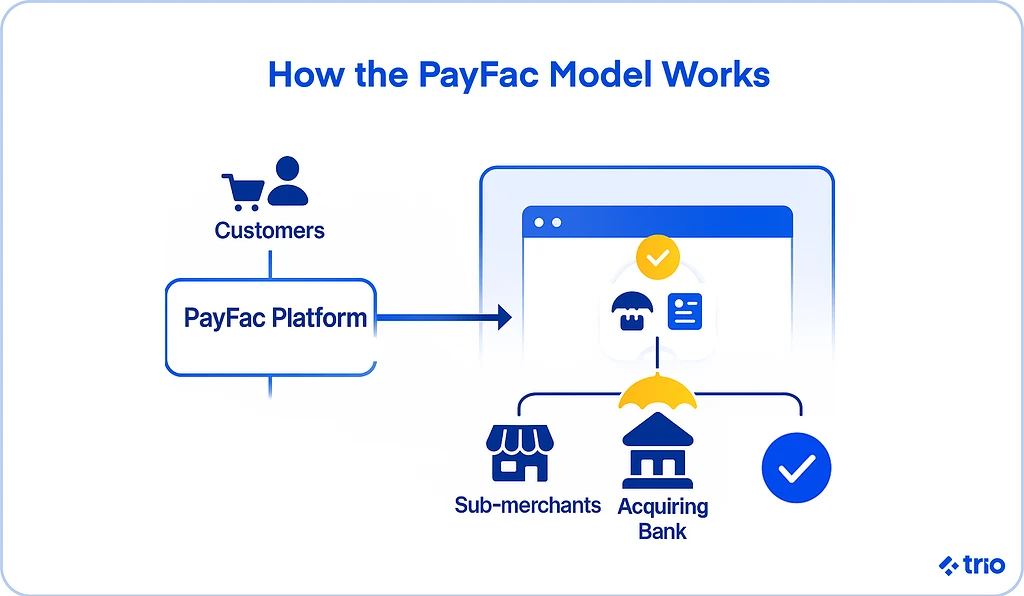
A Payment Facilitator, or PayFac, is an entity that enables sub-merchants (such as independent sellers, contractors, or SaaS customers) to accept electronic payments under its master merchant account.
This means that, instead of every small business or vendor applying directly to a bank or acquirer for a merchant account, PayFac payment solutions act as an intermediary. In theory, this means that they can start offering their services faster, with far less overhead.
The PayFac solution will handle onboarding, underwriting, compliance, and transaction processing on behalf of those sub-merchants.
How Payment Facilitation Differs from Traditional Payment Processing
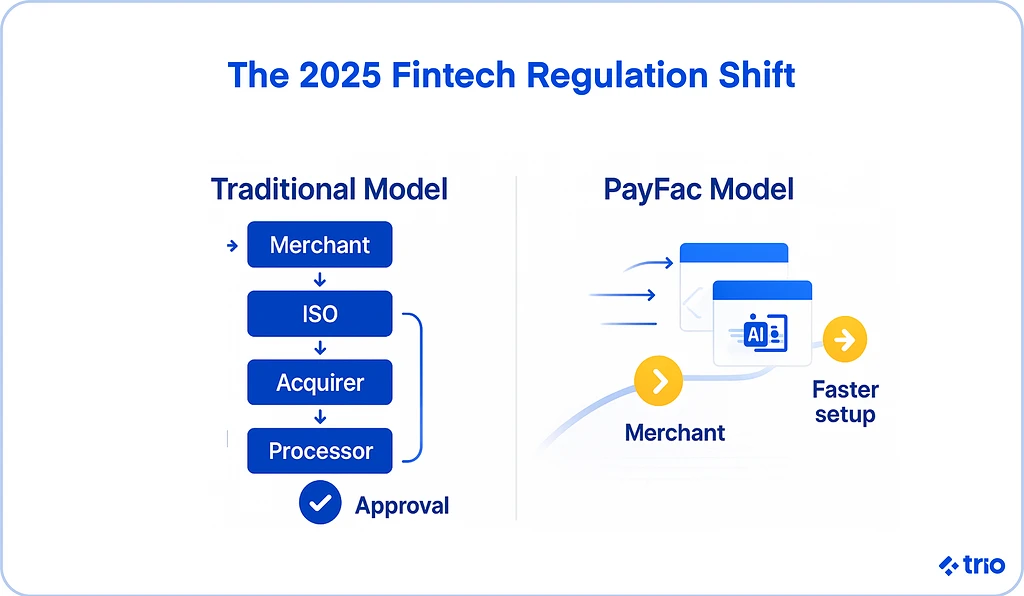
In the traditional payment model, each business has to set up its own merchant account through an acquiring bank or ISO (Independent Sales Organization).
This process usually means that they will have to deal with lengthy applications, credit underwriting, and compliance verification.
With payment facilitation, the PayFac aggregates these merchants into a single master account, so they can streamline the approval process of sub-merchants, sometimes instantly, while still ensuring compliance through automated KYC (Know Your Customer) and risk checks on your digital payments.
The trade-off is that PayFacs assume a higher share of operational and financial risk.
They’re the ones who are responsible for monitoring fraud, ensuring chargeback compliance, and maintaining adherence to PCI DSS standards.
The Role of Acquirers, ISOs, and Processors
Even in the PayFac model, you’re still going to be dealing with a bunch of different players, and understanding how they fit together helps clarify why this system works the way it does:
Acquiring Banks (Acquirers) are licensed institutions that hold merchant accounts and facilitate the flow of funds from issuing banks. Every PayFac must operate under an acquirer’s sponsorship.
ISOs (Independent Sales Organizations) resell payment processing services but don’t aggregate sub-merchants under their own account. They’re essentially intermediaries that help merchants connect to acquirers.
Payment Processors handle the technical routing of transactions, authorizing, capturing, and settling payments.
The PayFac sits between these players and the sub-merchants, bundling their roles into a unified experience, and becoming the merchant of record, embedding payments directly into the platform’s user experience.
PayFac vs. Payment Aggregator
The two get confused constantly, and the distinction is simpler than it sounds.
A payment aggregator pools every merchant's transactions under one shared merchant ID, so from the acquirer's point of view, there is really only one merchant: the aggregator itself.
A PayFac gives each sub-merchant its own sub-merchant ID, nested under the PayFac's master account.
The practical effect is visibility. With a sub-merchant ID, a platform can report per-merchant volume, apply per-merchant risk rules, and give each seller something closer to a real merchant account, without losing the speed of onboarding under one umbrella.
Most of what people call "PayFacs" today, including the major processors named below, operate this way rather than as pure aggregators.
Three Ways to Structure Payments: A Quick Comparison
Before going deeper, here’s how the three main approaches compare on the factors that usually decide which one fits a platform.
Factor | Traditional Processing | Full PayFac | PayFac-as-a-Service (PaaS) |
Setup time | Each sub-merchant applies separately; weeks per merchant | Months to years to launch (licensing, underwriting, sponsor bank) | Days to weeks; embed via API |
Compliance burden | Each merchant handles its own PCI DSS/AML | PayFac owns AML/KYC, PCI DSS, and sub-merchant risk | Provider (e.g., Finix, Global Payments for Platforms, Infinicept) owns most compliance |
Control over experience | Low; merchant deals directly with acquirer | Full control of onboarding, checkout, and payouts | High control of UX; less control over underlying rails |
Revenue potential | None; you’re not in the payment flow | Highest; you set pricing and keep the spread | Moderate; provider takes a cut, but you still earn margin |
Best for | Businesses with no interest in owning payments | High-volume platforms ready to invest in compliance | SaaS and marketplaces that want to monetize payments fast, or test the model before committing |
Most software platforms don’t start at either extreme.
One path that our developers see all the time is to launch with a PaaS provider to validate demand, then transition to a full PayFac once volume justifies the compliance investment.
We typically recommend the PaaS route for smaller fintechs with limited budget and development capacity.
Components of a Payment Facilitation System
A functional PayFac setup involves the orchestration of risk systems, onboarding tools, data pipelines, and financial controls.
Underwriting and Merchant Onboarding: The PayFac must verify its legitimacy and risk level through identity checks, business verification, and sometimes credit assessments. Advanced PayFacs automate most of this using API-driven KYC tools and risk scoring algorithms.
Transaction Processing and Settlement: The PayFac facilitates payment authorization and settlement through its acquiring bank and processor. When a customer pays, funds are first deposited into the PayFac’s master account, and after settlement, the PayFac disburses the appropriate share to each sub-merchant’s account, minus fees.
Risk Management and PayFac Compliance Requirements: They must continuously monitor transactions for fraud, chargebacks, and suspicious activity. This often includes velocity checks, machine-learning fraud detection, and manual review of anomalies. From a compliance perspective, PayFacs must meet PCI DSS standards and maintain AML/KYC documentation.
Reporting, Analytics, and Payouts: Reporting systems give both PayFac and its sub-merchants visibility into transactions, fees, and payout timelines, often through real-time dashboards, predictive analytics, and automated payouts via APIs.
Typical Transaction Flow in a PayFac Ecosystem
Here’s what happens in a typical PayFac transaction:
A customer initiates a payment through a sub-merchant’s checkout page.
The PayFac’s system routes the transaction to a payment processor for authorization.
The issuing bank approves or declines the payment.
The funds settle into the PayFac’s master merchant account.
The PayFac disburses the correct amount to the sub-merchant’s designated account.
The end user sees a single tap, but behind it, each step involves complex orchestration of data validation, compliance checks, and fund movements.
Benefits of the PayFac Model
There are many different reasons why people are utilizing PayFac models, many of which we have already touched on.
Faster Merchant Onboarding and Activation
Traditional merchant accounts can take days or even weeks to approve. PayFacs, on the other hand, let you get started almost instantly thanks to their automated underwriting and pre-vetted frameworks established with their acquiring partners.
For platforms, this means new sellers or service providers can start accepting payments within minutes, dramatically improving conversion and user retention.
Improved Control Over Payment Experience
When you operate as a PayFac, you get the ability to control how payments are presented, processed, and settled.
In other words, you own the checkout experience, the branding, and the payout logic, allowing you to ensure a cohesive UX and reduce your dependency on third-party providers.
It also gives you the flexibility to introduce features like instant payouts or multi-currency support, which could potentially strengthen your competitive position.
New Revenue Streams Through Fee Sharing
The main benefit is that PayFacs let you monetize payments.
Because they process transactions under their own account, they can set custom pricing structures, collect margins on processing fees, or share revenue with partners.
Many SaaS companies that we have worked with now use embedded payments as a profit center, offsetting platform costs and increasing lifetime customer value. In a sense, this turns them into fintechs in their own right.
Simplified Compliance via Aggregation
Aggregated compliance is an incredible benefit, not to be overlooked.
Instead of each merchant handling its own PCI certification or AML checks, the PayFac manages these obligations centrally.
This aggregated oversight makes life a lot simpler for sub-merchants, who gain access to enterprise-level compliance without the complexity or the need to keep developers on board to maintain complex systems.
How PayFac Compliance and Regulation Differ by Region
If you operate internationally, we highly recommend that you look into the current regulations and how they differ from region to region. At the moment, there are a few things worth knowing:
United States: PayFacs register directly with Visa and Mastercard and operate the master/sub-merchant structure described throughout this article. Compliance centers on PCI DSS, AML/KYC, and each card network’s own registration and reporting requirements.
European Union and UK: there’s no card-network-recognized master/sub-merchant structure. PayFacs must instead be licensed as a Payment Institution (PI) or Electronic Money Institution (EMI) under PSD2, and comply with strong customer authentication, AML rules, and GDPR. The revised framework, PSD3 and a companion Payment Services Regulation, reached political agreement in late 2025 but had not entered into force as of this writing. Expect phased application into 2027 and 2028 rather than an immediate shift. The role is functionally similar to the US version, but it sits inside a formal banking-style license rather than a card-network registration.
Australia: there’s no PayFac-specific license at all. Instead, payment facilitators operate under a mix of general obligations: an Australian Financial Services Licence (AFSL) or an applicable exemption from ASIC, AML/CTF reporting to AUSTRAC, and the same card-network and PCI DSS requirements that apply everywhere else. That gap is closing: Australian Treasury's 2026 Payment Systems Modernisation exposure draft would formally bring payment facilitation under the AFSL regime as its own licensed category, so this is worth revisiting once the legislation lands.
Becoming a Payment Facilitator
If you want to become a PayFac, it’s a formal financial undertaking with legal, technical, and operational obligations.
Regulatory and Operational Requirements
Before launching a PayFac operation, you need to establish relationships with key financial partners and comply with stringent industry standards.
Sponsoring Bank Relationships: You’ll need to partner with a sponsoring acquirer, a licensed bank that enables access to the card networks (Visa, Mastercard, etc.).The acquirer is the one that ultimately bears regulatory responsibility and expects strict adherence to compliance frameworks.
PCI DSS and Data Security Obligations: PayFacs handle sensitive card data, so they’re required to comply with PCI DSS (Payment Card Industry Data Security Standard), now at version 4.0.1 after the final set of previously future-dated requirements became mandatory in March 2025. This involves securing networks, encrypting data, and maintaining annual audits.
AML/KYC Responsibilities: Regulators hold PayFacs accountable for preventing money laundering, fraud, and terrorist financing. That means implementing AML (Anti-Money Laundering) and KYC (Know Your Customer) processes to verify the identity and legitimacy of each sub-merchant.
Steps to Establish a Payment Facilitation Service
Becoming a PayFac involves an operational transformation that can be broken into roughly four steps.
1. Licensing and Registration
Depending on your region, you may need to register as a Payment Facilitator with card networks like Visa and Mastercard.
In some jurisdictions, you’ll also need money transmitter licenses or equivalent financial permits.
All of this can take months, requiring legal expertise and ongoing communication with financial authorities.
2. Technical Infrastructure Setup
The technical backbone of a PayFac includes payment gateways, APIs, KYC systems, data encryption, and reporting dashboards.
You’ll also need redundancy and failover systems for uptime guarantees.
3. Risk and Compliance Framework Development
Building a risk management program is critical. You’ll need clear procedures for fraud monitoring, chargeback management, and AML escalation.
Regulators and acquirers will expect you to demonstrate how you prevent financial crime in real time.
4. Ongoing Monitoring and Reporting
After launch, a PayFac must continue reporting transaction data, risk events, and financial metrics to its acquirer.
Internal audits and compliance reviews are typically conducted quarterly or semi-annually to help ensure consumer protection and payment system integrity.
Challenges in the PayFac Journey
While there are many great things about operating as a PayFac, it also comes with real challenges.
High Capital and Compliance Burdens
As we have mentioned already, becoming a PayFac requires significant upfront investment. You’ll need to create the technology, but also pour resources into licensing, legal counsel, and compliance staffing.
For most smaller companies, this initial cost makes becoming a PayFac almost impossible without investor backing or substantial transaction volume.
Underwriting Complexity and Fraud Exposure
PayFacs underwrite sub-merchants and bear responsibility for their transactions, meaning that you take on an extraordinary amount of risk.
If a sub-merchant engages in fraudulent activity, your PayFac is the one that is going to absorb the losses.
Machine learning models and layered identity verification can mitigate risk, but fraud is a moving target. The system must evolve continuously, so you’ll want experts on your team, who themselves cost an incredible amount.
Scalability and Maintenance Costs
Maintaining a high-volume PayFac operation involves constant DevOps attention, 24/7 monitoring, and infrastructure scaling.
Payment data pipelines are resource-intensive, and downtime directly affects revenue.
Cross-Border and Multi-Currency Barriers
Expanding internationally introduces regulatory fragmentation, exactly the kind covered above: what counts as “compliant” in the US doesn’t automatically transfer to the EU or Australia.
Each region has unique licensing, taxation, and anti-fraud frameworks.
Supporting multi-currency settlement also complicates reconciliation and liquidity management.
PayFac-as-a-Service (PaaS)
For platforms that want the upside of payment facilitation without the full regulatory weight, PayFac-as-a-Service provides a practical alternative.
What Is PayFac-as-a-Service?
PayFac-as-a-Service providers offer a turnkey solution: APIs, compliance coverage, and settlement tools that let you embed payments into your platform almost immediately.
You still control the merchant experience, but the provider handles the back-end infrastructure and compliance obligations.
Key Features and Capabilities
There are several key features to consider.
Plug-and-Play Merchant Onboarding: Merchants can be approved and activated instantly through API-based KYC and preconfigured risk rules, allowing platforms to scale merchant acquisition without adding compliance bottlenecks.
Integrated Risk and Compliance Tools: PaaS vendors usually include built-in AML/KYC verification, chargeback monitoring, and risk dashboards, all managed centrally.
Simplified Settlement and Payout APIs: Payout automation and reconciliation APIs make it easy to distribute funds while keeping transaction data synchronized across systems.
What to Look for in a PFaaS Provider
Not every PFaaS vendor is interchangeable, and the differences tend to show up after you've already integrated. A few factors are worth checking before committing to one:
Pricing model: flat per-transaction rates are easy to forecast but don't improve with volume; interchange-plus or volume-tiered pricing costs more to understand but gets cheaper as you scale.
Compliance coverage: confirm in writing whether the provider or your platform is on the hook for PCI DSS scope, AML/KYC decisions, and disputes.
Branding and UX control: some providers let you fully white-label onboarding and checkout; others route sub-merchants to a hosted, co-branded flow you can't restyle.
Integration depth: look at the actual SDKs and API docs, not the marketing page, since onboarding flows and payout APIs vary widely in how much engineering work they still leave you.
Leading PayFac Providers and Major Players
Several companies have shaped the evolution of payment facilitation and continue to define its standards.
Stripe: The Pioneer of Embedded Payment Facilitation
Stripe effectively mainstreamed the PayFac concept.
Its infrastructure allows developers to integrate payments with minimal effort while maintaining full control of the user experience.
Stripe’s model inspired the next wave of embedded finance platforms.
Adyen, Square, and Marqeta: Expanding the Ecosystem
Adyen and Square built hybrid PayFac models, combining acquiring, processing, and risk management under one umbrella.
Marqeta, meanwhile, extended the concept to card issuing and spend management, proving that payment facilitation principles can apply beyond acceptance.
BaaS and PaaS Vendors Enabling White-Label PayFac Models
Today, Banking-as-a-Service (BaaS) and PaaS vendors like Finix, Infinicept, Global Payments for Platforms (formerly Worldpay for Platforms, and Payrix before that), and Rapyd enable companies to white-label PayFac capabilities without managing licenses themselves.
These platforms are helping software businesses evolve into fintech ecosystems, without needing to reinvent the compliance wheel.
Choosing the Right Payment Facilitation Approach
With how many options are at your disposal, choosing how to approach payment facilitation can be as much a business strategy decision as it is a technical one.
Key Evaluation Criteria (Risk, Cost, Time-to-Market)
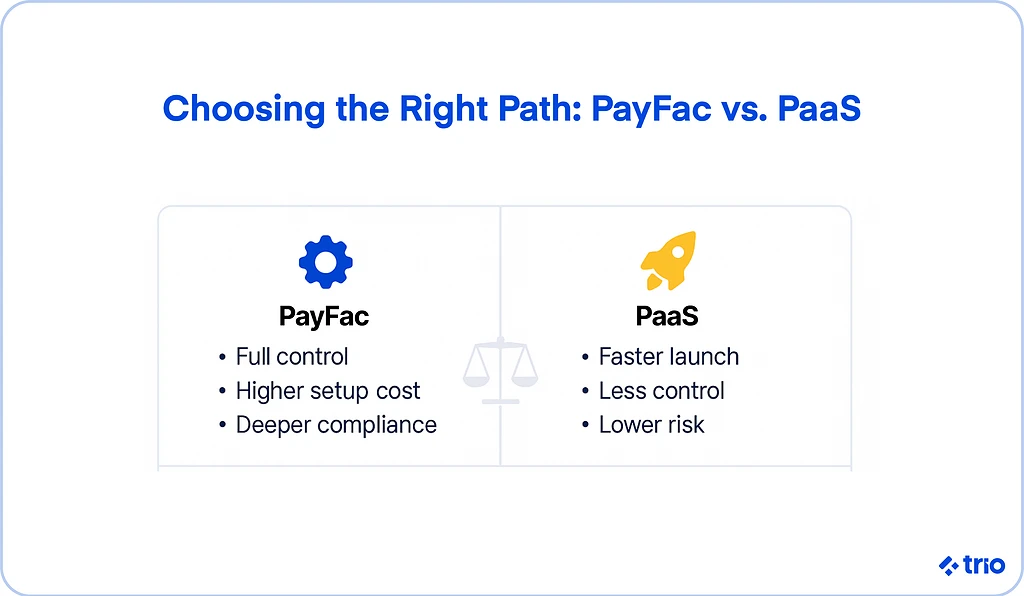
When evaluating models, weigh your available capital, compliance expertise, and desired speed.
The PayFac model offers maximum control and revenue but carries the highest complexity.
PaaS solutions are easier to deploy but may limit future flexibility.
When to Build, Buy, or Partner
If payments are core to your business model and you have sufficient transaction volume, building may make sense.
If payments are a feature rather than a focus, partnering with a PaaS or acquirer-led program is more efficient.
Many of our fintech clients take a hybrid route, launching with a PaaS and transitioning to a full PayFac structure once they’ve validated demand.
Aligning the PayFac Model with Business Goals
Ultimately, your payment strategy should serve your users and your growth plan, not the other way around.
Aligning operational capacity, compliance readiness, and long-term product vision will determine whether you thrive in this space or drown in regulatory overhead.
Conclusion
Payment facilitation has fundamentally changed how businesses think about payments, not as a back-office function, but as a growth engine.
Whether you build your own PayFac infrastructure or partner through a PaaS provider, the goal remains the same: creating a compliant, dependable, value-generating experience for your merchants.
At Trio, we’ve seen firsthand how the right approach to payments can elevate a platform from a simple software tool to a financial ecosystem in its own right.
As the PayFac model matures, the question isn’t whether to adopt it, but how to do it intelligently, sustainably, and in alignment with your broader business strategy.
If you need experienced fintech developers to help you do this, request a consult.