


 Read Client Stories





 Lace Brunsden

 Key Takeaways
- Diagnose the bottleneck before buying anything. A queue of untested features points to missing capacity, missing expertise, or an unmade product decision, and only the first two can be bought.
- An embedded QA engineer, a one-off specialist assessment, and fully managed testing carry very different management loads, and the phrase QA outsourcing covers all three.
- Ask for assignment-specific evidence rather than a capabilities deck: a redacted defect report, a walkthrough of how they would approach one of your own features, and a status report that says plainly what was not tested.
- Keep acceptance criteria, defect priority, and release authority inside the company. Those are product decisions, and a vendor can expose ambiguity without being able to settle it.
- Check the time-zone overlap before you compare hourly rates. A nearshore team sharing most of a US working day turns a blocking question into a same-day answer, where a twelve-hour gap turns the same question into a lost day.
- Budget your own team's time as part of the cost. Product context, environment access, answering questions, and reviewing findings all land on an already busy release team.
Software quality assurance outsourcing means handing agreed testing and quality work to an external team.
There are a couple of different things this could mean, including a QA engineer embedded in your squad, a specialist brought in for a single assessment, or a provider running a defined testing scope end to end.
What's incredibly important to consider is that outsourcing buys people and skills. It cannot buy a product decision nobody has made.
For a product leader watching features pile up before a release, that difference is what makes the sourcing conversation useful.
You can ask for the support the work actually needs, and settle in the same conversation who defines acceptance criteria, who prioritizes defects, and who authorizes release.
Let's look at everything you need to know about software quality assurance outsourcing, including when it is the right choice for you.
If the gap turns out to be people rather than decisions, Trio places QA engineers who have tested payments, lending and customer data flows under real regulatory pressure, and who work inside your sprints rather than alongside them.
What is software quality assurance outsourcing?
Quality assurance looks at how a team develops software and maintains agreed quality practices.
Testing examines the product's behavior to find problems and assess whether it meets expectations.
We have found that external engagements might support either activity, so the label “QA outsourcing” needs a concrete scope.
For example, you might need someone to test existing customer journeys, maintain automated checks, or assess a specialist concern such as performance under load.
Those assignments need different skills and different amounts of direction, though they rest on the same software quality assurance fundamentals.
Ultimately, the sourcing decision starts with identifying the work your team cannot currently complete.
Onshore, nearshore and offshore QA
Where the testers sit changes the engagement through working hours rather than hourly rates.
Onshore testers cost the most and remove the coordination problem entirely. Offshore teams in Asia or Eastern Europe carry the lowest rates, and a release-blocking question asked at four in the afternoon in New York waits until the next morning for an answer.
On the other hand, nearshore teams in Latin America offer rates below US levels, with most of a US working day shared.
That overlap matters most for exploratory testing and defect triage, where a tester needs to ask something and keep moving.
We have noticed that it matters a lot less for a scoped automation backlog that can be handed over and returned. Match the geography to the kind of testing rather than to the budget line.
Regulated products add a second constraint.
If the software handles payments, lending, or customer financial records, ask early where test data will live, whether production-like data can leave your jurisdiction at all, and who is accountable for the evidence trail an auditor will eventually ask to see.
Those answers often narrow the geography before cost does.
What does QA outsourcing cost?
QA Madness, citing Pangea.ai's 2026 analysis, puts manual QA at $8 to $55 an hour in India and Southeast Asia, $20 to $95 in Latin America, $25 to $110 in Eastern Europe, and $80 to $150 or more in North America.
DeviQA's own benchmarks land in similar territory, at $28 to $70 for Latin America against $80 to $180 for the US.
Both sources sell QA services, so read those as a direction rather than a quote.
Three things move a rate within those bands.
Automation work runs 20% to 50% above manual testing in every region, so an automation-heavy scope prices differently from an exploratory one.
Fixed-price contracts carry a risk buffer of roughly 15% to 25% over time and materials, which is what you pay for certainty about the total.
A managed service costs around 10% to 20% more than an equivalent dedicated team, while a six- to twelve-month commitment usually buys back 10% to 15%.
We reommend that you compare all of that against a loaded internal hire rather than against a salary.
Salary tends to be 60% to 70% of what an in-house QA engineer actually costs once benefits, equipment, management time, and bench time are counted.
When outsourcing QA makes sense.
Start by looking at recent releases with engineering leadership.
A growing list of untested features can look like a simple staff shortage, when the real cause is a missing test environment or a product question nobody can answer.
Capacity, expertise, and ownership are the three explanations worth checking, and they are theories to test rather than boxes to score.
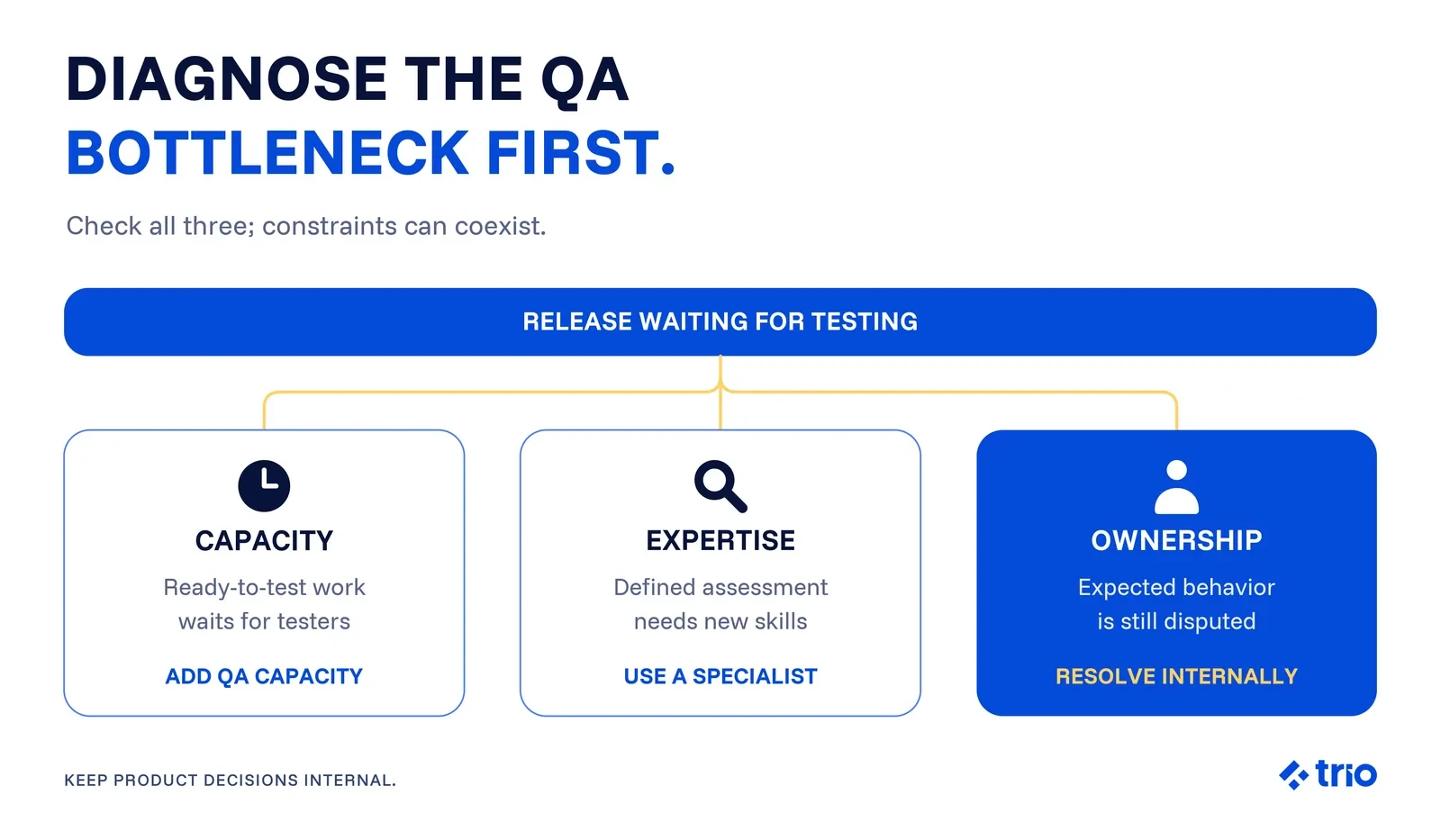
Capacity: clear work waits for someone to do it
Capacity is the likeliest explanation when testers understand the work, can reach a usable environment, and still cannot finish the agreed testing.
Look at which tasks waited, why, and whether the same pattern repeats across releases.
Check an alternative explanation before requesting more people.
If every tester waits for the same developer to prepare test data, added testing capacity leaves that dependency unresolved. If ready-to-test work consistently waits for available testers, additional QA capacity becomes a more plausible option.
Expertise: the team cannot confidently assess a specific risk
An expertise gap is about the kind of work.
Your team can test everyday workflows comfortably and still have nobody who can design a meaningful assessment of a new performance requirement.
Ask what the team needs to learn and who can judge the resulting evidence. A vague request to “test scalability” may first need a product decision about expected usage.
On the other hand, a defined usage scenario that nobody can assess points more clearly toward specialist support. More general-purpose testers would not necessarily address that gap.
Ownership: testing waits for an unresolved decision
An ownership gap shows up when people disagree about acceptable behavior, or when nobody can settle a release-blocking question.
Watch for defects that keep reopening, conflicting acceptance expectations, and decisions that move between teams without landing anywhere.
For example, testers cannot settle whether an account administrator should see a particular customer record if product and engineering have not agreed on the permission rule.
Clarify that decision before expecting external testers to verify it. Several constraints may coexist, so resolving ownership can be the first step before adding capacity.
The three QA outsourcing models compared.
The three outsourcing models are external QA capacity, specialist testing, and managed testing.
This table sets them against internal hiring, since that is the baseline any of them has to beat.
Option | Problem it may address | Daily management | Product context | Decisions to retain or explicitly assign |
|---|---|---|---|---|
Internal hiring | An enduring need for QA capacity and continuity | Your team manages the role | Plan for long-term product learning | Quality priorities, acceptance expectations and release authority |
External QA capacity | Defined work exceeds available testing capacity | Your leadership directs the work | Provide onboarding and access to product decisions | Scope, defect priorities and release authority |
Specialist testing | A specific assessment needs skills the team lacks | Agree a focused assignment and an internal contact | Supply relevant scenarios, constraints and system context | Assessment goals, interpretation of findings and remediation priorities |
Managed testing | You want a provider to organize an agreed testing scope | The provider manages that scope as contracted | Agree how the provider obtains and maintains context | Business expectations, escalation boundaries and release authority |
Internal hiring deserves consideration when the need will remain central to the product, and you want to build durable knowledge within the company.
External capacity may fit when you already have leadership able to direct testing but need additional people.
The important thing to keep in mind is that neither choice resolves unclear requirements by itself.
Managed testing means agreeing that a provider will organize a defined testing service.
Ask exactly what management includes: planning, staffing, execution, reporting, or some combination. Then identify which product decisions and approvals still require your team.
What outsourced QA costs your own team
As we have already mentioned, one of the biggest potential benefits of external support is access to capacity or skills your current team lacks.
Evaluate that benefit alongside the work required to make the engagement useful: explaining the product, preparing access, answering questions, and reviewing findings.
Ask who will provide that support during an already busy release.
Product learning: Identify who can explain important customer journeys, unusual behavior, and previously accepted trade-offs.
Access and data: Agree which environments and information testers need, and how your team will authorize and remove access.
Communication: Establish when questions receive answers and how urgent findings reach someone who can act.
Knowledge continuity: Decide where test cases, reports, and explanations will remain available as people change.
Supplier coordination: If development and testing involve different providers, name the person who resolves disagreements about defects and fixes.
Manual and automated testing also affect the assignment. If you need someone to maintain automated checks, ask who will update them when the product changes.
If the need involves exploring unfamiliar user behavior, discuss how the tester will learn the product and report what they discover.
One symptom, three different answers
A team ships an account-administration feature. Product and engineering agree on the expected behavior, the testers know how to assess it, the environment works, and testing still queues because those same testers are covering two other releases.
That is a capacity problem, and more testers fix it.
Change one thing. Nobody on the team knows how to design an assessment of what happens during a large batch of account changes.
Another tester with the same skills leaves that question open, so the conversation turns to specialist methods, representative usage, and who interprets the findings.
Change it again. Product and engineering disagree about which account changes need approval.
No tester can settle that, whether in-house or outsourced. The next step is naming who owns the permission rule.
Three different next steps from the same visible symptom: a release waiting for testing. Check why work waits before deciding which support to buy.
How to choose a QA outsourcing partner
When evaluating an outsourced software testing partner, one of the first steps is to define the product area and testing work you would delegate, then request evidence relevant to that assignment.
Ask how findings would reach your decision-makers, who would prioritize fixes, and where test assets would remain accessible.
A general capabilities presentation cannot answer those project-specific questions.
A representative-feature discussion: Ask the proposed team to explain what it would investigate and which questions it would raise. Look for reasoning tied to your product, including assumptions it cannot yet resolve.
A redacted defect report: Assess whether the report explains the observed behavior, conditions, expected result, and user impact clearly enough for your developers to investigate.
A specialist assessment approach: For a defined skills gap, request an explanation of methods, required inputs, and limitations. Ask how your team would interpret the results.
A reporting example: Check whether the report distinguishes completed work, blocked work, unresolved findings and areas not assessed.
An asset-access arrangement: Ask where tests and reports will live, who can use them, and how access will continue when the engagement changes.
What to keep in-house: the QA responsibility brief
Use a short responsibility brief to carry the sourcing decision into a working agreement.
We like to begin with the suspected bottleneck and the evidence for it, then write down the assignment and the decisions around it, using the checks below to tell when each part is actually settled rather than merely discussed.
Acceptance deserves shared attention.
ISTQB's Acceptance Testing certification overview explicitly includes collaboration between product owners or business analysts and testers.
That supports involving business and testing roles together; it does not determine who has release authority in your company.
Problem and scope: State the product area, suspected constraint, supporting observations, and work to delegate. Completion check: product and engineering can explain why this assignment addresses the constraint and identify excluded work.
Acceptance criteria: Name who defines expected behavior and resolves ambiguity. Completion check: the product owner and testing lead agree on the expected behavior of one representative feature and know who answers open questions.
Defect priorities and escalation: Name who assesses technical severity, decides business priority, and resolves disagreements. Completion check: walk through a disputed defect and confirm who decides whether it blocks release.
Test assets and access: Record where test cases, automated checks, environments and reports reside, who maintains them and who can access them. Completion check: the named internal owner can locate the assets and explain the agreed access arrangements.
Business acceptance and release approval: Name who accepts the business result and who authorizes deployment. Completion check: both roles understand what evidence they require and who may accept unresolved defects.
Review and exit: Agree when to review whether support addresses the original problem, how scope changes and what must remain available when the engagement ends. Completion check: both parties can describe the review evidence and the assets or knowledge to transfer.
It's important that you keep the brief usable. If nobody can identify who settles an acceptance question, adding more detail elsewhere will not close that gap.
Where outsourced QA usually goes wrong.
Three failure patterns show up often enough to plan around.
The first is the context gap. A tester who does not know why a rule exists will log cosmetic issues and miss the one that costs money, and no amount of test-case volume fixes that. Budget onboarding time rather than assuming a ramp-up.
The second is review latency. Findings arrive faster than anyone internal can triage them, and a backlog of unreviewed defects is hard to distinguish from not having tested at all. Agree on who triages and how quickly before the first report lands.
The third is the asset trail. When an engagement ends, test cases, automated checks, and environment knowledge tend to leave with it. Deciding at the start where those live and who owns them costs far less than rebuilding them afterwards. Access is the same problem in reverse: name the person responsible for revoking credentials on the day the contract closes.
Your next step
Bring the diagnosis and responsibility brief to engineering leadership before requesting proposals and make sure that you are on the same page aroung whether the immediate need concerns enduring internal capability, additional execution capacity, a focused specialist assessment, or an externally managed testing scope.
You can then use that answer to shape the conversations with prospective partners.
If the need is QA capacity inside a broader engineering team, Trio's dedicated teams include QA engineers among the roles we assemble, and nearshore overlap is part of what you are buying.
Bring your brief to that conversation so scope and responsibilities get settled together. If what you actually need is standalone managed testing, look for providers built around that scope instead.
Trio's QA engineers embed with your team, bring regulated-product experience with them, and leave the test assets behind when an engagement ends.