

 Read Client Stories




 Alex Kugell
 Key Takeaways
- The rate gap between LATAM and Eastern Europe has largely closed. Both regions sit approximately 30 percent below Western European rates and almost 50 percent below US domestic rates.
- Timezone is the most operationally consequential dimension, and it is structurally opposite between the two regions. LATAM provides 4 to 8 hours of real-time overlap with US business hours.
- Eastern Europe’s geopolitical risk profile is not uniform. Poland and Romania, as stable EU and NATO members, carry fundamentally different risk profiles from somewhere like Ukraine.
- GDPR data residency is a structural advantage of EU-member Eastern European countries for EU fintechs.
The choice between Latin America and Central and Eastern Europe for fintech engineering is usually framed as a cost or quality question, but both regions produce strong fintech engineers, and the rate gap that historically favoured Eastern Europe has largely closed.
Senior developer rates now sit at $40 to $80 per hour in LATAM compared to $50 to $90 per hour across Eastern Europe.
With cost and quality roughly comparable, the decision narrows to where your engineering team works (which determines how much value timezone overlap actually provides) and where your customer data must legally reside (which determines the compliance implications).
Making the wrong decision can rapidly increase costs and create compliance difficulties that slow your application development process.
For a US fintech, both questions point toward LATAM.
This article works through the comparison across five dimensions that matter specifically for fintech: cost and rate trends, timezone, geopolitical and operational risk, data residency and compliance, and fintech domain talent depth.
For assistance making the decision for your financial application and to hire pre-vetted developers, get pricing.
The Rate Gap Has Closed
The historical argument for Eastern Europe over LATAM was cost, but over the last few years, any meaningful differences have evened out.
Eastern European developer rates dropped in 2024, between 6 and 16 percent, depending on the specific country. This was largely driven by market softening and the displacement of some demand from Ukraine toward Poland and Romania.
LATAM rates seemed to resist those declines, holding steady on sustained demand from North American companies that value proximity.
This rate stability in LATAM reflects real demand rather than an overpriced market.
The 2026 rate picture by seniority:
| Region | Junior | Mid-Level | Senior |
| LATAM | $29 to $44/hr | $50 to $60/hr | $60 to $80/hr |
| Eastern Europe | $25 to $40/hr | $40 to $60/hr | $50 to $90/hr |
| US domestic | $80 to $130/hr | $120 to $160/hr | $150 to $200/hr |
The intra-region variance in Eastern Europe is incredibly noticeable and should be considered carefully when you are hiring.
Timezone: The Dimension That Determines Daily Collaboration
Instead of cost, timezone overlap is the single most consequential operational difference between the two regions.
Depending on your location, the two regions are structurally opposite because of how far apart they are, making LATAM optimized for North American teams and Eastern Europe optimized for Western European teams.
LATAM for US teams
LATAM engineers work in time zones from UTC-3 (Brazil, Argentina) to UTC-6 (Mexico, Central America).
This means they end up producing 4 to 8 hours of overlap with US business hours, depending on the hub.
A US fintech team running daily standups, real-time pull request reviews, and synchronous architecture discussions can include LATAM engineers in those activities as they happen.
For compliance-sensitive fintech engineering, this synchronous collaboration is particularly valuable.
A question about PCI DSS scope that arrives at the end of a US business day needs a 24-hour answer cycle with an Eastern European team. With a LATAM team in a similar timezone, that same question gets answered and acted on the same day.
Eastern Europe for US teams
Eastern European engineers are 7 to 10 hours ahead of US time zones, so for a US team, Eastern European engineers’ workday is largely complete before the rest of your developers might even be fully online.
Collaboration becomes asynchronous by default.
While this works well for teams with strong documentation practices and async-first workflows, synchronous product teams struggle as the timezone gap introduces decision latency that can accumulate.
Eastern Europe for EU teams
For a Western European fintech, Eastern Europe’s 1 to 2-hour offset provides full working-day overlap.
Collaboration happens very similarly here to how a LATAM developer works with US teams.
Timezone is not a dimension where one region is universally better. Instead, it depends on where the rest of your team is already situated.
Geopolitical and Operational Risk
Fintech is incredibly regulated. The engineering team’s location is a vendor risk consideration that appears in compliance documentation, banking partner due diligence, and operational resilience planning.
Under DORA (the EU’s Digital Operational Resilience Act), EU-operating fintechs must document and mitigate disruption risk for third-party technology vendors, including engineering service providers.
Eastern Europe’s risk is not uniform.
The war in Ukraine has introduced real uncertainty about hiring from the region.
However, from what we have observed, Ukraine’s IT sector has demonstrated genuine resilience, and Ukrainian developers have delivered on commitments through extraordinary circumstances.
But while we can acknowledge that, it is also important to note that the disruption risk is still very real.
Military activity, energy infrastructure attacks, and potential forced displacement of engineering talent represent inherent operational risks that your vendor risk assessment must address.
Poland and Romania carry a materially different risk profile.
Both are EU and NATO members, politically stable with mature business environments and rapidly expanding tech ecosystems.
Romania’s EU membership, #11 global ranking in the EF English Proficiency Index 2025, and growing fintech ecosystem make it a well-regarded nearshore destination for Western European teams.
Poland’s Warsaw and Kraków tech scenes have absorbed significant demand displacement from Ukraine and operate at consistently high quality.
LATAM’s risk profile
LATAM’s primary risk considerations are economic (currency volatility, particularly in Argentina) and periodic political transitions.
Again, each country is different, but these are genuine factors in some markets.
The major tech hubs for LATAM nearshore engagement, Brazil, Mexico, Colombia, and Chile, are politically stable with mature outsourcing ecosystems and well-established business environments.
At the moment, none of these tech hubs carries the acute disruption risk that active conflict introduces.
For a regulated fintech conducting vendor risk assessment under DORA or similar frameworks, the risk assessment should be country-specific in both regions, not regional.
Data Residency and Compliance: Decisive for EU Fintechs
Data residency is directly related to compliance, and thus one of the most consequential factors for fintech specifically.
Eastern Europe’s GDPR advantage for EU fintechs
EU-member Eastern European countries, including Poland, Romania, Bulgaria, and the Czech Republic, operate inside the GDPR jurisdiction.
If your fintech is going to be operating in the EU, this means that engineering work, including any access to customer data during development, debugging, or production support, stays within EU jurisdiction.
Since there is no international data transfer to assess, there is no need for Standard Contractual Clauses to implement, and no adequacy decision to rely on.
All of this simplifies the data protection impact assessment and third-party risk documentation for DORA and GDPR.
LATAM’s simplicity for US-only fintechs
If your customers are US residents, then their data is not subject to GDPR.
A LATAM engineering team accessing that data introduces no EU jurisdiction question.
The data flow is governed by the engagement contract and standard data processing agreements, without the EU adequacy framework complexity.
The cross-case complication
A US fintech that serves EU customers faces GDPR obligations regardless of where its engineering team sits.
In that case, an EU-based Eastern European team can simplify one dimension of the data residency question. But we have found that many US fintechs in this situation choose LATAM for the timezone and engineering velocity advantages.
When they decide to do this, fintech usually makes a point of handling EU data residency through architecture, regional data storage, data routing controls, and contractual protections.
Fintech Domain Talent Depth
Both regions have deep general software engineering talent. However, finding fintech-specific skillsets is often more difficult.
Eastern Europe’s fintech engineering heritage
Eastern Europe has a long-established track record in enterprise fintech and banking systems.
Poland’s banking sector has driven a generation of engineers with deep experience in core banking integrations, SWIFT connectivity, and complex financial infrastructure.
Romania’s technology sector, anchored by UiPath and a growing number of fintech companies, combines strong technical education with practical financial services experience.
If you are going to be working on enterprise banking integrations and complex financial infrastructure, then Eastern European engineers have genuine depth and maturity.
LATAM’s fintech ecosystem has produced engineers at scale
The LATAM fintech boom has dramatically expanded the region’s production of fintech engineering talent.
Brazil’s fintech market was valued at $5.5 billion in 2025 and holds roughly 62.3 percent of South America’s fintech market share.
Nubank has surpassed 127 million customers, investing heavily in its Brazilian operations in 2026.
The engineers who built and scaled these systems have production experience in consumer fintech, real-time payments, fraud detection, and digital banking at volumes that rival any market in the world.
Mexico (Clip, Konfío, Bitso), Colombia, Argentina (Ualá), and Chile have built similarly mature fintech engineering ecosystems.
The engineers who built these products and contribute to the many other unicorns in the region understand payment idempotency, KYC state machines, and financial data precision.
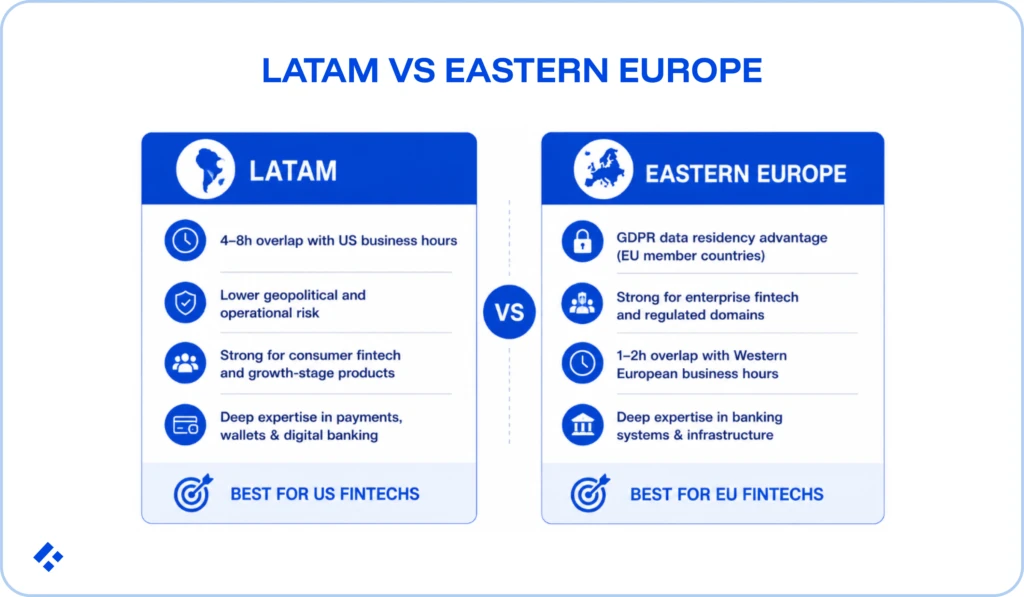
Comparison at a Glance
| Dimension | LATAM | Eastern Europe |
| Senior rate (2026) | $40 to $80/hr | $50 to $90/hr (wide intra-region variance) |
| Rate trend (2024-2026) | Stable | Down 9 to 16% in 2024 |
| US team timezone overlap | 4 to 8 hours (real-time) | 0 to 2 hours (largely async) |
| EU team timezone overlap | 1 to 3 hours (largely async) | Full working day (real-time) |
| Geopolitical risk | Low (stable hubs: Brazil, Mexico, Colombia, Chile) | Variable (Poland/Romania stable; Ukraine conflict-exposed) |
| GDPR data residency | Outside EU jurisdiction | EU jurisdiction for EU-member countries |
| Fintech domain strength | Consumer fintech, payments, digital banking | Enterprise banking, complex financial infrastructure |
| Primary fit | US fintechs | EU fintechs |
Decision Framework
- US fintech, US-only customer data, synchronous engineering team: LATAM. The timezone provides real-time collaboration, US-only data introduces no GDPR complexity, the rate is comparable to Eastern Europe, and LATAM’s consumer fintech and payments engineering ecosystem matches the typical US fintech product profile.
- EU fintech, EU customer data, GDPR and DORA obligations: Eastern Europe, specifically EU-member countries (Poland, Romania, Bulgaria). The data residency advantage simplifies compliance, the timezone aligns with Western European teams, and the region’s enterprise banking depth matches the typical EU fintech profile.
- US fintech with EU customers: A nuanced case. GDPR obligations exist regardless of the engineering team’s location. Many US fintechs in this position choose LATAM for timezone and engineering velocity and handle EU data residency through architecture rather than team location. If EU jurisdiction simplicity is a compliance priority, the alternative is the best option.
- Enterprise or banking infrastructure product, async-tolerant team: Eastern Europe’s deeper enterprise banking engineering track record is a genuine advantage, and an async-tolerant team with strong documentation practices neutralises the timezone gap.
Why Trio Operates in LATAM
Most of the fintech engineers we place at Trio are from Latin America. This is largely because our primary clientele is made up of US fintech companies.
For US fintechs, LATAM provides an incredible combination of real-time timezone overlap that supports the synchronous collaboration fintech engineering typically requires and data flow simplicity for US customer data.
On top of that, we are able to offer stable rates, at $40 to $80 per hour, with a fintech engineering ecosystem anchored by Brazil’s payment infrastructure and the region’s broader fintech boom.
Our vetting process targets engineers with production experience in exactly the consumer fintech, payment, and digital banking systems that US fintechs build.
We screen for specific domain competencies like understanding of payment idempotency, KYC state machine design, PCI DSS scope awareness, decimal precision in financial data, and compliance-aware logging.
For EU fintechs specifically evaluating the GDPR data residency dimension, we have alternate engagement structures that address EU data requirements.