


 Read Client Stories




 Lace Brunsden
 Key Takeaways
- Windsurf has been renamed to Devin Desktop on June 2, 2026.
- Cursor now belongs to SpaceX (a roughly $60 billion all-stock deal that closed August 14, 2026).
- AI-generated code fails security tests roughly 44% of the time in Veracode's 2026 testing, and that rate has barely moved.
- Copilot bills by metered AI Credits since June 1, 2026.
- Fintech teams tend to get the most from vibe coding on internal tools and tests, and the least on ledgers.
The best vibe coding tools include editors, terminal agents, and prompt-to-app builders. Looking at them all as one big pile can be incredibly confusing, as many of them don’t even compete.
Let’s group the eleven best AI coding tools by the job they do, flag what changed this year (a rebrand, an acquisition, a billing overhaul), and look at where the evidence on AI code runs thin.
We’ll cover the vibe coding tools engineering teams are actually using in 2026, including:
Cursor
GitHub Copilot
Devin Desktop (formerly Windsurf)
Claude Code
OpenAI Codex
Google Antigravity
Kiro
Lovable
Replit
v0 by Vercel
Aider
If you pick coding tools for a software development team, particularly one that handles money, choosing the right tool is essential to ensuring security and regulatory compliance.
At Trio, we have senior fintech developers with production experience, using a variety of these tools to build and maintain financial products. They can help you choose the right tool for your situation and implement it successfully.
The 11 tools at a glance
Tool | What it is | Suits | Watch for |
Cursor | AI-native editor (VS Code fork) | Interactive multi-file work | New owner (SpaceX); credit use |
GitHub Copilot | Editor extension, CLI and GitHub agent | Teams already on GitHub | Metered AI Credits since June 1, 2026 |
Devin Desktop (formerly Windsurf) | Agentic editor | Local work with cloud agents alongside | Rename; Cascade agent retired July 1 |
Claude Code | Terminal agent | Repo-level refactors | Heavy token use on big runs |
OpenAI Codex | CLI and cloud agent | Well-scoped tasks delegated and reviewed later | Less suited to real-time editing |
Google Antigravity | Agent-first editor | Several agents in parallel | Reported quota changes |
Kiro | Spec-first IDE from AWS | Changes that need a paper trail | AWS-centric; credit use |
Lovable | Prompt-to-app builder | Prototypes and MVPs | Security review; platform hosting ties |
Replit | Browser IDE with an agent | Prototypes that need hosting | Platform hosting ties |
v0 by Vercel | UI generator | React interfaces | Frontend focus; backend work is manual |
Aider | Open-source command-line agent | Bring-your-own-model setups | Terminal only |
What does it mean to vibe code in 2026?
Andrej Karpathy coined the phrase in February 2025 for a style of building where you describe what you want in natural language, accept whatever the AI generates, and you end up barely reading the diff.
The label stuck, and now covers everything from a founder prompting a landing page into existence to a senior developer steering an AI coding assistant through a refactor.
In both of these situations, they would say they vibe code, but these people share little else.
In 2026, Karpathy started calling the professional version agentic engineering.
In these cases, you orchestrate agents that write most of the code, and you stay accountable for what ships. The distinction is important here, because how much of the output a human actually reads decides which vibe coding tool suits a job.
Traditional coding sits at one end of that spectrum and pure vibe coding at the other.
We have found that most production work lands in between, which some people call AI-assisted development. The tools below sit at different points along it.
Which vibe coding tools do engineering teams actually use?
Stack Overflow's 2026 Developer Survey (30,903 responses, published this month) offers the cleanest picture. It found that 65.9% of respondents use coding assistants or agents, and 73% of those users reach for them daily.
Asked which coding agents they had used in the past year, 66% named Claude Code and 59% GitHub Copilot, ahead of OpenAI Codex (30%) and Cursor (26%).
What we found very interesting was that there were a fair number of people who had used no-code app builders, including Lovable (38%), Replit (28%), and v0 (28%).
Only 24% of respondents say their employer provides approved tools and guidance, while 30% say AI use is left to individuals. This probably means that many developers choose their own tools.
JetBrains' January 2026 AI Pulse survey of more than 10,000 professional developers put Copilot at 29% workplace use, with Cursor and Claude Code tied at 18%.
Are Cursor, GitHub Copilot and Devin Desktop still the default coding tools?
Cursor is still the editor many teams picture when they say AI-first. It is a VS Code fork with an AI agent that edits across files and supports several models.
SpaceX completed its all-stock acquisition of Anysphere, Cursor's maker, on August 14, 2026, folding it into SpaceXAI, and reporting at the time pegged Cursor's run-rate above $4 billion. Through this, Cursor kept its name. Just keep in mind that your procurement team should probably reread data-handling terms, since the owner changed.
GitHub Copilot is the incumbent and still the most widely used AI coding tool at work in JetBrains' January data.
The big change here is that its billing shifted on June 1, 2026: every plan now bills by GitHub AI Credits, so long agent runs cost more than quick chat. Inline completions stay included on paid plans.
Tools like GitHub Copilot suit teams already living in GitHub, and the metering means a monthly budget conversation now belongs in the rollout.
Devin Desktop is what Windsurf became.
Cognition agreed to buy Windsurf in July 2025, days after Google hired its CEO in a licensing deal, then renamed the editor on June 2, 2026.
The Cascade agent retired on July 1, 2026, replaced by a rewritten local agent called Devin Local. Existing plans carried over.
Cloud Devin, the autonomous agent, is still a separate product.
When does an AI agent like Claude Code or Codex beat an editor?
An editor suits work you watch closely, while an agent suits work you can specify and review afterwards.
Claude Code runs in the terminal and reads a whole repository, which tends to help on multi-file refactors and unfamiliar legacy code.
OpenAI Codex started as an open-source command-line agent and grew into a cloud mode that runs several tasks in parallel inside sandboxes. OpenAI merged the Codex app into the ChatGPT desktop app on July 9, 2026. We have found that it fits teams that already work GitHub-first and want to hand off well-scoped tickets, then review the pull requests.
Google Antigravity, an agent-first environment built on VS Code that runs several agents in parallel and can test apps in a browser, was used by 16% of the agent users in Stack Overflow's survey.
Both support the Model Context Protocol, so external tools like databases and issue trackers can plug in.
Community head-to-heads put Claude Code at roughly three to four times Codex's token use on similar work, which matters under metered plans.
Benchmark leadership isn't really clear since it flips by month and by test harness, so a one-ticket trial on your own code is going to be critical.
Can Kiro and spec-driven tools replace the vibe coding flow?
Kiro, AWS's agentic IDE, bets against improvised prompting.
Before it writes code, it produces a requirements document, a design document, and a task list, and those files stay in the repository as the source of truth. AWS announced Kiro in July 2025 and made it generally available in the first half of 2026.
It runs on models served through Amazon Bedrock, Claude among them.
There are a couple of trade-offs you need to be aware of here, though.
Kiro generates a lot of tests and burns credits on some that fail, and it relies on AWS's infrastructure certifications rather than holding its own, which means that if your team is outside AWS, you will get less from the integration.
Whether spec-first becomes the norm remains an open question. Developers who want a lighter version of the idea often keep a written spec file next to the prompt, though Kiro enforces it where other tools leave it optional.
Which tools work best for rapid prototyping?
Rapid prototyping is where prompt-to-app builders earn their hype.
Lovable generates full-stack apps with native Supabase and GitHub connections, and raised $400 million at a $13.3 billion valuation in August 2026.
Replit bundles hosting, databases, and auth with its agent, and reached a $9 billion valuation in March 2026.
v0 by Vercel specializes in React and Tailwind interfaces, and a February 2026 update reportedly added Git integration and database connectivity.
Google AI Studio belongs here too. Google's own documentation describes its Build mode as a way to "vibe code" an app from a prompt and deploy it, which makes it a handy free place to test an idea. Bolt.new fills a similar slot.
If you vibe code a prototype on one of these platforms, treat the output as exactly that.
A security researcher flagged a vulnerability affecting Lovable-built sites in 2025, and platform-hosted apps can tie you to one vendor's stack.
We recommend that you export to GitHub early to keep your options open.
Making sure that you have a senior React developer or Python developer on your team can harden what the prototype proved.
Is AI code safe enough for software development in fintech?
AI code is not safe enough for fintech development without review.
Veracode's 2026 GenAI Code Security Report found a 56% security pass rate across more than 100 models, which was about where it started a year earlier.
Coding-specialized models averaged 51%, general models 52%, and Java scored worst at 30%.
While we need to keep in mind that Veracode sells security scanning, the pattern fits what Stack Overflow respondents report: 48% trust AI output only when they can verify it easily.
Productivity evidence is a little more confusing since it points in several directions.
METR's 2025 randomized trial found experienced developers took 19% longer with AI while believing they were 20% faster.
METR now labels that result out of date, and its follow-up (57 developers, 800-plus tasks) pointed toward speed-ups, but METR called the estimate unreliable, partly because 30% to 50% of developers skipped tasks they would not do without AI.
For money-moving code, a generated rounding rule or a missing idempotency key costs real dollars.
A best practice is to treat AI-written code like any unreviewed code and scan it before it ships, so static analysis and dependency scanning in CI belong next to human review.
Internal dashboards, scripts, and test suites (58% of Stack Overflow respondents use AI for tests) look like safer ground, so that is where a developer can vibe code first with the least downside.
Ledgers and authorization logic deserve human authors with the right experience, such as ledger engineers and payment engineers, with AI assisting.
How should a software engineering team choose among AI coding tools?
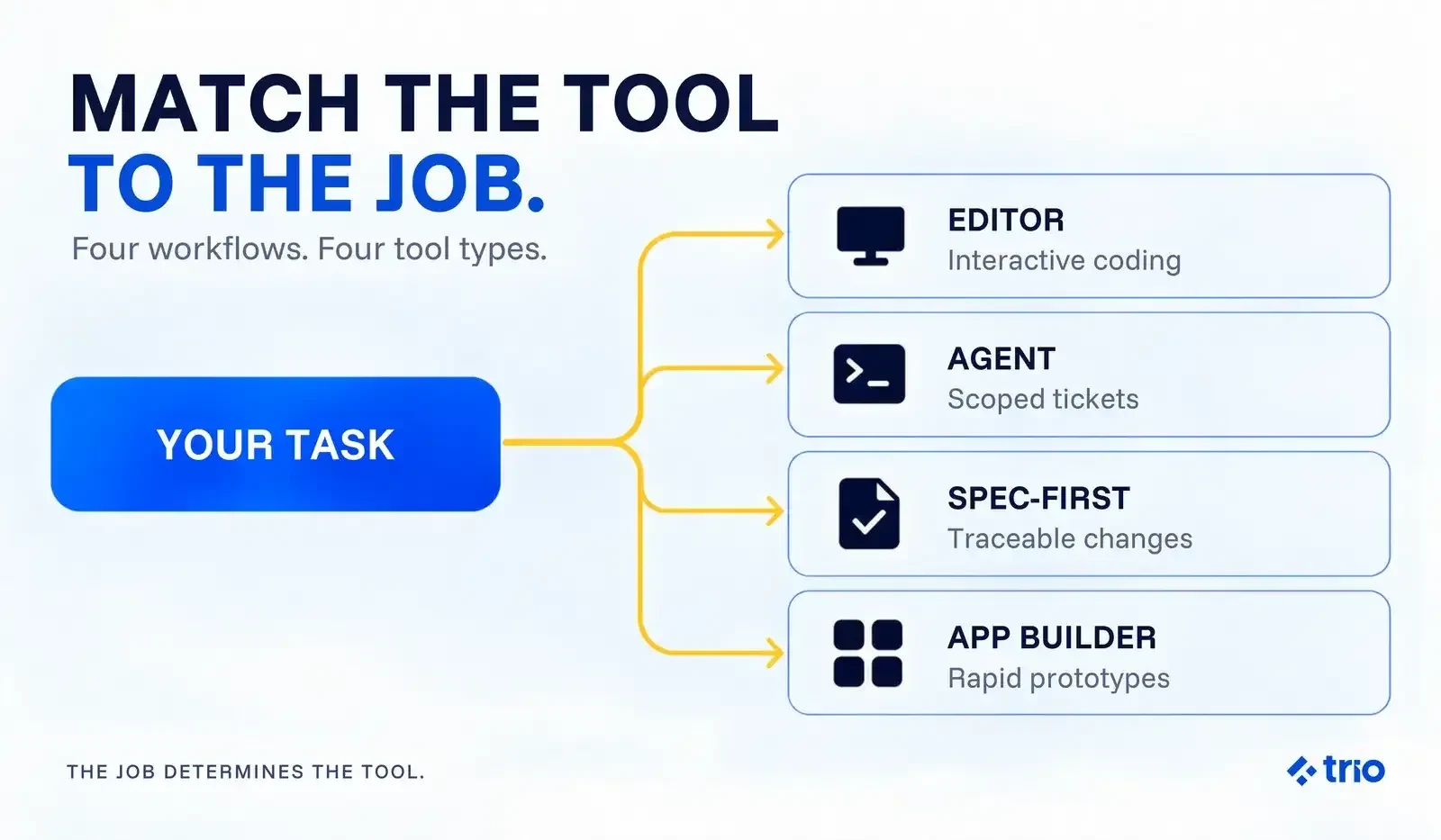
One of the best ways to choose the right AI coding tools is to start from the task, since the categories above solve different problems. Here are some simple steps you can follow:
Match the layer to the job: Editors for interactive work, agents for specified tickets, spec-first tools where changes need a paper trail, builders for throwaway prototypes.
Read the billing model: Copilot's metering and usage windows on agent plans mean cost depends on how the tool gets used, not on a flat seat price.
Write down review rules for AI-authored pull requests: Only 24% of respondents say their employer provides approved tools and guidance, and developers trust AI mostly when they can verify it.
Keep one open-source, bring-your-own-model option: Aider, a command-line tool that commits straight to your local Git repo and works with any major model through an API key, and OpenCode (used by 14% of Stack Overflow's agent respondents) both give you an exit if a vendor changes terms the way Windsurf and Copilot did this year.
Teams that add agents to an existing codebase often bring in backend developers first, because agent output tends to expose weak tests and unclear module boundaries.
What does agentic AI mean for the future of software?
Leveraging AI for first drafts appears to shift effort toward specification and review, and the people who tell good output from plausible output become more valuable.
For fintech teams, that suggests investing in reviewers before investing in more generation. Trio places senior engineers from Latin America through staff augmentation and dedicated teams, AI developers and fintech developers who understand both the tools and the review burden.