


Vue.js is a JavaScript framework that developers treasure for its versatility and maintainability, among other traits.
In the State of JavaScript 2020 survey, results found that nearly half of respondents were using Vue.js, and the framework had a satisfaction rate of over 80%.
Labeled “The Progressive JavaScript Framework”, no doubt Vue.js has something enticing to offer the common developer.
Since that survey is a few years old now, you might reasonably wonder whether Vue’s appeal has faded. It hasn’t. Vue 3 is now the default version, and the framework has continued to grow, helped along by a loyal community and plenty of real production use.
Stay tuned to learn more about Vue.js and why it’s becoming more popular by the minute!
What Is Vue.js?
Vue.js is a model-view-viewmodel (MVVM) JavaScript framework for building user interfaces (UIs) and single-page applications.
The creator of Vue.js is former Google engineer Evan You, who quickly grew frustrated with using AngularJS on Google projects.
He decided to extract the best features of Angular and build something incredibly lightweight.
The MVVM architecture of Vue.js ensures the separation of presentation logic from business logic, which represents the view and model, respectively.
Then the view model acts as a mediator by reading data objects for presentation.
But architecture aside, the most notable feature of Vue.js is directives. Directives extend HTML with HTML attributes, giving increased functionality to HTML applications.
These directives are built in, but they can also be user-defined. Essentially, they allow manipulation of the document object model (DOM).
The DOM is an interface of sorts, specifically an API for HTML and XML documents, that instructs machines on how to structure text.
The concept of directives exists both in Angular and Vue.js, but you can plug Vue.js into any part of a server-side application and hand-tailor a more interactive experience for consumers.
In short, this feature permits HTML elements to encapsulate reusable code.
JavaScript frameworks like Vue.js encourage more organization when it comes to front-end development.
Vue.js can take a web page and break it down into reusable components, each with its own HTML, CSS, and JavaScript elements.
Other clever tools of Vue.js include Vuex and Vue-Router. They work with core Vue.js programming by providing the following:
- State management, where UI controls like text fields, OK buttons, and more may require managing outside the current page a user is visiting (Vuex)
- Routing is a process that occurs when you need to sync URLs to views in your application (Vue-Router)
Although all of this still applies, modern Vue development typically leans on a few newer ideas.
Vue 3 introduced the Composition API, which gives developers a more flexible and readable way to organize logic. Some teams stick with the Options API because it feels clearer, and that tension between the two styles is part of Vue’s personality now.
Single-file components, written as .vue files, remain the most comfortable place to build everything from tiny widgets to large applications.
You may also see Pinia referenced more often than Vuex in the current documentation, since Pinia is the recommended state management library for new Vue 3 projects.
The same goes for Vite, which has replaced the old Vue CLI for a faster development setup.
What Is a “Progressive” JavaScript Framework?
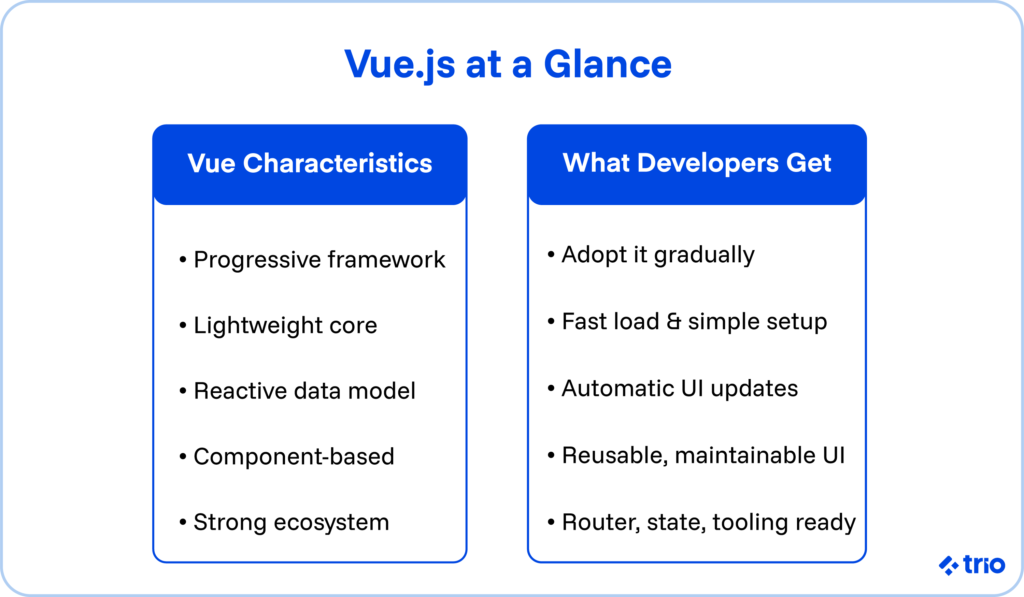
When people ask what a “progressive framework” actually means, the answer is fairly simple. Vue lets you adopt it little by little.
You might start by enhancing a single form on an existing page, then later build out a full single-page application without rewriting your entire codebase. That incremental approach is one reason developers warm to Vue so quickly.
This flexibility may suggest that Vue is soft or minimalistic, but that isn’t really the case. The ecosystem has grown into something much fuller, with official libraries for routing, state management, and even server-side rendering.
It just doesn’t require you to commit to all of that on day one.
Core Concepts of Vue.js
A few ideas sit at the heart of Vue, and understanding them helps all the other pieces make more sense:
- Declarative rendering: You describe what the UI should look like based on your data, and Vue handles the rest. It feels refreshingly direct once you get used to it.
- Reactivity: Vue tracks changes to your data and updates the UI automatically. This has always been one of Vue’s main selling points because it removes a surprising amount of busywork.
- Components: Everything on the page can be broken into smaller, maintainable units. Even simple things like buttons or form fields may become easier to reuse.
- Directives: v if, v for, v model, and others add expressive behavior to plain HTML. Your original explanation of directives is still accurate, so this builds on that rather than replacing it.
- Single file components: Templates, script logic, and styles all live together in a single .vue file. It keeps related pieces close, which many developers find easier to reason about.
- The ecosystem: Vue Router handles navigation, Pinia handles state, Vite handles tooling, and Nuxt supports server-side rendering and static site generation. You don’t need everything on this list to get started, but knowing they exist can help you plan for growth.
What Is Vue.js Used For?
Vue.js is a versatile language, so you can use it for a variety of purposes.
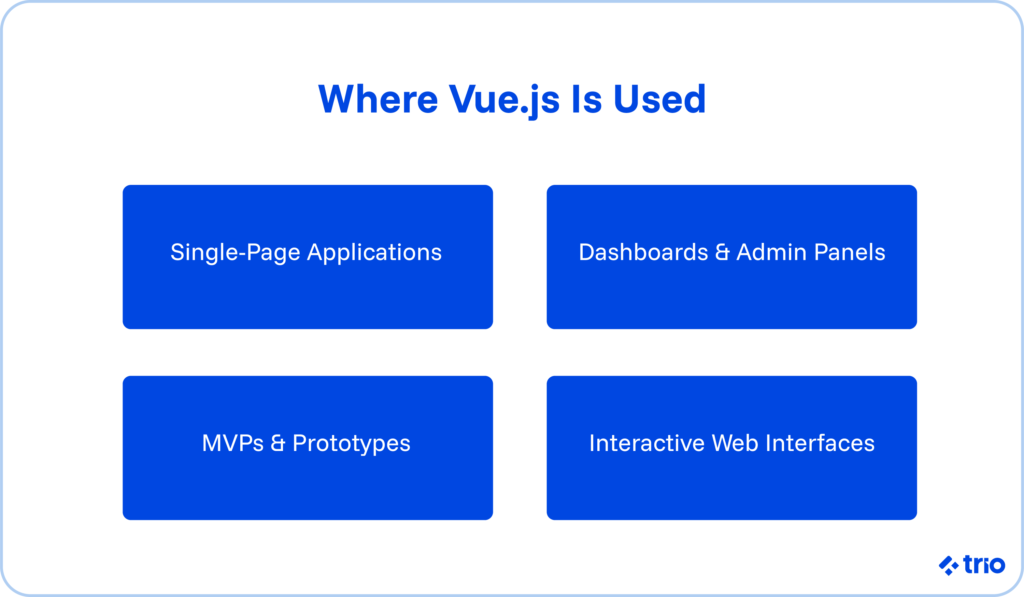
First of all, Vue.js works well for any projects that involve HTML, CSS, and JavaScript. And this is why Vue.js is primarily used for building UIs and any web development undertaking.
But because Vue.js is lightweight, it’s also a good choice for rapid prototyping.
Say, you wanted to build a minimum viable product (MVP) for one reason or another. Vue.js would get it done in a jiffy.
Single-page applications (SPAs) are within the range of Vue.js’s expertise as well.
In an SPA, there is only a single page to view information. Users access new information as the website dynamically rewrites the page upon user interaction.
Like React Native, Vue.js has the capacity for native mobile app development. Developers can utilize NativeScript to build mobile apps on Android and iOS with shared JavaScript code.
It might help to know that global websites using Vue.js include the likes of Facebook, Netflix, and Google, which demonstrates just how powerful the framework is.
In practice, teams also apply Vue to dashboards, internal tools, admin consoles, or anything that needs frequent UI updates.
Nuxt has become an increasingly common choice for companies that care about SEO or server-side rendering, especially in content-heavy apps or customer-facing marketing sites.
On the other side of the spectrum, frameworks like Quasar and Electron allow Vue developers to target mobile and desktop if the situation calls for it.
So while Vue often starts small, it rarely stays that way.
Why Is Vue.js Popular?
Developers use Vue.js for a number of reasons. It’s clear that Vue.js is popular, but its true appeal lies in its technical astuteness. Here are some features representing Vue’s aptitude:
Lightweight Design
Vue.js is called progressive because it is designed to be incrementally adoptable. This means that programming in Vue.js means starting small and scaling up as you so desire.
As a result, Vue.js is fairly straightforward and doesn’t have the complexity of larger frameworks.
Plus, it’s worth noting that the size of the Vue.js framework is less than 21 kilobytes. So rest assured, you won’t have to deal with the lag of heavy software on your business machines.
Two-Way Data Binding
DOM manipulation is a bi-directional event. What happens in the view affects the model, and vice versa.
While data flowing in a single direction might be less complicated on a cerebral level, one-way data binding hinders the development process.
Changes to the model reflect on the view but not the other way around. Ergo, making UI changes means putting in extra work.
DOM Rendering
Vue.js is a proud supplier of a virtual DOM. (Vue.js is free and open-source, so fees do not apply.)
The virtual DOM is a means of holding a representation of the UI in memory. Through reconciliation, the virtual DOM syncs changes to the ‘real’ DOM at a later time.
Virtual DOMs are advantageous because making updates to the ‘real’ DOM immediately can be tedious and slow.
By using a virtual DOM, developers can see the changes they make to the view without actually submitting those changes for permanent rendering.
Component-Based
Every piece of a Vue.js application or web page acts as its own component. The advantage here is that you’ll get to reuse components as you like.
Overall, this approach to development lends to better code readability, since there will be less clutter.
Easier unit testing is a secondary advantage, as you can check how the smallest parts of an application work on their own.
Community Support
Although having eager developers on your side isn’t necessarily a technical asset, it can amount to virtually the same thing.
Vue.js is popular because it’s popular. It’s circular reasoning, but when a certain technology has a large community of support, you can expect it to always remain up-to-date.
Besides staying relevant, a large community also means you know where to look when you need specific advice about any Vue-related dilemma.
Last but not least, this community is filled with talented Vue.js developers, meaning it’ll be easy to find talent for your software development team.
Vue.js vs. Other JavaScript Frameworks
Vue.js’s biggest competitors are other JavaScript frameworks, like React and Angular. You may want to see how they compare.
Vue.js vs. Angular
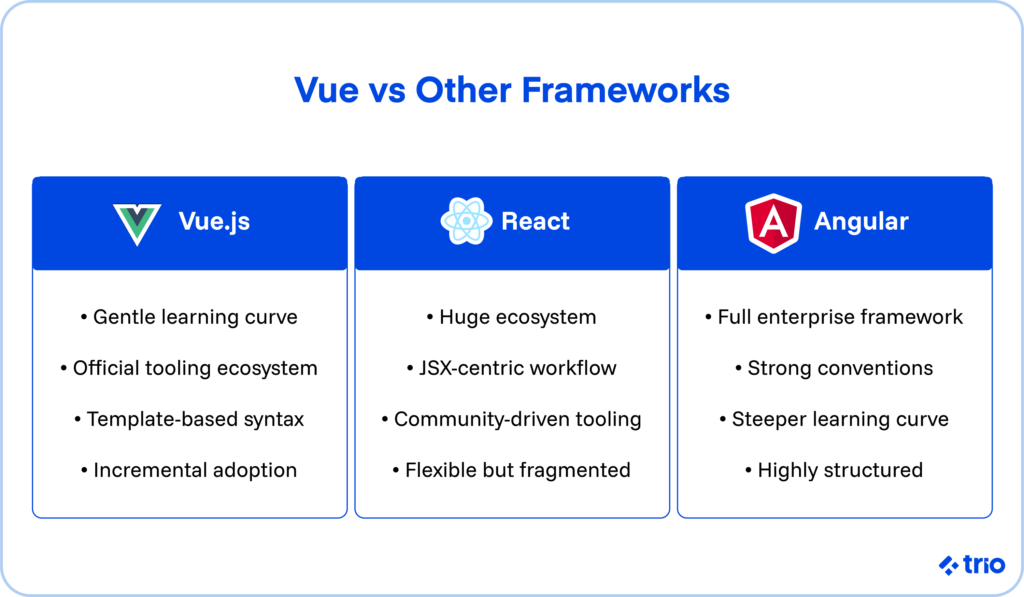
Angular is a TypeScript-based web application framework. It is cross-platform, meaning you can reuse TypeScript code for web, mobile web, native mobile, and native desktop use.
The framework also promises speed, performance, and useful tooling such as declarative templates and Angular-specific feedback for its editors and integrated development environments (IDEs).
But compared to Vue.js, experienced developers find that Angular is:
- Hard to learn
- Prone to jargon-y documentation
Some engineers also mention that Angular’s strong opinions can be comforting once you’re inside a large codebase, although that same rigidity may slow down teams that prefer a lighter touch.
Vue tends to feel more approachable for developers who want structure without committing to a fully prescriptive ecosystem.
Vue.js vs. React
React is a front-end JavaScript library for building UIs. Its component-based design makes it easy for developers to plug in UI components and make complex UIs without the need for state management.
JSX is also a fundamental aspect of React. Similar to XML, JSX combines HTML, CSS, and JavaScript into one language.
In spite of all this, developers who prefer Vue.js think:
- Using JSX makes code less maintainable
- Important features like navigation and state management are lacking
These points usually come down to taste. Some people enjoy writing JSX because it keeps everything in JavaScript, while others feel more grounded using templates like Vue’s.
React’s ecosystem is enormous and sometimes overwhelming, which can be energizing for seasoned teams and confusing for newcomers. Vue offers a more predictable set of official tools, and that consistency is one of the reasons it continues winning over first-time front-end developers.

What Are the Skills Needed for a Vue.js Developer?
An ideal Vue developer should be knowledgeable in JavaScript, Vue.js, HTML, CSS, and various other technologies and concepts discussed above.
But when you’re in the process of hiring Vue.js developers, you should also be ready with what exactly you’re looking for in potential hires.
What is the extent of knowledge and technical know-how required in a Vue developer? There are a variety of technical and soft skills that are a must in an ideal candidate.

JavaScript
Basic JavaScript proficiency is a given for any Vue developer. But Vue.js development also requires considerable knowledge of modern JavaScript versions. JavaScript evolved from a basic scripting language in the mid-90s to the omnipresent web development environment it is today.
The candidates you’re considering for your project should be able to answer questions about modern JavaScript features like template literals and object deconstructing.
Vue CLI
Vue Command Line Interface (CLI) is a system for rapid Vue.js development and does a lot of the grunt work behind the scenes.
Vue CLI is essential for developers as it provides valuable features out of the box, such as accessing front-end build tools, connecting them to sensible defaults, and smooth customization. Vue developers can also create their own plugins and presets.
HTML & CSS
HTML and CSS proficiency is also crucial for Vue developers. CSS is responsible for laying down document presentation rules in HTML, and HTML is needed to develop the final web pages.
GitHub
GitHub is an online repository that allows developers around the world to collaborate on software development. It enables developers to tweak existing code and develop new applications. It is crucial for Vue developers to have experience with GitHub.
Time Management
Time management is a highly desirable skill to have in a Vue.js developer, considering the highly time-sensitive nature of development projects. Only someone skilled in time management can accurately estimate the project duration and scope for it accordingly.
You can test candidates for this skill by asking them to complete a small Vue project in a designated amount of time.
Communication
Excellent communication skills can do wonders for a Vue developer’s performance and career prospects. It can not only foster a great working environment with peers and team members but also ensure that client-facing interactions go smoothly.
You can test the communication skills of candidates during interviews, group discussions, and simulated client meetings.
Teamwork
Teamwork is an essential ingredient in making any project a success. Developers who understand this tend to be open and collaborative in their approach and often go the extra mile for the project’s success.
Having multiple team members with this skill can lead to everyone taking individual responsibility for their job and ensuring the team’s overall performance stays high.
How Much Does It Cost To Hire Vue.js Developers?
If you’re looking to hire the best talent out there, you’ll also need to loosen your purse strings. It can cost anywhere from $40,000 to $160,000 annually to hire Vue.js developers, depending on your location, the experience of the developer, and the duration of the project.
United States
According to ZipRecruiter, a Vue developer’s annual salary in the U.S. is between $43,500 and $159,000. On average, Vue developers earn $116,615 in the U.S.
If you’re looking for short-term projects, you’re better off calculating your costs based on hourly rates. A junior developer in the U.S. earns $33-$47 per hour, while a senior developer earns $57-$82 per hour. This means a 6-month project can cost you anywhere from $38,500-$66,500.
South America
Offshoring Vue.js development to Latin America can get you significant cost benefits, as the average annual salary for a Vue developer there is around $100,000. A mid-level Vue developer in South America will cost around $76,000.
A short, six-month project will cost you anywhere from $29,000 to $48,500 in South America.
Asia
Vue developers in Asis are among the most affordable in the world. For a 6-month project with Vue.js developers in Asia, you can expect the costs to be between $20,500 and $35,000.
Vue.js Developer Job Description Template
So you’ve determined the scope of your Vue.js development project, budgeted for the costs, and arrived at the hiring stage. What now?
You can’t just head into the wild with an open-ended requirement, hoping to score the best Vue developers in the market. What you need is a proper, formal job description that introduces the job and the responsibilities and skills it entails.
You can look at the following job description as a template and modify it for your specific project:
Company Introduction
< Write a short and impressive overview of your organization. Make sure to include information about the company’s culture, perks, benefits, and everything else that you think makes your company interesting. >
Job Description
We are looking for an expert JavaScript developer who is highly skilled with Vue.js. You will work as part of a team, and your primary focus will be on developing user-facing web applications and components. You’ll implement them with the Vue.js framework, following generally accepted practices and workflows.
You will ensure that you produce robust, secure, modular, and maintainable code. You will coordinate with other team members, including back-end developers and UX/UI designers.
Your duties will include taking part in daily scrums, writing and developing modules for existing Vue applications, integrating Vue into existing projects, writing code and tests for code, taking part in code review sessions, and using version control software to push and pull code for testing and deployment.
Your commitment to team collaboration, perfect communication, and a quality product is crucial.
Responsibilities
- Developing user-facing applications using core Vue, Vuex, and Vue Router
- Building modular and reusable components and libraries
- Running code optimization tools and analyzers to spot and refactor inefficiencies to create highly-performant code
- Implementing automated testing integrated into development and maintenance workflows
- Integrating Vue into legacy projects
- Keeping an eye on security updates and issues found with Vue.js and all project dependencies
- Proposing any upgrades and updates necessary for keeping up with modern security and development best practices
- < Add any other relevant responsibilities here. >
Skills
- Bachelor’s degree or several years of experience in e-commerce, computer science, or other related fields
- Highly proficient with JavaScript and its modern ES6+ syntax and features
- Highly proficient with the Vue.js framework and its core principles, such as components, reactivity, virtual DOM, Vuex, and Vue Router
- Good understanding of HTML5 and CSS3, including < Sass or Less, depending on your technology stack >
- Understanding of server-side rendering, its benefits, and use cases
- Familiarity with automated JavaScript testing, specifically testing frameworks such as Jest or Mocha
- Proficiency with modern development tools, like Babel, Webpack, and Git
- Experience with both consuming and designing RESTful APIs
- Experience with integrating and maintaining external software libraries and APIs using a command-line interface and package managers
- < Make sure to mention any other frameworks, libraries, or other technologies relevant to your project. >
Vue.js Interview Questions Examples
Once you’ve shortlisted candidates for your Vue.js development project, it’s time to interview them to gauge their technical and non-technical skills on a deeper level.
You’ll require a set of interview questions for this stage of the process that can comprehensively judge the final set of candidates on their proficiency and fitment with the organization and the project:
- Why should arrow functions not be utilized in Vue instances when writing lifecycle hooks?
- How can the performance of Vue.js be improved?
- What are the advantages of utilizing VueJS Mixins?
- What is the best way to maintain state in an extensive Vue application, and why is it recommended?
- Is using variables for mutation types required?
- Describe the distinction between v-show and v-if.
- Explain Vue.js reactivity and common issues when tracking changes.
- List the most common causes of memory leaks in Vue.js apps and how they can be solved.
- Why would you choose Vue.js over other front-end frameworks?
- Does Vue.js compute a property with reactive dependencies every time the computation is invoked?
- How would you test that a parent component responds to a child component emitting an event?
- Imagine this scenario: you are trying to update a property in the state called ‘authenticated’, but it doesn’t happen.
Your store.js has code like the following:
state() {
Return {
authenticated: false,
user: {}
}
},
getters: {
authenticated(state) {
return state.authenticated
}
},
mutations: {
set_authenticated(state, value) {
return state.authenticated = value
}
},
What is missing from the above piece of code that could be causing the problem?
Where To Find Vue.js Developers?
When recruiting Vue.js developers, it’s essential to know where to look. There are numerous platforms available for you to hunt for the best Vue talent out there. Knowing which platforms are worth your time is essential to making the process as effective as possible.
Below are some platforms that you can consider to hire the best Vue.js developers in the market:
LinkedIn is the top recruiting platform worldwide, where you can find both onsite and remote opportunities. Listing your job on LinkedIn allows you access to its large candidate database. But on the flip side, it’s also a time-consuming process.
Moreover, LinkedIn is not the best platform when looking for short-term Vue.js developers. It works best when you’re hunting for full-time employees.
Upwork
Upwork is a leading online work marketplace and one of the most popular platforms for freelancers. You can discover and hire Vue.js developers worldwide by posting your job description on Upwork.
Upwork requires applicants to verify their qualifications and submit personalized bids, so you always have access to a great pool of candidates. Hiring Vue developers on a contract basis is a job better suited to Upwork. Do note that you still need to spend considerable time and effort vetting the applicants.
Trio
Trio specializes in connecting companies to software development professionals worldwide. Trio provides you instant access to extremely skilled and thoroughly vetted developers without the need to engage in a lengthy recruitment process.
A great benefit when hiring Vue.js developers from Trio is that you won’t incur hiring costs, which can sometimes amount to a significant portion of a developer’s annual salary. Trio developers also receive excellent professional and personal support, which leads to increased job satisfaction and low turnover.
When hiring from Trio, you don’t even need to handle HR responsibilities like payroll, benefits, and compliance. You can instantly hire committed, near-shore developers who are verified and are the best in their niche.
Use Vue.js on Your Next Project
Vue.js has so far been successful at silencing the issues of other JavaScript frameworks. For frustrated developers, this should be an enticing reason to adopt Vue.js.
Businesses, as a rule, should put their faith in the technical leaders within their organization and internalize their frustrations.
If you’re looking for a JavaScript framework to enhance your next software development project, it’s time to consult your technical team about choosing Vue.js.
If you learn that Vue.js is right for you, but still need talented developers to get your project to the finish line, get in touch with Trio about hiring Vue.js developers!
Trio goes beyond providing exceptional software development insights; we connect you with the best South American developers. Discover our elite Argentine, Chilean, Mexican, and Brazilian developers for your outsourcing needs.
As you explore your options, it might help to talk through your project goals with someone who has shipped Vue applications before.
Our team works with companies building dashboards, customer-facing apps, internal tooling, and a handful of more specialized interfaces that rely on Vue’s reactivity model.
FAQs
What does Vue.js mean?
The meaning of Vue.js refers to a progressive JavaScript framework focused on building interactive user interfaces. It originally centered on the “view layer,” which is where the name comes from.
Why is Vue.js called progressive?
The progressive nature of Vue.js comes from its ability to be adopted gradually. You can enhance a single page or scale up to a full application without committing to a heavy setup up front.
What is Vue.js used for?
The uses of Vue.js include building SPAs, dashboards, internal tools, and content-driven sites. Many teams also pair it with Nuxt when they need server-side rendering or improved SEO.
Is Vue a library or a framework?
The framework versus library question for Vue is common because its core is lightweight. It’s still considered a framework since it provides structure and integrates cleanly with official tooling.
Is Vue.js still relevant today?
The relevance of Vue.js today is easy to see, with Vue 3 as the default version and steady adoption across companies of all sizes. Its ecosystem continues evolving without forcing disruptive changes.


