

Hire by Technology
SERVICES


Getting ready to scope out your project? If you're budgeting for a nearshore development team, the hourly rate on a vendor's upfront pricing is just one consideration that will affect the overall cost.
You also need to consider developer seniority, tech stack, engagement model, and the hidden costs that compound into your actual spend over a 12-month engagement.
At Trio, the total nearshore software development rates for senior fintech developers across LATAM are $40-$90 per hour, depending on your specific needs, with developers across most major technologies hand-picked based on your requirements.
Let’s take a look at a variety of different factors that can influence costs, including average nearshore software development rates by region and seniority.
If you are ready to start hiring today, get pricing.
Nearshore software development means outsourcing to a neighboring or nearby country, typically one that shares a similar time zone. The most common mistake that we see in nearshore budgeting is that companies tend to treat developer hourly rates as equivalent to total engagement cost.
If you hire the wrong person and need to restart the hiring process, or you need to spend weeks onboarding developers so they can meaningfully contribute, you end up driving up costs.
Five factors appear to drive nearshore software development rates more than any others:
Let’s compare the costs of the different hiring models side-by-side so that you can see what you can expect in 2026:
| Model | Typical US or EU rate | Nearshore rate (LATAM/Africa) | Offshore rate (India/Philippines) |
| Junior developer | $80 to $120/hr | $20 to $40/hr | $15 to $30/hr |
| Mid-level developer | $120 to $160/hr | $35 to $60/hr | $25 to $45/hr |
| Senior developer | $150 to $200/hr | $55 to $85/hr | $40 to $70/hr |
On average, we’ve seen nearshore costs in Latin America typically run 40 to 60% below onshore US rates for comparable seniority.
Offshore development costs can be even cheaper, especially since there is a very large developer pool to choose from, but the time zone gap can run as high as 8 to 12 hours for India or Southeast Asia.
These timezone gaps create collaboration friction that shows up in longer feedback cycles, and means that even small issues take a full business day to get resolved.
This ends up compounding in additional costs, which means that nearshore development offers most of the cost savings of offshore outsourcing while preserving the collaboration model that most product teams actually need.
While we can generalize offshore, nearshore, and onshore figures, the reality is that there can be major differences between regions.
LATAM has become the primary nearshore destination for North American companies, and it is the region that we source our developers from the most.
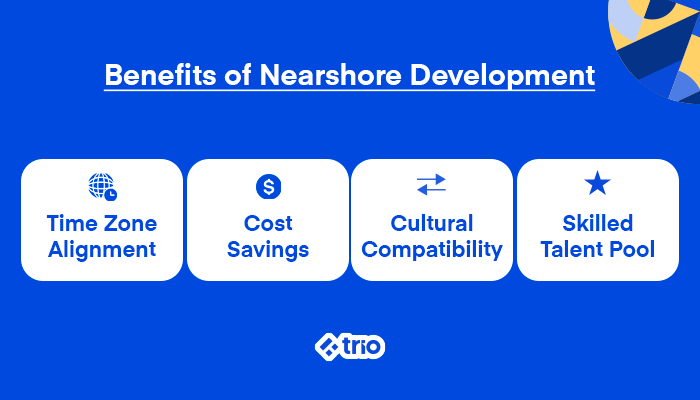
As we have already mentioned, the combination of time zone alignment, technical depth, and competitive rates all provides incredible benefits to North American companies.
Most of Latin America operates within 1 to 3 hours of US East Coast time, which makes real-time collaboration as simple as it would be with someone working from home in the United States.
Average nearshore software development rates in Latin America range from roughly $20 to $85 per hour, depending on country and seniority.
Here's a breakdown by country and experience level if you are hiring through a staff augmentation model with Trio:
| Country | Junior ($/hr) | Mid-level ($/hr) | Senior ($/hr) |
| Mexico | $25 to $40 | $40 to $60 | $60 to $85 |
| Brazil | $20 to $35 | $35 to $55 | $55 to $80 |
| Argentina | $18 to $30 | $30 to $50 | $50 to $75 |
| Colombia | $20 to $32 | $32 to $50 | $50 to $70 |
| Chile | $25 to $40 | $40 to $58 | $58 to $80 |
Just remember that hiring from major cities is going to drive up costs in terms of hourly rates, but you will also benefit from improved infrastructure, which means more reliable connectivity for developers.
Related Reading: Reasons to Hire Brazilian Software Developers
Many companies we work for, especially those expanding into Western Europe or who want people working alternate hours for roles that require round-the-clock attention, are expressing an increased interest in Africa.
Hiring nearshore developers from Africa is the best way for EU companies to get the time zone overlap, combined with the cost savings that a US company gets from LATAM.
South Africa, Kenya, Nigeria, and Egypt have developed meaningful engineering communities that offer competitive nearshore rates.
Average hourly rates for African nearshore developers:
| Country | Junior ($/hr) | Mid-level ($/hr) | Senior ($/hr) |
| South Africa | $20 to $30 | $30 to $45 | $45 to $65 |
| Nigeria | $15 to $25 | $25 to $40 | $40 to $60 |
| Kenya | $15 to $25 | $25 to $38 | $38 to $55 |
| Egypt | $18 to $28 | $28 to $42 | $42 to $60 |
South Africa is one of the best locations in terms of technical depth and English language proficiency within the region. We even get requests for South African developers from clients in regions like Australia.
But keep in mind that the quality does come at a slightly higher premium. It may still be the most cost-effective option for many, though.
CEE is a good comparison point for European companies.
Poland, Romania, Ukraine, and the Czech Republic all carry strong technical reputations, particularly in backend engineering and systems programming.
But the higher cost of living in these countries does mean that rates run higher than in LATAM and Africa.
| Country | Junior ($/hr) | Mid-level ($/hr) | Senior ($/hr) |
| Poland | $30 to $45 | $45 to $70 | $70 to $100 |
| Romania | $25 to $38 | $38 to $60 | $60 to $85 |
| Ukraine | $20 to $35 | $35 to $55 | $55 to $80 |
| Czech Republic | $35 to $50 | $50 to $75 | $75 to $105 |
At Trio, our nearshore hourly rates are pretty inclusive, but at some other companies, the total cost of ownership includes several additional factors that can add 30 to 50% to the headline number if they aren't accounted for upfront.
Domain experience matters more than general technical skill for specialized industries like healthtech or fintech, which we specialize in.
The ramp-up cost of training a technically skilled but domain-unfamiliar team on regulated product requirements often exceeds whatever hourly rate savings that team offered, and then you run the risk of an inexperienced developer making mistakes.
Ask about developer tenure and team stability, too. Developers working on your project for any length of time end up building institutional knowledge, which you ideally want to keep.
If you keep replacing people, or developers keep leaving, then every new person needs to learn about your project from the ground up. They may also never understand why certain decisions were made.
Also, make sure to check time zone overlap in practice, not on paper, and to be very clear about your requirements when contracting a nearshoring firm.
Mexico City at UTC-6 and New York at UTC-5 have a 1-hour gap on paper, but developers could adjust their working day if needed.
If possible, evaluate vetting processes directly.
Ask what assessments candidates go through before being presented to clients, and whether domain-specific screening, not just algorithmic tests, applies to the roles you're hiring for.
At Trio, we focus exclusively on fintech, which means our developers arrive with domain knowledge that reduces onboarding friction and the category of mistakes that come from not understanding how regulated financial products actually work.
We have worked with several companies of varying sizes, hand-picking pre-vetted developers from our talent pool based on their specific requirements.
If you want a cost estimate for your specific project, request a budget consult.
Nearshore software development rates in Latin America typically run from $20 to $85 per hour, depending on country, seniority, and tech stack. Senior developers in Mexico and Brazil sit at the higher end of that range, while junior developers in Argentina and Colombia fall at the lower end.
Nearshore development typically costs 40 to 60% less than equivalent onshore US rates for mid-to-senior developers. A senior developer billing at $60 to $80 per hour nearshore compares to $150 to $200 per hour onshore for similar seniority.
Developer seniority, local labor market conditions, tech stack, engagement model, and provider services are all factors that affect nearshore pricing meaningfully. Specialized skills like AI/ML engineering or cloud infrastructure command 30 to 50% rate premiums over general full-stack work across all regions.
The primary hidden costs that you should factor into a nearshore development budget include onboarding and ramp-up time, management overhead, developer attrition and replacement, infrastructure and tooling, and legal and compliance setup. These all add to the headline hourly rate.
Latin America tends to suit North American companies better than Eastern Europe because the time zone alignment allows real-time collaboration during standard working hours. Central and Eastern Europe carry comparable technical quality but create a 6 to 9-hour gap with the US East Coast.
African nearshore rates tend to run slightly lower than Latin American rates for comparable seniority, with South African senior developers typically billing at $45 to $65 per hour versus $55 to $85 per hour in Mexico or Brazil.