

 Read Client Stories





 Alex Kugell
 Key Takeaways
- Argentina’s developer pool sits somewhere around 115,000 software engineers, plus roughly 27,000 new STEM graduates a year.
- Hourly rates for experienced developers typically run $25 to $65, depending on seniority and specialization, with Trio’s own fintech-focused engineers priced separately.
- Argentina operates on UTC-3 year-round with no daylight saving time, putting it one to two hours ahead of US Eastern time and overlapping most of a standard US workday.
- The Knowledge Economy Law gives qualifying tech companies meaningful tax relief, which is part of why the sector kept growing through a rough macroeconomic stretch.
- Inflation has come down substantially from its 2023-2024 highs under the current administration’s stabilization program.
- IT staff augmentation, dedicated teams, and project-based outsourcing are all popular hiring models, and picking the wrong one causes more friction than picking the wrong country.
Argentina has a real case for software outsourcing. It has a deep developer pool, close time zone overlap with the US, and a government that has actively backed the tech sector through tax law rather than just rhetoric.
However, once you’ve decided Argentina is worth it, how do you actually structure the engagement, run the hiring process, and avoid the mistakes that show up three months in rather than during the sales call?
Knowing what to expect can help you avoid a myriad of issues that may have otherwise created vulnerabilities, or even regulatory issues in industries like fintech that are carefully governed.
Let’s take a look at everything you need to know in this guide to outsourcing software development to Argentina, so that you can better decide if it is the right option for you, and how to go about it.
To start hiring today, request regional talent.
Why Argentina: Summary
Cost is the first thing most companies notice when they are considering a nearshore software development partner.
Experienced developers in Argentina typically run $25 to $65 an hour, well below equivalent US rates. On top of the upfront savings, outsourcing also removes the overhead of office space, benefits, and full-time employment costs that come with an in-house hire.
In many nearshore or offshore locations, this savings comes with several tradeoffs which Argentina’s English proficiency largely mitigates.
Argentina ranks first in Latin America on the EF English Proficiency Index, and that shows up in code reviews, standups, and requirements discussions that tend to happen without the translation layer that slows down some other outsourcing relationships.
Time zone alignment is also an incredibly underrated advantage.
Argentina sits on UTC-3 year-round, one to two hours ahead of US Eastern time, which means a US team’s workday and an Argentine team’s workday overlap almost entirely.
Real-time standups, same-day code review, and quick unblocking are the norm, which is particularly invaluable in industries like fintech that face hard regulatory deadlines.
The government has also put actual policy behind the sector.
The Knowledge Economy Law reduces corporate tax rates for qualifying tech companies and removes VAT on software exports, which is a meaningful part of why the industry kept expanding even through a difficult macroeconomic period.
Software Development Hubs in Argentina
Not every Argentine city offers the same outsourcing experience, and knowing where the talent concentrates helps narrow a search.
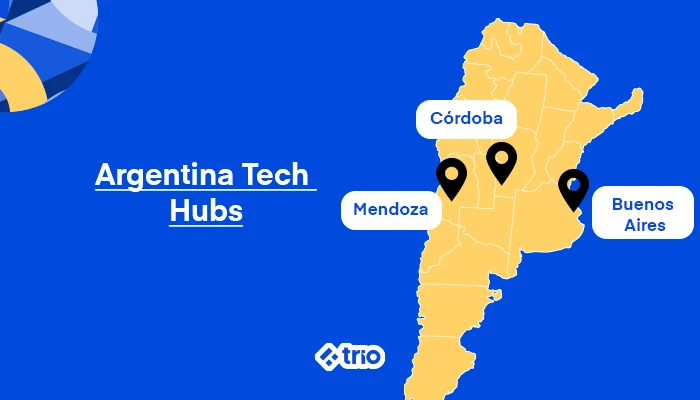
- Buenos Aires accounts for the largest share of the country’s tech industry. Microsoft, Dell, Amazon, and Meta all maintain offices there, and it’s home to most of Argentina’s tech unicorns, including MercadoLibre, Globant, and most major fintech firms.
- Córdoba functions as the country’s second major hub, responsible for an estimated 30 to 40 percent of Argentina’s software exports despite being considerably smaller than Buenos Aires. A strong university system and a somewhat lower cost base make it a common second choice.
- Rosario and Mendoza round out the picture, each with smaller but active tech scenes. Rosario benefits from the National University of Rosario, and Mendoza has developed some specialization in agritech and travel software, reflecting its regional industries.
Choosing the Right Engagement Model
In our experience, how the partnership gets structured tends to matter more than which specific vendor gets picked or even where the developers are hired from.
Three models are particularly popular, and cover most situations. Then there’s a fourth that is more seldom used, but still worth knowing about if the work is genuinely exploratory.
- Staff augmentation works well when individual developers need to join an existing team directly. Think of it as a normal remote hire, except a partner handles the paperwork, payroll, and local compliance, and there’s no long-term commitment required.
- A dedicated team is a longer-term extension of the company, usually a small group that owns an entire feature area or product line and builds deep context over months rather than weeks. From what we have observed, this tends to outperform staff augmentation once a project needs sustained ownership rather than incremental capacity, like financial software development.
- Project-based outsourcing hands an entire, well-scoped project to a vendor who manages it end to end. It requires the least internal management overhead, but also gives up the most visibility and flexibility if requirements shift mid-project.
The fourth pattern, which we usually only recommend if you are working on AI features, blockchain integration, and similar work, is a more hybrid arrangement.
In this case, you would have a partner that contributes technical direction and prototyping alongside straightforward delivery, rather than just executing a fixed spec.
How to Outsource Developers in Argentina: A Step-by-Step Process
Regardless of which engagement model ends up fitting your company and project the best, the actual hiring process tends to follow a consistent shape.
- Clarify project scope and the type of talent needed: A short written brief, role, seniority, and expected outcomes are usually enough to work from. The goal is having a reference point to evaluate candidates against.
- Choose the engagement model that fits the workflow: Revisit the models above and pick based on how much ownership, control, and duration the work actually needs.
- Shortlist partners with real screening capabilities: Ask specifically how they vet for communication, technical depth, and domain fit. Depending on your industry, you may want to ask about ownership and how they handle regulatory architecture, decision documentation, and information hand-offs when the engagement ends.
- Interview and evaluate the actual engineers: A short pairing session or a real technical conversation reveals more than a written assessment. Live, verbal code walkthroughs are one of the better ways to confirm a candidate can explain their own reasoning, and that they truly understand industry nuance.
- Start with a trial or pilot period: Even a few weeks gives practical insight into whether the working relationship holds up before committing to a longer engagement, or putting a developer in a position where they are able to open you up to long-term risks. Pair the new engineer with someone already on the team wherever possible during this stretch for improved onboarding and evaluation.
Related Reading: 9 Tips for Hiring Developers in Argentina
Hiring Considerations for Developers in Argentina
We have already covered a couple of considerations for developers in Argentina, but it’s worth looking at some factors in more detail.
Technical assessment
Coding tests and technical interviews are standard, but portfolios and references from actual past clients tend to be more revealing than either.
Make sure that you ask what the candidate built. It is also worth asking about how they are investing in their continued development and staying up to date with the latest industry standards.
Communication and English proficiency
Argentina’s reputation here is well earned, but the reality is that individual variation still exists.
A real conversation is the simplest way to confirm fluency at the level a role actually requires. Their written communication during the evaluation process will give you a good idea of that portion of their skill set, so it doesn’t necessarily need to be assessed outright.
Cultural compatibility
A developer having a strong general reputation doesn’t guarantee fit with a specific team’s working style.
While many LATAM developers have experience working with international teams and understand the general US working culture, it’s still worth probing directly rather than assuming it’ll work itself out.
Legal and compliance awareness
Argentine labor law includes mandatory bonuses (the Aguinaldo, a 13th-month salary paid in two installments) and meaningful severance requirements.
If you are hiring directly, you are going to have to factor these additional items into your cost projections.
Going through an outsourcing partner generally shifts this complexity off your plate entirely.
IP ownership should also be specified explicitly in the initial agreement rather than assumed.
Challenges of Outsourcing to Argentina, Honestly
Every outsourcing destination has real tradeoffs, and Argentina is no exception. Here’s where things actually go wrong, and what tends to fix it.
Economic volatility
Argentina’s currency has a documented history of instability, and inflation ran extremely high through 2023 and into 2024.
It has come down substantially since under the current administration’s stabilization program, but it hasn’t necessarily been resolved entirely, and it’s still worth treating as a live factor.
The easy fix here is to negotiate contracts in US dollars from the start, and confirm the partner has experience managing compensation in a dollar-denominated structure.
This removes the risk on your side, even if the underlying economy stays volatile.
Cultural and process alignment
The overlap in working culture between Argentina and the US is genuinely large, but it’s not total, and assuming zero friction sets you up for failure.
Establishing communication norms and regular check-ins early, rather than waiting for a misunderstanding to surface, heads off most of what would otherwise become a real problem.
Legal and contractual risk
Well-defined contracts covering scope, payment terms, IP rights, and confidentiality reduce this substantially.
If the engagement is large or long-term, legal counsel familiar with international outsourcing agreements is worth the cost.
Working through a US-based partner, like Trio, also simplifies this considerably, since the contracting entity is domestic even when the engineers aren’t.
Infrastructure reliability
Distance makes it harder to independently verify a partner’s technical infrastructure.
You can conduct basic checks around stable connectivity, current tooling, and secure data practices, but the more reliable approach is periodic review.
Argentina vs. Other Latin American Outsourcing Destinations
Argentina isn’t the only strong option in the region in LATAM, and there are many others that may be an even better option for you.
Compared to Mexico or Brazil, Argentina tends to offer a better balance of cost and seniority depth, particularly for teams that value strong communication and mature engineering practices over sheer talent-pool size.
Brazil has a considerably larger developer population overall, and Mexico’s geographic proximity suits teams that want closer time zone alignment or the option of in-person visits.
Where Argentina consistently stands out is in the depth of its senior engineering bench, shaped by years of local companies like Globant and MercadoLibre sending experienced engineers back out into the broader market.
The tradeoff is that very senior Argentine talent isn’t always the cheapest option in the region.
Conclusion
Argentina’s universities, startup ecosystem, and years of working alongside international teams have produced a developer community that understands what US and European product teams actually expect from a working relationship, and who have past experience working alongside these companies.
The concerns that come up most often (currency risk, labor law complexity, and infrastructure variability) all have practical, well-tested mitigations rather than open questions.
Getting the engagement model right is arguably more important than whether or not Argentina is the perfect fit.
At Trio, we offer a variety of plans and place hand-picked developers based on your requirements, so you not only get talent with the right experience, but also the most ideal hiring model.