

Hire by Technology
SERVICES


Figuring out whether to hire contract developers or commit to a full-time software engineer is critical to ensuring the successful development of your product, especially in fields as complex as fintech. Factors like budgets, timelines, compliance requirements, and how steady the workload will be in the future are all important considerations.
The difficulty a lot of our clients run into is the fact that the real cost differences are harder to calculate than they look. Contract developers tend to work for a certain period of time, or for a specific project, and then leave. You don’t need to pay benefits, take care of their taxes, etc. But they also take all the knowledge they built with them when they go.
Full-time software developers are more expensive upfront, but you keep all that knowledge. Both routes work well in the right setting, and both can hold a team back when misapplied. Let’s take a look at the key differences between contract and full-time employment to help you figure out which model will work best for your actual situation.
If you want access to pre-vetted developers to add engineering capacity to your team, compare options.
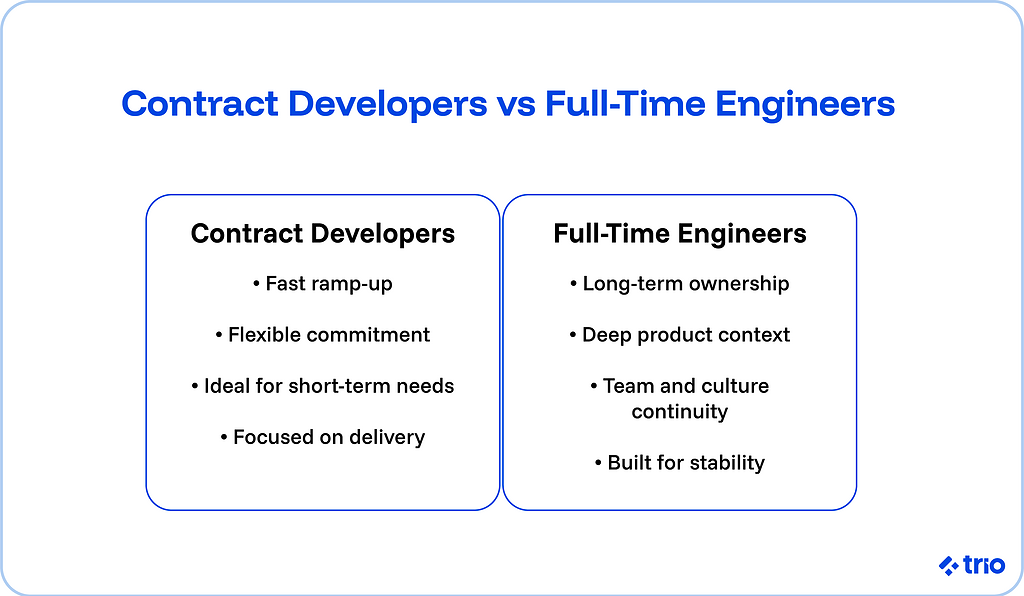
A contractor works on a contract basis with a defined scope and clear expectations around deliverables.
Usually, we see companies bring these onto their teams for project-specific needs or short-term capacity gaps. Contract developers tend to arrive ready to contribute quickly thanks to their extensive experience.
Contractors tend to move through multiple companies and projects over their careers, which builds a kind of pattern recognition that full-time engineers working in a single environment don't always develop.
These devs have probably seen more edge cases, more codebases, and more team structures than the average dev, which can be genuinely useful when you're navigating unfamiliar technical territory.
Some contractors operate like independent freelancers, managing their own tools and schedule. Others embed deeply into a team despite the temporary nature of the arrangement, attending standups daily and participating in architecture discussions, depending on how you structure the engagement.
Many engineers that companies interact with in contractor positions actively prefer contract work thanks to the higher day rates, the variety of projects, and the control over their career trajectory. All of this makes contracting an attractive long-term path.
Related Reading: Alternatives to Hiring Full-Time Developers
You might consider a contractor when you:
For teams working through a 6-month project with a fixed scope, such as building an initial compliance workflow, integrating a new payment processor, or shipping a standalone mobile app, contract software engineering jobs offer great value.
You pay for exactly what you need, for as long as you need it, without carrying all of the additional risks associated with the ongoing cost of a permanent employee once the work ends.
A full-time developer joins as a salaried employee on a permanent basis. The benefits package, including health insurance, paid time off, retirement contributions like a 401 (k), and equity, all reflect a longer-term employment commitment.
But there are benefits for the company too. You typically end up getting stronger loyalty and far deeper product knowledge that can benefit you later.
Full-time engineers build context that compounds like the reasoning behind past decisions, the edge cases that have already surfaced, and the regulatory or operational constraints that shape your architecture.
You may want to choose full-time when:
Teams in regulated industries like fintech often decide to hire full-time engineers as part of their risk management strategy, since rotating contractors through a codebase that handles payment processing or identity verification introduces context and compliance gaps.
Related Reading: Boutique Dev Shop vs Staff Augmentation
We often see companies surprised at the costs of both hiring models.
For a full-time software engineer in the US, a $125,000 base salary typically reflects only around 55 to 58% of the true annual cost. You also need to add employer payroll taxes, health insurance contributions, paid time off, etc.
Contract developers typically bill at higher hourly rates, often $75 to $125 per hour for experienced engineers, depending on seniority and specialization.
That range seems to overlap with full-time costs at the higher end, but you need to remember that it comes without benefits, overhead, recruiting spend, or the risk of needing to keep the developer when you have to work for them.
Many contractors handle their own taxes as independent businesses, which means you avoid employer-side payroll taxes on W-2 income, too.
Misclassifying a contractor as a de facto employee carries real legal and financial exposure in the United States and the United Kingdom, specifically.
In the US, the IRS uses a behavioral control test to assess whether a worker qualifies as an independent contractor or an employee.
This means that, if you direct not just the outcome but how the work gets done, set the hours, require specific tools, and prevent the contractor from working for other clients, they might actually be considered an employee.
In a case where this is discovered later, you’ll probably need to pay back taxes, penalties, and sometimes retroactive benefit obligations.
IR35 in the UK works similarly, assessing whether a contractor would be considered an employee if the intermediary company were removed from the equation.
We have seen a couple of companies operating internationally being caught off guard by this.
If you aren’t sure, hiring a full-time software engineer is probably the safer option in terms of employment legality.
A contract software engineer tends to ramp up quickly since they do it often and learn how to navigate issues like incomplete documentation, and make progress without much guidance from your internal management.
This is one of the primary reasons why engineers at Trio can start meaningfully contributing within 3-5 days.
A full-time software engineer integrates more slowly. This is partly because they don’t have the constant onboarding experience, and partly because they absorb more context and take on responsibilities that stretch beyond the immediate task.
If you are working on a 6-month project, for example, you probably can’t afford to have someone who takes 8 weeks to onboard properly.
Contract workers focus on delivering the agreed-upon output, so it is only natural that their intensity tapers off as the end of the engagement approaches.
Full-time engineers, on the other hand, tend to optimize for the product more broadly, dealing with problems that might not be in their immediate scope.
One option that can bridge this gap is contract-to-hire arrangements, where an engagement starts as a fixed-term contract with an explicit option to convert to permanent employment.
This is a great path to minimize risks on both sides since it gives both parties a kind of trial period.
You assess technical fit and cultural alignment before making a long-term commitment. The engineer evaluates whether the role matches their career goals before accepting a full-time position.
If you reach a point where neither option feels quite right, you're not alone.
Many fintech teams find that hiring a full-time software engineer takes time they don't have, while generic contract developers aren't always familiar with the realities of building financial products.
Trio gives fintech teams access to developers who already understand compliance, payments, lending, identity, and the broader financial ecosystem.
If you want to find out more about our different hiring models and whether we have the right people for you, book a decision call.
Contract developers join for specific projects or capacity gaps on a fixed-term basis, typically billing at higher hourly rates without receiving benefits. Full-time engineers work as salaried permanent employees, building deeper product knowledge over time in exchange for a lower effective hourly cost on longer engagements.
For engagements under 6 to 9 months, contract developers often cost less in total, even at premium day rates, because you avoid recruiting costs and benefits overhead. For roles lasting beyond a year, full-time employment tends to become more cost-effective.
Contracting tends to suit short-term projects, specific skill gaps, or situations where your startup needs someone to contribute quickly before a full-time recruiting cycle can be completed. It also makes sense when the workload fluctuates enough that permanent headcount would sit underutilized between peaks.
Full-time engineers generally build stronger product continuity because their institutional knowledge accumulates over time and doesn't reset when a contract ends, and provides better long-term stability. For compliance-heavy products, that continuity appears to carry meaningful operational value beyond the cost comparison.
Contractors can integrate well with an existing engineering team when scope, communication expectations, and onboarding processes are defined clearly at the start.
Contracting in fintech carries more risk when the contractor lacks prior domain experience, since gaps in compliance knowledge may not surface until an audit or incident reveals them. Vetting specifically for a fintech background, rather than general engineering skills, reduces that risk considerably.
Contract-to-hire starts as a fixed-term engagement with an option to convert to permanent employment, giving both sides a trial period before committing. It tends to work well when you want to assess technical and cultural fit before making a permanent offer.