


 Read Client Stories




 Alex Kugell

 Key Takeaways
- Quantified bullets beat descriptive ones. “Reduced p99 latency from 340ms to 45ms” tells a reviewer more than three sentences about your commitment to clean code.
- Your skills section feeds the ATS before a human sees it, so mirror the exact terminology in the job posting. A system searching for “Go” may not match a resume that only says “Golang.”
- Concurrency gets asked about in almost every Go interview. If goroutines, channels, and context cancellation appear nowhere on your resume, you have left the most Go-specific thing about Go off it.
- Two pages maximum, and one if you have under five years of experience.
- Projects carry disproportionate weight for junior candidates, since they substitute for the production experience you do not have yet. Link the repository.
- Go has become a default choice in payments, ledgers, and other financial infrastructure, which means fintech experience on a Go resume reads as a strong signal.
Sending out resume after resume and hearing nothing back wears you down. Most developers have been there at some point, and Go roles bring their own version of it, since the postings tend to attract strong applicants from backend, infrastructure, and platform backgrounds all at once.
Getting to the next stage comes down to whether your resume survives two filters: an applicant tracking system scanning for keywords, and a hiring manager who will spend maybe fifteen seconds on it before deciding.
Below you will find how to structure the document, what to put in each section, a fully worked example you can adapt, and the mistakes that get otherwise strong candidates filtered out.
If you happen to be on the other side of this and hiring a developer, get in touch with us at Trio. We handle staff augmentation, individual placements, full teams, and outsourcing.
Our senior Golang developers are also experts in fields like financial technology, where they need to keep up to date with rapid changes in regulations.
These developers would take weeks or even months to source, depending on your specific requirements, but we can connect you with senior fintech talent in 3-5 days to ensure your Golang applications are secure and compliant.
What hiring managers actually scan for
Before getting into structure, it helps to know what happens to your resume once it arrives.
Most companies run submissions through an applicant tracking system first. The system parses your document into fields and matches text against the job description.
Any unusual formatting confuses it, which is why multi-column layouts, text inside images, and tables sometimes cause a resume to arrive at the recruiter looking mangled or half empty.
Clear it, and a human picks it up.
Engineering managers we have spoken with describe roughly the same scan: job titles and company names first, then how long you stayed in each role, then the technologies, then one or two bullets if something caught their eye.
That scan pattern shapes everything below. Your strongest material belongs in the top third of page one, because a fair number of reviewers never reach the bottom.
How to structure your Golang developer resume
A well-structured resume presents your qualifications clearly and steers the reader’s eye through your information so nothing important gets skipped.
Sections to include
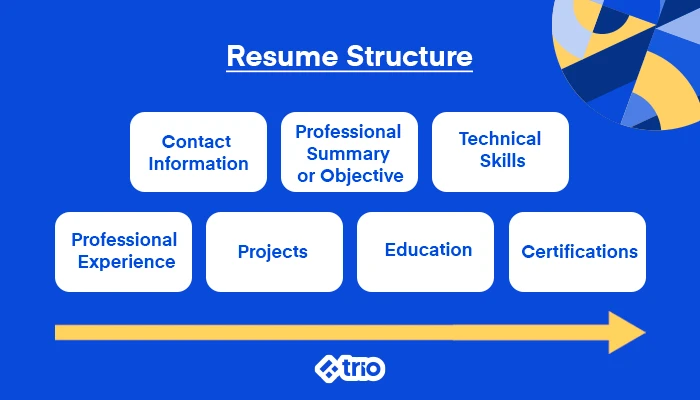
Divide the document into clearly defined sections, each with a plain heading. In order:
- Contact information: Full name, phone number, email, city and country, plus links. GitHub matters here more than on most resumes, and LinkedIn or a personal site helps too.
- Professional summary or objective: Three or four lines.
- Technical skills. Grouped by category rather than dumped in one paragraph.
- Professional experience: Reverse chronological.
- Projects: Especially valuable earlier in your career.
- Education
- Certifications: Only if you have relevant ones.
Keep information in the section it belongs to.
Technologies listed in your skills section should appear again inside experience bullets, in context, since a reviewer who sees Kubernetes listed but never applied to anything tends to discount it.
Choosing between a summary and an objective
Which one suits you depends on how much experience you have and what you want next.
With several years behind you, a summary works better. It gives a short overview of your background and your most notable achievements.
We really recommend that you resist the urge to compress your entire experience section into it. Specific is always going to beat comprehensive:
Golang developer with 6 years building payment and ledger services at scale. Designed a reconciliation pipeline processing 4M transactions daily at under 50ms p99. Strong background in concurrent systems, gRPC, and PostgreSQL.
Compare that with the version most people write:
Experienced and passionate Golang developer with a proven track record of delivering high-quality, scalable solutions and collaborating effectively with cross-functional teams.
The second one could describe anybody. The first one could only describe you.
Earlier in your career, an objective tends to serve you better, since it points at where you are going rather than where you have been:
Backend developer with a computer science foundation and two years writing Go services, including a CLI tool for automated backup verification now used across three internal teams. Looking to move into distributed systems work.
Including the company name in either one signals that you tailored the document rather than firing off the same file to forty listings. Worth the thirty seconds.
Essential elements
Hard and soft skills
Label this section clearly and keep it near the top, because recruiters and parsing systems both look for it early.
Hard skills cover technical ability. For Go specifically, group them so the section stays readable:
- Languages: Go, plus whatever else you genuinely use
- Go ecosystem: goroutines and channels, context, sync primitives, Go modules, table-driven testing, pprof profiling
- Frameworks: Gin, Echo, Chi, Fiber, gRPC and Protobuf
- Data: PostgreSQL, Redis, Kafka, MongoDB
- Infrastructure: Docker, Kubernetes, Terraform, AWS or GCP
- Observability: Prometheus, Grafana, OpenTelemetry
Concurrency is incredibly important here.
From what we have observed in our own company, Go interviews circle back to it constantly, and a Go resume that never says goroutine or channel has omitted the thing that distinguishes Go experience from general backend experience.
Soft skills matter too, but just listing them isn’t going to do much for a resume.
“Strong communicator” costs nothing to claim. Mentoring two junior engineers through their first production deployment demonstrates it. Where you can, push these into your experience bullets instead of listing them.
Detailing your experience section
Lead with your most recent role and work backwards. For each one, cover what you built and what changed as a result.
Strong action verbs help: developed, optimized, implemented, migrated, resolved. What helps more is a number.
Here is the same contribution written three ways, weakest first:
Responsible for working on the API team and improving performance.
Optimized API performance using Go concurrency patterns.
Rewrote the transaction lookup service in Go using worker pools, cutting p99 latency from 340ms to 45ms and removing the need for a planned database upgrade.
The third version takes up one line and tells a reviewer what you can do, how you did it, and what it was worth.
Realistically though, not every bullet can reach that standard, and padding weak work with invented numbers backfires in interviews. Aim to make your top two or three bullets per role carry real figures.
Useful things to quantify when you have them: request throughput, latency percentiles, error rates, build or deploy times, infrastructure cost, data volume, team size, incident counts.
Highlighting your Go projects
Projects demonstrate practical ability, and they matter most when your professional experience runs short.
Pick two or three that show your strongest work and relate to the role, rather than listing everything you have ever pushed. For each, cover the objective, your role, the outcome, and the technologies involved.
It’s always worth it to explicitly name Go, your database, and any frameworks or libraries that you used.
Worth including where it applies:
- Challenges you ran into and how you worked through them, particularly anything involving concurrency, since those bugs are hard and interviewers know it
- Integrations with external systems, which shows you can work with RESTful APIs, gRPC services, and third-party dependencies
- Development practices you followed, like table-driven tests or CI gates
- A link to the repository or a live demo
The repository does more than all of the rest combined for junior candidates. A reviewer who can read your actual code gets a far better signal than any bullet provides.
Just make sure what they find has a README and reasonably clean commits, since an abandoned repo with three commits called “fix” works against you.
Optimizing your resume
Showing certifications properly
Certifications validate skills, though they rarely substitute for demonstrated work. List them under a clear heading with the issuing organization and the date.
Go itself has no official certification, which trips people up. What carries weight for Go roles tends to sit in the surrounding infrastructure:
- Certified Kubernetes Application Developer (CKAD)
- AWS Certified Developer Associate
- Google Cloud Professional Cloud Developer
- HashiCorp Certified: Terraform Associate
- Microsoft Certified: Azure Developer Associate
For Go fundamentals specifically, the Programming with Google Go Specialization on Coursera gives you something to list, though most hiring managers will weigh a shipped project above it.
If you work in a regulated sector, security certifications read well too. Teams building financial systems often look for some evidence that a candidate has thought about secure coding beyond “we use HTTPS.”
Getting through applicant tracking systems
Most companies screen resumes automatically before anyone reads them, so a few formatting decisions determine whether your application survives.
Run through this before submitting:
- Single column layout: Multi-column designs parse unpredictably, and columns sometimes get read across rather than down.
- Standard section headings: “Professional Experience” parses. “Where I’ve Been” may not.
- No text inside images or graphics. Parsers cannot read it, and a skills section rendered as an infographic arrives empty.
- Terminology matched to the posting: If the job says Go, write Go. If it says Golang, write Golang. Using both somewhere on the page costs nothing and covers either case.
- A .docx or text-based .pdf file, not a scanned or exported image.
- Dates in a consistent format, since inconsistent ones occasionally produce odd gaps in the parsed output.
Keyword matching rewards specificity. A posting asking for gRPC, Kubernetes, and PostgreSQL should find those exact words on your resume, assuming you have actually used them.
General best practices
Formatting carries more weight than it should, mostly because it shapes the first impression before anyone reads a word. Consistent fonts, consistent spacing, consistent heading treatment.
Keep it to one page under five years of experience and two pages beyond that. Three pages gets skimmed rather than read.
Tailor each submission. Not a full rewrite, but adjusting your summary and reordering your skills to match the posting takes a few minutes and noticeably changes response rates.
When you think you have finished, leave it overnight and reread it cold. Typos in a document where you talk about your attention to detail can do real damage. You could also try having someone else read it.
A Golang developer resume example
Adapt the structure rather than the specifics. Replace the numbers with your own.
MARIANA COSTA São Paulo, Brazil · mariana.costa@email.com · +55 11 9xxxx-xxxx github.com/marianacosta · linkedin.com/in/marianacosta
SUMMARY
Golang developer with 5 years building high-throughput backend services for payments and lending platforms. Designed and shipped a ledger service handling 2.8M daily transactions with a 99.98% uptime record. Comfortable owning a service end-to-end, from schema design through on-call.
TECHNICAL SKILLS
Languages: Go, Python, SQL
Go ecosystem: goroutines, channels, context, sync, Go modules, table-driven tests, pprof
Frameworks and protocols: gRPC, Protobuf, Gin, Chi, REST
Data: PostgreSQL, Redis, Kafka
Infrastructure: Docker, Kubernetes, Terraform, AWS (ECS, RDS, SQS)
Observability: Prometheus, Grafana, OpenTelemetry
PROFESSIONAL EXPERIENCE
Senior Backend Engineer, Nubank · Mar 2023 to present
- Rebuilt the double-entry ledger service in Go, moving from a synchronous write path to an event-driven design with Kafka, which raised sustained throughput from 900 to 4,200 transactions per second.
- Introduced idempotency keys across six payment endpoints, eliminating a class of duplicate-charge incidents that had generated roughly 40 support tickets per month.
- Cut container image size by 78% by moving to multi-stage builds with distroless base images, reducing deploy times from 6 minutes to under 90 seconds.
- Mentored two junior engineers through their first production on-call rotations.
Backend Engineer, Stone · Jan 2021 to Feb 2023
- Built a reconciliation pipeline in Go processing settlement files from four acquirers, replacing a manual process that took two analysts three days each month.
- Diagnosed and fixed a goroutine leak in the webhook consumer that was causing weekly memory-pressure restarts, using pprof to trace unclosed channels in the retry path.
- Migrated 14 REST endpoints to gRPC, reducing average payload size by 60% and internal service latency by roughly a third.
- Raised test coverage on the core transaction package from 41% to 86% using table-driven tests.
PROJECTS
ratelimit-go · github.com/marianacosta/ratelimit-go Token bucket rate limiter implemented as middleware for net/http and Gin. Handles distributed state through Redis with a Lua script for atomic decrement. 340 GitHub stars, used in production by two companies that have contacted me about it.
EDUCATION
BSc Computer Science, Universidade de São Paulo, 2020
CERTIFICATIONS
Certified Kubernetes Application Developer (CKAD), CNCF, 2024 AWS Certified Developer, Associate, 2022
Note what this example does with space. The experience bullets carry almost all the weight, each one naming a problem, an approach, and a result. The skills section exists mostly for the ATS. The summary earns its place by being specific enough that it could not describe a different candidate.
Go in fintech: why it changes what to emphasize.
In the last couple of years we’ve watched Go turn up constantly in financial infrastructure, and that shapes which parts of your experience deserve the most space.
Payment processors, ledger systems, and transaction monitoring services tend to reach for Go because of the predictable latency under concurrent load, a small deployment footprint, and a concurrency model that handles thousands of simultaneous connections without the complexity of thread pools.
Several large payment companies even run core services on it, and the pattern holds across neobanks, lending platforms, and card issuers.
Applying to fintech roles changes what you should foreground:
- Correctness under concurrency: Financial systems cannot tolerate a race condition that double-credits an account. Mention mutex usage, atomic operations, or any work you did on idempotency.
- Failure handling: Retries, exponential backoff, dead letter queues, circuit breakers. Payment systems fail constantly at the edges, and how you handle that matters more than the happy path.
- Audit and traceability: Any work on immutable logs, event sourcing, or reconciliation reads well, since regulated systems need to prove what happened and when.
- Integration experience: Stripe, Plaid, Marqeta, Lithic, Unit, or any card network or banking-as-a-service provider. Naming the actual provider carries more weight than “third-party API integration.”
- Security practice. Secrets management, encryption at rest, PCI DSS exposure if you have it.
Compliance experience counts as a genuine differentiator here, and most developers undersell it.
If you have worked under PCI DSS or SOC 2, or built something that went through an external audit, say so explicitly. Teams hiring for regulated environments screen for it, and the pool of Go developers who have done it is considerably smaller than the pool of Go developers.
Common mistakes
A few patterns show up repeatedly in Go resumes that get passed over:
- Listing technologies with no evidence: A skills section naming fifteen tools, none of which appear in any experience bullet, reads as aspirational.
- Describing responsibilities instead of outcomes: “Responsible for maintaining microservices” tells a reviewer what your job description said, not what you did.
- Omitting concurrency entirely: This remains the most common Go-specific gap.
- Burying the Go work: Candidates coming from a mixed stack sometimes lead with the Java or Python half of their experience, leaving Go as an afterthought on a Go application.
- Dead links: A GitHub link going to a 404, or a portfolio site that has lapsed, actively hurts you.
- Over-formatting: Icons, progress bars rating your skills out of five, and colored sidebars tend to parse badly and persuade nobody.
Standing out as a Golang developer
Listing technical skills gets you parsed. Demonstrating them gets you interviewed.
Detailed project and experience descriptions do most of this, particularly where you name a specific problem and how you solved it.
You also need to make sure that you are contributing to open-source Go projects or writing about technical work builds credibility that a hiring manager can verify independently, which carries a weight that self-description never will.
Link your GitHub profile. Then make sure what sits there supports the case you are making.
If you are trying to find a developer for fintech projects specifically, we can assist with our pre-vetted pool.