


 Read Client Stories




 Lace Brunsden

 Key Takeaways
- Budget in three lines rather than one: build, run, and keep. Published build ranges cluster at $10,000 to $50,000 for a wrapper around a hosted model, $50,000 to $200,000 for retrieval or custom analytics, and $200,000 and up for multi-system agents.
- No independent benchmark for AI build cost exists, and the companies publishing the numbers are the same ones quoting the work.
- Expect people, not tokens, to dominate the running cost. One 2026 index that publishes its own arithmetic puts a retrieval agent's monthly token spend near $420, against $1,350 to $2,700 for the senior oversight sitting behind it.
- Check the rate assumption behind a quote before you compare totals. Published 2026 hourly rates run about $99 to $180 in the US, $45 to $85 in Eastern Europe, and $35 to $75 in Latin America.
- Ask what happens if the project gets cancelled. Gartner forecasts in 2025 that more than 40 percent of agentic AI projects would be scrapped by the end of 2027, which makes a small, bounded first scope much easier to defend than a platform.
Check the rate assumption behind a quote before you compare totals. Published 2026 hourly rates run about $99 to $180 in the US, $45 to $85 in Eastern Europe, and $35 to $75 in Latin America.
Ask what happens if the project gets cancelled. Gartner forecasts in 2025 that more than 40 percent of agentic AI projects would be scrapped by the end of 2027, which makes a small, bounded first scope much easier to defend than a platform.
AI development costs in 2026 run from roughly $10,000 for a rule-based assistant to $500,000 and beyond for an enterprise platform.
To budget successfully, you need to decide what you actually want, which version of the feature you are actually buying, and who keeps it running after launch.
Overall, the headline total is close to the least useful number in a given proposal. What matters far more is whether it covers the feature you actually intend to launch, and what happens to the bill once that feature is live.
Let's look at some of the current published pricing for AI development, where it comes from, the handful of decisions that move your number most, and a worksheet you can fill in with figures from your own vendors to make sure you aren't missing any factors.
If you would rather not work the estimate out alone, Trio's AI engineers build these features inside regulated financial systems, where the data access, the review workflow, and the audit questions usually turn out to be the hard part rather than the model choice.
What AI development costs in 2026
Three tiers show up again and again: entry, mid, and enterprise.
These tiers are a reasonable starting shape for you to consider. Just don't assume that they are the entire quote.
Tier | Published build range | What it usually buys | Typical timeline |
|---|---|---|---|
Entry | $10,000 to $50,000 | A wrapper around a hosted model: an FAQ assistant, a document summarizer, rule-based automation | 1 to 3 months |
Mid | $50,000 to $200,000 | Retrieval over your own content, custom analytics, a fine-tuned open-weight model, real integration work | 3 to 6 months |
Enterprise | $200,000 to $1,000,000 and up | Multi-system workflows, autonomous agents, large proprietary datasets, regulated-industry controls | 6 to 12 months and up |
Where those cost ranges come from
One of the most important things to consider when comparing cost ranges is who is publishing them.
Agency cost guides are marketing, and the ranges inside them are the ranges those agencies would like to quote, so they should be taken with a pinch of salt.
The second is the day rate hiding inside the total. Are you working with a build priced as engineering days times a flat day-rate? If this is the case, then you might be able to estimate six to ten days for a simple task agent, fifteen to twenty-five for a retrieval workflow, thirty to fifty for a multi-agent system.
Knowing how the pricing has come about allows you to argue it and make sure that you are truly paying for what you get.
This is especially important when rates are based on engineers, as the cost of these people could move the total more than the scope does.
For example, hourly rates in 2026 for AI engineers currently resemble the following:
United States: $99 to $180
Western Europe: $50 to $99
Eastern Europe: $45 to $85
Latin America: $35 to $75
India: $25 to $50
A twenty-five-day build therefore lands anywhere from about $7,000 to $36,000 in engineering time alone, which makes hiring from nearshore locations one of the biggest potential cost-savers.
What an AI development budget includes
We recommend that you split the budget into three lines and give each one an owner:
Build covers scoping, preparing the source material, wiring the feature into your product, and checking that its answers hold up.
Run covers model usage, hosting, and the staff time spent reviewing what it produces.
Keep covers document updates, re-evaluation after a model change, and repairing integrations when the systems around them move.
Total cost of ownership means the combined cost of building and operating the feature over a stated period.
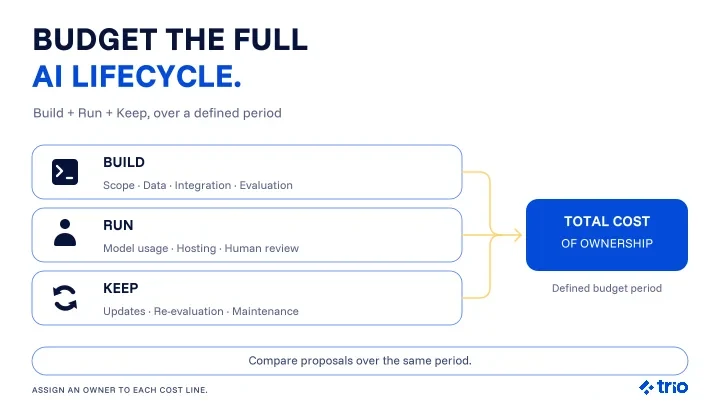
You need to choose that period explicitly when comparing proposals, since an estimate covering development through launch cannot really be compared directly with one that also includes a year of operation.
One of the easiest ways to do this is to start with the user task and intended benefit. “Help support staff find an approved answer” gives an estimator a clearer boundary than “add AI to customer support.”
We also recommend that you specify what the feature can read, what it can change, and when a person must take over.
AI development cost factors that change the scope
The AI development cost factors that you need to consider include workflow boundaries, data readiness, evaluation expectations, system connections, and operating choices.
Each of these factors changes the work being estimated.
Broader permissions, for example, require different product controls; incomplete source material creates preparation work; and more demanding answer requirements call for a more developed evaluation approach.
Workflow boundaries: Ask whether the feature drafts information for a person, answers users directly, or takes action in another system. For budgeting, describe the permitted actions and excluded actions separately. A support assistant that suggests an answer and one that changes an account balance represent different scopes.
Available data: Identify the material the feature needs and whether the team can actually access it. For a document-based assistant, estimating questions include whether documents contain conflicting guidance, whether their owners can approve them, and how access restrictions will be represented.
Quality expectations: Replace a vague promise such as “accurate answers” with examples of acceptable responses and situations requiring staff review. This recommendation does not establish a universal quality threshold, but it gives the team something specific to estimate and evaluate.
Operating choices: Treat model training, fine-tuning, retrieval, and self-hosting as options to justify against the task. Fine-tuning means adapting a model using additional examples, while retrieval means supplying relevant source material when answering. Ask what problem a proposed choice solves and which work categories it introduces before accepting it as part of the budget.
Narrowing the first release can make its boundaries easier to estimate and limit your expenses for something like an MVP, but it also limits what users receive. For example, restricting an assistant to approved product documentation leaves account-specific questions outside its scope.
Give data preparation and evaluation their own estimates
Having a document repository is great, but it does not always answer every preparation question.
For the proposed feature, you need to ask who selects the usable material, resolves contradictory instructions, records permissions, and maintains the approved source set
Put that work into the estimate.
Evaluation here means checking how the AI performs against its intended task.
For a support assistant, a proposed evaluation set could contain representative questions, relevant source passages, expected answer characteristics, and examples that should go to staff review.
Someone needs to be put in charge of preparing those examples. This deserves an owner and an estimate.
Scoring those answers costs money too. Amazon Bedrock's built-in evaluation uses a second model to grade responses and explain its scores, and that grading run is billed as ordinary inference, on top of whatever the feature already spends answering real users.
A great way to minimize costs here is to make sure that you keep preparing the evaluation material separate from running it, and ask when the team expects to run it again.
AI integration costs depend on the surrounding product.
AI integration costs should account for the project-dependent work connecting the feature to its product interface, user permissions, source systems, and staff-review workflow.
You need to ask which connections already exist, which need changes, and which team will estimate them.
A connection described as “available” still needs a clear statement of what the AI feature can access through it.
For an internal assistant, this could mean displaying answers in the support tool, restricting retrieved documents to the employee's access level, and providing a way to send uncertain answers to a colleague.
Also, make sure that dependencies are visible in the proposal. If a separate team must supply a document connection or permission service, record that assumption and identify whose estimate includes the work.
Budget recurring expenses and operating ownership
To figure out your recurring expenses, it's a good idea to ask the team to state expected users, requests, typical input and response sizes, and any additional model calls used for evaluation or review.
We have found that token spend is rarely the big number. Instead, senior oversight, meaning a person actually reading what the thing produced, can come to far more.
Alongside model usage and applicable hosting, consider who will update source material, maintain connections, investigate problems, and review escalated answers.
Distinguish external charges from internal staff time so the operating estimate shows both.
It's a good idea to assign responsibilities before treating a support allowance as complete.
“Maintenance included” leaves room for disagreement if nobody has specified whether it covers document updates, evaluation reruns, or changes to connected systems.
An AI development budget worksheet
Here is an AI development budget worksheet that can be used to estimate your own costs and help prevent gaps in your budget.
If you aren't building in-house, we recommend that you take it into the vendor conversation, ask each owner for an amount and what they are leaving out, and question any number without supporting evidence.
Work item | What it covers | Who owns the number | How to price the build | How to price the monthly run | Ask the vendor |
|---|---|---|---|---|---|
Scope discovery | Internal answer drafting; no payment execution or credit decisions | Product lead | Days spent defining the scope, times a blended day rate. | Nothing, until the scope reopens. | Which questions and actions are excluded? |
Data preparation and access | Use approved documents with existing access restrictions | Document owner and engineering lead | Days to clean and connect the sources, times a day rate, plus any licence fees. | Hours per refresh, times how often the material changes. | Who resolves outdated material and confirms permissions? |
Evaluation preparation | Prepare representative questions and acceptable outcomes | Product and support leads | Days to write a question set someone will sign off. | Hours to add new cases as the product changes. | Who approves examples and adds new cases? |
Evaluation runs | Assess the proposed answers against the agreed examples | AI engineering lead | Days to set the harness up once. | Runs per month, times the inference charge for a run. | Which method, usage charges, and repeat runs apply? |
Product integration | Connect the support interface, repository, and review workflow | Product engineering lead | Days per connection, times a day rate. | Monitoring, plus rework whenever an upstream system changes. | Which existing connections need changes? |
Model usage or hosting | Estimate usage for a named model and deployment approach | Engineering and infrastructure leads | Little, beyond a load test to find tokens per task. | Tokens per month, times the published price per million, or the monthly cost of the hosting you pick. | What request volumes and input/output sizes are assumed? |
Source updates | Keep the approved document collection current | Support content owner | Nothing to build, if the collection already exists. | Hours per update, times updates per month. | How are replacements approved and made available? |
Maintenance | Maintain the feature and its system connections | Engineering lead | Nothing at build time. | A share of an engineer’s month. Ask what share, and of whose time. | What changes and support activities are included? |
Human review | Staff review uncertain answers | Support operations lead | Nothing to build. Agree the workflow instead. | Answers reviewed per month, times minutes per review, times a loaded hourly rate. | What review workload and coverage are assumed? |
Where these numbers stop being useful
Two situations make the ranges above misleading, the first being
Once a feature touches money movement, credit decisions, or customer records, compliance review, audit trails, and model risk documentation become real engineering work.
In terms of pricing estimates, budget a minimum of 5 to 10 percent extra.
The second is that the project may not survive.
In a 2025 forecast, Gartner put the share of agentic AI projects likely to be cancelled by the end of 2027 at over 40 percent.
If your budget only models success, then it's just a forecast. You need to think about what stopping costs, and who keeps the data, prompts, and evaluation set if the build is shelved.
Decide whether the proposal is ready to fund
Once you have a budgeted amount, based on accurate cost estimates, you need to start thinking about whether the project is worth funding.
Request bounded discovery when data access, document readiness, or acceptable answers remain unresolved. Ask for a defined investigation scope and the estimating questions it will answer.
Request a revised proposal when work categories, exclusions, or operating owners are missing. Ask the estimator to distinguish included work from dependencies supplied by your team.
Consider funding a defined scope when the intended workflow, evaluation approach, initial work, and operating responsibilities are explicit. Record the assumptions that would trigger a new estimate.
Before commissioning a build, it's a good idea to bring together the intended workflow, connected systems, data constraints, evaluation needs, and unresolved estimates.
If that brief describes a concrete financial-software engineering project, discuss the scope and team needs with Trio.
Our AI and fintech engineers are used to being handed exactly that brief, and to saying plainly which parts of it still need discovery before anyone quotes a number.