

 Read Client Stories





 Alex Kugell
Argentina has become incredibly popular for nearshore software development markets for US companies.
You can hire a senior full-stack developer in Buenos Aires for roughly what you’d pay a junior developer in San Francisco, sometimes less. That gap has drawn significant attention from engineering teams looking to extend capacity without extending their runway.
Junior developers tend to earn between $21,000 to $28,000, mid-level developers between $35,000 and $55,000, and senior developers between $46,000 to $82,500.
But you need to consider Argentina’s economic environment, with persistent peso inflation and evolving labor regulations, before you consider an engagement.
USD-denominated pay has become the norm for developers working with international companies, and some partners add additional fees, which means the fully-loaded employer cost often runs 40 to 50% above the base figure once mandatory benefits enter the calculation.
Let’s look at realistic software developer salaries in Argentina for 2026, broken down by seniority, role, and city.
We will also cover what drives those figures.
If you want to hire vetted Argentine developers with fintech or product engineering backgrounds, Trio can help you find the right fit without rebuilding a recruiting process from scratch.
Key Takeaways
- Junior software developers in Argentina earn approximately $21,000 to $28,000 per year, mid-level developers between $35,000 and $55,000, and senior developers range from $46,000 to $82,500, with a median of around $51,000.
- Specialized roles typically cost more, with senior AI/ML engineers reaching $85,000 to $100,000 annually.
- The mandatory 13th-month salary (aguinaldo), social security contributions, and seniority-based annual leave entitlements all add to the cost of a full-time employee.
- Most experienced Argentine developers working with US companies expect USD-denominated compensation, which effectively shields both sides from peso volatility.
- Buenos Aires commands a 10 to 15% salary premium over other Argentine cities. Córdoba and Rosario offer comparable technical talent but have slightly lower rates.
What Makes Argentina Worth Considering in 2026
Argentina’s software development talent pool sits at over 115,000 developers, with roughly 27,000 new IT graduates entering the market annually.
That can be attributed to the very strong public university system, with institutions like the Universidad de Buenos Aires ranking among the top technical programs in Latin America, and partly to government-funded coding bootcamps designed to accelerate talent development.
A lot of the developers that you will encounter should have previous international experience as well, leading to increased technical depth.
We place a lot of them in high-complexity roles, and often see them as open source contributions.
Time zone alignment also makes the country incredibly appealing, since Argentina runs at UTC-3, placing it just 1 hour ahead of US East Coast time for most of the year.
This means that Argentine developers can do things like join your morning standup, review code the same afternoon, and respond to blockers without waiting until their next business day.
English proficiency makes the country stand out from the rest of Latin America.
According to the EF English Proficiency Index, Argentina consistently ranks among the top countries in Latin America for English ability, and among the top globally for non-native English-speaking nations, significantly reducing potential communication friction
Related Reading: Nearshore Software Development Rates
Build with Trio
Planning to hire developers in Argentina?
Tell us about your roles, seniority, and budget. We’ll discuss location requirements and potential matches for your project.
Meet engineers from the Trio network


 Back-End Developer


These profiles show our network. We’ll confirm skills, fit, and availability for your project.
Tell us what you’re building
Share your requirements. Our team will follow up to discuss a match.
Thanks for reaching out.
Your inquiry has been saved. Our team will review your project details and follow up using the email you provided.
Back to TrioSoftware Developer Salary in Argentina 2026: By Seniority
In recent times, we have seen the following salaries become standard practice for Argentine developers working with international companies. Since a lot of salaries are paid in USD, we will cover all salaries in that currency.
| Seniority level | Annual salary range (USD) | Monthly equivalent |
| Junior (0 to 2 years) | $21,000 to $28,000 | $1,750 to $2,333 |
| Mid-level (3 to 5 years) | $35,000 to $55,000 | $2,916 to $4,583 |
| Senior (5 to 10 years) | $46,000 to $82,500 | $3,833 to $6,875 |
| Tech lead / Staff (10+ years) | $75,000 to $100,000+ | $6,250 to $8,333+ |
We’ve seen entry-level positions starting around $12,000 do appear in the local market, but those developers are usually still in university or very early in their first role.
The $21,000 to $28,000 range reflects candidates with at least a completed portfolio and some professional exposure, which is the range you will be most likely to encounter when hiring a junior position internationally.
Software Developer Salaries in Argentina by Tech Stack
Tech stack creates some incredible salary variation within seniority bands. If a particular language or technology is particularly in demand, prices can be pushed up very quickly.
| Specialization | Annual salary range (USD) |
| AI/ML engineer (senior) | $85,000 to $100,000 |
| Go / Rust developer (senior) | $80,000 to $100,000 |
| Full-stack React / Node (senior) | $65,000 to $85,000 |
| Full-stack developer (all levels avg.) | ~$72,588 |
| Cloud / DevOps engineer | $35,000 to $60,000 |
| Blockchain developer | $41,000 to $48,000 |
| Python developer | $41,000 to $48,000 |
| Android / iOS developer | $36,000 to $50,000 |
| JavaScript (general) | $30,000 to $50,000 |
| PHP developer | $25,000 to $40,000 |
Developer Salaries by City: Buenos Aires vs Córdoba vs Rosario
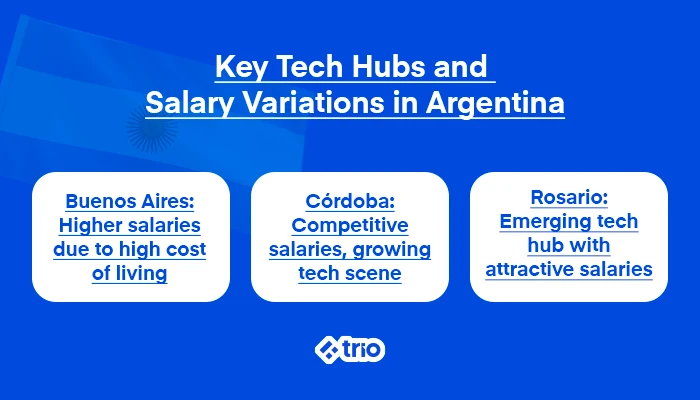
Geography within Argentina itself plays a big role in salaries. As is the case in most other countries, bigger cities have higher costs of living, and also more big companies that are competing for tech talent, leading to higher costs.
Buenos Aires concentrates roughly 56% of Argentina’s tech activity, and thus developers cost more there than anywhere else in the country.
If you are hiring from Buenos Aires, budget 10 to 15% more than equivalents in other Argentine cities.
Córdoba is another massive city, and accounts for roughly 30 to 40% of Argentina’s tech activity, but what makes it stand out is the strong engineering community, partly driven by its university ecosystem.
It’s a little cheaper than Buenos Aires, without a decrease in developer quality.
Rosario is a smaller but growing tech hub that might be worthwhile considering junior to mid-level hiring on standard stacks.
Remote work has partially flattened these differences, though, as a lot of Argentine developers working for US companies remotely tend to price themselves closer to the Buenos Aires range regardless of where they actually live.
Fully-Loaded Employer Costs: What Hiring in Argentina Actually Costs
If you are trying to hire a full-time developer, akin to a permanent employee, there are a couple of additional costs that you are going to need to consider. We have noticed that a lot of companies do not take these into account at all, and are often taken off guard.
- The aguinaldo, Argentina’s mandatory 13th-month salary, represents the single largest additional cost. Paid in two installments in June and December, each installment equals 50% of the highest monthly wage earned during the preceding 6-month period.
- Social security contributions add further overhead. Employer social security contributions in Argentina typically run 20 to 25% of gross salary for full-time employees, covering pension, health, and unemployment insurance.
- Annual leave entitlements increase with seniority. Employees under 5 years of service receive 14 calendar days of leave. That increases to 21 days for 5 to 10 years, 28 days for 10 to 20 years, and 35 days for over 20 years.
All of this means that, if you are hiring a full-time developer on a $50,000 base salary, you will need to budget approximately $70,000 to $75,000 in fully-loaded annual cost.
Hiring a contractor can help you reduce these costs, but you need to be careful.
Argentina’s evolving regulatory environment under recent economic reforms has moved toward simplifying contractor engagement for international companies, but the specifics have changed.
Working through a platform or employer of record, like Trio, that stays current on the legal landscape, reduces the compliance risk considerably.
Currency Volatility: A Practical Consideration
Argentina’s peso has depreciated significantly over the past several years.
This means that paying in USD, or USD-equivalent stablecoins, has become very normal for Argentine developers working with US companies. It protects the developer from peso depreciation and gives the employer stable, predictable costs.
Offering US currency contracts from the start can be a great way to increase your attractiveness to a developer, and may even allow you to negotiate a slightly lower rate.
Comparing Argentine Developer Salaries to the US Market
| Seniority | Argentina (USD/year) | US equivalent (USD/year) | Approximate savings |
| Junior | $21,000 to $28,000 | $70,000 to $100,000 | 65 to 75% |
| Mid-level | $35,000 to $55,000 | $110,000 to $145,000 | 60 to 70% |
| Senior | $46,000 to $82,500 | $150,000 to $220,000 | 50 to 65% |
| Senior AI/ML | $85,000 to $100,000 | $180,000 to $280,000 | 50 to 65% |
The savings compress at the highest seniority levels and for the most specialized stacks.
For a very senior position, with a very skilled tech stack, you might be looking at roughly 50% savings versus the US equivalent.
For more general, junior roles, you are probably looking at savings closer to 70%.
Final Thoughts
Working with a partner who vets for domain experience, not just technical skill, can help you increase the chances of success when hiring internationally.
Argentina’s engineering talent pool runs deep for general software development. Finding developers with specific fintech, payments, or compliance backgrounds requires more targeted sourcing than a general developer search.
At Trio, we focus exclusively on fintech, which means the developers we present arrive with relevant domain context rather than requiring extensive orientation before they can contribute safely in a regulated environment.
We take care of all the complexities of hiring internationally on your behalf, too.
Get in touch for a budget consult.
Frequently Asked Questions
What is the average software developer salary in Argentina in 2026?
The average software developer salary in Argentina depends heavily on seniority and whether compensation is denominated in USD for international work. Remote developers working with US companies earn approximately $58,000 per year on average, with junior developers starting around $21,000 to $28,000 and senior developers ranging from $46,000 to $82,500 annually.
Are Argentine developer salaries paid in USD or ARS?
USD-denominated compensation has become standard practice for Argentine developers working with international companies, since it protects both parties from peso volatility.
What is the fully-loaded cost of hiring a developer in Argentina?
For a developer on a $50,000 base salary, plan for approximately $70,000 to $75,000 in fully-loaded annual cost when hiring as a formal employee to account for the Aguinaldo (13th-month salary), employer social security contributions of 20 to 25%, and seniority-based annual leave.
How do Buenos Aires developer salaries compare to those in other Argentine cities?
Buenos Aires generally costs 10 to 15% more than developers of the same skill level in other Argentine cities. This cost reflects the higher living costs and greater competition among international companies.
What tech stacks have the highest salaries for Argentine developers?
Senior AI/ML engineers earn $85,000 to $100,000 annually, making that the highest-compensated specialization in Argentina’s developer market. Go and Rust developers also reach $80,000 to $100,000.
How much can US companies save by hiring Argentine developers?
US companies typically save 50 to 70% by hiring Argentine developers compared to equivalent US-based hiring, depending on seniority level and specialization. But this depends on a variety of factors, like the hiring model.