

 Read Client Stories




 Alex Kugell
 Key Takeaways
- Mobile apps run on smartphones, tablets, and wearable devices rather than in browsers. They get distributed through the Apple App Store and Google Play Store, which require approval before an app reaches users.
- Three main app types exist: native (built for one platform, best performance), cross-platform/hybrid (one codebase targeting multiple platforms), and progressive web apps (browser-based, no installation required).
- Native iOS apps are written in Swift or Objective-C, while native Android apps are written in Java or Kotlin. React Native and Flutter are the most widely used cross-platform frameworks and produce near-native performance for the majority of fintech use cases.
- For fintech specifically, mobile apps provide direct access to the device security infrastructure like Face ID, fingerprint authentication, the device keychain for secure credential storage, and NFC for contactless payments.
A mobile app is a software program specifically designed to run on smartphones, tablets, and wearable devices.
Unlike desktop software, mobile apps get built for touchscreens, compact screens, and intermittent connectivity. In most cases, they also have access to device hardware like GPS, cameras, biometric sensors, and push notifications in ways that web applications simply cannot.
In fintech, hardware access matters considerably.
A mobile banking app that uses Face ID for authentication, NFC for tap-to-pay, and push notifications for real-time fraud alerts delivers an experience that a mobile website cannot replicate.
If you are creating a fintech product targeting consumers, mobile may be your primary channel.
There are several technologies that can be used to create mobile apps, and several development roles are required. Making an architectural mistake early on or hiring the wrong person can be incredibly detrimental to the quality of the user experience and may create security issues.
This guide covers what mobile apps are, how the three main types compare, why mobile apps matter specifically in fintech, the technologies you may want to consider, and what it costs to hire the developers who build them.
At Trio, we place pre-vetted mobile app developers with fintech production experience in 3–5 days at $40–$80/hr.
What Is a Mobile App?
A mobile app is a software application developed specifically for mobile devices, like smartphones and tablets, instead of desktop or laptop computers.
Mobile apps run on the device’s operating system (iOS or Android) and typically get downloaded and installed from a platform-specific marketplace, like the Apple App Store or Google Play.
Once installed, they can run locally on the device, which gives users offline functionality and hardware integration that browser-based alternatives can’t replicate.
The original purpose of mobile applications centred on productivity, through calendars, email, and contacts. Those have long since become built-in operating system features.
Now, the mobile app market tends to focus more on gaming, social networking, financial services, food delivery, health tracking, and practically every other consumer and business function that benefits from being available in a pocket.
How a mobile app works:
When a user opens a mobile app, it communicates with the device’s operating system to access hardware and services. This includes things like their camera, GPS, NFC, biometric authentication, and internet connectivity.
It also typically communicates with a remote server through APIs, sending and receiving data to render content, process transactions, and synchronise state.
The combination of local processing and server communication is what makes fintech mobile apps feel fast and responsive even when handling complex financial data.
The Three Types of Mobile Apps
Mobile apps can be separated based on how they are coded.
Native Apps
Native apps get built exclusively for one platform. Today, this means either iOS or Android. They use the languages and tools specific to that platform.
iOS apps, for example, use Swift or Objective-C, with Xcode as the development environment. Android apps, on the other hand, use Java or Kotlin with Android Studio.
Because native apps get built to the platform’s exact specifications, with the best possible language for each platform, they deliver the best possible performance and the deepest access to device hardware.
This is the way to go if you have very complex animations that need to feel fluid. Biometric authentication is also easier to integrate correctly, and NFC tap-to-pay works as the platform intended.
In other words, the user interface matches what users expect from other apps on that device.
The trade-off is cost and duplication.
Building a native iOS app and a native Android app means maintaining two separate codebases, two sets of developers with different skill sets, and two separate App Store submission processes.
For fintech products where security review, compliance requirements, and hardware integration all matter, native development often justifies that cost. But if cross-platform consistency and faster time-to-market matter more, consider some alternatives.
Cross-Platform and Hybrid Apps
Cross-platform apps use a single codebase that compiles or runs on both iOS and Android. React Native and Flutter are the two dominant frameworks.
React Native uses JavaScript and React to build interfaces that map to native platform UI components.
This means that the final product looks and performs like a native app to the end user.
Flutter uses Dart. The primary difference here is that it renders its own UI layer, which produces highly consistent interfaces across platforms but doesn’t use native UI components directly.
Both have become widely used in fintech mobile development, with several major neobanks and payment apps having shipped on React Native.
Hybrid apps, which are often confused with cross-platform apps, take a different approach. They wrap a web application built with HTML, CSS, and JavaScript inside a native container using frameworks like Ionic.
The problem with hybrid apps in the past has been that their performance has lagged far behind that of native apps, though modern hybrid frameworks have closed that gap for most use cases.
When it comes to making a decision for your fintech, the primary advantage you need to consider for cross-platform development is that you can have one team and one codebase.
This results in faster development and consistent feature parity across iOS and Android.
At the same time, the limitation to keep in mind is that certain hardware integrations and platform-specific security features occasionally require native modules even within a cross-platform architecture.
A React Native app that needs NFC can implement it, but you’ll need a native module, not pure JavaScript.
Progressive Web Apps (PWAs)
PWAs are web applications built with HTML, CSS, and JavaScript that behave like native apps in the browser.
These apps can work offline, send push notifications, and access certain device hardware like cameras and GPS.
They don’t require installation from an app store. Instead, users access them via a URL, though they can be added to the home screen.
For fintech, PWAs are a useful complement in specific scenarios like onboarding flows accessible before a user downloads the full app, simple account views for infrequent users, or financial products in markets where app store distribution creates barriers to adoption.
However, you can’t think of PWAs as a replacement for native or cross-platform apps for primary financial product experiences, since browser-based access to the device keychain, NFC, and biometric authentication is very limited.
Why Mobile Apps Matter More in Fintech Than in Most Industries
- Hardware access for security: Face ID and fingerprint authentication, device keychain storage for credentials, NFC for contactless payments, and hardware security module integration for cryptographic operations all require native or near-native app access.
- Emerging market reach: In South Africa, Brazil, Nigeria, and Southeast Asia, mobile devices are the primary or only computing platform for a significant share of the population.
- Real-time financial notifications: Push notifications for transaction alerts, fraud warnings, and payment confirmations reach users immediately on mobile in ways that email and SMS cannot replicate in terms of delivery reliability and user attention.
- User trust and brand perception: A well-built mobile app signals investment and permanence to users who are considering trusting a product with their financial data. A poorly performing or visually inconsistent app erodes that trust quickly.
- Regulatory distribution requirements: Some regulated financial products require app store distribution specifically because the App Store and Google Play provide an independent vetting layer.
Fintech Mobile Apps: Real-World Examples
- Payment and digital wallet apps: Revolut, Cash App, and PayPal process payments, currency exchanges, and peer-to-peer transfers. The mobile app is the primary product for most of their user base.
- Neobank apps: Monzo, Chime, and Starling Bank deliver core banking services like account management, card controls, spending insights, and customer support entirely through mobile.
- Investment and wealth management: Robinhood, Stash, and various robo-advisor platforms built their products mobile-first, recognising that their target demographic manages finances on a phone rather than a financial planning desktop.
- Lending platforms: Several consumer lending and BNPL products use mobile apps to handle the full loan lifecycle, from application and initial KYC verification to disbursement notification and repayment management.
- Insurance: Digital-first insurance products use mobile for policy purchase, claims filing, and document submission, replacing processes that previously required phone calls and physical paperwork.
How Mobile App Development Works
Building a mobile app follows a sequence of stages. These are pretty consistent, whether the product is a simple utility or a compliance-regulated financial platform.
1. Define goals and requirements
Before any code gets written, the product needs a defined purpose, a target user, a prioritised feature set, and a compliance assessment.
In fintech, particularly, the compliance assessment shapes the architecture.
Some of the most common architectural decisions that are specific to fintech include a KYC-enabled onboarding flow, a PCI DSS-scoped payment integration, or biometric authentication.
2. Choose the development approach
Once you have your goals and requirements refined, you can decide whether you’ll benefit from native, cross-platform, or PWA development.
This decision should follow from your performance requirements, hardware integration needs, available engineering talent, and timeline.
3. Design
UI/UX design needs to take into account iOS and Android conventions, along with accessibility requirements, and the specific trust signals that matter in a financial interface.
A fintech app that looks visually inconsistent or behaves unpredictably loses user trust before the first transaction.
4. Development
This is where your developers actually build the app, integrate with APIs, implement authentication, and connect to back-end financial infrastructure.
In fintech, this stage includes compliance-critical decisions, like how KYC verification data flows, how payment credentials get stored, and how audit logs get created.
4. Testing
Before your application reaches users, you need to conduct functional testing, performance testing on real devices (not just simulators), accessibility testing, and security testing.
Depending on your application, you may need to include idempotency testing for payment flows, KYC state machine validation, and penetration testing before banking partner review.
5. Deployment
App Store and Google Play submission involves review processes that can take days to weeks.
Fintech apps with payment functionality occasionally face additional scrutiny, so planning for submission timelines in a product roadmap is important.
Once these reviews are completed, your applications can finally be deployed on the relevant app stores and reach users.
6. Ongoing maintenance
Mobile operating systems release major updates annually and minor updates regularly.
Apps need maintenance to stay compatible, and user feedback produces a continuous stream of small improvements that compound into meaningful product quality over time.
It is important that you have the necessary developers on hand to be able to keep your app updated and continue to improve it.
Mobile App Developer Skills to Look For
A mobile developer for a fintech product needs some unique skills that aren’t required for more general applications:
- Swift (iOS) or Kotlin (Android): For native development, strong proficiency in the platform’s primary language is the baseline. If this is the way you decide to go, your developers will need to know both.
- React Native or Flutter for cross-platform: Knowledge of the specific framework the product uses, including native module integration for hardware features that JavaScript can’t access directly.
- API integration: Fintech mobile apps connect to payment providers (Stripe, Adyen), KYC services (Sumsub, Onfido), banking APIs, and internal back-end services. Experience integrating third-party financial APIs and handling their edge cases (rate limits, partial failures, webhook processing) is a meaningful differentiator.
- Security at the mobile layer: Certificate pinning, secure credential storage using the device keychain, biometric authentication implementation, and understanding of what data should never be stored locally.
- TypeScript for React Native: Most production React Native fintech codebases use TypeScript. Type safety for financial data structures catches a category of error that plain JavaScript misses.
- Performance optimization: Memory management, efficient list rendering, startup time optimization, and battery usage awareness all affect whether a financial app feels trustworthy or frustrating on mid-range devices.
How Much Do Mobile App Developers Cost?
Mobile app developers earn between $103,000 and $157,000 annually in the US, with an average of around $127,000.
Senior developers with the fintech domain experience required for payment system integration, biometric authentication, and NFC tend to average more toward the top of that range.
LATAM nearshore developers provide a viable way to reduce costs.
Senior mobile app developers in Latin America average around $100,000 annually, without forcing you to sacrifice quality.
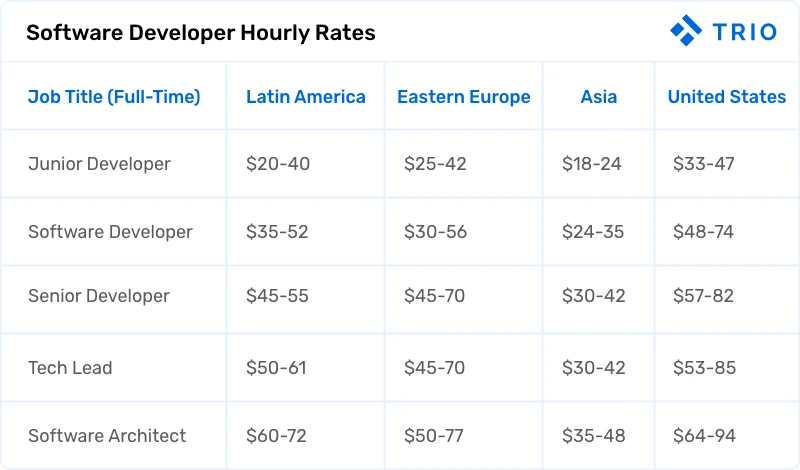
Through Trio’s LATAM nearshore model, you can gain access to expert fintech developers at $40–$80/hr.
Hourly rates for contract or staff augmentation work:
Why Hire a Mobile App Developer Through Trio?
Trio pre-vets mobile app developers specifically for fintech production experience.
This means that any mobile developers have integrated payment providers, implemented biometric authentication in a production environment, built KYC flows that hold up to regulatory review, and written tests that cover the financial edge cases.
This vetting means that you can avoid spending several months finding the right candidate, or the 4–8-week domain ramp that general mobile developers typically need before producing compliance-safe production code.
We can provide portfolios in as little as 48 hours and final placement in 3–5 days.