
Artificial intelligence is no longer something tucked into tech conference talks or sci-fi trailers. You probably use some form of AI each day, even if it’s just your phone pulling up your calendar or responding to a quick voice command.
With so many teams trying to build products around machine learning and large language models, one question comes up again and again: What are the best languages for AI development in 2026?
You might already have a sense of what you want to build, or you may still be sorting through ideas. In either case, choosing the right language can shape everything from hiring to long-term maintenance.
There is no single perfect answer, and anyone who insists there is probably has not spent much time shipping production systems.
Still, some languages do a lot of heavy lifting in AI projects, while others shine in specific situations.
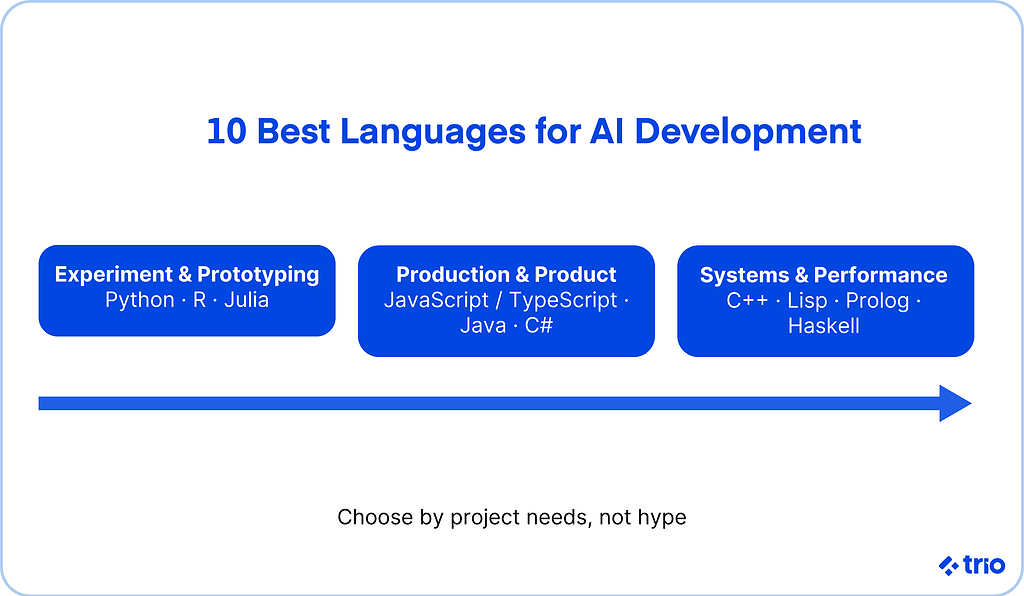
This guide walks you through what matters in 2026, how to think about your options, and the strengths and trade-offs of the most relevant languages today.
If you need AI developers to help you launch your project, we may be able to connect you with the right professionals through staff augmentation and outsourcing.
What Is Artificial Intelligence?
If you think that artificial intelligence makes for some scary alternate realities, you’re not alone.
Anyone who’s seen Terminator knows good and well that when you start giving machines human traits, things go south quickly!
In reality, the chance of killer robots threatening your livelihood anytime soon is quite small.
At its core, artificial intelligence (AI) refers to intelligent machines.
Really, if you’ve ever worked with a digital device that didn’t know how to tell up from down or do a simple task, you’d probably quite like artificial intelligence.
No doubt, you’re already using artificial intelligence as is. You know that robot voice you talk to on your phone? That’s AI technology at your fingertips.
In a business capacity, artificial intelligence has a number of benefits. Most marketing automation tools, for one, rely on AI.

What AI Programming Languages Really Mean in 2026
Artificial intelligence felt simpler a few years ago. Machine learning meant scikit-learn or TensorFlow. Natural language processing meant sentiment analysis and keyword extraction.
Now the field includes a mix of generative models, retrieval systems, transformer-based architectures, symbolic reasoning, traditional ML, statistical modeling, and the entire world of MLOps.
When people ask about the best programming languages for AI, they sometimes mean languages suited for training models.
Others are thinking about production systems. Some want languages that integrate smoothly with web applications. A few are dealing with edge devices.
10 Best Programming Languages for AI Development
AI development is not for the faint of heart.
Building artificial intelligence into your software requires a certain skill set, and on that note, an adjacent tech stack, for development to run smoothly.
Below are ten programming languages well-suited for AI development.
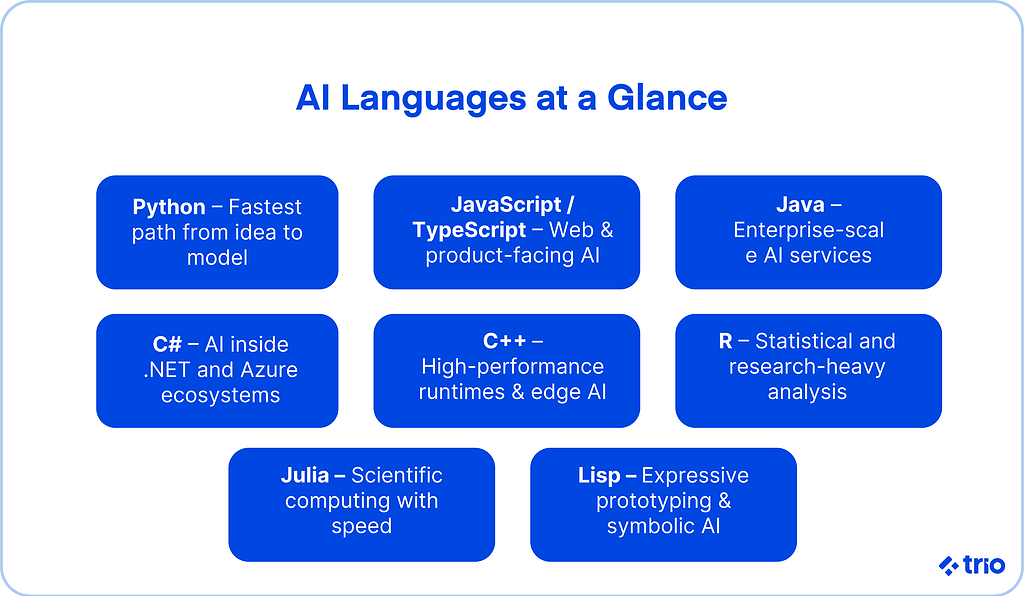
1. Python
Python is a high-level general-purpose programming language.
Developers cherish Python for its simple syntax and object-oriented approach to code maintainability.
But although Python seems friendly, it’s well-equipped to handle large and complex projects.
Data engineering remains a frequent use case for utilizing Python, as does machine learning.
Machine learning is a subset of AI that involves using algorithms to train machines.
TensorFlow is Python’s most popular framework for AI development. It’s an open-source machine learning library where you can train deep neural networks.
Other pre-existing libraries and frameworks include:
- Pandas
- SciPy
- nltk
- PyTorch
- Keras
- Theano
- scikit-learn
Besides machine learning, you can use these technologies for natural language processing (NLP) and evaluating advanced mathematical expressions.
NLP is what smart assistant applications like Google and Alexa use to understand what you’re saying and respond appropriately.
Another great thing about Python is that it is one of the easiest languages to learn, in spite of what it’s capable of!
2. JavaScript and TypeScript
Many AI projects touch the web at some point, and JavaScript or TypeScript often becomes part of the conversation.
This is one of the biggest updates to the original article. Even if you are training a model in Python, the product that uses it may run in a browser, a Node.js environment, or a TypeScript application.
AI on the web may have once felt limited, but that is no longer the case. Libraries such as TensorFlow.js, transformers.js, and several WebGPU-backed runtimes let teams run models directly in user-facing environments.
Sometimes this creates privacy benefits because no server round-trip is needed. Other times, it makes prototyping smoother because you can test ideas without managing infrastructure.
JavaScript and TypeScript also help bind the front end to an AI service. For teams building chat interfaces, interactive dashboards, or LLM-powered workflows, these languages feel natural. They play well with Python back ends, and the hiring pool is very wide.
3. Java
Java is a treasured server-side language. Its key feature is that you can use Java almost anywhere, on any platform, through its virtual machine.
Though Android developers now work with Kotlin as well, Java is still a common choice for enterprise-scale systems, and many companies rely on it for stability.
You originally described how Java supports machine learning libraries for deep learning and natural language processing, and this still holds up.
Developers may look at options like the Deep Java Library, OpenNLP, Kubeflow integrations, or the Java Machine Learning Library.
These tools can be helpful when a team needs AI inside large backend systems, especially when they want to avoid mixing too many languages.
Java’s object-oriented design and predictable performance appear to make it attractive for long-running services. In an industry where many AI projects now run as part of larger microservice architectures, Java may be the smoother fit.
4. C Sharp (C#)
C # was not in the original article, but it belongs here in 2026. Many enterprise teams use the Microsoft stack for their internal systems, and C # tends to be their default programming language.
ML.NET has matured into a fairly friendly framework for building machine learning features directly inside .NET applications.
This is helpful for organizations that want to keep their systems cohesive rather than sprinkling Python scripts around production code.
C # also works well with Azure services, which matters for teams deploying AI workloads on cloud infrastructure.
Another advantage is that hiring C # developers is usually straightforward in many regions, which lowers the long-term risk of maintaining AI features.
5. C plus plus (C++)
C++ has been around for quite some time and is admittedly low-level. This means it works well with hardware and machines, but not so well for the more theoretical side of software.
Yet in practice, C++ is essential for performance-sensitive workloads. Many inference engines and deep learning frameworks use C++ underneath, and developers often rely on it when they need predictable latency.
You previously noted that many machine learning libraries were built with C++, and that has not changed. C++ is often used to create the inner loops of neural networks or to support deployment on edge devices.
This includes robotics, custom hardware, and systems that cannot afford slow responses. The language may appear difficult at first glance, but its influence on AI infrastructure is larger than many people expect.
6. R
R is a popular language for budding and professional statisticians alike. To be fair, R is not the best language for artificial intelligence, but it is helpful for number-heavy tasks.
In AI development, data is often the most important ingredient, and accurate analysis can save a team from a long debugging cycle or a bad model architecture.
You highlighted packages like Gmodels, Tm for text mining, and OneR for classification tasks. These are still useful in some contexts. R tends to shine when teams want to explore and validate datasets, especially when the work leans toward research or forecasting.
Many data scientists keep R nearby for exploratory analysis even if they train models in Python.
7. Julia
Julia is one of the newer languages for AI development, but that should not deter you from considering it. Its community is still smaller than Python’s, although it has gained quite a bit of attention.
You originally pointed out Julia’s dynamic interface, strong visualizations, and interest in mathematical use cases. All of these observations still hold true, and Julia’s tooling has improved steadily.
For AI-specific work, you now see packages like Flux.jl for deep learning, Turing.jl for probabilistic programming, and Metalhead for computer vision tasks.
Julia also supports parallel and distributed computing in a fairly clean way, and its design feels approachable to scientists who want high performance without dropping into C++.
8. Lisp
Lisp is one of the oldest languages in circulation. It originated in 1958 to support list processing, which was one of its early strengths.
By 1962, with the aid of its creator, John McCarthy, Lisp had become capable of addressing problems related to artificial intelligence.
In more recent years, developers tend to mention Lisp less often because of its difficult syntax and unusual libraries.
Still, it offers rapid prototyping, dynamic object creation, and the interesting ability to treat code as data. Lisp has always been flexible and expressive, and some researchers still enjoy how directly it translates ideas into working code.
9. Prolog
Prolog, a portmanteau of logic programming, has been around since 1972. Although it does not appear often in modern commercial systems, it still suits certain projects that require symbolic reasoning or deterministic rule structures.
In Prolog, instead of writing long sequences of code, you define facts, rules, goals, and queries. This creates a language that is surprisingly apt at pattern matching.
The first chatbot in history, known as ELIZA, used Prolog’s system of logic to rearrange and reinterpret user inputs. You described this nicely in the original article, and the example still helps readers understand what Prolog brings to the table.
Cloud technology allows chatbots to be more intelligent than anything built with Prolog alone, but the language remains a reminder of where rule-driven AI began.
10. Haskell
Haskell is a statically typed and purely functional programming language. Its abstraction capabilities reduce the amount of debugging time developers may spend on a project.
You also pointed out its efficient memory management, type system, and reusable code structures. All of that is still true.
One of Haskell’s more interesting traits is that it is a lazy language, meaning it only evaluates code when necessary. This can be a strength or a frustration depending on your expectations.
Haskell tends to make developers think carefully about how data flows through a system, which some people find refreshing.
While it is not a mainstream choice for AI in 2026, it plays a role in academic settings and advanced functional programming work.
How to Choose the Right Language for Your AI Project
There is no universal winner here. The best language is usually the one that fits your actual constraints, and that may be more practical than philosophical.
Below are some factors that tend to matter when teams make decisions.

Your Project Type
Different problems surface different needs.
If you are building an LLM-powered application, you will likely reach for Python plus JavaScript or TypeScript on the front end. If your team works on computer vision or robotics, you may lean toward C++ for performance-sensitive components.
Forecasting models, economic analysis, and research-grade statistical work still rely heavily on R or Julia.
Your Existing Tech Stack
Teams often underestimate how much a current stack influences what makes sense going forward.
A company with Java services may find it easier to integrate AI features in Java, even if they prototype in Python.
A large .NET organization may prefer C# with ML.NET, especially when they are building features into existing systems rather than launching something from scratch.
Performance Constraints
Some AI workloads need near real-time execution, especially in robotics or edge computing.
A Python-only solution might struggle in those contexts, which is why you see mixed setups with Python for orchestration and C++ for the performance-critical inner loops.
Hiring and Talent Availability
Python, JavaScript, Java, and C# usually make hiring easier.
Languages like Prolog, Lisp, or even Julia may create friction when you try to scale a team.
This is something you notice quickly in real projects, and it is one of the reasons enterprise teams are careful about experimental languages.
Library and Framework Support
In 2026, Python still dominates because of PyTorch, TensorFlow, JAX, Hugging Face Transformers, LangChain, FastAPI, and a wide spread of production tools. JavaScript and TypeScript now have solid front-end integrations and growing backend inference libraries.
C++ is the quiet backbone of many frameworks. Julia and R continue to serve specialized scientific and analytical workloads.
AI Coding Assistant Support
This may seem like a small detail, but some languages are easier to work with in AI-assisted development than others.
Python, JavaScript, TypeScript, Java, and C# usually get strong results. Less common languages may not benefit as much from AI code generation or explanation tools.
It is not a deciding factor for every team, but it can shorten development time.

Use AI in Your Next Project
Artificial intelligence is no joking matter. You use machines every day to make things easier, from driving to putting appointments in your digital calendar.
Well, what happens when your machines know exactly what you want and have the intelligence to meet your needs without prompting?
On a personal level, such a prospect is glorious. On a business level, there’s even more to be excited about.
Deploying one of the languages above in your tech stack is only a minor part of building competent AI software.
The first step is finding a team that can make sure your project is successful. Our work here at Trio is to deliver the best developers in the market.
Contact Trio now to learn more about what we can do!
FAQs
What programming language is used for AI?
The programming language used for AI in most cases is Python because it supports the widest range of modern libraries and tools.
Which programming language is best for AI?
The programming language considered best for AI is typically Python, although JavaScript, Java, and C # work well in production systems.
What language does AI use?
The language that AI systems use most often is Python, with C++ playing a key role inside high-performance model runtimes.
Why is Python used so much in AI?
The reason Python is used so much in AI is that its libraries, simple syntax, and strong community help teams move from ideas to models quickly.
Why do some researchers use Julia for AI?
The reason some researchers use Julia for AI is that it provides strong performance while still feeling comfortable for scientific computing.