


 Read Client Stories





 Lace Brunsden

 Key Takeaways
- Define customer repayment, seller contribution, and platform-fee treatment separately before implementing marketplace refunds.
- Allocate a partial cancellation to the affected seller's items rather than automatically spreading it across every seller.
- Keep target entitlements, required seller recovery, and confirmed recovery distinct, especially after a seller transfer.
- Apply Stripe charge and transfer limits separately, and keep Adyen multi-pay-in responsibilities scoped to that workflow.
- Test duplicate requests, allocation errors, conflicting policies, and unknown outcomes against explicit financial expectations.
Marketplace refund allocation forces decisions most teams never make explicitly: what the customer gets back, what each seller owes, and what happens to the platform fee. A completed customer refund does not, by itself, close the seller-recovery obligation, and teams that treat it as resolved often can't produce evidence months later that the seller ever paid their share back.
That gap determines which seller bears a cancellation, how support explains the outcome to a confused customer, and who ends up owning an unresolved balance with no name attached to it.
The fix starts with an explicit allocation policy, mapped to the operations your provider configuration actually supports, before a line of integration code gets written.
Skilled fintech developers with experience building marketplace apps can set this up correctly the first time, which is why Trio keeps pre-vetted experts who understand regulatory requirements on hand.
Step 1: What a marketplace refund actually has to resolve
A marketplace refund looks like a single action from the customer's side: they get their money back.
From the implementation side, however, it is four separate questions, each needing its own answer.
The customer refund is the amount returned to the buyer.
Seller recovery is what the seller owes back when the marketplace has already transferred their share.
A transfer reversal is the specific provider operation that claws back a transfer.
The platform fee is whatever the marketplace kept, and it has to be addressed on its own: returned, retained, or split, as a deliberate policy rather than a default.
Let's look at voluntary refunds on orders split across multiple sellers in a single checkout. Just keep in mind that a platform that only connects buyers to financial-service providers works differently.
A refund triggered by a customer dispute rather than a voluntary return is a different animal too: Chargeback management applies there instead, with its own evidence requirements and deadlines. Here, the customer has already agreed to the refund. The open question is how to allocate it.
Keeping those four concepts separate is itself a domain-driven design decision that needs to be made early.
Step 2: Decide the allocation before you calculate it
Splitting a refund across a marketplace order starts with a decision about which seller's items were affected, and how much of the platform's fee comes back with them.
We recommend that you work out the customer-facing refund first, from the canceled items and whatever policy applies, then work out each seller's share and the platform's share separately.
In the worked example below, those shares add up exactly to the customer refund, but we have found that in most production cases you will need to account for other parties or adjustments too.
The order-to-seller relationship should always drive the split, not the order total.
A cancellation of seller A's item points to A's allocation and, where one exists, A's transfer.
Spreading the refund across every seller in proportion to the original order produces the wrong commercial outcome the moment only one seller's goods were canceled, since seller B ends up charged for a cancellation that was never theirs.
Two inputs decide which policy applies. Treating them as explicit fields is one of the best ways to keep the logic consistent order to order.
Fault: a cancellation the seller caused, a wrong item, or a late shipment argues for a different allocation than a no-fault return the customer initiated, since the party responsible for the loss is a reasonable candidate to absorb the fee.
Order age relative to a defined finality window: a refund inside that window can reverse the platform fee automatically under a standing policy, while one filed after it closes needs a specific, logged decision rather than a default, since by then the platform has already delivered the matching service.
Technically, a refund that is both no-fault and inside the finality window can follow the automatic path. Everything else should route to a manual decision.
Record which policy version produced the calculation before you execute it. Getting this right prevents finance from having to redo it later.
A policy change months from now, over whether the platform fee comes back to the customer or stays with the platform, has to be traceable to a specific decision for audit purposes.
A marketplace that reverses its fee on every refund, no exceptions, is going to watch its effective take rate erode with refund volume alone, not with any change in sales.
Fault and timing as explicit inputs are what keep that a deliberate trade-off.
Step 3: Walk through a two-seller refund
Picture an order split between two sellers where there is roughly USD 60 of goods from seller A, USD 40 from seller B.
The marketplace withholds a 10% platform fee from each seller's sale, which puts initial entitlements at USD 54 for A, USD 36 for B, and USD 10 for the platform.
If the customer cancels half of A's goods, they will need a USD 30 refund, but there are two ways you can approach this, and it needs to be clear in your policies.
When you return the associated platform fee, then A contributes USD 27 while the platform covers USD 3. If you retain the fee instead, A absorbs the full USD 30.
Before a seller transfer goes out, this is only a question of which target allocation to record:
Return the fee: target allocations land at A USD 27, B USD 36, platform USD 7. No prior transfer exists yet, so there is nothing to recover, only a revised allocation to record.
Retain the fee: target allocations land at A USD 24, B USD 36, platform USD 10. Same situation, except A absorbs the fee instead of the platform.
Check both outcomes against the USD 70 remaining once the customer refund is accounted for. Returning the fee leaves USD 27 + USD 36 + USD 7 = USD 70. Retaining it leaves USD 24 + USD 36 + USD 10 = USD 70. Both balance, but they assign the cost differently between seller A and the platform.
After a transfer has already gone out, the same two policies produce a recovery requirement instead of a clean allocation:
Return the fee: A’s original USD 54 transfer already went out, so returning the fee creates a USD 27 recovery requirement against A, confirmed on the customer side and still open on the seller side.
Retain the fee: the same USD 54 transfer stands, but retaining the fee pushes the recovery requirement to the full USD 30, since A gets no fee relief this time.
That arithmetic establishes the intended allocation. I
Step 4: Check what Stripe and Adyen actually let you do
Turning these policies into a specific provider's API call is a second, separate problem, and we have often found that providers solve it differently.
Stripe
Stripe's Create a refund documentation states a refund can refund only up to the remaining, unrefunded amount of the charge. That is a charge-level ceiling, and it says nothing about which seller should contribute.
Their Create a transfer reversal documentation sets a separate limit where a reversal can only reverse up to the unreversed amount remaining of the transfer, and partial transfer reversals apply only to transfers made to Stripe-hosted accounts.
If you are going to use Stripe, it's important that you keep both checks in the design since neither excerpt guarantees automatic reversal of every transfer tied to a canceled item, or of a transfer that has already been paid out externally.
Stripe also exposes two parameters directly on the refund-creation call.
Setting reverse_transfer to true reverses the linked transfer in the same request, proportional to the refunded amount, instead of a separate reversal call.
refund_application_fee does the same for the platform fee: refunded in full on a full refund, proportionally on a partial one.
Both only work when the application that created the original charge is the one issuing the refund.
Adyen
Adyen's third-party payment refund documentation covers multi-pay-in. These are payments a third party processes and settles into a user's Adyen balance account.
In that flow, the funds return through Adyen to the multi-pay-in account, while actually repaying the customer is the pay-in partner's job, not Adyen's.
The documentation is very clear that, for partial refunds, you should always provide split instructions in your request.
They also explicitly state that sending the refund amount to your user's customer is your pay-in partner's responsibility.
Adyen's split-payments documentation adds a constraint outside multi-pay-in: a refund can only draw from balance accounts that received the original payment, and a full refund issued without split instructions falls back to the original payment's split ratio.
What is very important to keep in mind here is that platform commission on a refunded amount comes out of the platform's own balance account by default, landing in roughly the same place as Stripe's refund_application_fee even though the two providers model it differently.
Step 5: Recover seller funds after the transfer already went out
Before a seller transfer, revise the intended allocation and block the transfer from going out at the old amount.
After the transfer, the problem changes shape entirely. Now you are dealing with the fact that the money has already left, and updating a number in the database does not get it back.
Stripe's own marketplace guidance, outside the refund API itself, names three ways to recover funds that already reached a seller: debit the seller's connected account directly, draw from a platform reserve set aside for exactly this situation, or absorb the loss as a cost of doing business.
None of these is free.
Debiting a connected account can fail if the seller's balance is too low, so you need ot make sure that a reserve is funded before you need it, usually by holding back a percentage of every payout for 30 to 90 days, which carries its own trust cost with sellers.
Absorbing the loss is simplest operationally and worst financially if it happens often.
Whichever path you choose for your marketplace (and we've found that most configure more than one depending on seller risk tier), the thing that has to survive the decision is the audit trail.
You need to record which recovery mechanism was applied, to which seller, for which refund, and whether it actually succeeded.
Also record the required recovery amount, the specific transfer it is tied to, and the evidence of outcome as three separate fields, not one.
Keep the customer-repayment status separate from all of it, since a completed customer refund and an unresolved seller recovery can be true at the same time, and reporting them as one combined status hides exactly the gap you need visible.
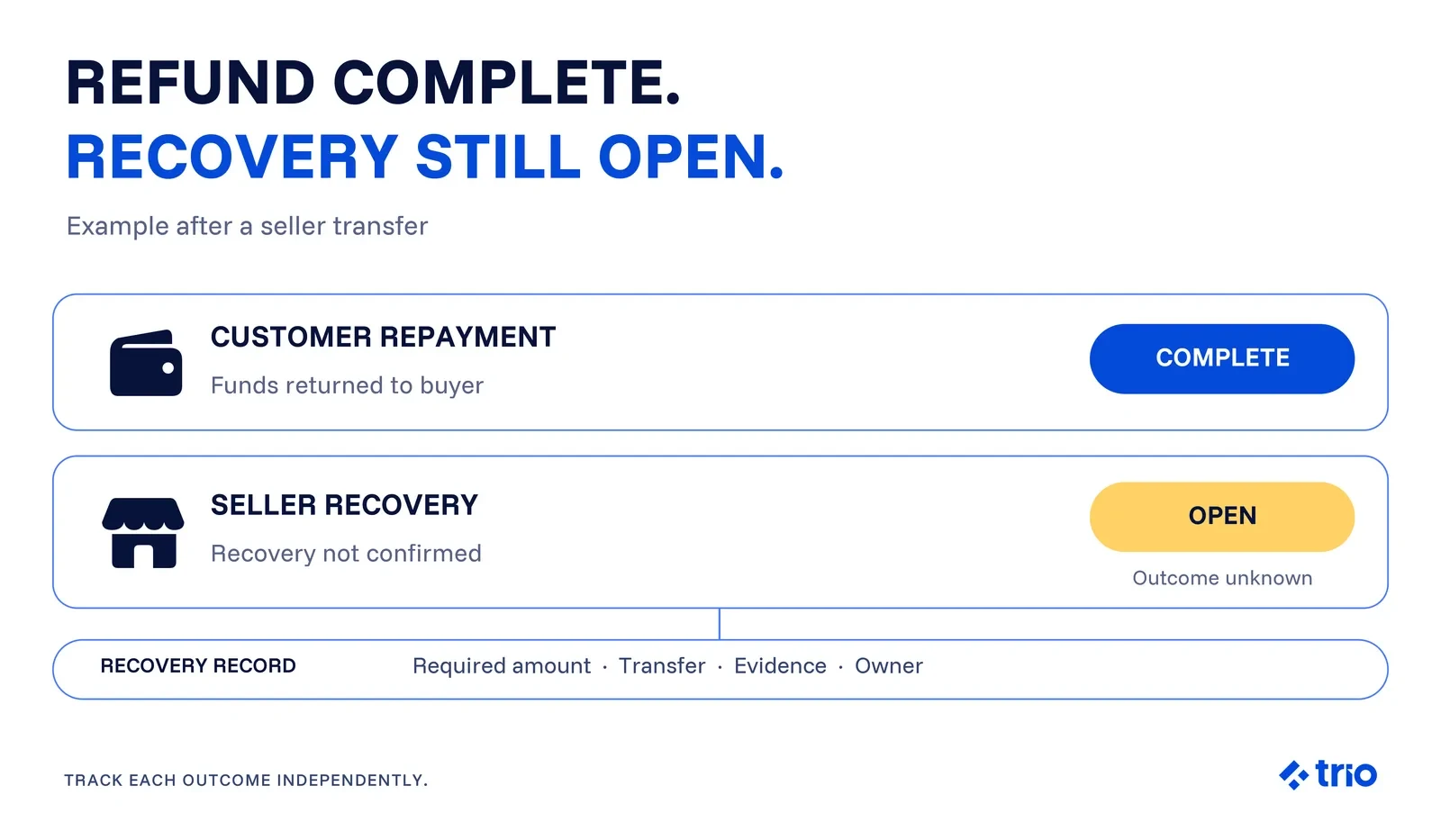
When neither recovery confirmation nor failure is available yet, we have found that it's best to record the state as unknown rather than guessing.
A provider's API success response confirms the request was accepted, not that funds actually moved; payment ledger architecture that treats those as the same thing will eventually show a balance that does not match reality.
For downstream matching of confirmed movements against bank and provider records, payment reconciliation system development is the adjacent discipline.
It's usually worth keeping the two concerns separate, with the refund policy deciding what should happen and the reconciliation confirming what did.
Step 6: Test the policy against the cases that break it
A hypothetical order can help you make a reasonable acceptance fixture before you write additional cases.
There are a couple of engineering requirement tests you can explore. Each one should assert the customer repayment, each seller's contribution, the platform's contribution, and unresolved ownership independently, rather than checking only that an API call returned success.
Repeated cancellation: submit the same USD 30 cancellation twice. One logical refund and one seller obligation should result; the second submission should surface the existing outcome rather than create a new one. This is the same idempotency guarantee a scalable payment system needs for charge creation.
Concurrent excess: submit requests that together exceed the remaining refundable amount. The combined excess should be blocked, with accepted, rejected, and unknown amounts all explicitly recorded.
Wrong seller: map A's canceled item to B's transfer. Validation should block the recovery request before submission and leave B's USD 36 entitlement untouched.
Unresolved recovery: confirm customer repayment while seller recovery stays unconfirmed. The customer refund should stay marked complete, with recovery separately open and assigned to an owner, not silently rolled into the same status.
Conflicting fee policies: calculate the cancellation under both policies at once. Execution should pause until a policy version determines whether it is the USD 27-plus-USD 3 allocation or the USD 30-plus-USD 0 allocation.
Ambiguous outcome: simulate a timeout after submission. The result should record an unknown outcome and require a check against authoritative provider evidence before anything else money-moving gets submitted.
These failure modes sit downstream of fraud and risk screening.
Step 7: Package the policy for engineering, then for operations
A refund brief is useful when it lets an engineer account for every dollar before writing a line of integration code.
You need to make sure that you include the provider and charge configuration, the order-item-to-seller mapping, the policy version, platform-fee treatment, and transfer stage.
Also be very clear about which recovery constraints are already established and which still need configuration-specific research.
Attach the worked allocation, the expected final entitlements, and the acceptance fixtures above, and name the evidence that closes customer repayment and seller recovery, along with who is responsible when either stays unknown.
Once that brief is complete, you can scope your engineering work from it.
Finally, there are four things you need to decide as the system moves to production:
Who monitors the unresolved seller-recovery balance day-to-day, named by person or role, not just by team.
What counts as proof of seller recovery for this configuration, and where it is stored so support and finance can both find it.
How often an unresolved balance gets reviewed before it escalates, since this guide intentionally leaves retry timing and collections out of scope.
Who approves a policy-version change, since deciding whether the platform fee comes back or stays changes who bears the cost after the fact.
At Trio, we have engineers who can carry you through all of these steps, using their production experience to make sure nothing is missed, so you not only end up with fully functional marketplace refund systems, but systems that are compliant and secure.
Request a consult to find out more.