


 Read Client Stories




 Lace Brunsden
 Key Takeaways
- Budget $25,000 to $60,000 for a single-platform MVP with a working backend. Cheaper quotes usually describe a prototype.
- Scope the journey to its end. Most first releases stall because the payment gets sent and the confirmation never arrives.
- Ask whether the first test needs an app at all, since a browser-based flow answers most first questions and skips store submission entirely.
- Name the manual work and who performs it. “Staff reconciles settlement from the bank feed each morning” belongs in the brief.
- Some parts of a regulated build cannot be deferred. Identity checks, a record of every transaction, and an honest status are structural rather than features.
- Write down why each deferred feature waits. MoSCoW can help give you the vocabulary to describe your reasoning.
- Expect three to five months for a mobile MVP.
MVP mobile app development starts with a specific product assumption. Your first release should focus on allowing people to complete the journey needed to test that assumption.
Before commissioning an app, decide what you need to learn, which features make that learning possible, and whether the experience actually requires a mobile build.
For a founder preparing to request development proposals, those decisions give the project a useful boundary.
There is no universal list of features a first release has to contain. What replaces that list is the question you are testing. A payments product might need an amount, an authorized payment, and proof the money arrived. Recurring schedules can wait while the open question is whether anyone sends the first one.
The practical deliverable that can help prevent unnecessary features that only add to timeline and cost is a scope brief: one page connecting the business question to the user journey, included features, exclusions, and provisional build route.
Start there so developers can challenge a defined proposal and explain what completing it would involve.
Let's look at everything you need to know about building an MVP in mobile app development, including the cost and timeline of a first mobile release, how to choose what that release should prove, which features stay and which wait, whether the test needs an app at all, and how to write the one-page brief you take to developers.
Scoping a first release gets easier with engineers who have shipped one before.
Trio places senior Latin American developers with US companies, most of them on products where money moves, who have the experience to advise and execute efficiently.
What an MVP means in app development
An MVP in app development means a minimum viable product, or a usable first version designed to test a specific product assumption with intended users.
“Minimum” describes the scope. “Viable” means the selected journey works well enough for someone to reach its intended outcome.
Some people use it interchangeably with prototype, but this is not correct since a prototype serves a different purpose. It might demonstrate screens or help you explore whether people understand a proposed interaction. A usable MVP lets participants carry out the selected task, although some supporting work may remain manual if that arrangement fits the question being tested.
A proof of concept exists even earlier in the process, and answers whether something can be built at all, usually a technical question about an integration or an algorithm, and it rarely involves users. Run one when the risk sits in the technology. Run an MVP when the risk sits with the customer.
For example, a clickable payment prototype can show whether someone understands the amount and the recipient on screen.
A usable payment MVP also has to move the money and tell the payer whether it arrived. Stopping at the confirm button leaves the payer’s outcome unfinished.
For an MVP, it is critical that you keep the scope narrow without treating reliability, understandable errors, or appropriate data handling as optional extras. Each of those depends on software quality assurance work that someone still has to do.
Ask developers what supporting work the chosen journey requires, and where it sits in the wider process of creating a mobile app.
Types of MVP worth knowing
Several MVP patterns have names, and knowing them helps when a developer proposes one.
A concierge MVP delivers the service by hand while the customer experiences it as a product. Nobody automates the reconciliation; someone checks the bank feed and replies.
A Wizard of Oz MVP looks automated from the front and runs on human effort behind the screen.
A piecemeal MVP stitches existing tools together, a form plus a spreadsheet plus a payment link, rather than building anything new.
A single-feature MVP ships one function properly and leaves the rest out.
The payments example below mixes the first and the last: one journey, with staff confirming settlement by hand.
Choose what the first release should prove.
For MVP development for startups, a useful starting point is the uncertain customer behavior behind the mobile product.
Name who should use it, what they should accomplish, and which decision their behavior will help you make. That gives feature discussions a purpose beyond building a smaller version of the eventual app.
“People want easier payments” leaves too much open. A more useful assumption would be: “Owners of small businesses who already approve supplier invoices by email will pay an approved invoice from their phone and trust the status the product shows them.” That statement identifies a user, a setting, and an observable action.
Next, name the decision that follows.
If owners complete a payment, you might investigate whether they come back for the second one without a reminder. If payments stall at authorization, you might look at the funding method, the wording around fees, or a failure in the provider integration.
Neither result alone settles the business’s long-term prospects.
A useful scope sentence: “We will help [specific users] complete [one outcome] so we can learn [uncertain behavior] and decide [next investment or investigation].” Use this as a practical planning tool to focus discussions, but recognize that it cannot, by itself, prove sustained market demand.
A payments MVP: what stays and what waits
Let's look at a startup exploring one-off supplier payments for small businesses, where an owner pays an approved invoice from a phone instead of signing in to online banking.
The test covers one country, one currency, and one funding method.
Money moves over an existing rail through a licensed provider, since nobody can simulate that, and the test does not require card acceptance, multi-user approvals, or automated reconciliation.
The learning objective concerns whether owners will pay an approved invoice through the flow and trust the status it reports back.
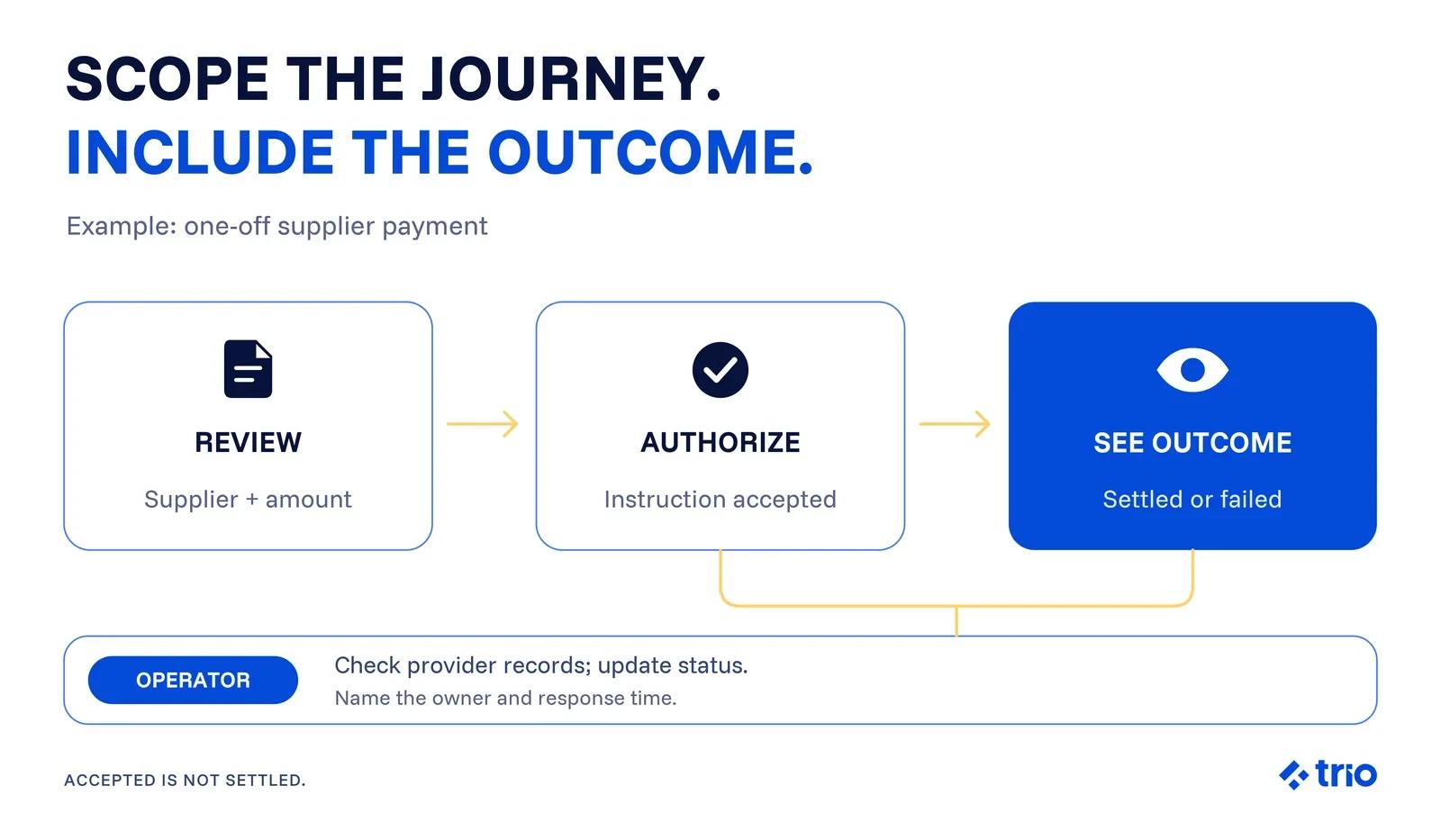
Under these assumptions, the first journey needs three connected steps:
Review the approved invoice: The owner sees the supplier, the amount, and the date payment is due. This stays because an owner who cannot check what they are paying will not authorize it from a phone.
Authorize the payment: The owner confirms the amount against one funding method and gets an immediate acknowledgement that the instruction was accepted. This stays because reading an invoice on a phone proves nothing about willingness to pay on one.
See the money land: The payment reaches a settled or failed status the owner can read without contacting anyone. This stays because an accepted instruction is not an arrival, and the gap between the two is where a payments product earns trust or loses it.
The operator side belongs in the scope too.
Somebody has to watch the provider feed, match an arriving settlement to the instruction that caused it, and push out a status the owner can read. A daily check against a bank dashboard may fit this test, as long as the brief says who performs it and how quickly they are expected to do it.
What stands out in this specific example is that there is one part of a payments build that cannot be done by hand. A regulated product needs identity checks on the paying business, a durable record of every instruction, and an honest answer when an owner asks where their money is.
We often find that it is more realistic for a smaller company to use a licensed provider that carries most of that weight. To make sure that you avoid compliance issues, this RegTech integration belongs in the first release rather than in a later phase.
Give every deferred feature a reason.
A deferred-feature list helps developers understand their current boundaries, especially when a feature sounds like an obvious addition.
MoSCoW gives the common shorthand here: must have, should have, could have, and won’t have this time. The labels move a conversation along without explaining themselves.
Just keep in mind that a feature marked “won’t have” still needs a sentence saying why.
This is what it might look like for our payment MVP example:
Recurring payments wait: setting up a standing instruction tests a different behavior from sending one payment. Come back to it if owners ask for it unprompted.
Card and wallet funding waits: a second funding method brings its own fees and failure modes, which would make a stalled payment harder to read.
Two-person approval waits: the test covers an owner acting alone. Adding an approver changes who the user is and what the journey has to prove.
In-app chat waits: the status message is the thing under test. If owners have to ask whether the money arrived, that is a finding rather than a missing feature.
These exclusions are always going to depend on your assumptions.
For example: if an owner cannot tell from the invoice alone whether a payment is safe to make, a review step may belong in the first journey after all. Change the scope when evidence challenges the assumption, and record why.
Does the first test need a mobile app?
We recommend that, in cases like our example, you separate the payment question from the mobile experience question.
If you need to learn whether owners will pay an approved invoice at all, a browser-based flow could fit the payments example. If you need to learn whether paying from a phone works in the conditions people actually work in, that experience has to be represented in the test.
It's important that you ask where the task happens, which devices participants use, and what the journey depends on. Camera access, location, connectivity, and background behavior may affect the choice.
Just keep in mind that their presence does not automatically settle which development route fits, so you may need to ask developers to verify the required behavior on the intended devices.
Suppose the concept changes into a product for staff who authorize payments while out on a job, where the approval has to happen within minutes of the request, and a notification is the only thing that prompts it. A browser demonstration would leave that central requirement unanswered. The scope would need to describe how a request reaches the phone and what should happen when it goes unread.
Release mechanics belong in this decision too.
A browser-based test goes live when you decide it does. An app needs developer accounts on each store, a listing, and a review pass before anyone can install it.
Apple says App Review typically clears at least 50% of submissions in under 24 hours and 90% in under 48, so the queue rarely causes the delay. The cost sits in the setup and in rejections, since each one sends you round again.
For the payments example, a browser-first test remains a reasonable provisional choice, because no essential device-specific behavior has been identified.
Biometric authorization is worth asking about here since people moving money from a phone tend to expect it. A browser test would show whether owners pay at all, but still leave unanswered questions around installation, notifications, and the everyday experience of an installed app.
Choose a build route around the learning objective
Compare routes after defining the journey.
A browser-based product runs through a web browser. A progressive web app, or PWA, uses web technologies; MDN explains that a PWA can run across platforms and devices from a single codebase. That definition does not establish support for every behavior your test may require.
Cross-platform frameworks support development for multiple operating systems. React Native’s documentation describes building Android and iOS applications using React and native platform capabilities.
Flutter confirms Android and iOS support and access to platform APIs and hardware through plugins.
These capabilities do not remove the need to investigate each integration, since certain device requirements may need extra checking or specialized work. If this route fits, the next question becomes who builds it, and what to look for when you hire React Native developers.
Native development means building specifically for an operating system, such as iOS or Android.
Since you'll need a separate app for each ecosystem, which costs more time and money, we only recommend this when a platform-specific experience forms an important part of the test.
Route | Learning fit | Essential capabilities | Intended devices | Unresolved verification |
|---|---|---|---|---|
Browser-based version or PWA | Consider when the initial question concerns a workflow users can complete through a browser. | List every required behavior; do not assume offline or background behavior comes automatically. | Name the phones, browsers, and any desktop use in scope. | Verify the complete journey and required capabilities in those environments. |
Cross-platform app | Consider when the test calls for an app on iOS and Android. | Confirm framework support and investigate any necessary plugins or custom platform work. | Name the operating systems and devices included in the release. | Verify integrations and the journey on each intended platform. |
Native app | Consider when the test centers on a specific operating system or platform experience. | Describe the platform behavior that matters to the assumption. | State whether one operating system answers the initial question. | Confirm the proposed approach demonstrates that behavior under real usage conditions. |
A useful proposal explains why its route fits your test and what remains uncertain.
If the discussion expands into development tools and long-term software ownership, that becomes a separate decision between low-code, no-code, and pro-code approaches.
What MVP mobile app development costs
Mobile app MPs are incredibly difficult to estimate since scope decides the number.
Most published ranges for a first mobile release land between $25,000 and $120,000.
Netguru puts a single-platform MVP with core features at $25,000 to $60,000, and reports a $76,000 median across more than 200 apps it has built. Helpware’s breakdown gives $25,000 to $120,000 for mobile specifically, with simpler builds at $10,000 to $40,000. ScienceSoft estimates higher, $40,000 to $300,000 and up, which it frames as 10 to 50 percent of a product’s eventual total cost.
Low-code and no-code routes sit well below that, roughly $3,000 to $20,000. Just keep in mind that they buy a narrower result: enough to watch people attempt a journey, rarely enough to carry real users afterward.
What actually moves the number
Hours drive the number: A quote multiplies team size by duration, so two engineers over three months at a $65 blended rate comes to roughly $67,000 before design and QA.
Where the team sits: Trio’s Latin American engineers run $45 to $90 per hour depending on location, seniority, and the exact experience required, against $160 to $220 for senior engineers in the US and Canada on Netguru’s figures.
Whether the operator side counts: the payments example needs someone to reconcile settlement every working day. Building an internal view costs money, and doing it by hand costs someone a morning.
Integrations: payments, identity, and anything regulated cost more than the screens around them. A provider integration also brings a test environment, certification steps, and onboarding paperwork that never appear on a feature list.
How long a first release takes
Published timelines cluster between two and five months for a mobile MVP.
Helpware gives three to five months for mobile and one to three for a basic build. Netguru describes a fourteen-week runway for a lean team of two developers and shared QA. ScienceSoft opens at two weeks and extends to eight months, with the short end reserved for low-code work.
Agencies quoting three to four weeks exist, but these usually describe a very narrow scope with maybe one user role, one integration, an existing backend, and standard interface components.
Sometimes, that can be the right trade, but it quickly becomes a problem when the narrow scope quietly drops the step that completes the journey.
We recommend that you treat any published number as a starting point for a conversation rather than an estimate for your project.
What a focused MVP can and cannot tell you
A focused scope gives you a way to limit the initial investment to a defined question. It also makes observations easier to interpret, which means that you can more easily investigate where a particular journey succeeds or breaks down.
What a focused scope is not is the promise of lower costs or a successful business.
It is essential that you keep the operating context beside the results.
Owners recruited personally may behave differently from strangers who arrive cold. A support call can rescue a payment while hiding a confusing screen. Reconciliation done by hand each morning tells you little about how an automated version would hold up at volume.
A completed payment also leaves other questions open, including repeat use, what an owner will accept in fees, and whether the service can operate sustainably.
You'll have to choose a next investigation based on what remains uncertain.
Don't just declare the entire product validated because a narrow test went well.
Prepare a one-page scope brief.
The brief should make your reasoning visible without prescribing every technical detail. Here is a template you can use to create your own:
User and problem: Who will participate, in what setting, and what specific problem should the release help them solve?
Assumption and next decision: What behavior remains uncertain, and what investment or investigation will the observations inform?
Complete journey: What starts the task, what steps must connect, and what tells the user the outcome?
Included and deferred features: Why does each included feature belong in this test, and why can each deferred feature wait?
Mobile necessity and provisional route: Which usage conditions or capabilities matter, which devices are in scope, and why does the proposed route fit?
Dependencies and open questions: What staff work, data handling, external services, or unresolved capabilities could prevent completion?
Observations and interpretation: What will you observe, how will you distinguish attempts from outcomes, and what would lead you to continue, revise, or stop?
Read the brief as if you were the developer receiving it. An undefined outcome, unexplained feature, or unassigned manual task marks a question to resolve.
Take the brief into a development discussion.
At this point, it is a good idea to ask developers to challenge the proposed route, identify missing work needed to complete the journey, and explain which exclusions could undermine the test.
Once the scope makes sense, your team can evaluate how the work would be owned and maintained.
In many cases, that turns into a partner question: what to look for in a mobile app development company, and which engagement shape fits.
Some teams extend an existing roster through staff augmentation, while others prefer a dedicated team built around the project.
Trio’s developers work mostly on payments, banking, and other money-movement products, and most have carried a first release through to production more than once.
That experience shows up early, in the questions they ask about your scope.