

Hire by Technology
SERVICES


Choosing a mobile app development company differs from choosing any other build partner because the app store sits between you and your users.
This means that your distribution identity, your signing keys, and your ability to ship a hotfix can all end up belonging to someone else. That could make even small issues take hours, which is a major problem in fields like finance where users rely on apps.
Skilled developers are essential to make sure that you not only prepare with app store requirements in mind from the start, but also that you are prepared for industry nuances if you are working in an industry like fintech that is heavily regulated.
At Trio, our mobile app developers have production experience dealing with issues in real-time, which often becomes a real asset to the teams they work with. This is especially the case in fintech mobile apps where downtime and issues negatively affect reputation.
Four things make mobile genuinely different, worth previewing before going deeper on each:
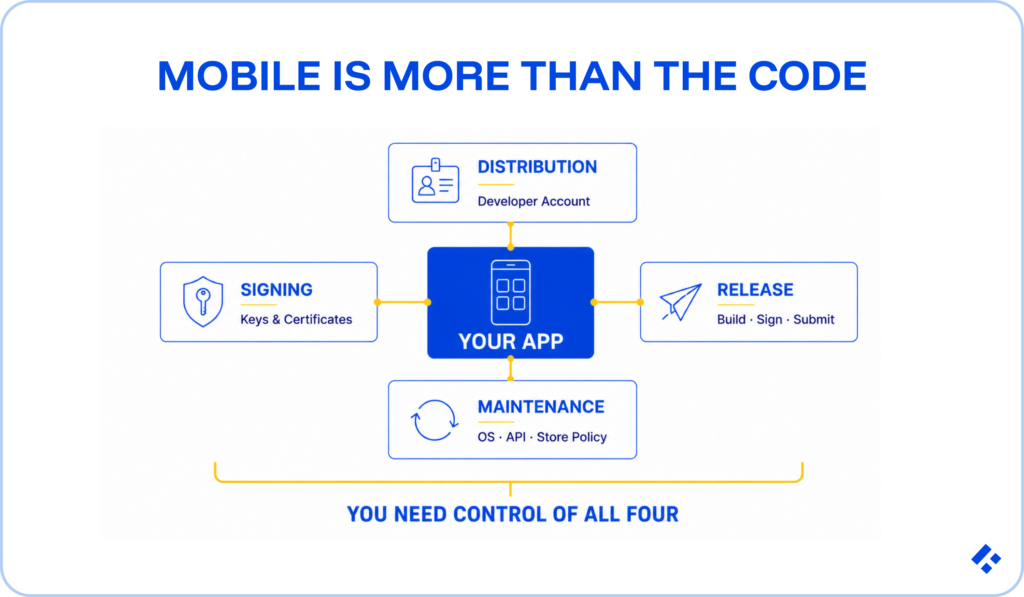
In a web engagement, if the relationship ends badly, you take the code and deploy it somewhere else. Mobile has a gatekeeper.
Your app reaches users through Apple's and Google's stores, and access to those stores runs through a developer account.
This developer account includes a set of cryptographic signing keys, and, increasingly, a verified developer identity.
While this increased security is a massive asset in the fintech industry, none of this transfers automatically with a repository, which creates massive complications when using external skill sets.
One of the biggest questions to clarify early when partnering with a mobile app development company is whose Apple Developer and Google Play accounts the app will actually publish under. Yours or theirs?
Agencies often propose publishing under their own account. This is because it's genuinely faster.
In most cases, they already have verified accounts, established entities, and payment details in place. You can take advantage of an existing reputation, which is very important when users need to hand over sensitive information.
For a small app, this can look like sensible convenience rather than a trap.
The problem is what it costs later.
The store listing, ratings, reviews, and app store optimization history all attach to the app under an account someone else controls. Even analytics, crash reporting, and store console access all run through their credentials.
In the event that you ever consider ending the relationship, it quickly becomes a negotiation instead of a decision you're free to make on your own timeline.
On top of all that, Google's Android Developer Verification Program is rolling out in stages through the year. The underlying verifier system service began appearing on devices in mid-2026.
Verification opened to all developers in March, and device-level enforcement begins September 30, 2026, in Brazil, Indonesia, Singapore, and Thailand, with global expansion planned for 2027.
That device-level rule sits within a broader Google Play package registration requirement that applies to developers globally, and being non-compliant results in removal from Google Play itself.
If your build partner is the verified developer for your app, that's become a structural dependency on their corporate identity, inside a system specifically designed to make publisher identity permanent and traceable.
Recovery is possible, but it's a real process.
Apple does support transferring an app between accounts. The app keeps its bundle ID, its reviews and ratings, and its version history, and users keep receiving updates throughout.
But there are some very stringent transfer criteria. The account holder on each side has to initiate and accept the transfer, and apps with auto-renewable subscriptions specifically require app-specific shared secret handling on both sides, like if your fintech product has subscription tiers.
What to ask: "Will the app be published under our developer accounts, from the very first submission?" The right answer is yes, with the partner added to your account under appropriate roles.
Code signing applies a cryptographic signature that proves an app's origin and integrity.
On iOS, this means distribution certificates and App IDs. On Android, it means an upload key and a separate app signing key.
The pattern worth watching for specifically on iOS.
The modern approach is adding the developer to your App Store Connect account with the Developer role, so they can handle signing through Xcode without ever holding your credentials. Sharing certificates and private keys outright is no longer considered good practice.
On Android, Play App Signing is now required for new apps. Google manages and protects the actual app signing key, while you hold an upload key to prove your identity to Google.
That's greatly advantageous to fintechs, for example, because it creates a shared-responsibility model that meaningfully reduces the classic disaster of a lost or hoarded signing key, though it also increases security concerns since that account is still the thing standing between you and the ability to ship at all.
What to ask: "How will signing be handled, and who holds the keys once the engagement ends?" A partner who's done this properly answers in one sentence and talks about account roles.
In a situation where a payment bug, for example, reaches production on a Friday afternoon.
Your web team would have a fix deployed in twenty minutes. On mobile, you need someone who can build, sign, and submit a new binary, then wait for store review.
You need to prepare for these moments by thinking about whether or not anyone on your side knows how to produce a release build without the partner's involvement.
Is the CI/CD pipeline sitting in your infrastructure or theirs? Automation can greatly reduce the manual bottlenecks and human error that come with signing, but only if the pipeline is somewhere you can actually reach it.
Do you actually have a documented runbook for an emergency release, or does that knowledge live entirely in one person's head? Do you have a server-side kill switch or feature flags, so a fix doesn't always require a full store submission to take effect?
An app that can only be fixed by shipping an entirely new binary has a worse incident posture than one where risky behavior can simply be turned off from the server.
In fintech specifically, that difference is the gap between a bad hour and a whole week. A payments bug sitting live in production for days while a store review clears could ruin your relationship with your customers, and potentially with a regulator.
As we have already mentioned, mobile carries a permanent maintenance obligation that exists independent of whatever feature work is on your roadmap.
The reality is that a mobile app isn't a project with a natural end date, and a partner engagement shaped like one will leave you stranded.
You need to think about what happens after launch, and who's actually responsible for keeping the app shippable.
If a separate maintenance contract needs to be negotiated later, price that in.
Native versus cross-platform is a decision with some real trade-offs behind it.
We recommend that you use native for deep platform integration, better performance on lower-end devices, and platform-specific security features.
Cross-platform usually works better for shipping one codebase to both stores with a smaller team, when the interface itself isn't performance-critical.
It may be worthwhile to ask a prospective partner which approach they'd recommend for your specific product, then separately ask what they mostly build day to day.
A mobile banking or payments app carries platform-specific security obligations that a web frontend simply doesn't. Here are some questions you need to think about:
Five mobile-specific items worth raising with counsel, distinct from standard software terms:
Standard terms, IP assignment, confidentiality, and subcontracting still apply here too. Ultimately, you may want to speak to a qualified legal advisor to ensure nothing has been missed.
Everything above is a consequence of the app being built by a company rather than by people who work directly for you.
In some cases, simply adding the developers to your own team is the better option.
Staff augmentation removes most of the issues you may run into when working with an external partner, without the commitment of a long-term hire.
Engineers work inside your accounts, your repository, your pipeline, under your direction. There's no handover to manage later, because nothing was ever held anywhere else in the first place.
The only caveat is that you need the management in place on your side to direct the work. If you have no internal mobile capability and nobody to manage one, a managed partner remains a legitimate choice.
At Trio, we offer both hiring options, as well as the ability to enter a hybrid agreement where some features would benefit from being developed in-house, while others can be outsourced entirely.
To find out if we are the right fit for you, book a consultation.