


 Read Client Stories





 Lace Brunsden
 Key Takeaways
- Staff augmentation adds capacity under your leadership. A dedicated-team label leaves management open, while managed delivery needs an explicit scope and responsibility agreement.
- Business associate status depends on the actual relationship and PHI handling, including qualifying downstream subcontractors. Engagement labels do not settle it.
- Invented prototype records and transformed patient records require different questions. Removing names alone does not establish HIPAA de-identification.
- A qualifying cloud provider can remain a business associate without the decryption key. Encryption does not eliminate those obligations.
- A useful engagement brief connects scope, internal owners, proposed access, and dependencies to concrete acceptance evidence.
Finding engineers is relatively easy these days. There are a variety of potential partners who can assist.
What decides whether the engagement goes well in industries like healthcare is whether or not the developers have worked in the industry before and are familiar with its unique regulatory and engineering requirements.
A lot of people are hesitant to outsource, but HIPAA, the Health Insurance Portability and Accountability Act, applies to the relationship. The engagement model just explains how work gets managed without settling what you owe.
Let's work through what to delegate and what to keep in-house, how the engagement models differ, what the patient-data relationship turns on, what the work costs once you count the line items outside the rate card, and when outsourcing is the wrong call.
Trio staffs engineering teams for companies that work under this kind of regulatory pressure, so the division of responsibility below is the part we see go wrong most often.
Our developers have worked inside these arrangements, which tends to be useful while a scope is still being written.
What should you outsource, and what should stay in-house?
It's a good idea to start with the gap you need to fill.
A capacity gap means your leaders can direct development but need more people or a particular skill. A management gap means someone must also organize delivery, resolve technical questions, and coordinate reviews.
Those needs call for different proposals.
You can outsource healthcare software development while retaining product priorities, technical review, and acceptance inside your company.
If, for example, you want to build an appointment screen, the supplier could build and test the screen while your product owner defines booking rules and accepts the completed workflow.
Before requesting proposals, assign people to the decisions the supplier cannot make independently:
Product priorities: Who explains the intended user workflow and resolves competing requests?
Technical direction: Who reviews design choices, integration assumptions, and the maintainability of the result?
Data and access: Who reviews proposed information use and authorizes access after the relevant questions are resolved?
Acceptance and operation: Who accepts the commissioned work, approves release, and owns support afterward?
One person might hold several roles, but each role needs time and authority. If nobody can direct or review additional engineers, staff augmentation leaves that leadership gap unresolved.
Ask for delivery management explicitly, or establish internal leadership before adding capacity.
Engagement models: staff augmentation, dedicated team, or managed project
Healthcare software development outsourcing proposals should distinguish additional engineering capacity from supplier-managed delivery.
Staff augmentation can fit an existing team with available leadership; a managed project can fit a defined outcome when the proposal includes the management needed to deliver it.
Use these as working distinctions when comparing proposals.
Arrangement | Who directs daily work? | Supplier management to confirm | What the buyer retains |
|---|---|---|---|
Staff augmentation | Your engineering leadership directs the added engineers. | Staffing coordination and any expressly included support. | Priorities, technical direction, review, and acceptance. |
Dedicated team | Depends on the proposed arrangement. | Whether a technical lead or delivery manager is included, and their authority. | Business priorities and acceptance, plus any management excluded from the proposal. |
Managed project | The supplier organizes an agreed delivery scope. | Planning, technical leadership, testing, dependency management and reporting. | Business decisions, required approvals and acceptance against agreed criteria. |
Actual responsibilities require agreement-specific confirmation.
Ask who handles changing priorities, unresolved requirements, and work that fails review. A dedicated team may suit an evolving roadmap, but only if both parties understand who makes those decisions.
Related Reading: IT Outsourcing Guide
Is outsourcing healthcare software development HIPAA compliant?
Protected health information, or PHI, means individually identifiable health information protected under HIPAA.
A covered entity typically means a healthcare provider, health plan, or healthcare clearinghouse that handles and electronically transmits protected health information as defined by HIPAA.
A business associate performs qualifying functions or services involving PHI on behalf of a covered entity, or handles PHI on behalf of another business associate.
Does your development partner count as a business associate?
That downstream relationship matters when a healthcare software company brings in a development partner.
HHS states that a business associate also includes a subcontractor that creates, receives, maintains, or transmits PHI on behalf of another business associate.
The actual functions and relationship need review.
What a BAA covers
A business associate agreement, or BAA, documents obligations within a qualifying relationship.
HHS describes contract subjects including permitted information uses, safeguards, reporting, subcontractor obligations, and return or destruction of information where feasible.
Its business associate contract guidance provides a starting point rather than a complete project-specific contract.
When HIPAA may not apply
Not every health app has the same relationship. HHS’s February 2016 health app scenarios distinguish consumer-directed apps from services contracted to operate on a provider’s behalf.
For a founder, the useful starting questions are who the customer is, whose purposes the software serves, and what information the company and developer will handle.
A conclusion that HIPAA does not apply also leaves other rules to assess. HHS’s mobile health app resources identify potentially relevant federal regimes, including the FTC Act and Health Breach Notification Rule.
The two 60-day clocks after a breach
The clocks that start after an incident are worth understanding, because they decide how long you can be in the dark while your own notification deadline is already running.
Under 45 CFR 164.410, a business associate that discovers a breach of unsecured PHI must tell the covered entity without unreasonable delay and no later than 60 calendar days after discovery.
Your own clock under 45 CFR 164.404 then gives you 60 days from the point the partner informs you, provided the partner is not acting as your agent. Where it is, its discovery counts as yours and the two periods overlap instead of running in sequence.
Two details change the arithmetic.
Discovery is the day the breach should have been found with reasonable diligence, so a partner with thin monitoring starts its clock earlier than it realizes.
Breaches touching 500 or more people in one state carry HHS and media notification on the short track.
Negotiate that reporting window down in the BAA rather than accepting the regulatory maximum.
We recommend that you ask for a fixed number of days, a named recipient, and a defined set of facts in the first report.
Properly encrypted PHI counts as secured, and losing it generally does not trigger these duties at all, which is a strong argument for keeping identifiable records out of development environments in the first place.
Can an outsourced team use real patient data?
Scenario 1: a prototype on invented records
Hypothetical prototype: A founder commissions an appointment screen using entirely invented records. The supplier receives no production credentials, patient screenshots, real logs or backups. The brief records those restrictions, and internal reviewers assess the arrangement on that basis.
Invented records and de-identified patient records have different origins. If someone proposes using a transformed patient dataset, ask how it was produced and assessed.
Removing names alone does not establish HIPAA de-identification.
HHS describes two de-identification methods: Expert Determination, which involves qualified analysis, and Safe Harbor, which involves specified identifier removal and additional conditions.
Its de-identification guidance, last reviewed February 3, 2025, also explains that some identification risk remains.
A proposed dataset needs its own assessment.
Scenario 2: troubleshooting with real patient logs
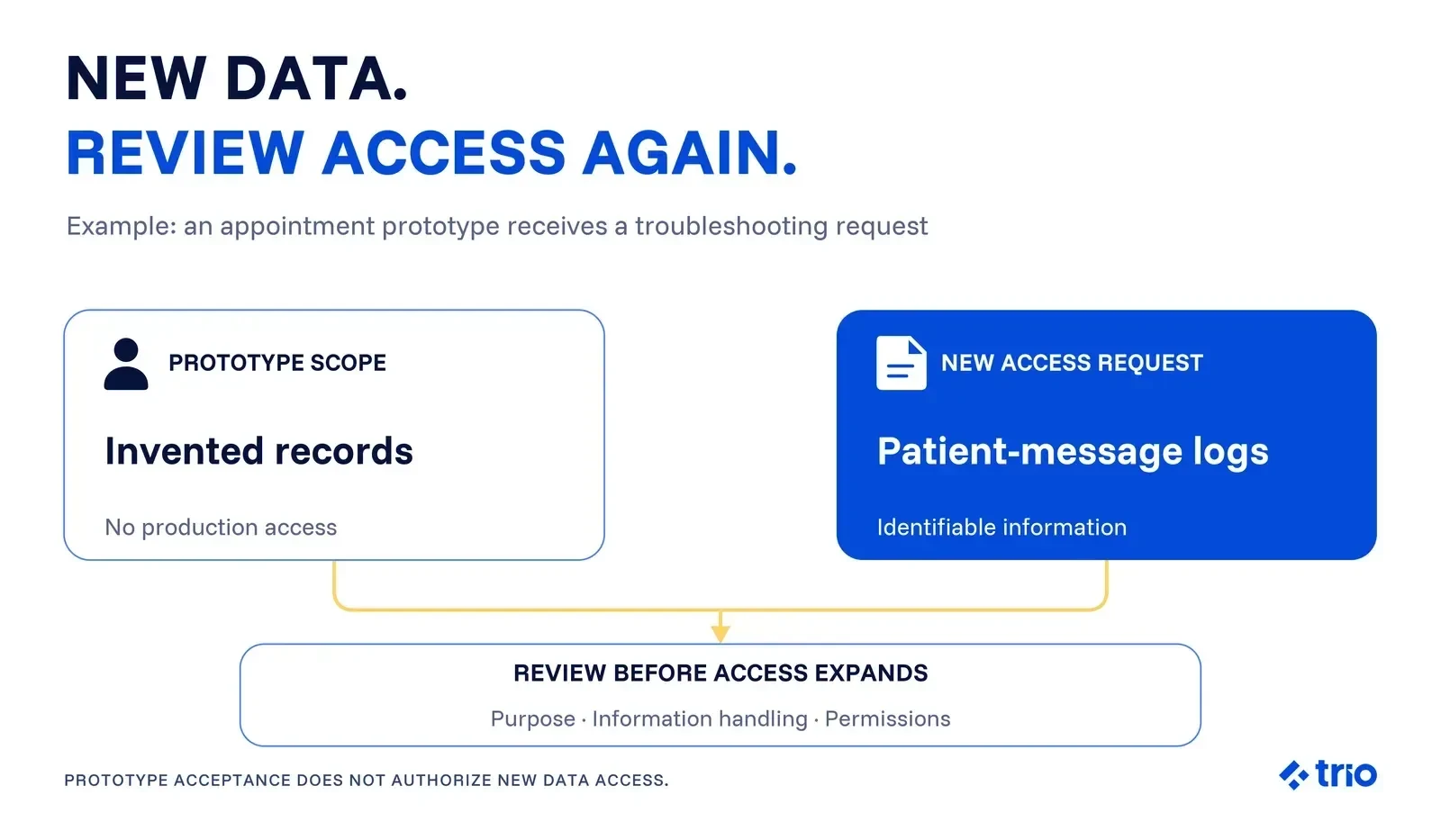
Hypothetical troubleshooting request: A software company serving a clinic asks its external developer to investigate failures using identifiable patient-message logs. Before granting access, the company reviews its upstream role, the developer’s downstream handling, permitted uses and agreement requirements. If this request follows an invented-data prototype, it changes the original access assumptions.
Make sure that you review the supporting tools too, asking whether information would enter cloud storage, diagnostic systems, or supplier support tools.
For qualifying cloud relationships, HHS explains that a cloud service provider maintaining electronic PHI can remain a business associate even without the decryption key.
Encryption does not remove that status.
What should you ask a prospective development partner?
A good way to assess a prospective partners is to give them a concrete description of the intended work and to then ask them to explain how they would perform it.
A general statement about secure development leaves too much open when the proposal involves patient information.
Proposed access: Which people, systems, and environments need access, for what purpose, and who authorizes it?
Development and testing records: Will the team use invented records, assessed de-identified data, or identifiable information? What supports that description?
Subcontractors and locations: Who else would perform the work or handle information, and where would that handling occur?
Reporting and support: Who receives incident reports, investigates problems, and coordinates responses with your company?
Termination and transition: What happens to information, access, and supporting records when the engagement ends?
Some questions connect to BAA subjects described by HHS; others are recommended procurement evidence.
Do not treat every requested document or demonstration as a statutory requirement. Ask your privacy and technical reviewers to distinguish required obligations from additional evidence your company needs to assess the proposal.
A signed BAA documents obligations; it does not demonstrate that safeguards work.
For example, request an explanation of how the proposed team receives and loses access, then have the responsible reviewer assess whether that approach matches the agreed restrictions.
Related Reading: Regulated-Software Partner Framework
What does outsourcing healthcare software development cost?
It can be difficult to assess costs since requirements differ so greatly, but as a rough estimate:
Asia: roughly $24 to $41 an hour.
Eastern Europe: roughly $31 to $76 an hour.
Latin America: roughly $33 to $75 an hour, inside US working hours.
A US in-house median sits near $93 an hour, which is the comparison those bands are built to flatter.
Whole projects get quoted anywhere from $40,000 to $500,000 and up, driven mostly by EHR integration depth.
What the rate card leaves out
Always keep in mind that the rate card is not the entire budget. Healthcare adds line items that rarely appear in a proposal.
Legal review of the BAA and its subcontractor flow-down, which is a real cost the first time and a template afterwards.
A separate, scrubbed development environment, plus the work of keeping production records out of it.
Expert determination, if you intend to build on de-identified patient data, which is a paid specialist assessment rather than a script that strips names.
Security questionnaires, penetration testing, and whatever evidence your own customers demand of you, such as SOC 2 or HITRUST.
Integration against HL7 FHIR interfaces and, where you sell into certified settings, the ONC criteria the receiving system has to meet.
Software that diagnoses, treats, or drives a clinical decision can fall under FDA oversight as a medical device, and that changes the documentation, testing, and release burden entirely.
Settle which side of that boundary your product sits on before you price anything, because no hourly rate absorbs it.
How to compare proposals and dependencies
We recommend that you ask each supplier to price the same outcome and disclose what your company must provide.
A proposal containing engineering alone needs a different internal commitment from one that includes technical leadership, testing, release coordination, and ongoing support.
For an integration, identify the external system and who can approve access. Ask whether a sandbox, a separate environment for testing, exists and whether the project can use it.
Keep availability, permissions, and any associated charges unresolved until the relevant provider confirms them.
Request a proposed schedule that identifies dependencies: requirements decisions, environment access, external approvals, and review availability. Ask how changes affect scope, fees and delivery expectations.
These answers help you compare what each proposal actually includes without relying on a standard healthcare development budget or launch duration.
What goes in an engagement brief?
The following hypothetical brief carries the appointment-screen example into a partner conversation. It demonstrates the information to agree on, rather than granting legal or operational clearance.
Outcome: Build a demonstrable appointment-booking screen where a user selects an available slot, receives confirmation, and sees an error when attempting to select an unavailable slot.
Scope exclusions: No production deployment, live clinic integration, clinical decision support, or production support.
Internal owners: The product lead defines booking behavior and accepts the workflow. The technical lead reviews the design and test evidence. The designated privacy reviewer assesses proposed information handling.
Supplier management: The proposal must identify who organizes development, reviews code, and coordinates testing. Any responsibility excluded from the price must be named.
Data and access: Use entirely invented appointments and people. Exclude production credentials, patient screenshots, actual logs, and backups. Any proposed change returns to the designated reviewers before access expands.
Subcontractors: Identify proposed contributors, work locations, and any additional company involved. Describe whether anyone beyond the proposed team would access project systems.
Integration dependencies: Use a simulated appointment service for the prototype. A future live integration requires separate confirmation of provider access, test environments, and permissions.
Acceptance evidence: Demonstrate the agreed booking behavior using the specified invented records. Supply test results covering available and unavailable slots, plus instructions for running the demonstration. The product lead accepts the workflow once the technical lead has completed review.
Open questions: Confirm the future integration provider, intended operating owner, and whether later work would require patient information. Assign each question to an internal owner.
If troubleshooting later requires patient-message logs, pause that access expansion and revisit the relevant relationships, permissions, and agreement assumptions. Acceptance of the prototype does not settle those new questions.
When outsourcing healthcare software development is the wrong call
Nobody internal can authorize data access: The privacy decision cannot be delegated to the partner making the request, and a founder without a reviewer tends to approve whatever the proposal asks for.
The product may be a regulated medical device: Resolve the FDA question first, because retrofitting design controls onto finished code costs more than building under them.
The work is mostly EHR integration politics: Getting a hospital to grant interface access is a relationship problem, and an offshore team cannot do that part for you.
You are buying on rate alone: The gap between $24 and $75 an hour disappears the first time a breach notification, a failed security review, or a rebuilt integration lands on your side.
Preparing the scope-fit conversation
Prepare your version of the brief before comparing partners.
A useful proposal should show which leadership and delivery responsibilities the supplier provides, what your company retains, and which patient-data questions remain open.
Trio builds engineering teams for companies working under regulatory pressure, mostly in fintech, with senior developers in Latin America on US hours.
Request a consult, and we will work through the brief with you, including the parts we would not take on.