


 Read Client Stories





 Lace Brunsden
 Key Takeaways
- A signed-off checklist proves documents changed hands, but it doesn't always prove the new team can run the product.
- We see credential and secrets rotation gets skipped more than any other line item, usually because nobody wants to admit how many services still point to the old team's API keys.
- GitHub keeps webhooks, deploy keys, and secrets attached to a repository after it's transferred, so an inherited integration can keep running on old credentials long after the handover is "done."
- IP assignment and support terms belong in the contract before the handover starts, not negotiated once it's underway.
- Most rushed handovers are actually a scheduling problem where nobody budgeted overlap time between the outgoing and incoming teams.
- Treat a vendor handover, an in-house ownership change, and bringing on a staff augmentation partner as the same checklist run at different speeds.
A software vendor handover checklist protects your new team from inheriting a product it can't operate, regardless of how complete the paperwork might be on the surface.
That happens whether you're moving on from an underperforming vendor, pulling a product in-house, or bringing on a staff augmentation partner to extend an existing team.
In many cases, the outgoing side hands over what's convenient, and the incoming side only finds out what's missing once something breaks in production.
For a product that touches money, the stakes run higher than usual since an unrotated payment-processor key or an untested backup carries real compliance exposure.
Let's take a look at a software vendor handover checklist so you can have a better idea of what you need to check, and what could slip by.
Trio's engineers have run transitions like this one before, and can help you do the same through staff augmentation.
What a handover checklist actually needs to cover
Most handover documents list what to hand over based on pre-transfer assumptions, but very few confirm it still works once it's in the new team's hands.
You need to know both what to collect and how to check it holds up.
This applies to a software development vendor transition, an in-house move, or a staff augmentation team taking over day-to-day ownership. The only thing that really changes is the urgency.
1. Source code and repository access
Make sure to hand over the full repository, not a zip export.
That means complete history, every branch and tag, and the CI configuration that builds it.
A snapshot of main loses the context in old branches and commit messages, and that context is often incredibly important once breaks start appearing.
If ownership of a GitHub repository transfers, know that webhooks, deploy keys, and secrets stay attached to it rather than resetting.
That's convenient for continuity but a massive risk if nobody reviews what's still wired up.
This is why we always recommend that you treat "transferred" and "reviewed" as two separate checklist items.
Also confirm access to any private package registries the build depends on. A repo that builds locally but fails in CI because of a missing private package is a common first-week surprise.
2. Credentials, secrets, and access rotation
It's best to rotate everything rather than copy it over. That includes cloud IAM roles, database credentials, third-party API keys, SSO configuration, and payment processor keys if the product touches money.
Copying credentials forward means the outgoing team can still technically reach production after they're gone, which defeats the point of a handover.
For a product built on Stripe or a similar processor, validate new credentials in test mode before cutting over.
Test-mode transactions don't move real funds, so the incoming team can confirm the new keys work, failure paths included, without risking a live charge.
If the product includes a mobile app, apply the same mobile app security discipline to credential rotation.
Anything hardcoded or cached on a device needs its own rotation plan, separate from the backend.
For fintech products, lingering access by former staff or an outgoing vendor is exactly what a SOC 2 audit will flag if it isn't closed out on schedule.
3. Documentation: architecture, API, deployment, runbooks
A README covers local setup but not necessarily what to do when a service goes down.
Make sure to hand over architecture diagrams, API documentation that matches what's actually deployed, deployment steps tested on a clean machine, and runbooks for incidents that have already occurred.
Anything that only lives in a person's head is a liability and should be treated as such.
If the outgoing team knows why a service restarts twice a week and that never makes it into writing, the incoming team will need to learn that lesson themselves.
In the case of your product storing any data governed by GDPR or a similar regime, data-handling documentation deserves its own checkbox here.
4. Infrastructure, cloud, and CI/CD access
Ownership of cloud accounts and billing needs to move with the handover.
A product running on an account the outgoing vendor still owns and bills, is still their product in every way that matters.
Hand over infrastructure-as-code, including Terraform state, and every pipeline configuration, including secrets the pipeline uses that aren't visible in the repo itself.
Change management is going to be critical here, since an incoming team that doesn't know how production changes get approved will either move too fast or get stuck waiting on a process nobody explained.
5. IP assignment and ownership
Confirm, in writing, that the code, designs, and any custom tooling built during the engagement are actually owned under a proper IP assignment, not just licensed to you.
This should be settled in the original contract, not negotiated during the handover.
A vendor with leverage at handover time has much less incentive to sign off cleanly.
6. Testing, QA, and acceptance sign-off
Hand over the test suite, and confirm it still passes on the incoming team's own infrastructure before anyone signs off.
A test suite that only passes in the outgoing vendor's CI environment won't be able to prove anything beyond that environment.
We have found that it's best to write down the software handover acceptance criteria before testing starts: what has to pass, on whose infrastructure, before sign-off counts.
Be as specific as possible to prevent anything slipping through the cracks in a rushed handover.
It's always a good idea to budget for this properly since QA costs for a regulated financial product are a real line item, and skipping acceptance testing to save money is one of the more common ways we've watched handovers go wrong.
7. Data backup and restore verification
You need to confirm the incoming team can actually restore from backup, not just that backups exist.
A restore script written against the outgoing team's infrastructure can fail.
One concrete gotcha we see on AWS is that restoring an RDS snapshot always creates a new database instance. You can't restore a snapshot onto an existing one.
A runbook that assumes otherwise will fail during an actual incident.
8. Support, SLA, and maintenance terms
Settle what support looks like during and right after the transition, including things like response times, who's on call, and how long the outgoing vendor stays obligated to answer questions.
This belongs in the staff augmentation contract or MSA before the handover starts, covering standard clauses plus whatever fintech-specific provisions apply around data access and liability.
It's also worth reviewing the original MSA for anything that makes a clean exit harder than it should be: auto-renewal clauses, vague IP language, or termination notice periods that don't match how the relationship is actually ending.
9. Knowledge transfer and training
We have found that it's best to budget real overlap time between outgoing and incoming teams.
How much will depend on the system's complexity.
A short, structured transition with recorded walkthroughs and a defined point of contact for the following few weeks tends to catch problems.
You can treat this stage as its own engineering knowledge transfer checklist: who explains what, which systems need a live walkthrough, and who's reachable after the formal handover ends.
If the incoming side is a new nearshore or offshore team, build in time for that process and tooling to land properly as well.
How to verify the new team can actually run it
A signed checklist is necessary, but it's not sufficient. The strongest handovers that we have encountered add a short acceptance test.
Have the incoming team deploy from scratch using only the handed-over documentation. Run a test transaction through the new payment credentials. Restore a backup in a non-production environment.
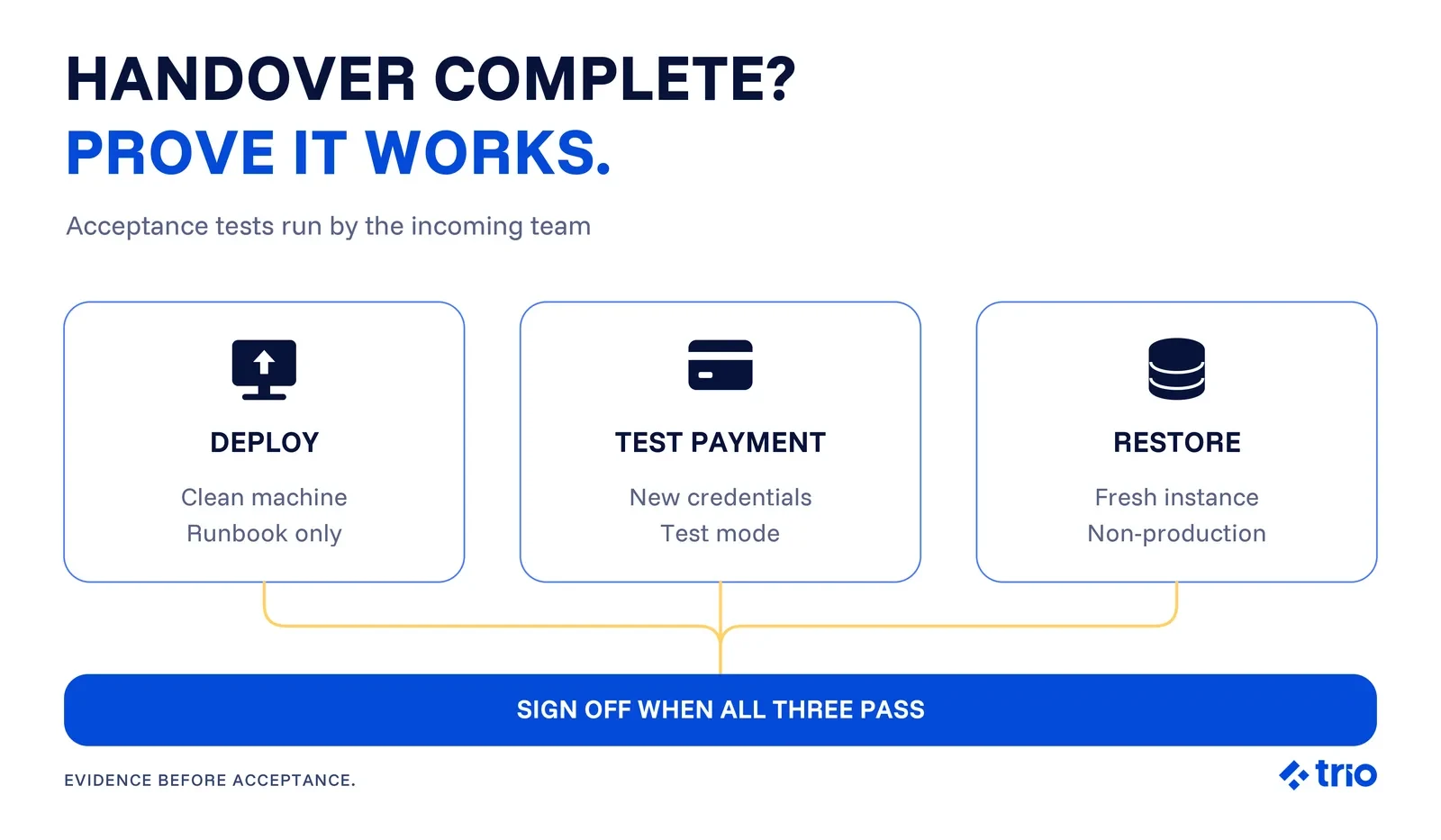
A few concrete tests worth running:
Trigger a failed test payment and confirm the incoming team's error-handling code correctly reads a cleared last_payment_error field on a later confirmation. This is documented Stripe behavior.
Restore a database snapshot into a fresh instance, not an existing one, and confirm the application reconnects without manual intervention.
Deploy the application on a clean machine using nothing but the handed-over runbook. If a step needs knowledge the runbook doesn't mention, that's a gap worth fixing before sign-off.
All of this is the same logic behind any acceptance test, where you need to confirm the thing works under the conditions the new owner will actually face.
What a handover checklist doesn't solve
While a checklist is a good way to reduce risk, it doesn't fully eliminate it.
Checklists won't fix a team that lacks the capacity or seniority to run what it just inherited, no matter how thorough the documentation is.
It won't replace genuine overlap time either. A document can describe tribal knowledge, but it rarely transfers it as well as a few weeks of a person being reachable.
And it won't catch what nobody thought to write down.
The best mitigation for that is picking an incoming team experienced enough to know which questions to ask, and with the experience to know what can easily go wrong.
When a handover checklist isn't enough
Sometimes the problem isn't a clean handover. It's a vendor relationship that's already failed, with an underperforming codebase and a team that needs to triage first.
That calls for engineering rescue work, not a handover checklist.
Trio places senior engineers who've handled transitions like this one, ready to step in before the risky part starts.
Request a consult.