


 Read Client Stories





 Lace Brunsden
 Key Takeaways
- Name a perpetual term and a worldwide territory in the IP assignment clause. Indian copyright law defaults a silent assignment to five years, within India only.
- Budget India mid-level work near $20 to $52 an hour against $44 to $70 for Latin America, then add the management hours each proposal quietly assumes you will supply.
- India does not observe daylight saving. The US does, so a fixed schedule gains or loses an hour of overlap twice a year.
- Separate team location, delivery management, and pricing when reading a proposal.
- Ask the vendor for its attrition figure. The largest Indian IT firms ran near 13% to 15% through FY26, so continuity has to rest on documentation rather than on individuals.
- Treat product authority, operational access, and contractual ownership as three separate questions. An answer to one does not settle the others.
Outsourcing software development to India means contracting development work to a team based in India, and it belongs on your shortlist when a prospective partner can demonstrate relevant skills, workable collaboration hours, and a clear division of responsibilities that your company can support.
If you are comparing proposals, the useful question concerns the actual engagement: who would build the product, how you would work together, and what your own team would still need to manage.
It is essential that you evaluate those commitments alongside the price. A destination alone does not establish quality, savings, or delivery capacity.
Trio does not place engineers in India because we often find that the initial cost savings are greatly minimized by things like time lost in asynchronous work.
Instead, we work with senior Latin American developers whose working hours overlap US teams in full.
If collaboration hours sit near the top of your list, request regional talent.
What choosing India does and does not decide.
Choosing India identifies where the proposed development team would work, but you still need to decide what you are buying.
Do you need additional engineers under your direction, a partner responsible for a defined delivery scope, or another explicitly agreed arrangement?
We recommend that you think about three separate questions to make sure every aspect of your hiring decision is covered:
Who will organize and direct delivery?
How will the work be priced?
If your decision has been cemented on India, then each proposal you review needs to address all of those.
What India costs, and what moves that number
Rate cards put Indian mid-level developers around $20 to $52 an hour and senior developers around $30 to $72, against roughly $44 to $70 and $57 to $89 for Latin America, on SecondTalent's September 2026 offshore rate card.
We recommend that you treat those as opening bands rather than quotes, though.
City tier, domain experience, and how much delivery management the vendor carries move the number more than the country label does.
Four costs sit outside the hourly rate, and proposals rarely show them:
Your own management time: Someone writes the requirements, answers questions, reviews the work, and runs the demos. Price that at your internal cost, because it does not disappear when the engineers are external.
Re-onboarding after turnover: The largest Indian IT services firms reported attrition near 13% to 15% through FY26, with TCS at 13.7% for the quarter ending March 2026. Mid-size vendors have no obligation to publish a figure, so ask for one.
Asynchronous waiting: A question asked at 16:00 Eastern gets answered the next Indian morning. Work needing several of those exchanges burns calendar days a co-located team would spend in an hour.
The evening shift: A vendor committing named people to a 13:00 to 22:00 IST schedule pays for that, in money or in retention risk, and it usually surfaces in the rate.
Indian software exports are zero-rated under GST, so a compliant invoice to a US company carries no Indian GST.
Instead, the vendor files a Letter of Undertaking (Form GST RFD-11) each financial year to export without paying IGST upfront. Payment normally has to arrive in convertible foreign exchange for the work to qualify as an export of services under Section 2(6) of the IGST Act.
If you notice that a vendor’s invoice unexpectedly includes a tax line, we recommend that you ask which export or compliance condition might not have been met.
When India belongs on your development shortlist
It's probably a viable option to consider an India-based partner when you can connect its proposed capacity or skills to a defined product need.
Ask the partner to explain who would do the work, demonstrate relevant delivery experience and describe how its approach would fit your company's available leadership.
It's critical that you treat access to external capacity, specialist skills and a potentially suitable commercial proposal as benefits to investigate.
Use interviews with proposed team members, relevant work examples and written scope assumptions to assess those possibilities. Broad claims about a country's engineering sector don't indicate whether a particular team fits your product.
A hypothetical SaaS founder's decision
Suppose a US SaaS company wants to add an account-administration feature to an existing product.
Its founder can explain customer needs, and an internal technical lead can review design choices and integration work. The company wants external help delivering that feature.
An India-based proposal could deserve consideration if the proposed team demonstrates relevant experience and offers collaboration hours the founder and technical lead can sustain. The founder should then compare its scope, responsibilities, and exclusions with other proposals against the same requirements.
Now change one assumption: the company has nobody available to make technical decisions, while the proposal supplies engineers who expect internal direction. That arrangement leaves a leadership gap.
The founder should clarify whether the partner would provide the missing leadership, seek separate technical support, or reconsider the engagement.
A useful shortlist tests a specific engagement. Ask whether the proposed people, responsibilities and availability fit the work your company needs to complete.
When India is the wrong fit
India tends to stop making sense in a few specific situations, and most of them have little to do with engineering quality.
Work that needs same-day iteration: Live debugging, incident response, and a genuine argument about a design all degrade when the shared window runs two or three hours. A pre-launch product changing every week pays that cost every week.
Contracts the vendor will not amend: If a partner declines to state assignment duration and territory in writing, treat that as a hard stop rather than an opening position. The ownership section below explains why.
Data that cannot leave a jurisdiction: A residency commitment in your own customer contracts, or a restriction one of your clients imposes, can rule out any offshore vendor, whatever the destination.
Very small engagements: Coordinating a remote vendor across a ten and a half hour gap does not scale down well. Below roughly one engineer's worth of sustained work, the coordination can cost more than the rate saves.
English is usually not the binding constraint. India sits 74th on EF's 2025 English Proficiency Index with a score of 484, a little under the 488 global average, down from 69th the year before.
The thing to keep in mind is that those indices sample self-selected test takers across an entire population, so they say almost nothing about the five engineers a vendor would actually assign.
What is far more important than these general figures is that you interview the named people and judge the ones you would get.
Latin America is the usual alternative when overlap drives the decision, and the trade is fairly clean. Most of the region sits within about three hours of US business hours, so an ordinary workday overlaps instead of a shifted one.
You pay for that: the same rate card puts Latin American mid-level developers at $44 to $70 an hour against $20 to $52 for India.
If your constraint is budget and headcount, the sheer size of India's tech workforce is real. If it is how fast you can close a loop, the hours matter more than the rate.
Choose the engagement before comparing the price.
For proposal evaluation, distinguish adding engineers under your company's direction from assigning a defined delivery scope to a partner.
In the first arrangement, you need to identify who internally will set priorities, answer questions, and review the work. In the second, ask precisely which planning, coordination, and delivery responsibilities the partner accepts.
Pricing describes another part of the arrangement.
For example, a fixed-price proposal needs a defined scope and an explanation of how changes will be handled. Under time and materials, we've usually found that payment follows the hours worked and resources used.
Neither label actually tells you who will resolve a disputed requirement or approve a release.
For each proposal, you need to identify a retained decision owner inside your company.
That person should know which product questions remain theirs and when the partner needs an answer. If the proposal includes delivery management, request a concrete description of that role rather than assuming it covers every decision.
Once you have all of that information, you can start to compare the quoted fee with the internal effort the arrangement expects. Who will prepare requirements, provide access, attend reviews, and coordinate with your existing team?
We recommend that you record that effort separately from the vendor fee so you can assess whether your company has the capacity to support the proposal.
Related Reading: IT Outsourcing Guide
Check the working hours your project actually needs
We highly recommend that you assess actual shared working hours before accepting a general promise of US availability. Specify the people who need to collaborate and the activities that require a live conversation, such as clarifying a feature or reviewing a disputed design choice.
Indian Standard Time (IST) uses UTC+05:30, according to CSIR-NPL's time display. US Eastern Time uses UTC-05:00 during standard time and UTC-04:00 during daylight time, according to NIST's Local Time FAQs.
On top of that, you need to keep in mind that Eastern Time represents one US time zone, so make sure to use your team's actual location when evaluating a proposal.
India keeps a single time zone and does not observe daylight saving, so the Indian half of that arithmetic never moves while the US half does, twice a year. An arrangement with three and a half hours of overlap in July therefore has two and a half in January, without anybody changing their stated hours.
Agree on the schedule in both directions before you sign it.
Compare India-based proposals against the same requirements
Give prospective partners the same description of the product need, existing system, and collaboration constraints. Then use the worksheet below to record what each proposal establishes.
Make sure that you indicate where evidence is still missing.
Requirement | Proposal A evidence | Proposal B evidence | Unresolved question |
|---|---|---|---|
Delivery scope | Record the scope statement and exclusions. | Record the scope statement and exclusions. | Do both proposals cover the same product outcome and integration work? |
Proposed people and relevant skills | Record named roles, interviews and relevant work examples. | Record named roles, interviews and relevant work examples. | Which proposed people have demonstrated the skills this assignment needs? |
Shared working hours | Record named staff availability, time zones, breaks, and dates. | Record named staff availability, time zones, breaks, and dates. | Can the required people attend essential conversations? |
Internal leadership required | Record the responsibilities and availability expected from your team. | Record the responsibilities and availability expected from your team. | Who internally can supply the requested direction and reviews? |
Price inclusions | Record included roles, activities, assumptions, and exclusions. | Record included roles, activities, assumptions, and exclusions. | What would trigger an additional charge or revised estimate? |
Decision responsibilities | Record who prioritizes work, resolves questions, and approves delivery. | Record who prioritizes work, resolves questions, and approves delivery. | Does every consequential decision have an agreed owner? |
Repository and account access | Record proposed access arrangements and account administrators. | Record proposed access arrangements and account administrators. | What can your company access and operate during and after the engagement? |
Ownership and transition expectations | Record proposed terms for agreement review and transition support. | Record proposed terms for agreement review and transition support. | Which ownership, third-party asset, or exit questions still need resolution? |
Related Reading: Choosing a Software Development Partner
Clarify what your company expects to own and direct
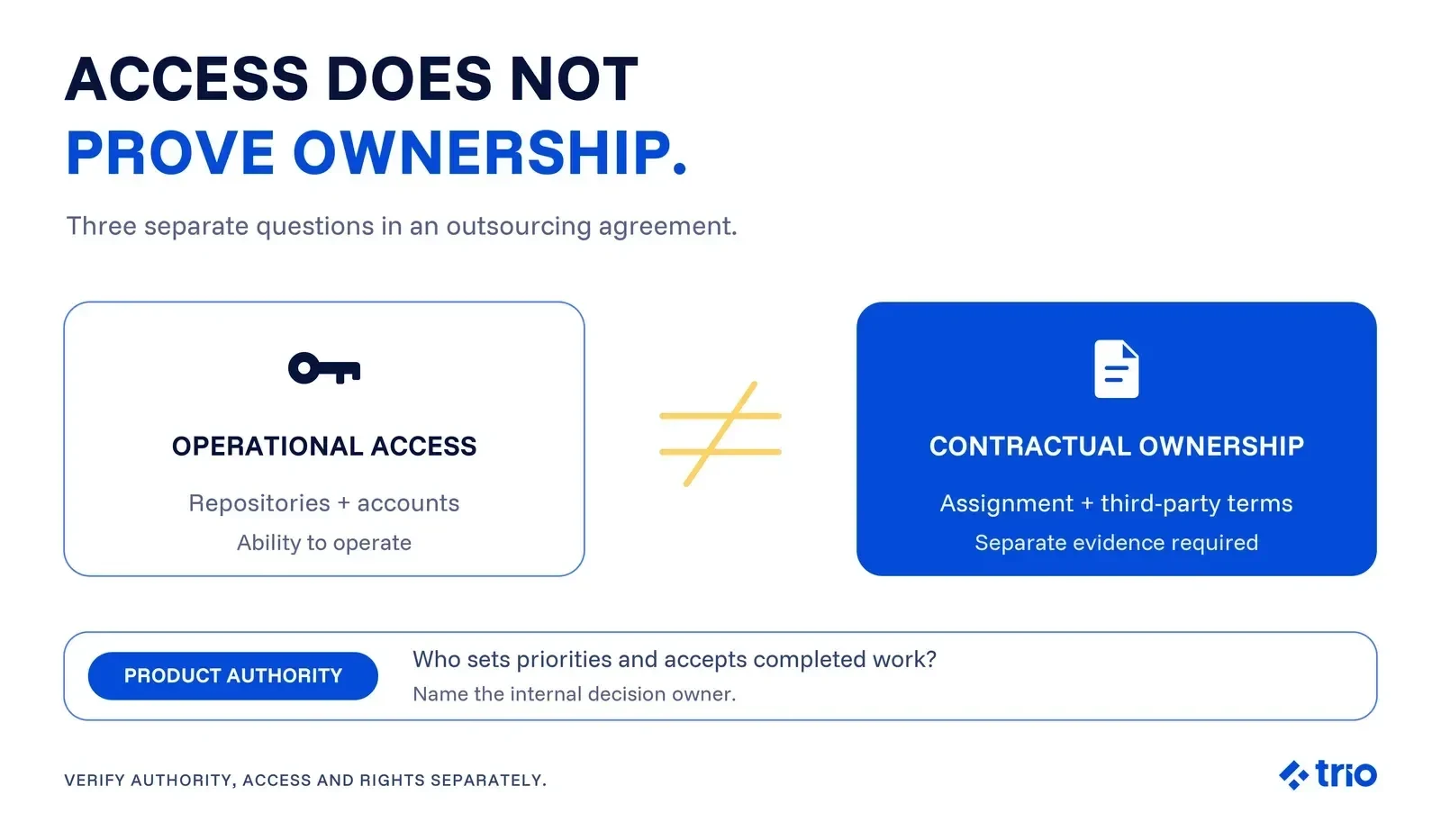
We have already alluded to the fact that you should separate product authority, operational access, and contractual ownership when reviewing an engagement.
Decide who will set priorities and accept completed work. Ask how your company will access repositories, documentation, and relevant accounts. Then have the proposed ownership terms reviewed in the context of the actual agreement.
Do not use repository access as a substitute for resolving contractual ownership. Likewise, a proposed ownership clause does not explain who administers a production account or how another team would continue the work.
Under Sections 19(5) and 19(6) of India's Copyright Act, a written assignment that does not state its duration defaults to five years, and one that does not state its territory applies only inside India. The Delhi High Court applied exactly that in Pine Labs v Gemalto, where a work order silent on both left the assignment lapsing after five years and the rights reverting to the developer.
Ask for a perpetual term and a worldwide territory named in the assignment clause itself, not in a side letter, and have Indian counsel read the wording.
Data protection has firmed up too.
India's Ministry of Electronics and IT notified the Digital Personal Data Protection Rules on 13 November 2025, and most operative duties under them, covering notice, consent, security safeguards and breach reporting, phase in by 13 May 2027. Section 17(1)(d) of the Act disapplies most of those duties where an Indian company processes the personal data of people outside India under a contract with a foreign client, which describes a good deal of US SaaS work.
Ask a prospective partner what it has done to prepare regardless, since the answer says something about how it treats compliance in general.
We also recommend that you ask them to identify third-party components, any subcontracting arrangements, and proposed transition support.
If the work requires sensitive information, which it almost always does in industries like fintech, document the access being requested and obtain appropriate review before agreeing to it.
Decide whether to proceed or clarify the arrangement
Consider these outcomes as decision guidance rather than a provider rating:
Proceed with evaluation when the proposed people, scope, and collaboration commitments fit, and the founder has identified the internal leadership the arrangement requires.
Request clarification when a potentially suitable proposal leaves availability, inclusions, responsibilities, or ownership expectations unresolved.
Consider another arrangement when required live collaboration cannot be supported, or the proposed engagement depends on leadership the company cannot provide. Options could include a different management scope, internal leadership support, or a team with more compatible availability.
It's always a good idea to prepare a short requirements brief covering the product outcome, required collaboration windows, internal decision owners, and access or ownership expectations, and then to ask each prospective partner to respond to it.
That gives you a concrete basis for deciding whether India belongs on your delivery shortlist.
If the overlap arithmetic is what rules India out, the same document is what you would hand a nearshore software outsourcing partner, and the comparison stays like-for-like.
At Trio, we help companies match with the developers they actually need, from LATAM and Africa.
These developers have experience working on international teams and understand not only what you need from them, but can help you put processes in place to ensure you are set up for success long after they have gone.
Talk to us.