

 Read Client Stories





 Alex Kugell
Outsourcing software development has become essential for companies aiming to cut costs while accessing skilled talent worldwide, but there are also some unique challenges that come along with it.
Selecting the right country for outsourcing can be challenging.
Some top options to consider include:
- India
- Ukraine
- Poland
- The Philippines
- China
- Pakistan
- Romania
- Brazil
- Argentina
- Mexico
- Egypt
- Vietnam
In our many years of implementing outsourcing and staff augmentation for our clients, we have seen how each destination offers unique advantages in terms of cost, technical expertise, work culture, and language proficiency.
If you are interested in trying to implement outsourcing and need a development company to create your custom financial mobile and web apps, especially in Latin America, we might be the right fit for you.
Key Takeaways
- Outsourcing software development is largely driven by the need to reduce costs while accessing global talent pools.
- The top 12 countries span Asia, Eastern Europe, Latin America, and Africa, each offering distinct strengths.
- India and China lead in scale, while the Philippines and Argentina excel in English communication.
- Latin America (Brazil, Argentina, Mexico) offers strong time zone compatibility with North America, improving real-time collaboration.
What are the best countries to outsource software development to?
The 12 best countries to consider for outsourcing software development include:
- Brazil: With a developer community of over 500,000 and a time zone just one to three hours behind the US East Coast, Brazil offers a young, talented workforce and a favorable time zone for North American companies, making it a strong choice in Latin America.
- Argentina: Known for high-quality education and technical skills, Argentina ranks 26th globally for English proficiency on the EF EPI and provides affordable outsourcing solutions for North American teams that prioritize clear daily communication.
- Mexico: With close proximity to the U.S., Mexico offers skilled developers, a cultural affinity with Western clients, and favorable time zone alignment.
- India: Known for its massive talent pool, competitive costs, and high technical skills, India has long been a top destination for IT outsourcing.
- Ukraine: Despite recent challenges, Ukraine remains a popular choice in Eastern Europe, thanks to its strong educational system, moderate English proficiency, and technically skilled developers.
- Poland: Considered to be in the top three countries in Europe for developer skill and home to over 600,000 software developers, Poland offers a tech-savvy workforce, cultural alignment with the West, and solid English skills, making it a preferred destination in Eastern Europe for quality development.
- The Philippines: Offers strong English proficiency, cultural alignment with Western countries, and affordable rates, making it ideal for communication-heavy projects.
- China: Boasting advanced technical skills and the world’s largest developer workforce at over 7 million, China remains a key outsourcing destination, though language barriers may require extra attention.
- Pakistan: With a growing IT sector, competitive rates, and technically proficient developers, Pakistan has been steadily gaining recognition in the outsourcing landscape.
- Romania: Romania’s well-educated workforce, affordable rates, and experience with Western business practices make it a reliable European outsourcing partner. The country ranks well globally in the National Cyber Security Index, which matters if your project involves sensitive data.
- Egypt: Egypt’s affordable rates, technical expertise, and English proficiency make it an emerging outsourcing destination in Africa. It tends to suit European companies better than North American ones, given the time zone overlap.
- Vietnam: Pairing a large developer pool with affordable hourly rates, Vietnam has earned a strong following in Southeast Asia for companies seeking affordable development without sacrificing technical depth.
Most of these regions are going to offer incredible cost savings in comparison to North America. But not all of them are going to be cost-effective.
It is incredibly important that you consider the quality of the code being produced and the difficulties of asynchronous communication and language barriers.
How to Choose the Right Country to Outsource Software Development?
Choosing the right country for outsourcing starts with a well-rounded look at a couple of factors.
What Factors to Consider When Choosing?
Starting with each country’s technical strengths makes sense.
Looking into education and coding skill rankings can give you a sense of how well developers there might fit your project’s needs, especially considering the time difference.
Language is also key.
The EF English Proficiency Index offers a useful starting point for comparison. Poland ranks 15th globally, Romania 11th, and Argentina 26th.
Markets like Brazil (75th) or Egypt (89th) might require you to be more careful when hiring.
If there are gaps, they are probably going to show up in day-to-day standups and written communication. Having initial conversations with potential teams in popular outsourcing destinations can help you gauge those communication skills firsthand.
As we already mentioned, balancing cost is incredibly important, too. Checking out average rates in each region and comparing these with real-world examples can help you find a fit that aligns with your budget while maintaining high standards.
Client feedback and case studies are a great way to assess potential partners, too.
Looking at a country’s track record through verified reviews on platforms like Clutch or G2 tends to be more informative than any sales pitch. But we always recommend that you actually follow up with past clients and try to speak to them personally.
How Important is the Time Zone for Development Teams?
Advances in remote collaboration tools mean time zones present less of a barrier than they once did.
For projects where asynchronous communication works well, teams can still operate effectively even with significant time zone differences, especially if developers offer flexible working hours.
However, time zones still shape how smoothly your project runs, especially if real-time collaboration sits at the center of your workflow.
Choosing an outsourcing destination within a similar time zone can simplify scheduling if your project requires regular, synchronous meetings.
If the project is quite complex and time-sensitive, like in the case of an upcoming compliance audit, you need to be able to take care of blockers and answer questions as quickly as possible.
A LATAM team operating one to three hours behind the US East Coast will simply cause fewer scheduling headaches than a team in Eastern Europe or Asia.
What Role Does Cost Play in Choosing a Country?
While cost drives the decision for many companies looking to outsource, it’s not the only consideration.
Countries like India or the Philippines may offer more affordable rates, but LATAM countries like Brazil and Argentina balance reasonable pricing with higher technical expertise and a close cultural alignment with Western companies.
We always remind our clients that they need to weigh the hourly rates against the overall quality, as lower rates don’t always equate to higher value if skill levels are compromised.
Getting the best value from outsourcing usually means finding the intersection of strong vetting, clear communication systems, and reasonable rates.
What Are the Top Asian Countries for Outsourcing?
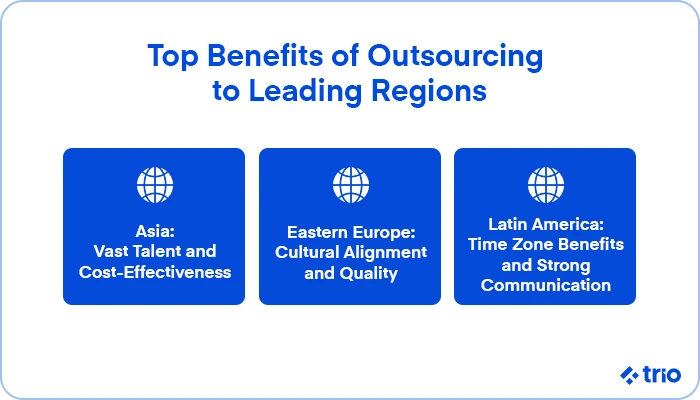
Asia remains a popular choice for outsourcing software development, and from what we have seen, it holds that position thanks to its vast talent pools, cost-efficient rates, and advanced technical skills.
India, with its extensive developer community and affordable rates, has long been a leader in the global IT outsourcing sector.
Producing over 1.5 million STEM graduates annually, India attracts companies looking for both cost efficiency and access to talent across a wide range of specializations.
China is also quite popular, boasting a technologically skilled workforce, although language proficiency can sometimes pose a challenge for Western clients.
The Philippines, on the other hand, offers a unique advantage with its high English proficiency and cultural alignment with Western countries, making communication seamless.
Meanwhile, Pakistan’s IT industry has been growing steadily, offering competitive rates and technically adept developers who are adaptable to various project needs.
All of these countries have a far lower cost of living than countries like the United States, which means that, as long as you are willing to deal with the unique challenges they can sometimes provide, they offer incredible value.
How Do Asian Countries Compare in Software Development Services?
Each country in Asia offers distinct strengths.
India’s technical expertise spans various programming languages and tech stacks at a scale few regions can match.
China’s developers excel in technical proficiency, although communication can require additional coordination. That said, it depends on the specific developer you work with.
The Philippines shines in projects that require heavy communication, thanks to its high English proficiency, while Pakistan brings competitive rates and a versatile workforce, making both popular outsourcing destinations.
What Are the Advantages of Nearshore Outsourcing in Asia?
Although Asia is geographically distant from Western companies, nearshoring within the continent can offer benefits for businesses located in the region.
Asian companies often provide flexible working hours to accommodate clients in various time zones, making collaboration easier.
Additionally, Asia’s diverse pool of developers with varying levels of expertise and cost structures means companies have more options to tailor outsourcing to their budget and skill needs.
What Are the Leading European Countries for Outsourcing?
Eastern Europe has become an outsourcing hotspot of sorts, celebrated for its strong educational institutions, high-quality developers, and cultural alignment with Western nations.
Poland leads among European outsourcing destinations due to its skilled developers, extensive tech ecosystem, and high English proficiency, which makes communication easier.
HackerRank has ranked Polish developers among the top three globally for overall skill pretty consistently, particularly in Java and algorithms, and the country’s strong developer pool makes it one of the most accessible markets in the region.
Ukraine, known for its excellent technical education and expanding IT sector, has also become a major player in outsourcing despite recent regional challenges.
Romania, with its competitive rates and well-trained developers, is another great option.
How Does the Quality of Development Teams in Europe Compare?
Eastern European developers often stand out for their strong technical skills and familiarity with Western business practices, making them highly dependable partners.
Although their rates are generally higher than those in Asia, we have found that many companies find the quality, reliability, and cultural compatibility in Eastern Europe well worth the investment.
This holds especially true for our clients who are looking for long-term software outsourcing services involving very large projects or continuous maintenance.
Developers in this region are often highly proficient in multiple programming languages and have experience working on complex, large-scale projects. However, it’s still best to assess each developer individually.
What can you expect from outsourcing services in Europe?
As we have already mentioned, outsourcing to Europe tends to come at higher rates than in Asia, but the quality, consistency, and ease of collaboration often justify the extra expense.
Additionally, developers in Eastern Europe often bring a mix of technical expertise and strong problem-solving skills that can be highly beneficial for projects requiring advanced coding or complex technical solutions.
As long as you have done your research and know what to expect from the Eastern European software development market, you should not run into any issues and can expect a successful software development partnership.
What Are the Best Latin American Countries for Outsourcing?
Latin America is by far one of the best places to outsource if your company is based in the US. The reason usually comes down to time zones.
Brazil, Argentina, and Mexico all operate within one to five hours of the US East Coast, which makes synchronous collaboration far more natural than working with teams eight or ten time zones away.
Brazil leads the pack in terms of raw developer supply. With over 500,000 developers, the country has people with general depth across JavaScript, Java, Python, and increasingly AI and machine learning.
Cities like Campinas and São Paulo anchor a tech scene that has attracted significant US investment for decades. Brazilian developers also tend to exhibit a proactive attitude, with outsourcing projects being done on schedule.
Argentina tends to attract companies that prioritize English fluency and education quality. With its high English placement, Argentine developers generally communicate more fluidly with North American clients.
This popularity means that domestic demand for developers in Argentina has been growing faster than supply, so finding the right individual candidate independently can take longer than it might seem. This should not be a problem if you prepare for it, though.
Mexico completes the picture for companies that want a near-zero time difference. A team based in Mexico City operates on Central Time, and cultural alignment with North American clients tends to require minimal adjustment.
However, arguably one of the most important benefits of hiring across Latin America, regardless of the country chosen, is the fact that many international firms based in these countries have experience working with US teams in US regulatory markets.
This experience is crucial in sectors like FinTech and healthcare.
Final Thoughts
At Trio, Latin America sits at the center of our staffing model.
Our developers go through a rigorous process covering technical skills, communication, and cultural fit before any introduction to a client.
Since we have expert developers in niches like FinTech on hand already, we just need to match them to your project based on your specific requirements.
Placements and onboarding can happen in as little as 3-5 days. This is invaluable when compared to the typical hiring timeline of as much as six months in competitive industries.
Ready to start hiring?
Talk to us!
Frequently Asked Questions
Which countries are best for outsourcing software development in 2026?
The best countries for outsourcing include India, Poland, Brazil, and the Philippines. These countries stand out compared to others for their mix of cost efficiency, talent availability, and communication skills.
What factors should you consider when choosing an outsourcing country?
Key factors when selecting a country include skills, cost, language, time zone, client reviews, and real-world performance. It is important that you consider your specific project and requirements to make the right choice for you.
How important are time zones in outsourcing software development?
Time zones matter depending on your need for real-time collaboration when outsourcing software development. There is no reason why projects can’t succeed asynchronously with flexible teams and good tools, but it definitely isn’t suitable for all situations.
Why is Latin America popular for outsourcing?
Latin America is a very popular destination for outsourcing, thanks to its time zone alignment with North America. It also offers skilled developers and relatively good English proficiency levels, depending on the country you look at.