Businesses rely on all kinds of data to make decisions that reap both short-term and long-term revenue benefits and KPIs.
To organize data in a way that’s readable to the human eye, you need a special type of programming for statistical measurements and reporting. This is where R comes in.
Trio delivers top-tier software insights and access to South American developers. Discover our exceptional Argentine developers, Mexican developers, and Brazilian developers for outsourcing success.
Let’s look at this R developer hiring guide so you understand what to expect from the process.
What Is R?
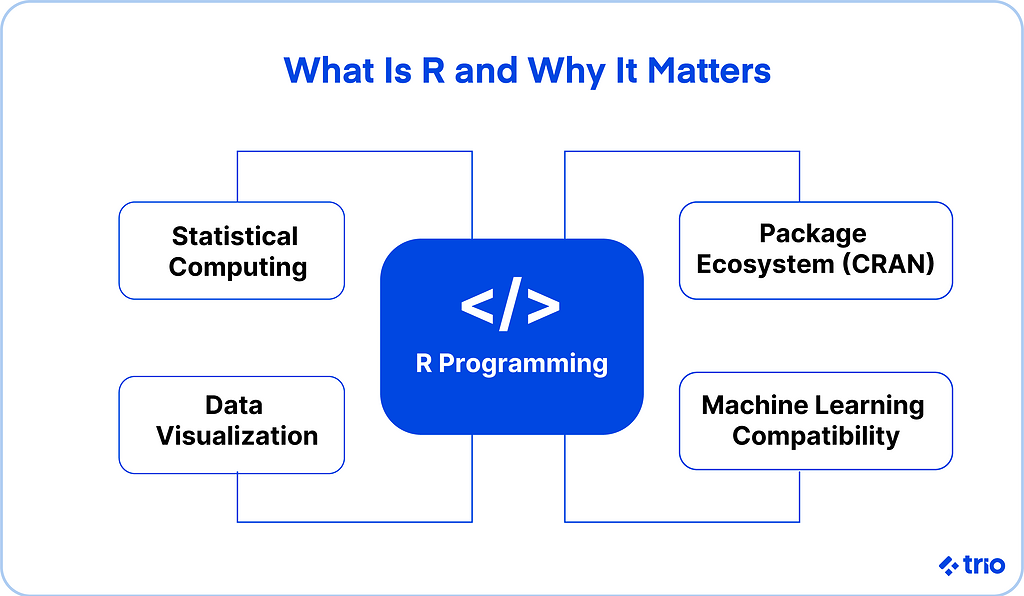
R is both a programming language and a development environment for statistical computing and graphic imaging (related to graphs, charts, and other models). Statisticians and data miners are the most likely users of this software.
Although R’s early history is interesting to some developers, the day-to-day value tends to come from its modern ecosystem and the problems it solves.
The roles of statisticians and data miners somewhat intertwine. Statisticians analyze statistics, and this is towards any objective. Data miners turn raw data into useful information that businesses can use for marketing strategies.
R has been around since 1993, and it was designed by Ross Ihaka. It is based on S, another programming language that R draws its statistical capabilities from.
Most teams using R today may not think much about its heritage, but the language has kept its footing because of its massive package ecosystem and steady performance improvements over the years.
In programming, scoping describes the level of association between two or more elements. For example, a certain scope would define whether a variable within a function is meant to be referenced only within the function or within the program as a whole.
Lexical scoping, also known as static scoping, is a set of defined rules for a program that cannot be changed.
Other than this improvement, the source code for S and R is virtually the same. But R has much more package support. It offers many statistical features through its dynamic libraries.
According to the Tiobe Index, which measures the popularity of programming languages, R is the 12th most popular language as of November 2025. At the very least, this means that R is useful enough to attract many programmers to its doors.
R’s popularity appears to fluctuate depending on industry trends, but it consistently ranks as one of the most widely used languages for analytics teams, academic researchers, and companies that care about reproducibility and statistical accuracy.
Why Hire an R Developer?
R is the only language of its kind, other than S, of course, where R has enhanced its features. Though other software like Stata exists to compete against R, only R gives developers ultimate autonomy.
Free
R is free. You can install, use, update, and modify R for free. In the same vein, R is open-source, meaning developers can manipulate the language and environment to their needs. Many companies build commercial versions of R to better support customers.
Well-Supported
If you have a proprietary version of R, you’ll have access to a paid helpline. But even if you don’t want to pay a dime, you’ll have many resources available to you.
Many blogs and forums offer the help you need for free, with Stack Overflow being the most reliable of them all. R-Blogger is another accessible resource.
Popular
To the same effect, R is popular, meaning you have a large community to look to for advice. Moreover, R is becoming the standard worldwide for employers. For you, this means that many developers will be encouraged to learn R, and you’ll have many professionals to choose from in a line of applicants.
Heavy-Duty
R does its job well. It can create highly complex simulations and is adaptable to the performance capacity of your business.
For instance, R can be used on high-performance computer clusters. These are large computer clusters, often found in colleges and universities, that can manage thousands of computer processors at once.
R supports multicore task distribution. Most computers run on multiple processor cores. A core is basically the brain of the computer that receives instructions. R allows developers to divert different tasks to different cores and optimize processing.
Flexible
It may go without saying, but R can handle both standard and immensely complex projects. From complicated statistical modeling to building a web app, R does it all.
When You Should Hire R Developers
There are a few moments where bringing in an R developer makes life noticeably easier.
You might be facing messy data pipelines that keep breaking or a forecasting model that needs more than an off-the-shelf spreadsheet.
In other cases, your team may want interactive dashboards built with R Shiny so non-technical teammates can explore data on their own.
You may also consider hiring R developers when:
- Your reporting cycle depends on R Markdown or Quarto, and the current workflow feels fragile
- You need statistical modeling that goes beyond basic regression
- Your analysts are stretched thin and need someone who deeply understands the Tidyverse
- You want reproducible results and a clear audit trail for analytical decisions
Teams sometimes wait too long to bring in help, but a strong R developer can shorten project timelines and reduce frustrating back-and-forth around data interpretation.
Advantages of Using R
Generally, developing in R supplies you with a number of benefits right out of the box. Here are some things you can look forward to if you decide to work with R.
Package Support
CRAN, or the Comprehensive R Archive Network, has more than 10,000 packages in its repository. These packages help with modifications so that professionals and developers of every industry can use R to support their needs.
Compatibility
R can work side by side with some notable programming languages like C++, Java, and Python. You can also integrate R with several database management systems.
Platform Flexibility
R is a stand-alone language. It doesn’t depend on any specific platform. In this sense, it is effectively cross-platform. Windows, Linux, and Mac users can all use R.
Machine Learning
Machine Learning is the way in which artificial intelligence (AI) learns, processes, and internalizes new information for ongoing development. R is one of the most helpful languages to facilitate this operation.
Companies That Use R
- Microsoft
- Ford
- Uber
R Developer Skills and Requirements
An R developer at the expert level should be capable of the following:
- Writing and implementing code for data analysis, statistical computing, and modeling in R
- Demonstrating a background in computer science with languages such as Python and SAS
- Proving prior knowledge in statistics-centric work
- Providing programming for a business deployment of R
- Performing high-capacity data analysis
A well-rounded R developer is also likely to be familiar with tools like dplyr, tidyr, ggplot2, caret, or tidymodels. Some have hands-on experience building Shiny apps or working with cloud services.
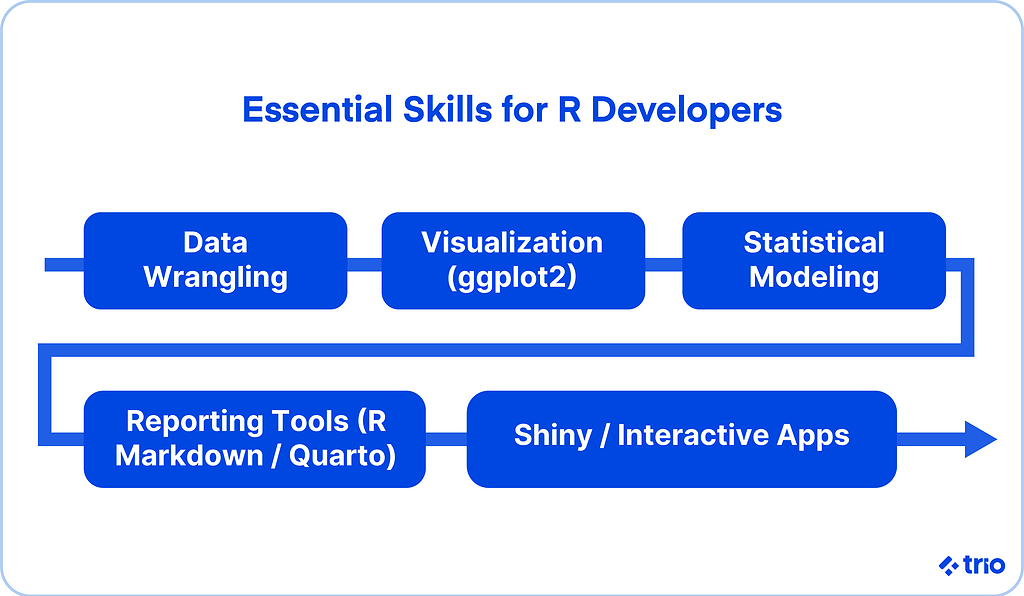
Others lean toward data engineering tasks like ETL pipelines or scheduled reporting. The ideal mix depends on your goals, and it’s worth asking candidates how they balance analytical thinking with practical software habits.
R Developer Job Description
Below is a job description you can use as a starting point. Feel free to adjust depending on how much modeling, reporting, or dashboarding your team actually needs.
Job Title: R Developer
Responsibilities:
- Develop, maintain, and document R scripts for analysis and reporting
- Build statistical or predictive models when needed
- Collaborate with analysts, engineers, and business stakeholders
- Create reproducible workflows using tools like R Markdown, Quarto, or Shiny
- Support data cleaning, transformation, and visualization tasks
Qualifications:
- Strong knowledge of R and the Tidyverse
- Background in statistics, analytics, or a similar field
- Experience with SQL or Python may suggest a smoother collaboration with engineering teams
- Working knowledge of data modeling concepts
- Comfortable explaining technical results to non-technical audiences
Interview Questions for R Developers
If you’re unsure how to assess an R developer beyond the resume, a few targeted questions can reveal how they think and how they handle uncertainty.
You do not need to interrogate candidates; even casual discussions can surface whether someone understands the tradeoffs behind their decisions.
Here are some questions you might use:
- How do you decide when to use the Tidyverse vs base R for a particular task?
- Can you walk me through how you handled missing data in a recent project?
- What’s a modeling mistake you’ve seen teams make, and how did you deal with it?
- How familiar are you with tools like Shiny or Quarto, and what kinds of projects have you built with them?
- Tell me about a dataset that surprised you and how you approached exploring it.
Good candidates usually speak plainly and acknowledge the gray areas in analytics, which can sometimes matter more than delivering a perfectly polished answer.
Technical Assessments for R Developers
You don’t need a lengthy take-home assignment to gauge someone’s skill. Something small and focused often says more about the way a developer approaches messy problems. I’ve seen teams learn a lot from quick tasks that mimic real work instead of synthetic puzzles.
A few effective assessment ideas include:
- A short data wrangling task where they reshape, clean, or join multiple tables
- Building a simple Shiny app that responds to user input and updates a plot
- Creating a small predictive model and writing a short explanation of their approach in R Markdown
The goal isn’t perfection. You’re mostly looking for clarity, reasonable choices, and a sense of how they communicate their thinking.
How much do R developers cost in the U.S.?
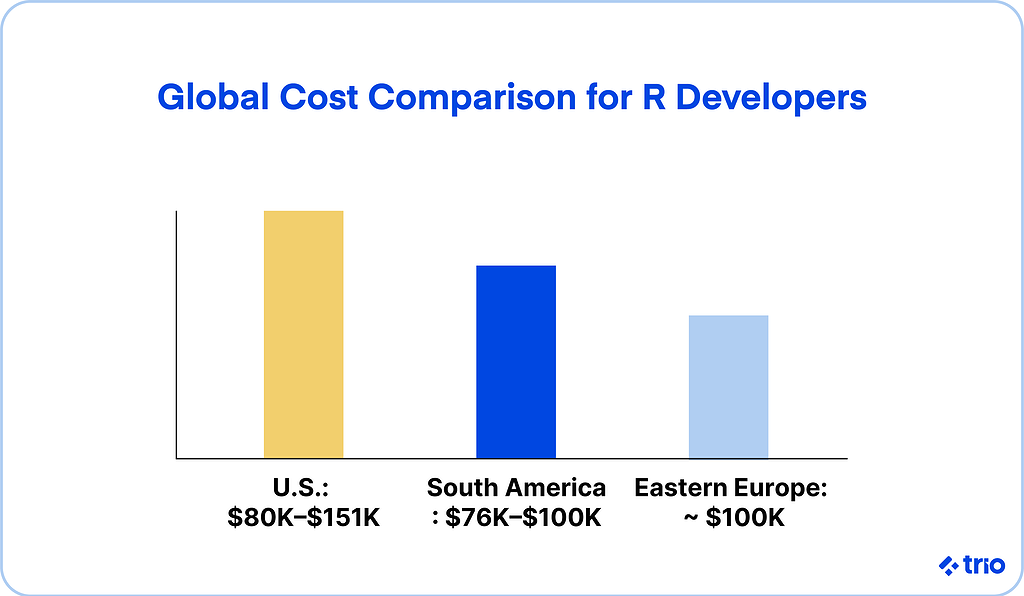
In the United States, ZipRecruiter reports that R developers make $125.5 annually on average. They can make as low as $80,000 and as high as $151,000.
How much do developers cost in South America?
Due to economic differences between the United States and South America as a whole, the cost of offshoring software development is significantly lower than hiring full-time U.S talent. For Senior R Developers in South America, the average salary is currently around $100,000, whereas a mid-level developer costs around $76,000.
How much do developers cost in Ukraine / Eastern Europe?
Eastern Europe shares very similar rates to South America, again due to the economic differences. When looking at salaries in Eastern Europe, data shows that a Senior R Developer costs around $100,000 on average.
Hourly Rates for Developers
Another way to look at developer costs is through hourly rates. While salaries are good to understand for hiring developers for full-time and long-term, you might just need a developer for a period of 3-6 months or 6-12 months. In these types of situations, it’s best to calculate your costs based on the hourly rates of a developer.
Below is a table that lists the various hourly rates of developers in different locations based on their job title.

Hire an R Developer with Trio
Trio R developers are pre-vetted, interviewed, and then trained further to become true software professionals, capable of adapting to situations that are both within and outside of the scope of their general expertise.
At Trio, we hold our developers to a higher standard. Much like how elite special forces units recruit only the best from the main branches of the military, we recruit developers who either show amazing potential or demonstrate exceptional skill. We then take their talents and sharpen them even further.
Another benefit of hiring a Trio developer is that you won’t incur the costs of hiring, which can add up to be around 30% of a developer’s salary on average, as well as overhead costs associated with full-time employment.
By working with Trio, you can enjoy a highly experienced full-time developer for a fraction of the cost, along with additional project management support.
To learn more, tell us about your project, and we’ll get you started.

R Resources
FAQs
How do I hire an R developer?
Hiring an R developer usually means clarifying your project needs upfront and then evaluating candidates on both coding habits and statistical judgment. A short trial project often helps confirm fit.
What skills should an R developer have?
Skills an R developer should have generally include strong R and Tidyverse knowledge, plus enough statistical grounding to make sound modeling choices. Experience with Shiny or SQL is a helpful bonus.
How much does it cost to hire R developers?
The cost to hire R developers depends on region and seniority, with North American rates at the top and LATAM or Eastern Europe offering more affordable options. Hourly or monthly pricing can simplify planning.
Where can I find R developers for hire?
You can find R developers for hire on platforms like Trio, Toptal, Terminal, and Upwork, along with communities like Kaggle and Posit. A mix of direct outreach and curated talent sources works well.
What does an R developer do?
An R developer typically works on data cleaning, analysis, modeling, or dashboards, depending on your needs. Many also help maintain reproducible workflows using R Markdown or Shiny.
When should I hire an R developer?
You should hire an R developer when your team needs support with modeling, reporting, or analytical workflows that spreadsheets can’t handle. Complex or fragile data processes are common triggers.
Is R good for machine learning?
R is good for machine learning when you want approachable modeling tools and clear documentation. Libraries like caret and tidymodels make ML tasks easier without requiring heavy engineering work.
Can an R developer build dashboards?
An R developer can build dashboards using Shiny, which is widely used for interactive analytics. These dashboards often help non-technical teammates interact with data more comfortably.