

Software development team structure may sound like a dry operational detail, but it shapes nearly everything about how your product comes to life.
And in 2026, with remote work becoming the default and AI tools creeping into every corner of the workflow, the way you organize your team has a much bigger impact than it did a few years ago.
Finding the optimal software development team structure will help you more than you know.
With new technologies popping up every day, it’s easy to adopt a consumer mindset. You start thinking about life in terms of products rather than people.
In business, especially, it’s only natural to pay attention to the numbers instead of who’s producing the numbers.
But in software development, your team will ultimately determine the success of your business.
And to make sure you and your team are on the right track, you must find the ideal software development team structure for business growth.
Follow along to learn more about how you can build the optimal software development team structure. Keep reading!
Are you ready to start your development project?
We have the developers you need to take your development project in the right direction.
Companies are proven to grow their business faster with Trio.
What Is a Software Development Team Structure?
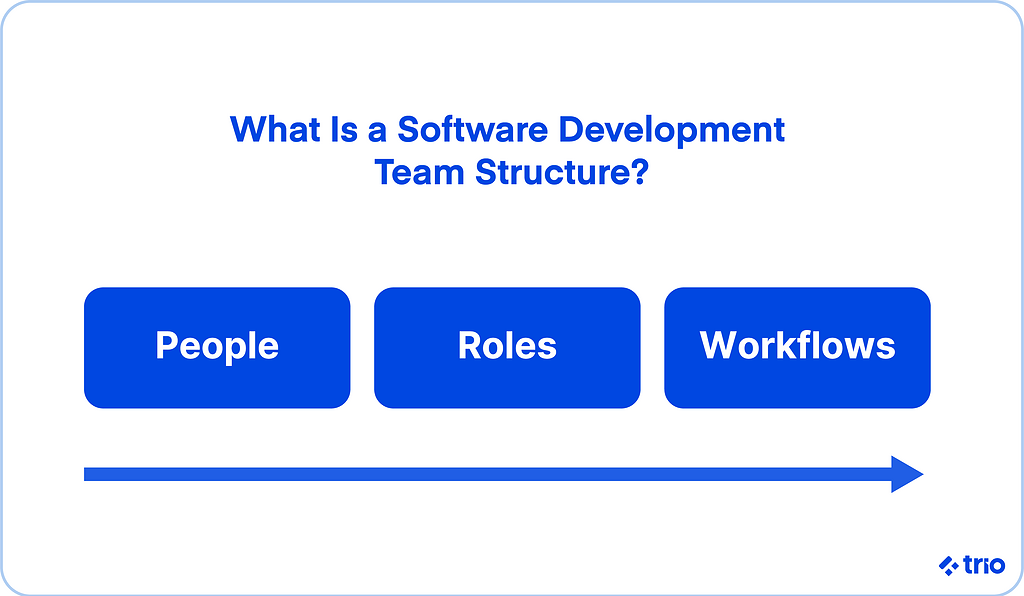
A software development team structure describes how your team is arranged, who is responsible for what, and how decisions move from idea to implementation.
It may look a little like a hierarchy on paper, although in practice, most modern teams operate more fluidly than a strict org chart might suggest.
Your structure can be functional, cross-functional, agile, or something in between. The right choice depends on your product stage, complexity, budget, and your appetite for change.
Teams that handle fast-moving products usually keep things flatter and more collaborative, while teams dealing with legacy systems or compliance-heavy environments often prefer a bit more definition in roles.
This may sound obvious, but a clear structure also gives your developers a way to understand who to ask for what, which reduces a surprising amount of friction in day-to-day work.
Why Choosing the Right Structure Matters in 2026
The fundamentals haven’t changed.
A great product still comes from great people. But the world around those people has shifted. Remote collaboration is now the norm, even inside companies that once avoided it.
AI tools can accelerate development or, depending on how they’re integrated, introduce new gaps in the process. And expectations for delivery speed have tightened.
Because of all this, the structure you choose isn’t just an internal preference. It shapes communication, handoffs, team morale, hiring, and how easily your team adapts when priorities inevitably change.
Identify Key Factors in Building a Software Development Team
There are several key factors you should identify before building a software development team. This will all play a part in how your software development team structure will look in the end.
Complexity of Project
First and foremost, you must determine the complexity of your project. A notes app, for example, has a simple function.
Sure, you could fill it to the brim with a bunch of neat features. But at its base level, an app of this kind would not require a full-fledged software development team.
In fact, you’d probably only need one software developer to work on the project, or no more than four dedicated developers.
On the other hand, if you’re building something more complex, there are many more resources that you’ll want to account for.
A complex app might have multiple third-party integrations and require lots of business logic and data manipulation.
For instance, a project management system or a mobile game is a complex enough product to require several specialists, from front-end developers to security engineers.
And complexity rarely stays still. As features expand or customer expectations shift, a team that originally worked just fine may start showing signs of strain.
Paying attention to how complexity evolves helps you adjust your structure before issues snowball.
Scope of Project
You also want to understand what stage of development your project is in because this will affect your overall software development team structure.
In general, there are three major stages of development: proof of concept, MVP development, and product development.
Proof of Concept
The proof of concept stage, also known as the discovery stage, consists of documentation and evidence to demonstrate the feasibility of an idea.
In the software development industry, this often looks like gathering market research to see just how well similar products have performed compared to what you have in mind.
In addition to marketability, market readiness depends on your potential product’s:
- Target demographic, or how likely intended users are to adopt your software
- Necessity, or the ability to address pain points
- Functionality, or your team’s capacity to make the product function as intended
- Tech stack, or what technologies the team will use in development
During this stage, teams may stay intentionally small because adding more people too soon often creates confusion rather than clarity.
A designer, an architect, and a product owner can usually carry the load.
MVP
The minimum viable product (MVP) is a test of your product’s viability in the live market.
It describes a specific development technique where you introduce the product to the market with only its most basic features.
Once the product starts getting attention from consumers, you can collect feedback and assess for future changes.
MVP teams tend to grow a little here, although you still want a lightweight group that can operate quickly. Too many voices may slow things down at exactly the wrong time.
Product Development
The product development stage will be the most time-consuming.
Now, your developers are punching code into machines and awaiting the results of their efforts.
Depending on the complexity of your project, you could be pouring blood, sweat, and tears into this project for months at a time.
Budget
No doubt, the budget will affect each and every factor in optimizing a software development team structure.
Many software development technologies are free and open-source. But software developers with great talent do not come cheaply.
Some companies choose to hire remote software developers to offset the cost of physical infrastructure.
As a bonus, remote developers would mean greater access to global talent. And global talent has much to offer.
India is a popular country for outsourcing software development. Eastern European countries like Ukraine have free rein in the industry, too.
For all that, offshore software development knows no boundaries. Brazil, for example, is leading the educational sector for software development and information technology.
Yet, outsourcing costs in the Latin American region remain low due to economic differences.
In short, financially savvy businesses can still make ends meet while hiring qualified software engineers.
Your structure may shift depending on your budget, too. If funds are tight, you might rely more on generalists or a smaller team.
With more room to work, you may introduce specialists for better quality or faster delivery. It isn’t always a straight line, and companies often adjust year by year depending on revenue cycles.
Deadlines
Meeting deadlines is a point of contention in itself within the software development industry.
Software development teams certainly don’t lie about their capacity to build a product.
That said, delays and bottlenecks tend to materialize in thin air, and no one ever sees them coming.
Project management encompasses the role of overseeing a team and seeing to it that the project is finished on time and on budget.
While you can quantify cost and time, the performance of a team — though visible in metrics — is rarely cut and dry.
For instance, software developers do their best work when they share the same motivations as the businesses they work with.
Ergo, keeping software developers motivated should be a priority. In spite of deadlines, keeping things flexible and setting realistic goals is crucial to motivating software developers.
Creating an open line of communication is similarly essential. Even if a developer isn’t able to reach a deadline, they probably have a good reason.
Being able to talk to supervisors about a problem without hesitation is indicative of a positive work environment.
To add, many software development team structures involve remote work. And managing a remote team is bound to get difficult.
Use a variety of tools to get everyone on the same page and hold regular check-in meetings.
Altogether, ensure that communication and empathy are key values within your software development team to guarantee success.
As your team grows, deadlines may need to be approached differently. Larger groups sometimes look more efficient on paper, but can move more slowly because coordination overhead increases.
A smaller, experienced team can sometimes outpace a larger one. This dynamic often surprises newer founders but becomes obvious once you’ve lived through a few product cycles.
Resources
The resources you need for software development can range from office space to having insider knowledge.
Still, there are three vital elements that every software project needs:
Human Resources
Once again, people over products. Finding the optimal software development team structure begins and ends with people.
Analyze the skill sets and specialties of applicants during the hiring process and assign them to the roles that fit best.
Building a successful software development team means not only zeroing in on the technical skills of a job candidate but also evaluating and cultivating soft skills as well.
Teams that struggle usually do so not because someone can’t code, but because personalities clash or communication habits don’t align.
Small things like preferred communication style or comfort with ambiguity play a bigger role than most job descriptions admit.
Reusable Components
Reusability is an integral concept in software engineering that stresses the importance of using existing assets during the software development process.
Code reuse has been an efficient practice to transcend the test of time. Without question, this tried-and-true technique has sped up the software development lifecycle for ages.
Besides code, you should always look to reuse the assets you already have to better manage your budget.
Whether it’s documentation, technology, or templates, all are great candidates for reuse.
If you find yourself writing the same internal explanations repeatedly or reinventing typical components like login flows or dashboards, it may suggest your structure needs someone responsible for shared knowledge or platform-level thinking.
Hardware & Software Tools
These are the material resources you need for your project.
You should plan out what hardware and software tools you’ll be using before starting development. Otherwise, you’re sure to run into issues.
Hardware provides a platform of support for the software tools your team will inevitably be using.
Make sure that your software development team structure accounts for what hardware and software each team member needs and when they need it.
Size of Team
The size of your team is extremely variable, and there is no one-size-fits-all solution.
For product development, the Scrum methodology insists that the perfect team size is seven members or fewer.
The creator of Scrum, Jeff Sutherland, found through investigative research that teams with six members took nearly a year to get the job done.
Adversely, teams with 10 members delayed the project another six months.
However, the most productive teams split into subgroups of seven members or fewer.
Of course, the type of project you’re working on plays a large role in team size, too.
For proof of concept, you may not even need actual software engineers. But you will need up to five specialists.
This team would include the product owner, project manager, business analysts, software architect, and a UI/UX designer.
When it comes to developing your MVP, you’d need at least six specialists, with the addition of software engineers and test engineers.
In product development, agile methodologies enforce having no more than 10 people per team.
And you can choose to bring in DevOps engineers, security engineers, test automation engineers, and performance engineers at this point.
More important than team size is building cross-functional, self-managing agile software development teams that are nimble and collaborative.
Some founders assume that adding more people naturally speeds things up.
In practice, team size needs to match the communication bandwidth of the group. Too big and every decision gets bogged down in Slack threads. Too small, and people get overwhelmed. It’s a balancing act that changes with your product’s maturity.
Agile vs Traditional Team Structures
Agile and traditional structures both have their place, although teams sometimes adopt one without really thinking about why.
Agile teams tend to be smaller, cross-functional, and comfortable with shifting priorities. Traditional structures lean more toward clear handoffs, distinct phases, and a bit more predictability.
If your project changes often or relies heavily on user feedback, an agile structure usually fits better.
On the other hand, if your product has strict regulatory requirements or a complex approval pipeline, a more traditional layout may appear safer.
Neither choice is automatically right or wrong, but mismatching your structure to your environment can slow your team down before it even starts.
A quick comparison can help clarify things:
- Agile teams stay small and cross-functional, with designers, developers, QA, and sometimes DevOps working side by side.
- Traditional teams separate responsibilities into stages like analysis, design, development, and testing.
- Agile teams revisit priorities frequently, while traditional teams tend to lock scope earlier.
If you’ve ever been in a project where the requirements shifted halfway through, you’ve probably felt the pain of using a traditional structure when the work needed to be agile.
It’s a lesson most of us learn the hard way.
Define Your Software Development Team Structure
There are three common ways to structure a software development team.
The structures in question are designed to be elastic and accommodate an Agile approach to development.
Generalist
Generalist teams include developers who are keen on multitasking and can generally do anything.
They wear several hats, not focusing on any one software (like PHP or Go).
Generalists can also be full-stack developers who are capable of working on both the back-end and front-end of a software project.
The drawback is that if a certain project requires a high level of specialization, a team of generalists might not have the skill set required.
Generalist teams may move quickly in the early stages, although quality can slip on more advanced features if no one has deep expertise. That tradeoff is manageable for MVPs and smaller projects, but larger systems may strain this model.
Specialist
Specialists stick to one technology for the majority of their professional careers.
The clear advantage of being a specialist software engineer is that, over time, specialists become experts in the platform, framework, or language that they specialize in.
On the other hand, the major con of having specialists on your team is that they do not have much of an understanding of other team roles.
This makes communication between other team members cumbersome.
Teams built mostly from specialists tend to have high technical quality, although they sometimes move more slowly and may struggle with quick pivots.
A specialist team usually benefits from a strong tech lead who keeps everyone aligned.
Hybrid
You won’t be shocked to hear that hybrid teams combine the best of both worlds.
In a hybrid team, specialists work on functional parts, and generalists focus on communication and collaboration within the team.
The only downfall here is that it is harder to acquire a team of this kind. You need more time and money to make it happen, which isn’t always readily available.
Most mature products eventually lean toward a hybrid layout because it covers the gaps of the other two models.
That said, it requires thoughtful hiring and a clear sense of who fills which role; otherwise, hybrid teams may feel unfocused.
Establish Software Development Team Roles
It’s a common misconception that a software development team only includes software developers.
In reality, there are numerous roles on a software development team. Take a look below.
Product Owner
The product owner represents the needs of stakeholders and communicates the product goal.
As a result, they should have the answers to the majority of the questions the team has.
Product owners manage and optimize the product backlog by internalizing the clearest vision of the final product.
A good PO also translates vague stakeholder requests into something the team can reasonably execute. Without that ability, teams may waffle between tasks or unintentionally build the wrong thing.
Account Manager
The account manager fosters communication between the client and your business.
They tend to be versatile in their role. For example, they might wish a client “Happy Birthday” or give them an update about the project.
Client satisfaction is the chief key performance indicator for account managers.
Not every team needs an account manager, although in service-based environments, this person helps reduce misunderstandings that tend to crop up around timelines and expectations.
Project Manager
Known as the scrum master on some teams, the project manager (PM) mediates the software development process.
Project managers act as a liaison between the team and the product owner, serving the best interests of the official project deadline.
They eye the workflow like a hawk, keeping everyone on task. And prevent further disruptions in the workflow when they do occur.
Some companies separate the PM and Scrum Master roles, while others merge them.
The right call depends on your team size and how strictly you follow agile ceremonies. It’s one of those decisions where culture matters as much as process.
UI/UX Designers
This title goes under many names, including but not limited to information architects, user-pleasers, product designers, and experience designers.
But user interface (UI) and user experience (UX) appropriately describe the relationship UI/UX designers have with the product.
Essentially, they curate the look and feel of your application so that users can thoroughly enjoy using your product.
In doing this, they collect market research and user interviews to develop a product with end-users in mind.
Their work may seem subjective at times, yet a strong designer often prevents costly mistakes by identifying usability issues early.
You save a surprising amount of time by having a designer who asks the right questions before a single line of code is written.
Software Architect
Software architects are software development experts who make high-level design choices and set the technical standards for the entire project.
They may be developers themselves, but the role they occupy carries more responsibility than the typical developer.
An architect’s influence varies from team to team. On small projects, they may be hands-on. On larger ones, they guide patterns, security considerations, and long-term maintainability.
Their presence often becomes noticeable only when they’re absent, since technical decisions start drifting apart.
Developers
It should come as no surprise that developers are a quintessential component in building the optimal software development team structure.
Sometimes called product engineers, these team members apply their software engineering skills to product development, programming the application based on project requirements.
Developers can be front-end, back-end, or full-stack.
Some teams also identify specializations like mobile developers, data engineers, or AI engineers.
Whether you need these roles early depends on your product’s direction, but adding them too late can slow adoption of new features.
DevOps Engineer
DevOps engineers tackle all the logistical issues you may experience after releasing your application.
Your application needs to perform for users 24/7. To maintain its accessibility, the product must be able to respond well to sudden spikes in user activity or upcoming upgrades.
DevOps specialists also account for how much it will cost to maintain your app, given all these considerations.
They are also the ones who remind everyone that launching the feature is only half the job. Keeping it running is the other half, and it tends to be the one teams forget.
Quality Assurance
Software quality assurance (SQA) is critical to your product’s success.
Testing is an SQA fundamental that ensures the product works in the first place.
But quality assurance also relies on a set of standards, like functionality and maintainability.
QA engineers test the product and manage its quality prior to release.
Some founders try to skip QA early on to save money, and it almost always backfires. A single overlooked edge case can cost more to fix later than the cost of bringing QA in from the start.
Business Analyst
The job of the business analyst is to tell you what more you can do to create a great product.
They consult with stakeholders and listen to their concerns. Then, business analysts document and analyze common pain points to come up with a solution.
Analysts often bridge the gap between what stakeholders want and what developers can realistically achieve.
When this bridge is missing, teams may quietly accumulate a backlog of features that no longer match the business context.
Security Engineer
Security engineers keep your security systems up and running. As the first line of defense against unauthorized access to private data, their job is mostly to pinpoint potential threats.
They will test and screen security software and implement new security features when possible to protect you from vulnerabilities.
Even small products benefit from early security thinking. All it takes is a single misconfigured permission or an innocently exposed endpoint to create serious headaches down the road.
How To Build a Software Development Team (Step by Step)
If you’ve ever felt unsure about how to actually assemble a team from scratch, you’re not alone. Here’s a simple process that avoids the usual guesswork.
- Clarify your product stage and expected pace. A PoC doesn’t need the same setup as a mature product.
- Choose your delivery approach. Agile, traditional, or something hybrid.
- Select a structure. Generalist, specialist, or hybrid.
- Determine team size. Start with what the project demands, not what your budget spreadsheet assumed months ago.
- Identify critical roles. Some roles can wait, others can’t.
- Decide how you’ll hire. In-house, outsourced, or a mix of both.
- Set communication and workflow expectations early. This step may seem small, but it removes a lot of friction later.
Even if your project shifts direction, this process gives you a stable starting point. Teams that skip it often struggle with duplicate responsibilities or unclear decision paths.
Elevate Your Team with Trio AI Talent
Empower Your Projects with Trio’s Elite Tech Teams
Build a Great Software Development Team
Building a great software development team starts with hacking your software development team structure.
There are many more puzzle pieces to software development than most people care to know. But for you and your business, it’s imperative that you get things right.
Looking to hire some specialists for your software development team? Look no further.
Trio has a full team of highly skilled software developers that can build your software product without you having to lift a finger.
We’re also equipped with the administrative and managerial human resources required to complement and balance your ideal software development team structure.
At Trio, we’re your advantage! Experience the AI revolution with our expert AI Developers and OpenAI Developers. Boost efficiency, make data-driven decisions, and captivate your customers with personalized experiences.
Don’t wait; explore our AI Developers and OpenAI Developers services now for a transformative business journey!
Contact Trio now to learn more about how we can help!
FAQs
What is the optimal size of a development team?
The optimal size of a development team usually means keeping the group small enough to communicate easily, often around five to nine people. Larger teams tend to slow down because coordination becomes harder.
How do you structure a software development team?
Structuring a software development team starts by matching roles and responsibilities to your project stage, then deciding whether you need generalists, specialists, or a mix. Clear ownership helps the structure work in practice.
What is a typical software development team structure?
A typical software development team structure includes a product owner, a project manager or scrum master, developers, QA, and sometimes a designer or DevOps. This setup keeps delivery moving without too much overhead.
What roles are needed in a software development team?
The roles needed in a software development team normally include a product owner, developers, QA, and a project manager. More complex products may add UX, DevOps, or an architect.
What is the best software development team structure?
The best software development team structure tends to be the one that fits your complexity and speed, which often ends up being hybrid. This gives you the flexibility of generalists with the depth of specialists.
How do you build a software development team?
Building a software development team starts by clarifying your scope and picking the right structure. Hiring people who communicate well usually matters as much as their technical skills.