

Hire by Technology
SERVICES

Changes in AI, machine learning, blockchain, cybersecurity, and user requirements mean that the industry is shifting all the time, and you could take advantage of those changes if you had the talent on your team. But that also means there are many opportunities in the fintech market.
As you scale, you'll want to find developers who not only have strong technical abilities but also experience in the fintech industry, and familiarity with industry nuances, such as security and compliance.
We have connected clients with developers from all over the world. Let's take a look at everything we have learned about how to hire fintech developers, including some easy steps you can take to improve your chances of success:
If you want to find the right fintech programmers for your project without the hiring drama, or you want to figure out whether to augment your in-house team or go with a model like outsourcing, you are in the right place.
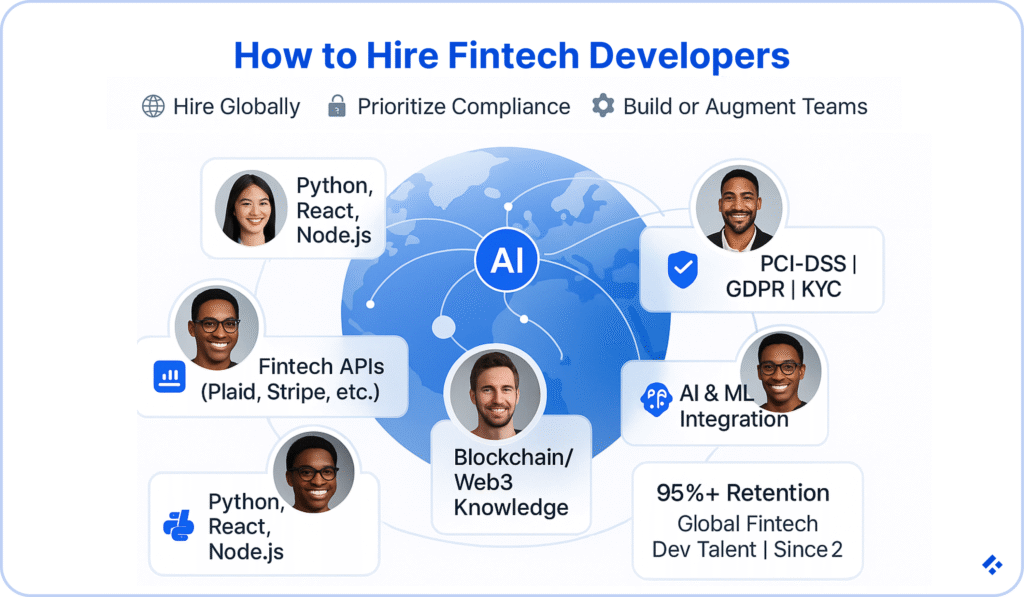
If you want to hire the best fintech developers on your own, a few specific steps can improve your odds considerably.
Before anything else, you need to nail down what skills your developers must have.
This means that you need a good understanding of the end product technically, then you need to be able to translate that into specific languages, frameworks, compliance standards, and security approaches.
If you already have a team, think about cultural fit and what gaps actually need filling long-term, rather than just where your team is experiencing massive workload right now.
By writing a comprehensive job description, you not only attract the right candidates but also filter out the wrong ones.
We recommend that you split your requirements into "must-have" and "nice-to-have" categories. Include enough context about the project that candidates can self-select honestly, and so that you can avoid generalists without the right skillset.
When you post, do so across more than one channel.
Job boards like LinkedIn, Wellfound (formerly AngelList Talent), and Toptal are generally good options.
Niche fintech communities on GitHub, Slack, and professional associations should not be ignored, since they'll give you access to great developers who aren't necessarily job-hunting but would consider the right opportunity.
Related Reading: Fintech Recruitment Reshape: Strategies to Win Talent
When creating a shortlist, make sure that you look at their general resume, as well as their portfolio.
When reviewing a fintech developer's portfolio, look specifically for projects where compliance and security decisions appear to have been made deliberately, not as afterthoughts, and where the situations in which they work are similar to your own.
We've also seen great results with some preliminary screening questions before scheduling calls, which allows us to filter for both technical knowledge and communication quality.
The initial call can be very productive if you use it wisely.
Assess communication skills, familiarity with the financial industry, and how the candidate stays current with a rapidly changing space.
If you are hiring for in-house roles specifically, also think about long-term potential. A developer who's slightly light on one skill but genuinely curious and well-aligned with your direction may be worth investing in, provided they have experience in the fintech industry as a whole.
Live coding challenges and system design interviews both have a place in fintech hiring, but the most useful assessments mirror real-world fintech problems.
Candidates need to grasp both the technical implementation and the compliance implications. Just remember to be considerate of their time. Since the industry is so competitive, they are likely weighing other offers.
The most basic due diligence you can do is to ask about their practical experience with KYC, AML, or PCI DSS.
A simple question like "How would you log user activity in a way that satisfies auditors without overwhelming the database?" separates people with hands-on experience from those who've only read about compliance.
Red flags worth watching for are general overconfidence without any regulatory experience, and a tendency to treat compliance as something that slows innovation rather than something that gets built in from the start.
Cultural fit is a little more difficult to assess up front. A short probationary period may be best before you make a long-term commitment.
Once you've settled on a candidate, we suggest that you move quickly.
Market research helps calibrate your offer, and if you're unsure of current ranges, consulting a hiring firm removes some of the guesswork.
Remember that different hiring models affect how compensation flows, whether that's a salary, a vendor contract rate, or a blended arrangement.
You can't just hire anyone to create your fintech solutions. The survival of any fintech company hinges on user trust, since you are dealing with money and sensitive personal data.
Then there are global regulations to comply with, and the consequences of missing them range from heavy fines to product shutdowns, which might sink a startup that doesn't yet have the cash reserves to absorb a hit like that.
The financial software development sector also changes fast, and staying ahead of new payment rails, fraud tactics, and compliance requirements demands people who are actively working in that space, not just adjacent to it.
All of this means you need specialists who are fully educated on fintech software development, not generalists who will learn on your dime.
At a baseline, you need developers skilled in secure backend systems, scalable infrastructure, and resilient data handling. But that's the floor, not the ceiling.
A strong fintech hire understands transaction consistency, fraud detection patterns, and the subtleties of integrating with third-party financial APIs. They can provide things like audit trails or meet customers' expectations for real-time financial transparency.
Recently, we're also seeing increased requirements for AI-driven tooling as a baseline.
If you're building a payments platform, you need someone who has successfully integrated Stripe, Plaid, Square, or custom bank APIs and understands how these systems fail under stress.
On the compliance side, having a general awareness of GDPR or AML, and having designed systems that hold up under real audits related to those regulations, is critical. Generally, this only comes from lived experience.
When hiring fintech developers, seniority level affects salary as well as how much supervision you'll need to provide, how independently someone can handle compliance decisions, and how quickly they'll contribute to production.
Here's a rough breakdown of what to expect at each level:
As products mature, you end up needing a mix of particular roles. While starting with fintech-experienced generalists is possible for smaller products, overlooking these specializations can create issues later, leading to delays and even failed audits.
Hiring looks different now than it did even five years ago. Remote work has opened up access to fintech developers globally, across several different engagement models.
| Hiring Model | What It Is | What You Gain | What You Give Up / Risks | Typical Cost Range | When It Works Best |
| In-House Developers | Full-time employees embedded in your company | Strong long-term scaling, deep product and compliance knowledge, full control over priorities | Higher fixed costs (salaries, benefits), slower hiring for niche fintech roles | High fixed cost. In the US, roughly $105K–$164K+ per year per developer, often higher for senior or specialized roles | When you’re building for the long haul or preparing for scale and regulatory scrutiny |
| Freelance Fintech Developers | Independent contractors hired per project or task | Quick access to talent for narrowly defined work, flexible engagement | Inconsistent availability, weak compliance continuity, and knowledge loss after the contract ends | Variable. Often $30–$150+/hour depending on experience and region | Short, clearly scoped work like audits or one-off integrations |
| Outsourced Fintech Development | External firm delivers the project end-to-end | Fast execution, access to established teams, reduced internal workload | Quality depends on the vendor, risk of weak compliance if fintech experience runs shallow | Mid to high. Typically project-based or $40–$120+/hour depending on firm and location | When speed matters, and you can properly vet firms with compliance-heavy experience |
| Staff Augmentation | External developers join your team temporarily | Adds specialized skills without permanent hires, flexible scaling, and easier to swap talent | Requires internal management, can strain teams new to distributed collaboration | Mid-range. Often $40–$90/hour for vetted developers, depending on requirements and region | When your team exists but needs targeted expertise or extra capacity |
| Hybrid Models | Combination of in-house, outsourced, and augmented teams | Flexibility across growth stages, balance of control and speed | More coordination is required, and management complexity increases | Blended cost. Core salaries + external rates, optimized based on where you allocate work | When moving between product discovery, scaling, and regulatory readiness |
Hiring a great fintech developer solves only part of the problem. Keeping them when other large companies are trying to get them on their team is another challenge.
After you have finalized the contract, don't just assume your developers will show up and figure things out.
Instead, bring new developers up to speed on internal tools, compliance procedures, and the specific systems they'll own. Establish a clear hierarchy so they know who to report to and who to ask for help.
It can be helpful to assign a mentor or partner for the first few months, which tends to speed up integration and makes people feel supported.
Compensation typically includes base pay, equity options (especially relevant for startups), and benefits like healthcare and retirement matching. All of that can be circumvented if you go through a hiring model like staff augmentation, but keep it in mind if you're getting someone in-house.
Many developers find fintech startups appealing specifically because of the chance to work on products that actually matter and will make them feel like they are contributing to the forefront of the industry.
These could be tools that improve credit access, simplify payments, or bring financial services to underserved populations.
Continued education also matters more than most employers realize. Providing a budget for certifications or conference attendance signals that you're investing in your developers' growth, which makes staying more attractive than leaving.
Hybrid or remote working options, flexible hours, and a healthy work culture all affect long-term satisfaction, too.
We've seen even well-funded fintech firms struggle with hiring. Money isn't the only thing that matters. Fortunately, being aware of where others run into issues means that you can be prepared ahead of time and avoid the issues entirely.
Hiring generalists because they are easy to come by is by far the most common mistake we see. It feels like a win because you access development talent earlier, but without fintech-specific experience, the developers end up creating liabilities.
These then take even more time and resources to fix retroactively.
Underestimating the importance of compliance and risk expertise leaves your product exposed to fines or shutdowns. Fintech specialists will be able to best advise you, and will help you bake these features into your product from the ground up.
Making sure that you build a long-term hiring strategy is the best way to ensure that you can easily expand your team up and down in the future.
At Trio, we take care of this for our clients through staff augmentation. This means they can onboard extra talent in days when they need it, without starting the hiring process from scratch, and don't need to commit to those developers when their job is done.
However, if you are hiring on your own, you will need to consider several factors to ensure that you are prepared.
Inflating your headcount can be tempting, especially if you think that you will grow quickly. However, having way too many developers on your team before you really need them consumes resources you could better spend elsewhere.
On top of that, bigger teams take longer to make decisions, which can delay your growth.
The best thing you can do is keep your team as lean as possible for as long as you can.
Even though you don't want to hire early, you should definitely build relationships as soon as you can.
That might mean cultivating university partnerships, participating in fintech communities, or staying in warm contact with candidates who weren't quite right a year ago but may be now.
Related Reading: Building a Fintech Talent Pipeline
If you do your due diligence, hiring fintech developers is a fairly straightforward process. However, you may need at least some level of technical knowledge, as well as a general awareness of the fintech industry, so you can assess candidates.
The risk of a wrong hire is high, and competition for top candidates is steep.
If you do not have the required skills to hire fintech developers on your own, or you cannot afford to take on the additional risk, hiring through an industry-proven staff augmentation partner like Trio can be beneficial.
Our pre-vetted engineers can onboard in as little as a week. And if you decide that the developer does not fit your company culture, easy replacement is baked into our processes.
To get started, book a discovery call.
To hire fintech developers for your team, you first need to define the roles you need, source through specialized channels like fintech communities and vetting firms, and evaluate both technical skills and compliance knowledge. Do not neglect things like cultural fit, as this can affect long-term retention.
Fintech developers for hire appear on platforms like LinkedIn, Toptal, and Wellfound, but the most experienced engineers tend to surface through niche fintech communities, open-source projects, and specialized staffing firms like Trio.
When hiring fintech app developers, look for experience with payments APIs like Stripe or Plaid, compliance frameworks like PCI-DSS or KYC/AML, and security-first development practices.
A typical in-house hire for a fintech role takes two to four months from posting to start date, largely because the talent pool is small and specialized. Staff augmentation through a firm like Trio that already has vetted fintech developers available tends to compress this to one to two weeks.
The difference between a fintech developer and a regular software developer is largely domain knowledge, which means fintech-specific developers are aware of compliance requirements, fraud patterns, financial API behaviors, and audit trail design.