
Upwork comes up in almost every conversation about hiring freelance developers. The platform has built a name around its marketplace model that promises quick connections to technical talent across every possible tech stack.
If you need to add engineering capacity to a fintech product, you might be tempted to use Upwork. But just because it is a good option for more general projects does not mean it is suitable for those in the heavily regulated financial environment.
When it comes to payments, lending, insurance, investment, and anything else that might fall into the fintech category, Upwork and Trio solve different problems for different teams.
They have entirely different approaches to vetting, support, domain fluency, and what happens after the match.
Let’s break down Trio vs Upwork for fintech teams, figure out which platform actually delivers, and see where each one fits depending on what you’re trying to build.
For help deciding which option works for your situation, book a decision call.
Key Takeaways
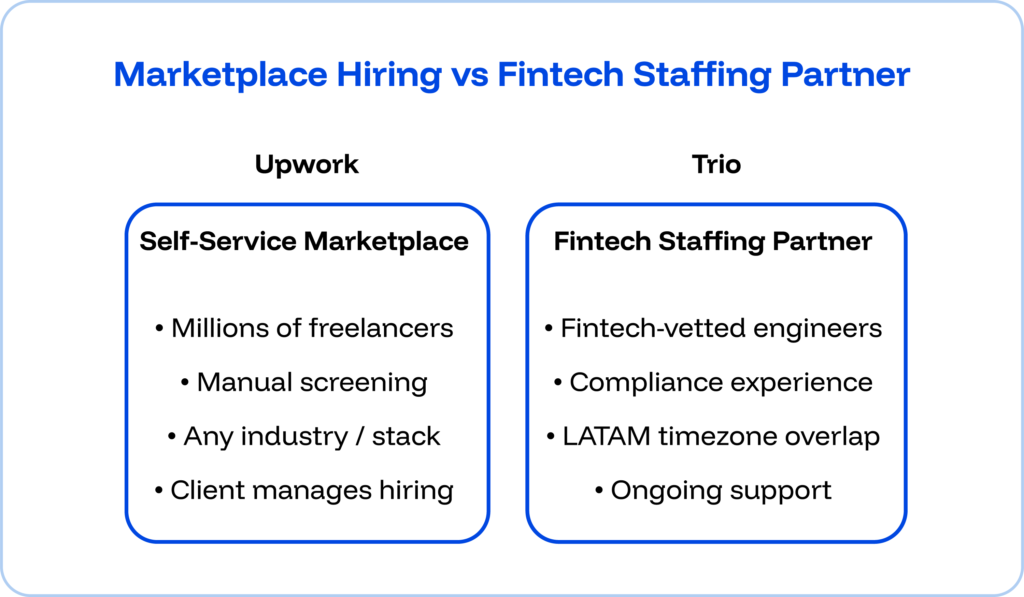
- Upwork works like a self-service freelance marketplace with millions of profiles to choose from. Trio operates as a fintech-focused staffing partner with a smaller collection of fintech domain-vetted engineers.
- You can search keywords on Upwork, but there is no other way to filter for fintech domain expertise short of reviewing portfolios manually. Trio screens every engineer for actual compliance and regulatory exposure, as well as work on similar projects.
- Upwork’s pricing ranges from as low as $3 to $100+ per hour, depending on geography and experience. Trio’s transparent rate sits between $40 and $90 per hour, but you are guaranteed a senior fintech developer.
- Trio and Upwork both offer some protection during onboarding, but Upwork is more focused on secure payment and dispute capabilities, while Trio offers the option to try another developer without restarting the hiring process entirely.
- For teams working on niche legacy stacks outside fintech, Upwork’s global reach gives you access to a wider talent pool than Trio’s limited LATAM and African talent.
Quick Comparison
| Upwork | Trio | |
| Model | Self-service freelance marketplace | Dedicated fintech staffing partner |
| Talent Focus | Generalist (all industries, all roles) | Fintech-specific engineering |
| Geography | Global | LATAM / Brazil-forward |
| Time to First Candidate | Hours to days (self-search) | 3 to 5 days |
| Pricing Range | $3 to $150+/hr | $40 to $90/hr |
| Vetting Process | Self-reported profiles, reviews | Domain-vetted for fintech fluency |
| Replacement Support | None (client manages) | Ongoing replacement support |
| Onboarding Help | Self-managed | Assistance available |
| Stack Coverage | Extremely broad | Fintech-focused |
| Domain Expertise | Variable by candidate | Payments, lending, banking, compliance, etc. |
Upwork Overview: What the Platform Offers
Founded in 2013 as a merger between Elance and oDesk, Upwork has more than 18 million registered freelancers covering everything from graphic design to mobile development to financial modeling.
Thanks to the massive variety and its global availability, Upwork has become a one-stop marketplace for any kind of contract work.
The model centers on self-service.
You post a job, freelancers submit proposals, you review profiles and portfolios, conduct interviews, and make a hire.
Payments and dispute resolution are taken care of on Upwork’s side, but ultimately, responsibility for screening and hiring, as well as everything outside of that, like onboarding, all falls on your shoulders.
Pricing varies wildly depending on what you are looking for and how new the Upwork platform is. Region also plays a major role in costs, as developers in India, for example, can get away with charging a lot less than developers in a place like Germany.
You’ll find developers charging $3 per hour in some regions and $100+ per hour in others.
Upwork applies a sliding service fee to freelancers (5% to 20%, depending on lifetime billings with a client), which might also play a role in the rates that they charge.
Protection comes through Upwork’s Payment Protection program.
For hourly contracts, you can set spending limits and review work logs. For fixed-price projects, milestone-based escrow gives some assurance.
But if the match doesn’t work, finding a replacement means starting the search process over.
Where Upwork clearly wins relates to breadth.
If you need a Laravel developer with experience in e-commerce, a technical writer who knows SaaS documentation, a data analyst fluent in Tableau, or someone with experience in some obscure technology that is only seen in very few legacy systems, you’ll probably find them here.
The global talent pool means there is a wide variety of skills available. That coverage extends across time zones and languages, too, which is something that a smaller platform cannot compare with.
Related Reading: Top 8 Best Toptal Alternatives
Trio Overview: How the Platform Approaches Fintech Differently
Trio is a smaller firm that focuses exclusively on fintech engineering.
Every developer that works for Trio carries real experience in financial systems, whether that shows up as work on payment processors, lending origination platforms, banking APIs, digital wallets, or compliance-adjacent infrastructure.
Vetting goes beyond LeetCode exercises. The team that considers developers at Trio is, of course, fintech-experienced themselves, so they know what to look for when screening for domain fluency.
The result is that all candidates are already familiar with KYC workflows, AML reporting requirements, SOC 2 controls, PCI DSS scoping, and the practical reality of building in regulated environments.
Beyond that, Trio makes sure to consider your specific requirements and considers whether the developers have proven experience in similar projects and in similar regions before presenting you with portfolios.
Sourcing centers on Latin America, with particularly strong coverage in Brazil. These regions are emphasised because of the time zone overlap with US Eastern and Central teams, which tends to reduce the friction that comes from asynchronous-only collaboration.
After you are matched with a developer, Trio stays involved as a long-term tech partner. If you need it, you can get a structured onboarding process that covers sprint participation, ticket assignment, escalation paths, and regular check-ins.
And if, despite the thorough vetting and careful placement, an engineer isn’t working out, you can start the process of replacing them without having to go through the entire hiring process from scratch.
Since Trio offers only senior fintech developers, pricing ranges from $40 to $90 per hour. This is considerably less expensive than developers of the same caliber would be if hired in-house in the U.S.
The tradeoff appears in stack coverage. Trio is smaller than Upwork and has a definitive niche. You may struggle to find the right developer if you are working with software that is only seen on very rare occasions.
Related Reading: Fintech Recruiting Agency Alternatives
Vetting Process Comparison
Both Trio and Upwork vet their developers, but they do so very differently.
Upwork’s vetting consists of profile verification and skill tests (optional and self-selected by freelancers). Outside of that, you have to rely on the freelancer’s self-presented portfolio and client reviews accumulated over time.
A developer with strong reviews and a solid portfolio likely knows their craft, but it is difficult to discern whether they truly understand the nuance that comes with security and regulatory compliance in the financial services industry.
The result is that, for fintech work specifically, that gap creates onboarding friction.
A talented generalist engineer can absolutely learn the domain, but the timeline for that learning doesn’t always match your product roadmap, and since they are freelancers, you may go through all the effort of teaching them only to have them unavailable in the future.
Trio’s process adds a domain screen on top of technical ability.
Every developer you hire at Trio has guaranteed fintech experience, where they have worked on real products with regulatory oversight. They just need to familiarize themselves with your software, not the whole industry.
Trio’s developers are also full-time employees at Trio, so there is a greater chance that you can access the same developers again in the future.
Speed to Hire and Time Zone Considerations
Upwork’s self-service model means you can post a job and start receiving proposals within hours.
If you are comfortable managing the entire selection process and have the resources to do so, then this could be a good option.
The onboarding timeline after you make a selection, though, depends entirely on how quickly the freelancer can start and how much context transfer you need to handle.
Trio targets three to five days from intake to first candidate introduction, with onboarding support included. And, of course, you have to spend far less in terms of time and resources to ensure the candidate is suitable.
Time zones add another layer of consideration.
Upwork’s global reach means you might hire someone in Eastern Europe, South Asia, or Southeast Asia. Those developers might be affordable, but the time difference might not be suitable for your team.
Trio’s LATAM focus provides 0 to 3-hour time zone differences from US teams, which keeps most communication synchronous.
That overlap tends to accelerate velocity on fintech projects where you can answer important questions and unblock development in real-time.
Pricing Breakdown
We have already mentioned pricing briefly, but to recap, Upworks developers can charge anywhere from $3 per hour for junior talent in lower-cost regions to $100+ per hour for senior specialists in the US or Western Europe, while Trio charges $40 to $90 per hour depending on your requirements.
It is also important to note that Upwork charges clients a service fee (currently 5% to 10% depending on contract type), and freelancers pay a separate fee that effectively gets priced into their rates.
For a mid-level fintech developer on Upwork, you might pay $60 to $100 per hour all-in, but the variance depends heavily on where they’re based and how they’ve structured their pricing.
Trio has no platform subscription and no hidden markup. That transparency makes budgeting simpler, particularly when you’re scaling a team or planning capacity across multiple sprints.
The more important thing to consider is ROI.
If you can find a genuinely better technical fit for a specific problem through Upwork, paying more may make sense.
But for regulated fintech work, you need to think about the cost of addressing gaps in compliance and security later, or the cost of fines and loss of customer trust if a problem surfaces.
Fintech Domain Fluency
This is where the biggest difference between Trio and Upwork is.
Regulated financial products carry specific constraints that shape how engineers need to approach their work.
Data residency requirements, transaction idempotency, audit logging, separation of duties, least-privilege access models, and incident escalation protocols all require either prior exposure or a learning curve.
Upwork’s talent pool includes engineers from every industry background. Some have fintech experience, but a lot of them don’t.
The probability of finding a fintech-ready candidate depends on how many profiles you review and how well you screen during interviews. And that’s assuming that you have fintech specialists in the pool of applicants.
That variability creates risk.
Trio’s fintech focus attempts to eliminate that variability by screening every candidate for domain exposure before their portfolios are ever presented to do.
Ongoing Support and Relationship Management
Once Upwork facilitates a match, the platform steps back.
Performance management, communication norms, scope clarification, and conflict resolution become your responsibility.
If you have the resources, that’s fine. For lean teams, like startups led by non-technical founders, or engineering leaders already stretched across multiple priorities, the self-managed model adds overhead.
Trio stays involved throughout the engagement.
Clients get documented onboarding steps, defined communication expectations, sprint integration guidance, and an escalation path when issues arise.
Trio also provides additional support directly to the developers if they see that there are issues regarding things like soft skills.
When Upwork Makes More Sense
There are real scenarios where Upwork fits better than Trio.
If your tech stack involves niche frameworks or if you need to fill a position outside of fintech development, like designers, copywriters, data analysts, or finance contractors, Upwork’s massive global pool likely gives you more options.
For teams that already have strong processes for vetting freelancers, managing remote contractors, and handling compliance internally, Upwork’s self-service model may feel more efficient than working through a staffing partner.
If budget constraints push you toward lower-cost regions and you’re comfortable managing significant time zone gaps, then Upwork’s global nature is also going to be advantageous.
When Trio Works Better
For fintech teams at Seed through Series C building products in payments, lending, banking, or compliance-adjacent spaces, the combination of domain-vetted talent, time zone alignment, and ongoing support makes Trio a suitable option.
Teams that have struggled with offshore or nearshore contractors in the past and want to avoid communication gaps or culture alignment issues also benefit from the hand-picked nature of Trio’s developers.
Finally, for engineering leaders who don’t want to rebuild contractor management processes from scratch, Trio’s onboarding support may justify working with a staffing partner instead of a self-service marketplace.
Related Reading: Trio vs Toptal
Conclusion
Upwork and Trio operate in fundamentally different ways and serve entirely different buyer profiles.
Upwork has a lot more variety, but functions as a self-service freelance marketplace where you pick and choose from any industry. Trio works as a fintech-focused development partner with far fewer developers to choose from, but each provided portfolio is guaranteed to be a good fit.
If you are in the fintech industry, building or dealing with regulated products and unique challenges like compliance requirements, Trio is probably the better fit to help you build not only quickly but also successfully.
The combination of fintech-vetted engineers, time zone overlap, transparent pricing, and relationship continuity means you are able to build new features without worrying about taking on additional risks.
If you are a smaller company, the cost savings alone tend to create meaningful budget flexibility.
That said, if your situation involves unusual stack requirements or if you need non-engineering freelancers, the sheer variety that you will find on Upwork is going to make that a better option.
For more information, schedule a call to compare options.
Frequently Asked Questions
Does Trio work for fintech startups, or only for larger companies?
Trio is a great hiring option for fintech startups from Seed through Series C. Trio’s staff augmentation hiring model is particularly suitable for companies that need to move quickly without building a full internal hiring infrastructure.
How does Upwork’s pricing compare to Trio for fintech developers?
Upwork’s fintech developer rates generally range from very little to $100+ per hour, depending purely on what the developer decides to charge, with no guarantees that quality work will be performed. Trio’s pricing sits between $40 and $90 per hour, with a guarantee that you are accessing senior developers with proven experience.
Can I find fintech-specific developers on Upwork?
Yes, you can find fintech-specific developers on Upwork by searching keywords and manually filtering profiles and reviewing portfolios, but the platform doesn’t screen candidates specifically for domain expertise.
What happens if a Trio engineer isn’t working out?
If a Trio engineer isn’t working out, you can get a replacement without restarting the entire hiring process. Thanks to Trio’s fintech expertise and the way that developers are hand-picked based on past experience, replacements are rarely ever required, with a 97% placement success rate.
Does Upwork offer any support after matching me with a fintech developer?
Upwork offers payment protection and dispute resolution, but does not provide additional support beyond that, like ongoing relationship management or onboarding support.
How long does it take to hire a developer through Upwork versus Trio?
Through Upwork, you can post a job and start receiving proposals within hours, but then you need to sift through all of those proposals and start the vetting process. Trio typically delivers portfolios tailored to your project within as little as 48 hours, with guarantees that the developers have all the necessary experience to start contributing almost immediately.
Does Trio only hire from Latin America?
Trio hires a lot of fintech developers from Latin America thanks to the massive tech pool in countries like Brazil and the convenient time-zone overlap with the United States. However, Trio also hires from Africa, providing access to developers in alternative time zones while still providing cost savings.