

 Read Client Stories





 Alex Kugell
 Key Takeaways
- Grails is an open-source web application framework built on top of Spring Boot, running on the JVM, and using the Apache Groovy programming language. It became an Apache Software Foundation top-level project in 2025. It brings Ruby on Rails-style productivity to Java developers.
- Groovy and Grails follow a “convention over configuration” philosophy, which means the framework makes sensible assumptions by default.
- Domain classes define the data model, and GORM (Grails Object Relational Mapping) handles persistence automatically based on that model.
- Grails is a full-stack framework. It handles the model, view (via Groovy Server Pages), and controller layers, and integrates natively with Spring Boot’s dependency injection, Hibernate for data access, and existing Java libraries.
- Grails makes the most sense for Java teams that want faster application development without switching languages or losing access to the Java platform’s existing ecosystem of tools, libraries, and frameworks.
If you value simplicity and consistency, Grails might be a great option for your next software project. Technical details aside, all you need to know is that Grails favors high productivity.
Grails is a lesser-known JVM framework (written in Groovy and built on Spring Boot) with similarities to Ruby on Rails (RoR). This can be a massive asset if you are working with a legacy enterprise system built on Java, like the kind found in banking systems.
Let’s take a closer look at exactly how Grails is used, where you may stand to benefit, and give you all the information you need to decide if it is the right choice for you.
Trio goes beyond providing exceptional software development insights. We connect you with the best South American developers, with senior-level experience in Java and Grails.
On top of that, our focus on financial applications ensures that you get developers pre-vetted for industry experience and knowledge of things like regulatory best practices.
What Is Grails?
In short, Grails is an open-source, Apache Software Foundation web application framework for the JVM that uses the Apache Groovy programming language.
Java is one of the most reliable languages there is, but it is older and often compared to more modern, minimalistic languages, especially as more options become available that might be easier for newer developers to learn.
Ruby on Rails, released in 2004, showed how much faster web development could be with conventions instead of configuration.
In 2005, Graeme Rocher started a Groovy-based equivalent for the JVM, first called "Groovy on Rails", to bring the same rapid-development approach to Java teams.
Officially released in 2008, Grails is more than capable of streamlining web development for businesses and developers who want to spend less time configuring and more time coding.
Like many web frameworks, Grails implements the traditional model-view-controller (MVC) software architecture, which makes Grails even better at speeding up development since the pattern separates concerns between the model (business logic) and view (graphical interface).
The controller in this pattern serves as a liaison between the logic and the interface, converting data from the model to the view and vice versa.
But one of Grails's most prominent features is that it stresses a convention over configuration (CoC) paradigm, also described as "coding by convention."
Because of CoC, Grails developers aren't privy to much of the configuration detail development typically entails.
Instead, the framework makes reasonable decisions by default, so the development team can focus on writing application logic instead of wiring components together.
What Is Groovy?
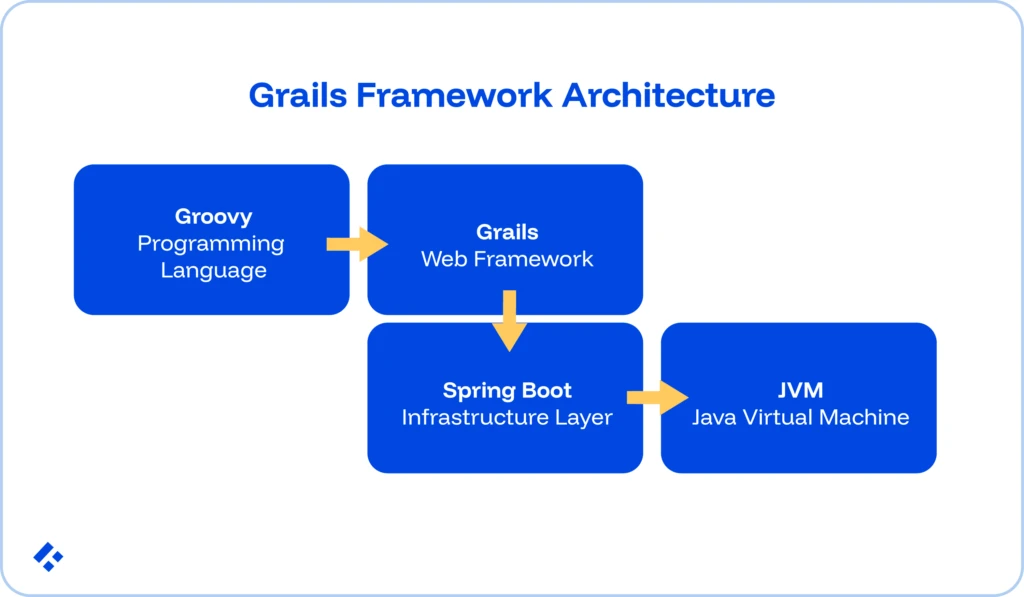
Grails is built on top of other Java frameworks like Spring and Hibernate, but utilizes the Groovy programming language because of its virtually flat learning curve.
Ironically, Grails was first known as Groovy on Rails to imply its likeness to Ruby on Rails. But in March 2006 the name was dropped after a request from David Heinemeier Hansson, the creator of Ruby on Rails (Wikipedia).
If you are looking for "Groovy on Grails," you usually mean this framework. Just keep in mind that the name is simply Grails, and Groovy is the language it is written in.
That said, Apache Groovy remains a powerful object-oriented programming language with an easy-to-learn syntax.
Groovy code compiles and runs on the Java Virtual Machine (JVM), which means it works directly with existing Java libraries and Jakarta EE (formerly Java EE) containers without modification.
Here's an overview of Groovy's technical makeup:
Optionally typed: denotes an option in Groovy's syntax to leave out type definitions so they can be implicitly assigned, accelerating development. In Groovy, developers have the option to use static typing and static compilation, where variable types must be explicitly declared.
Dynamic: some behaviors, such as method resolution, happen at runtime rather than compile time, which makes Groovy flexible, although some type errors surface only when the code runs.
General-purpose, with DSL support: Groovy is a general-purpose language, but its flexible syntax makes it well suited to writing domain-specific languages (DSLs), which Grails uses for validation, querying, and markup.
In addition to the qualities of Groovy's syntax, the language extends metaprogramming at runtime and compile-time, which is where the machine can modify the program itself to optimize the program.
Groovy is primarily object-oriented, with functional features such as closures, which lends itself to the much-desired modularity in Grails.
Groovy also supports expressive domain-specific languages (DSLs) for validation, querying, and markup rendering.
Grails and the JVM: Built on Top of Spring Boot
Grails is built on top of Spring Boot. Grails 3 and later versions build directly on Spring Boot's auto-configuration, embedded server, and dependency injection capabilities.
Grails 7, released in October 2025, runs on Java 17 or later with Groovy 4, Spring Boot 3.5, and Jakarta EE 10.
Java developers using Grails gain all of Spring Boot's time-saving features without having to configure the Spring application context manually.
Java programmers can also introduce Grails into a project incrementally, using existing Java classes and libraries directly from Groovy code. There's no migration required.
Development tooling integrates well.
IntelliJ IDEA Ultimate provides strong Grails support out of the box, and the framework's development mode includes live reloading and an embedded servlet container so developers can see changes without restarting the server.
The Grails community also actively maintains the framework.
What Can Grails Do?
First and foremost, Grails is a full-stack web application framework for back-end development.
When it comes to web development, JavaScript handles everything on the front-end.
Of course, JavaScript frameworks ease the development process quite a bit, so it's always best to use them when you have the chance. But generally, any web development undertaking needs a back-end language as well.
Back-end languages for web development must address complexities involving application programming interfaces (APIs), web servers, and anything else that only business logic can take the reins on.
More than back-end development, Grails can do a number of things to improve business efficiency.
For example, developers can build plugins to enhance and extend the framework. And Grails has asynchronous capabilities that simplify concurrent programming.
Borrowing from Spring, Grails allows for dependency injection, a time-saving feature where objects receive their dependencies automatically.
Grails also integrates directly with GORM, a data access toolkit with a rich set of APIs for prime data manipulation.
GORM handles persistence based on your domain class definitions, generating standard CRUD operations automatically so your development team can focus on business logic rather than boilerplate data access code.
On the view layer, Grails uses GSP (Groovy Server Pages), which works similarly to JSPs but with Groovy syntax, making it straightforward for Java developers to transition.
If you are building a JavaScript front-end, Grails also supports REST APIs directly, allowing it to serve as a backend for React, Angular, or Vue applications.
Related Reading: API Development for Fintech Apps
Domain Classes in a Grails Application
Domain classes are the heart of a Grails application. They define the data model using Groovy classes stored under grails-app/domain, and GORM maps them to database tables automatically based on naming conventions.
A simple domain class in Groovy code requires no XML configuration and no manual table creation.
Grails reads the class definition, creates the corresponding table structure, and provides built-in validation, querying, and relationship management through the GORM API.
For most standard web applications, the boilerplate that Java developers associate with Hibernate or JPA largely disappears.
Domain classes also respond to dynamic finders. A Grails-specific feature that allows queries like Book.findByTitle("Groovy in Action") without writing any SQL or HQL.
The framework interprets the method name at runtime and generates the query accordingly.
For iterative development, this approach to the domain model is one of Grails's most practical advantages. Developers can define or modify a domain class, restart the development environment, and see the schema update automatically.
Why Use Grails?
What pulls most Java developers and businesses alike to deploy Grails in their tech stack is its status as a high-productivity language.
While you've already heard a slew of Grails's most fine-tuned features, there are some quintessential details of the language that make it stand out amongst other Java frameworks.
XML Configurations
In Java frameworks and nearly every framework, developers are made to configure their environment and framework before and during development.
These configurations provide greater consistency across applications, or at least they were meant to, but developers can find them quite tedious, especially since conventional configurations are all that are ever used anyway.
Grails largely removes XML configuration. Settings live in application.yml and the Gradle build files, and the framework opts to use a system of rules and conventions to inspect your code and create the feng shui of configurations that suit your work best.
Ready-To-Use Development Environment
Traditional Java frameworks require that you assemble development units before you begin.
The Grails framework comes equipped with a web server, Java web environment, and all your necessary libraries. Your developers can get to it right away.
In development mode, the embedded server supports live reloading so code changes appear without a full restart, which keeps the feedback loop tight during active application development.
Mixins Support
Mixins are a type of class with methods.
In classic object-oriented programming, methods are bound to a class for good. But in Grails, you can use the methods of a certain class outside of its originating or parent class.
Groovy now recommends traits for this: its documentation marks static mixins (@Mixin) as deprecated in favor of traits, which let a class pick up shared methods from several sources.
Code reuse at this level makes for an extremely dynamic language and happy developers as a result.
The Grails Community and Framework Ecosystem
The Grails community has grown considerably since the framework moved to the Apache Software Foundation.
Grails graduated to an Apache top-level project in 2025 (the ASF board vote was on 24 September 2025), and Grails 7.0.0, released on 18 October 2025, was the first stable release under Apache governance, which brought increased organizational support and a more formalized release process.
Grails 8, which moves to Java 21 and Spring Boot 4, is in development.
The plugin ecosystem remains one of the framework's practical advantages, since most common Java technologies have Grails plugins that reduce integration work to a few lines of configuration.
For development teams already invested in the Java platform, this means they can use Grails without abandoning the toolchain and libraries they already rely on.
Get Started with Grails
To get started with Grails, you're going to need some talented Java developers who understand your project requirements and have industry experience in similar projects to be able to advise you throughout the development process.
When hiring Grails developers, look for solid Groovy and Spring Boot experience, familiarity with GORM and Hibernate, and experience with upgrades: Grails 7 requires Java 17 or later and moved to the Jakarta EE namespace, so teams on older versions need engineers who have handled that migration.
Our Java developers include engineers with this background.
At Trio, our developers are determined to serve businesses in need. They are industry experts with extensive experience in production applications and are trained to program efficiently.
They are also familiar with the requirements of heavily regulated industries like financial technology.
We start every agreement with a consultation to make sure we place the right people, who can start contributing productively in as little as 3-5 days, through staff augmentation with senior Latin American developers.