

 Read Client Stories





 Alex Kugell
Golang has become immensely popular in the past several years. And in a moment, you’re about to learn why.
According to the esteemed Stack Overflow — an online community of software developers —as of 2025, Go is the 13th most used programming language.
There’s no doubt that Go is making headway in the developer world. But Golang is fairly young, and no matter your field, it’s difficult to transition to modern technology without first gaining a sense of trust.
Well, you’re in luck. Today, you’ll get a brief introduction to Go, and you might even find yourself eyeing Go for your next project. Keep reading to learn more!
Before we get into the details, here’s the short version: if you’re a founder, engineering lead, or someone trying to choose a back-end language that won’t drag behind once traffic grows, Go may be exactly the kind of language you want to understand.
It’s not magic, but it consistently solves problems that tend to slow products down.
Are you ready to start your development project?
We have the developers you need to take your development project in the right direction.
Companies are proven to grow their business faster with Trio.
What Is Go?
Go is a Google project stemming from a need to improve programming productivity where other languages were failing.
The language (often called ‘Golang’ because of the site domain golang.com) came to life in 2007 thanks to Ken Thompson, Rob Pike, and Robert Griesemer.
At that time, C++, Java, and Python were in frequent use, but problems associated with multicore processors and large codebases held them back from their true potential.
To put it simply, programming has evolved to become more complex than classic programming languages were prepared to handle.
In response, Google built Golang with many technical characteristics to ensure simplicity, reliability, and efficiency in modern programming.
Here are a few of those characteristics:
- Static typing: a programming feature that optimizes runtime efficiency by automatically tracking variable types, leading to fewer errors
- Readability and usability: a reference to the syntax of Go, meaning that the language is intuitive for English readers/speakers
- High-performance networking & multi-processing: which describes Go’s capacity to utilize multiple central processing units (CPUs) on a network to conduct simultaneous tasks
- Built-in concurrency: another allusion to Go’s ability to process several computer instructions at a time using a multi-channel server model
- Garbage collection: a memory management technique where unused objects are automatically discarded, so future references do not wreak havoc.
To sum things up, Go’s design not only took into account the functionality of any given Go program but the experience of the developers as well.
In 2012, Go went public. As an open-source project, the popularity of the language surged tremendously. And the hype has yet to die down.
What Is Golang Used For?
Golang is used for many things. But you should note that Golang is primarily a back-end language, signifying that it is best used for data manipulation, rather than building user interfaces.
Cloud-based and server-side applications tend to benefit from Go the most. Though even DevOps can make use of Go.
Only a year after Golang’s public release, Dropbox traded in Python for Go to tackle its performance-critical back-end features.
Since then, you can find Go carefully embedded in a number of major companies, from Facebook to the New York Times.
Based on this, you may be able to guess that Go works well with high-performing applications where millions of users are accessing a turbulent network all at one time.
You could say Golang is pretty scalable as well. Because if Go can manage the likes of a worldwide social network and cloud technology for notably voluminous file hosting, you can bet it can help your business grow, too.
But more than anything, Go is simple. Developers choose to use Go because it makes software development just a bit easier.
And this seems to be the trend of new-age programming languages like Go and Rust.
With the average software developer working nearly nine hours a day, often to meet deadlines and troubleshoot tedious errors, it’s becoming more and more clear why the developer experience is just as important as the user experience.
Go provides that experience, and then some. Or at least, that’s what it promises to do for you.
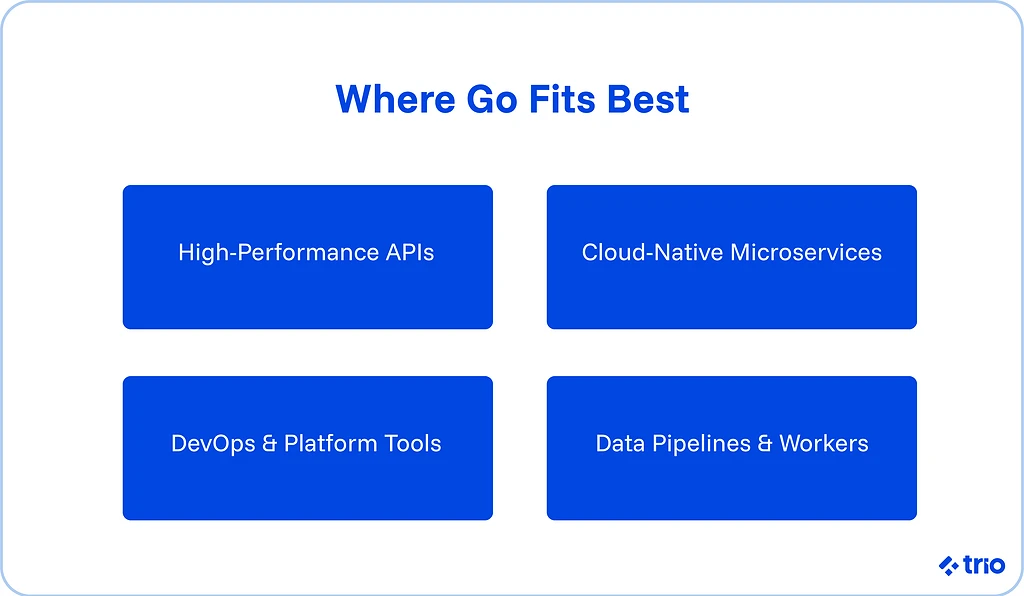
That said, its real-world use cases tend to fall into a few predictable buckets:
- High-performance web services and APIs that need consistent response times, even when traffic spikes
- Cloud-native systems, including microservices and distributed workloads that rely on concurrency
- Tools for DevOps and platform engineering, where static binaries and simple deployment help teams move faster
- Large-scale data pipelines or background processes that handle many tasks at once, such as log processing or queue consumers
Why Use Go?
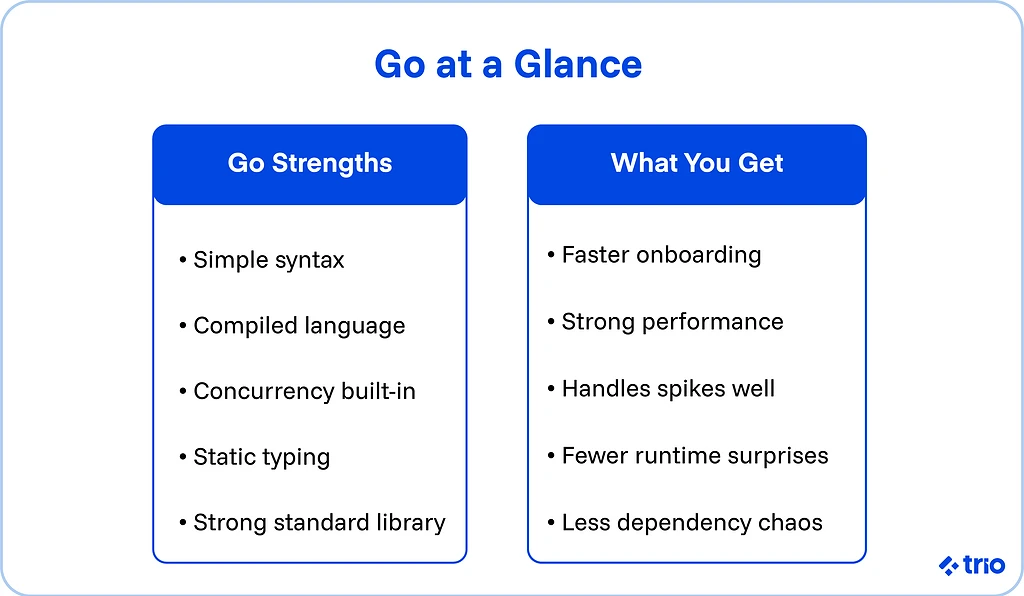
There are many advantages to Go, and it’s worth getting familiar with them to truly know what the language can offer. Take a look below for a quick breakdown of where Go is thriving.
Fast
Go is a compiled language. Compiled programming languages are generally fast because they translate source code directly to machine code.
For the computers processing Go syntax, they’re able to read and return the functions you’re running.
Not to mention, Go has benchmark measures against Java — known to be a notoriously fast language — and in most categories, Go surpasses Java’s speed, if only marginally in some instances.
You already know how it feels when you’re loading something on your computer, and it’s taking its sweet time to make an appearance. It’s beyond frustrating.
So it should be obvious why being fast is a desirable advantage. Faster programs mean happier users.
In practice, teams often shave noticeable milliseconds off p95 latency without major rewrites. It isn’t always night and day, but the consistency you get under load may surprise you, especially if you’ve ever battled with unpredictable performance on other stacks.
Easy
Go’s introductory documentation is not more than 50 pages. This means you can get down to business in the span of one afternoon.
Plus, the syntax itself is similar to Java and C. Therefore, Java and C developers looking to try something new will get the hang of Golang quickly.
In general, Go only has 25 keywords. If you’ve ever struggled with learning a new language, Go certainly won’t be a repeat experience.
What’s more, there’s Godoc, a Go feature that automatically generates documentation by parsing Go code and offers testable examples.
Our developers sometimes joke that Go feels almost bare on purpose.
That simplicity can be a relief during stressful deadlines, though it may occasionally leave you wishing for one or two conveniences you’re used to. It’s a tradeoff, but a practical one for many teams.
Comprehensive
Though Go prides itself on its minimalist zen, its tools are quite comprehensive.
First of all, Go is an open-source programming language, meaning you, your friends, and the next guy can contribute to Go’s greatness whenever you feel the desire.
Go also has various editors, integrated development environments (IDEs), and plugins available that you can download from the Go GitHub repository.
The features of Go do not disappoint, either.
You can manage packages through Go modules and store them in a file tree for easier navigation later on.
And on the subject of packages, Go has a powerful standard library with a hefty stack of core packages that fit right into a variety of project types.
The ecosystem isn’t enormous compared to, say, JavaScript, but it tends to be clean, predictable, and well-maintained. When your tools are steady, your engineering footprint feels a bit steadier too.
In-Demand
Hired’s 2023 State of Software Engineers survey ranked Go as the fourth most in-demand language on the planet.
This should tell you two things.
- Businesses are realizing just how beneficial Go is; it’s not a bad idea to get on the bandwagon.
- Finding Go developers won’t be too difficult, and you’ll save yourself a lot of time in the hiring process.
To boot, since there is likely a large pool of Go developers standing at attention to be hired, quite a few of them are going to be exceptionally talented. That’s simply a matter of logistics.
That said, demand for Go has stayed fairly steady in newer surveys, too.
Although the exact rankings move around year to year, Go repeatedly shows up in lists of high-salary or high-satisfaction languages, which may quietly suggest that people who pick up Go tend to stick with it.
Scalable
Think about it. Google built Go. And when you think of big-name companies, Google should be one of the first names that come to mind.
If Go was designed to work for software monstrosities like Google, then there isn’t much Go can’t do. On a technical level, Goroutines are a noteworthy Go feature allowing functions to run concurrently with other functions and methods.
As far as asynchronous programming goes, it’s rarely been this easy to code event-driven behavior into a program.
Really, you should be able to run millions of Goroutines on the regular, and your system won’t crash into smithereens anytime soon.
Actual numbers vary, but seeing thousands of goroutines running without drama isn’t unusual. It’s one of the reasons back-end teams reach for Go when their systems feel like they’re about to tip over.
When You Should Use Go
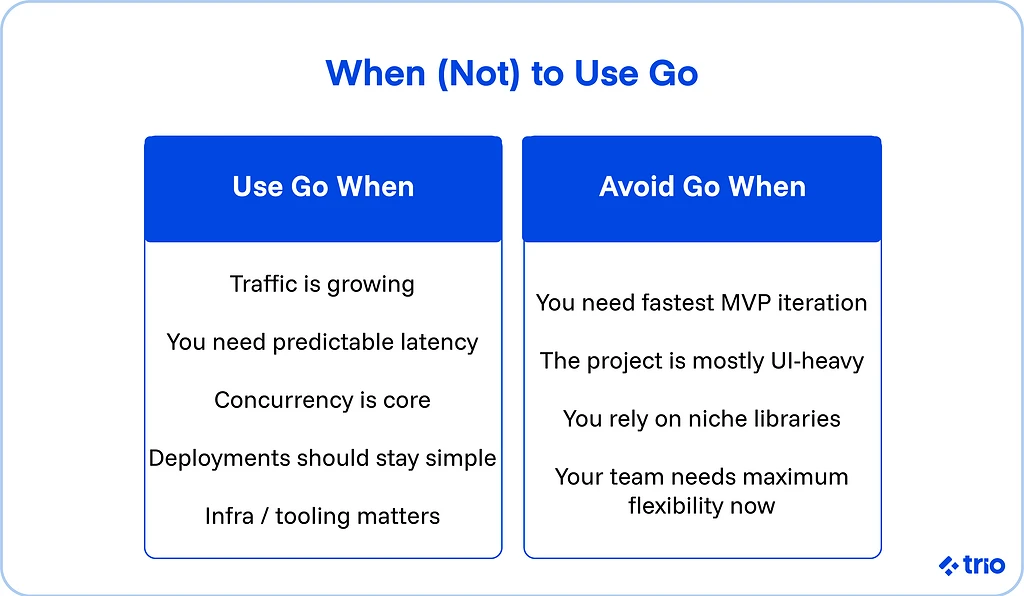
While Go can be useful in many different contexts, there are a handful of situations where it tends to shine without much debate.
These aren’t strict rules, but they come up often enough that engineering teams usually know the feeling when they get there.
- Your back-end is starting to feel slow under real traffic
- You’re moving toward a microservices or cloud-native setup
- You need predictable performance for user-facing features
- You’re building infrastructure, tooling, or internal platforms
- Your developers want a straightforward language that doesn’t fight them
Teams also reach for Go when they need to keep operational overhead low. A single static binary and a small runtime footprint mean you don’t have to tiptoe around dependency breakage or complex deploy steps.
Few people get excited about deployment pipelines, but that friction adds up over time.
When (Not) To Use Go
Even Go has its shortcomings. You should be aware of what Go can’t do just as much as the alternative.
For instance, Go is time-consuming. Though its syntax is a source of elation for the tired developer, remember that Go has only a handful of keywords.
As a result, the Go language is not very descriptive. This means you have to do more work to get the point across.
In comparison, a language like Python that’s similarly prized for its simple syntax can do in a couple of lines what Go does in a couple of dozen lines.
On the other hand, there’s something to sacrifice for every language.
But this is why Go is a good recommendation for late-stage startups that know what they’re doing and already have some footing.
At this stage, businesses are struggling with bottlenecks and finicky back-ends, making Go a good choice.
Businesses that are still working on their minimum viable product (MVP), to compare, should avoid Go if they want to present a swift demo of their future investments.
However, they should definitely plan to transition to Go once everything is up and running.
Golang vs Node.js
People often frame this as a fight between a runtime and a language, which sounds a little odd at first. In practice, though, teams usually reach for either Go or Node.js for the same kinds of back-end problems, so the comparison keeps coming up in real projects.
The short version: both work well. The longer version depends on what kind of pressure your system will face, how your team likes to work, and where you want to feel the pain, up front or later.
Here’s how the differences tend to show up in day-to-day work.
Performance and Workload Type
Go compiles straight to machine code, and that shows up when CPU time starts to matter. Services that chew through data, run lots of background jobs, or need steady performance under load often feel calmer in Go. Teams moving APIs from Node or Python to Go regularly report lower and more predictable latency, even before they touch serious optimizations.
Node.js, on the other hand, shines in IO-heavy scenarios. If your app mostly waits on databases, APIs, or file systems, Node’s event-driven model keeps things moving with very little overhead. For many web apps, that’s more than enough, and sometimes faster to build.
A rough rule of thumb:
If the bottleneck lives in the CPU, Go usually pulls ahead. If the bottleneck lives in network or disk IO, Node keeps up just fine.
Concurrency Model
This part often ends up deciding things.
Go’s goroutines make concurrency feel almost boring, in a good way. You can spin up thousands of lightweight tasks, pass data through channels, and let the runtime handle scheduling across CPU cores. The mental model stays fairly direct, and it scales without too much ceremony.
Node uses a single-threaded event loop with asynchronous callbacks and promises. That works beautifully for handling lots of concurrent requests, but once CPU-heavy work sneaks in, you start juggling worker threads or external services. It’s doable, just more fragile if you’re not careful.
If your system already feels like it wants to run many things at once, Go’s model usually stays easier to reason about over time.
Development Speed and Team Experience
Node often wins the first lap.
If your team already lives in JavaScript, spinning up a Node service feels almost effortless. You get to share language knowledge between front-end and back-end, pull from a massive npm ecosystem, and move fast while the product still changes shape.
Gback-endor a bit more discipline up front. The language stays small on purpose, and you’ll write more explicit code for things that feel automatic elsewhere. The payoff tends to show up later, when the codebase grows and still feels readable at 2 a.m. during an incident.
In other words, Node often feels faster at the start. Go often feels steadier a year in.
Ecosystem and Tooling
Node’s ecosystem looks like a city that never sleeps. npm offers hundreds of thousands of packages, which means you can usually grab something off the shelf for almost any problem. The tradeoff shows up in dependency sprawl and occasional maintenance surprises.
Go’s standard library covers a surprising amount of ground, especially for networking, HTTP, and concurrency. The wider ecosystem feels smaller, but also more predictable. Fewer moving parts, fewer “why did this break after an update” moments.
Neither approach stays strictly better. It mostly comes down to whether you prefer a huge toolbox or a smaller, more controlled one.
Hiring and Talent Availability
JavaScript and Node still win on sheer numbers. It’s easier to find developers who can be productive in Node quickly, especially if you want full-stack flexibility.
Go developers tend to be fewer, but often more specialized in back-end and infrastructure work. In practice, teams hiring for Go roles usually look for people who care about performance, reliability, and system design, not just shipping features fast.
The market shifts year to year, but Go keeps showing up near the top of well-paid and high-satisfaction lists, which suggests the people who learn it often stick around.
A Simple Decision Matrix
Choose Go when:
- You’re building CPU-bound services or heavy background workers
- Your back end needs to handle high concurrency without turning into a puzzle
- You’re moving toward microservices, infrastructure, or platform tooling
- Predictable performance under load matters more than quick experiments
Choose Node.js when:
- You want fast iteration with a JavaScript full-stack team
- Your APIs mostly deal with IO-bound work like databases and external services
- Time-to-market matters more than squeezing out every last millisecond
- You plan to lean heavily on the npm ecosystem for features and integrations
Golang vs Other Languages
People often compare Go against a few usual suspects, and the differences can feel subtle or pretty stark depending on your background. Here’s a quick look at how things tend to shake out in practice.
Golang vs Python
Python is famously friendly. If you’re experimenting or working with data science tooling, Python will feel more flexible.
Go, on the other hand, tends to outperform Python by a wide margin in production workloads. Teams moving an API from Python to Go often mention seeing faster responses even before optimizing anything.
Golang vs Java
Java is incredibly mature, and it still powers a huge portion of enterprise systems. If you already have a deep Java infrastructure, switching isn’t always necessary.
But Go avoids some of Java’s ceremony and usually compiles faster, which can make day-to-day work a bit calmer.
Some teams like Go because it feels like Java without quite as many layers to manage.

Elevate Your Team with Trio AI Talent
Empower Your Projects with Trio’s Elite Tech Teams
Schedule a CallStart Your Next Project With Go Now
Does Go seem like the right choice for your business? Only you and your stakeholders can make that decision.
When you do, Trio will be here and ready for your call. Trio hires quality software developers who are trained to meet the objectives of businesses in need.
Being the powerhouse that it is, Trio makes sure that businesses have skilled Go developers at their helm to complete their projects successfully.
Interested? Talk to Trio now about hiring Go developers!
Trio offers more than just software expertise; we bring you the top Latin American developers. Unlock the potential of our Mexican, Brazilian, and Colombian developers for outsourcing success.
FAQs
Is Golang good for web development?
Golang works well for web development when you need reliable, fast back-ends, especially APIs or streaming services, though it isn’t meant for building front-end interfaces.
Why is Golang becoming so popular?
Golang’s rise in popularity mostly comes from its mix of simplicity and steady performance, which helps teams avoid the complexity common in larger ecosystems.
Should startups use Golang for an MVP?
Using Golang for an MVP can work, but it often depends on how quickly the idea needs to evolve, since many teams prefer flexible languages early on.
Is Go faster than Node or Python?
Go tends to run faster than Node or Python in many back-end scenarios, especially when handling a large number of simultaneous tasks.
Is Golang good for microservices?
Golang suits microservices because its concurrency model stays easy to manage, and deployments tend to stay simple even as the system grows.