

 Read Client Stories




 Alex Kugell
 Key Takeaways
- How many programming languages there are depends on which authority you ask and what they choose to count. Wikipedia, TIOBE, and GitHub each land on a meaningfully different number, and each is right by its own definition.
- Python holds the top spot across nearly every major ranking in 2026, driven largely by AI, machine learning, and data science adoption, alongside its long-standing use in general backend development.
- Most working developers know three to five languages well in practice, including one general-purpose language, one web language, and a database language like SQL.
- The practical hiring question is whether a candidate has real depth in the specific handful your actual stack runs on, working in your industry, and around the regulations you may face.
When trying to figure out how many programming languages are available, you can get a wide variety of answers. Some sources say hundreds, others thousands.
There are a couple of reasons why these differences are so drastic. Mostly, it’s because a few include markup and query languages in their count, while others leave out newer languages that are still gaining ground.
So, how many programming languages are there?
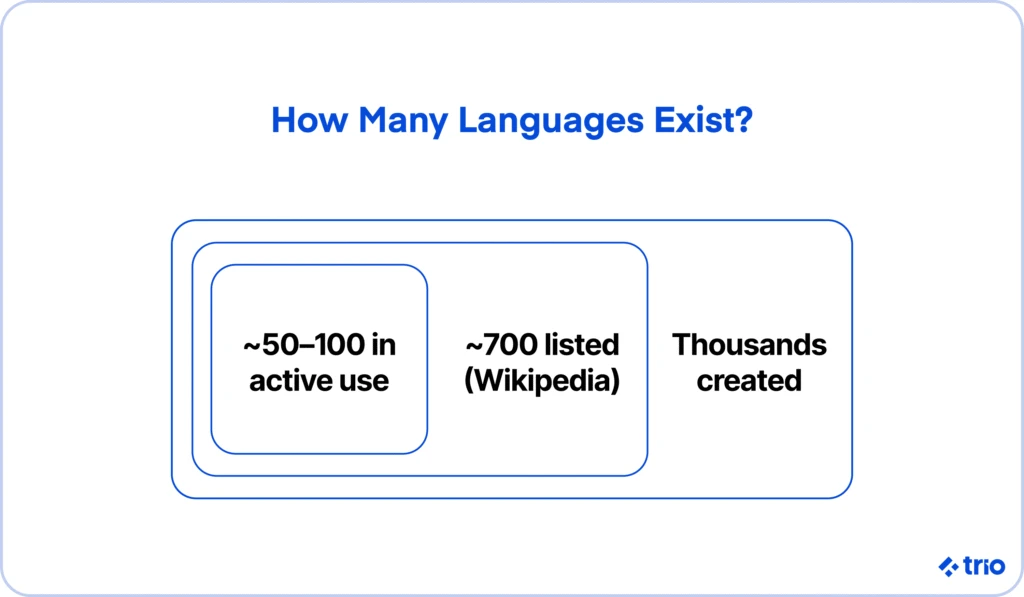
It’s impossible to say precisely, but it could be anywhere from a couple of hundred in active use to a couple of thousand if you count every language that has ever been created.
Of these, only a small number are popular enough that software developers rely on them regularly for mobile app and web development, and even free ones are used in niches like fintech where security and compliance are essential.
Learning one of these popular, fintech-approved languages (Python and JavaScript among the more obvious examples) can make a real difference in a team’s speed, scalability, security, and even how easy that team is to hire for.
Let’s look at exactly how many programming languages there are, what some of the more popular ones are, and which ones you will probably need for your fintech app development.
At Trio, our fintech developers know a variety of languages and are familiar with best practices in the fintech industry.
Quick Answer: How Many Coding Languages Exist Today?
Different authorities count differently, but looking at a few major sources gives a good sense of the range.
Wikipedia
Wikipedia has a list that does not include esoteric programming languages or markup languages. This brings the number to around 700.
TIOBE Index
The TIOBE Index is a measure of programming language popularity.
On the primary page of the TIOBE programming community index, you can view the top 100 programming languages in the world, as measured by the site. We can assume that there are more than that.
GitHub
GitHub is a tool that is familiar to most in the programming community. There are several repositories available, many of which are still active.
It’s difficult to say, but we estimate that there are about 50-100 that see a lot of use.
If you want to know which programming languages are used to write code today, GitHub is one of the best places to check out.
The Current Rankings, as of 2026
As of the most recent TIOBE Index (August 2026), the top languages are Python, C, C++, Java, C#, JavaScript, Visual Basic, SQL, Go, and Delphi/Object Pascal.
Python’s position at the top isn’t new by any means, but its margin has grown.
Based on what we are seeing in the market, it’s fair to conclude that this was driven overwhelmingly by AI and machine learning work, data science, and automation, on top of its long-standing role in general backend development.
In fintech, we generally see it used in models that need to analyze massive amounts of information in real time, like when doing a credit check or scouring transaction histories to pick up fraud happening in real time.
The PYPL Index, which weights language tutorial searches rather than raw popularity, tells a similar story, even though it showcases that there is quite a lot of regional variation.
In markets like India and Germany, Python’s share runs even higher, over 44% and 46% respectively, reflecting how dominant it’s become in education and early-career hiring specifically.
The Languages That Actually Matter for Hiring
For most software teams, the realistic shortlist looks like this:
- Python for AI, data science, automation, and general backend work.
- JavaScript and TypeScript for the web.
- TypeScript for anything enterprise-scale, since static typing catches a category of bugs before they ever reach production.
- Java and C# for established enterprise backend systems, both still powering a huge share of large organizations’ core infrastructure.
- Go, for cloud-native services and DevOps tooling, thanks to its simplicity and strong concurrency support.
- Rust and C++ for where performance and memory safety matter most, like systems programming, game engines, and high-frequency trading.
- SQL for anyone touching a database, regardless of which other languages sit around it.
Mobile development carries its own smaller list: Swift for iOS, Kotlin for Android, with cross-platform frameworks increasingly handling both from a single codebase for products that don’t need deep.
What This Means in Practice
Most working developers know three to five languages well.
From what we have seen, it’s fair to assume that they will be good at one general-purpose language for the bulk of the work (commonly Python or Java), one web-facing language (JavaScript or TypeScript), and a database language (SQL) rounding it out.
Specialization from there tends to follow the specific domain. An ML engineer is probably going to lean further into Python and its ecosystem, a systems engineer leans toward Rust or C++, and a mobile developer picks up Swift or Kotlin as needed.
The biggest takeaway for anyone hiring should be that the sheer number of programming languages that exist is mostly irrelevant.
What matters is whether a candidate has real depth in the specific handful of languages your actual stack runs on, and whether they have had experience working in your industry, with the regulations and user expectations you may face.
That is why, at Trio, we hire only senior fintech developers, who are placed based on their production work. They are guaranteed to know what your product requires and can help you pick the best languages going forward.