

Hire by Technology
SERVICES

Scaling a fintech is not the same as scaling a general SaaS product.
You’re dealing with finance, regulation, compliance, reputational risk, and regulators watching your every move. The conditions are strict, the expectations are high, and customers rarely forgive mistakes that touch money.
So how can you find cost-effective talent for your fintech applications? Hiring models like staff augmentation, through a firm that specializes in financial services.
Let’s take a deeper look at how fintechs can scale engineering cheaply and sustainably, so you can do the same.
If you are ready to hire developers to add capacity to an existing workforce, or you want to build a fintech software development team from scratch, without breaking the bank or creating risks, we might be able to help.
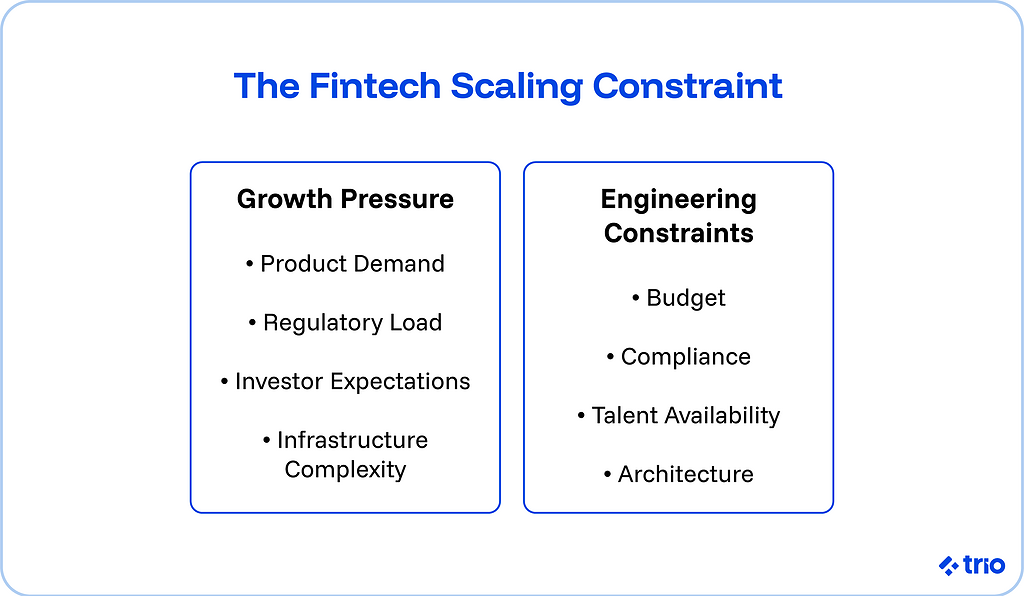
Most growing fintechs sit at the intersection of technology, regulation, and investor momentum.
You are balancing product velocity with scrutiny.
To do that successfully, you need engineers who understand financial data flows, banking integrations, identity verification and validation, faster payment rails, and the internal logic that keeps everything secure. Those people are expensive and scarce.
But hiring generalist backend developers is not an option.
Compliance requirements evolve every quarter. Infrastructure can get complicated quickly as you add new features. And just when you think the architecture is stabilizing, investor expectations shift again.
If you are building in insurtech, lending, crypto, or a mobile finance app, you need people familiar with what those landscapes require and who have the technical skills to deliver.
Cost optimization usually begins with urgency.
A founder feels behind, tries to scale rapidly, and ends up hiring too many engineers too early. That may help for a few months until burn rates spike.
We have seen teams freeze hiring entirely simply because one ambitious hiring quarter pushed them past their funding comfort zone.
Another trap that appears harmless at first is when you bring in generalist engineers who are excellent but unfamiliar with regulatory workflows. We often see how that decision postpones development.
Engineers spend weeks learning compliance basics and trying to understand why seemingly harmless shortcuts are not allowed, and even then, they are liable to make mistakes because the real world has far more nuance than sandbox environments.
A third trap is architectural. Early fintechs build quickly, which is normal, although the software architecture becomes harder to extend. Teams then throw more engineers at the problem, which usually makes things costlier instead of faster.
Related Reading: Case Study: How a Consumer Fintech Tackled 9 Engineering Problems with Trio
If you want to scale cheaply, a lean mindset may be your safest starting point.
Instead of adding bodies, you should try to design a system that allows a small team to work efficiently.
A modular architecture helps here.
It lets you expand a financial platform one segment at a time rather than rewriting the entire codebase when a new customer asks for an edge case. It also protects you when new regulations appear.
A focused workflow matters too, especially in optimizing development costs.
When your engineers know exactly how an idea moves from product to execution, iteration becomes predictable. You gain continuous momentum without inflating headcount, which helps in maintaining a healthy budget.
Some fintech teams that we work with also introduce production shadowing programs during onboarding.
This allows any new engineers to observe real transaction flows, compliance checks, and incident handling before shipping code.
Several strategies tend to show strong results.
It might sound counterintuitive because senior talent costs more per hour, but they often reduce total cost by cutting ramp time.
At Trio, we only have senior fintech specialists, so you are guaranteed to get engineers who understand financial infrastructure, compliance, lending systems, banking integrations, and the realities of regulated environments.
They arrive ready to contribute with minimal onboarding, so you end up saving on ramp time and avoiding costly mistakes in the software development process.
AI-assisted testing, documentation, and analytics frees your team for the parts of software development that require deep reasoning.
You can maintain engineering clarity without adding another full-time engineer.
But it's important to remember that AI-driven tooling is not magic. It can streamline repeatable tasks throughout the fintech product development lifecycle, but you still need fintech specialists on your team to make sure AI is being used responsibly and not being fed with sensitive user data.
Many fintechs still handle regulatory steps manually. Simple automation may lower both risk and cost. It often reduces the need for extra staff during audits or regulator check-ins.
The most common regulatory automation we see is in documentation or report creation.
When your technology foundations are stable, scalable, and modular, you avoid the costly cliffs that force expensive rewrites when things naturally happen, like massive spikes in payments on Black Friday, or when you are about to be acquired by a major bank.
It is one of the quietest cost savers in scaling fintech products, allowing for better budget management.
Related Reading: How to Reduce Engineering Backlog in Fintech
A distributed team gives you access to global senior talent without paying inflated local salaries. It is one of the easiest ways to maintain quality while keeping costs predictable.
At Trio, for example, people have access to senior fintech specialists from LATAM for between $40 and $90, depending on their specific requirements. That's as much as 60% cheaper than the same developers would be in the United States.
Some founders hesitate to use external partners, and in many cases, the hesitation is valid.
A generic staffing firm may give you engineers with little fintech experience, which shifts the burden back to your internal team. That is usually a poor use of money.
If you decide to bring in outside help, look for engineers who already understand compliance, risk, and how financial systems behave.
You want people who integrate quickly and do not require heavy hand-holding.
Trio is specifically in that category. We focus exclusively on fintech and vet every engineer for domain expertise.
Our model removes friction, slows the hiring spiral, and gives you scalable capacity that adjusts to shifting roadmaps. It also maintains trust and regulatory alignment, which can be difficult to achieve with cheaper generalist options.
You do not have to measure everything. A few indicators tend to matter more than others.
For fintech startups working on payments infrastructure, tracking how quickly you can safely ship improvements to faster payments systems is an increasingly relevant efficiency metric.
Scaling a fintech cheaply requires clarity around the real constraints: compliance, regulation, infrastructure, investor expectations, and the everyday realities of finance.
Many fintechs overcomplicate the solution. You may simply need engineers who already speak the language of financial products and a workflow that keeps your team moving without costly turbulence.
When you approach scaling with this mindset, you maintain quality, satisfy regulators, and keep engineering costs from spiraling.
You also create a platform that can expand as the fintech ecosystem reshapes itself. And if you choose to work with a partner, make sure they treat you like a collaborator instead of a vendor.
Trio has strictly senior fintech-ready engineers who plug in quickly, support your trajectory, and help your team build the future of finance with confidence.
To hire these specialist fintech software developers, request a consult.
Scaling engineering cheaply for fintechs usually means finding ways to expand capacity without lowering quality, and the simplest route is using engineers who already understand finance, so you avoid long ramp times and rework.
The most cost-efficient roles tend to be senior engineers with fintech experience, since they reduce onboarding time and keep compliance-related decisions on track.
Using external partners often saves money when the engineers arrive fintech-ready, since that avoids training, delays, and the extra staff needed to manage unfamiliar teams.
AI may reduce engineering costs by handling repetitive work like testing or documentation, which frees your team for the harder financial and regulatory tasks.
Compliance matters during expansion because new engineers need to understand regulated workflows, and ignoring that creates costly delays and potential audit headaches.
A founder usually looks for a partner with domain expertise, predictable integration, and engineers who understand payments, lending, or banking from day one.
You measure scaling efficiency by watching indicators like velocity, onboarding time, and the cost required to ship a meaningful feature.
Hiring generalists can be risky because they often lack experience with regulated finance, which slows development and increases the chance of compliance mistakes.
The right time to increase headcount usually comes when product velocity stalls and your current team cannot keep up with the roadmap or regulatory demands.
A small team can often support growth if the architecture is modular and the engineers understand financial systems well enough to maintain clarity under pressure.