
Hire by Technology
SERVICES


Payments are under pressure. It feels like the rails keep multiplying, compliance rules get tighter, and customers expect speed with zero tolerance for friction.
Most fintech teams we work with start off strong, but quickly start struggling with payment infrastructure that immediately starts aging, layers of legacy code (theirs and partners’), brittle integrations, and manual processes that consume engineering hours.
That situation becomes more painful as volumes grow.
This is where AI has begun to reshape the payments landscape, but while rising tools can be useful for payment modernization, you still need to use them responsibly, maintaining a balance between compliance, cost, and reliability.
Let's look into how AI is being applied in real payment contexts, from fraud detection to predictive routing, and what best practices fintech leaders can follow to avoid hype traps and build systems that scale.
If you need developers who understand the intricacies of using AI for payments modernization, you are in the right place. As an IT staff augmentation and outsourcing firm, we have curated the top 1% of applicants, placing our fintech experts based on their past experience on similar projects.
Modernizing payments has always been about speed and scale. What's changing is that AI brings a different kind of capability: systems that not only move money faster but also interpret, predict, and respond in real time as transactions occur.
Analyst forecasts put the online payment fraud detection market on track to roughly double from about $9 billion in 2024 to $22 billion by 2030, a signal of how much weight the industry now places on intelligent systems (figures vary by source and methodology).
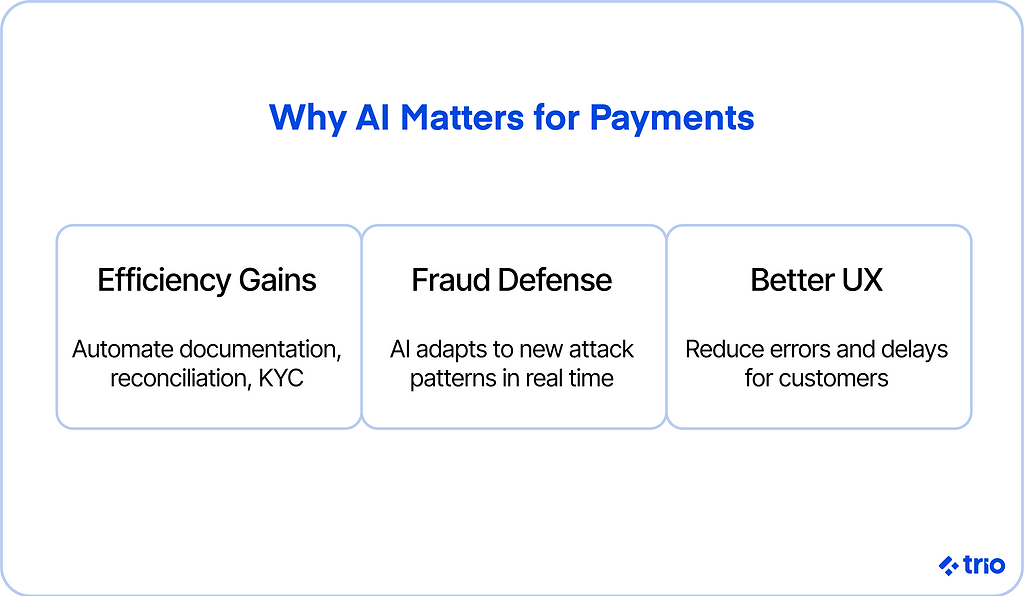
For many fintech teams, the immediate draw is automation.
Tasks like documentation, reconciliation, or know-your-customer checks consume thousands of hours and tie up skilled engineers, so if AI can take over large parts of this work, your people can focus on other things.
It’s an incredibly effective way to reduce both time and cost for a lot of menial, but essential tasks.
Fraud has become incredibly complex. Since fraudsters adapt to new barriers, static detection rules quickly end up behind.
But while manual monitoring can't keep up, AI models, especially when layered in multi-agent setups, identify subtle anomalies in real time and adjust as new tactics appear, creating a more resilient system overall.
Any delays and errors in payments hit the end user directly.
AI enables personalized payment flows, anticipating issues before they trigger support tickets and nudging users toward the smoothest path.
Done well, this creates experiences that customers barely notice, which is often the highest compliment in payments.
The push toward ISO 20022 and similar standards means more structured data is available than ever before, giving AI models more information to make better decisions.
Combined with monitoring tools, it can highlight compliance risks, automate reporting, and flag anomalies that auditors will eventually ask about anyway.
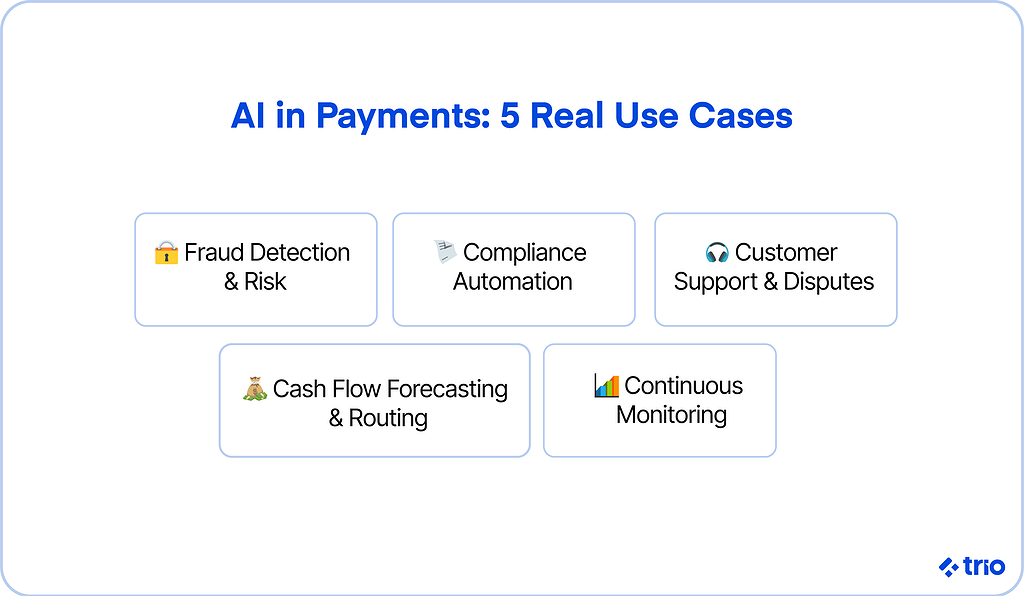
Before diving into best practices, it helps to look at where AI is already delivering value in payments today, where fintech teams are actively experimenting, and where we’re seeing results.
Rule-based systems were fine when transaction patterns were predictable, but, as we have already mentioned, they break down once bad actors learn the rules and adjust faster than teams can update them.
AI models add flexibility since they can watch for subtle shifts in behavior, like a user who suddenly changes device, location, and purchase size within minutes, that would slip through static filters.
We’re seeing some fintechs training anomaly detection models on live transaction streams, but others rely on behavioral biometrics like keystroke patterns, swipe speeds, or how a user holds a phone.
The most advanced setups are probably the ones that layer multiple models together, sometimes orchestrated by agent-based systems, so one model handles transaction history while another focuses on device risk or geolocation.
The main goal is to pick up on fraud, but also to cut down false positives that frustrate legitimate customers.
Traditional straight-through processing tops out around a 60% touchless rate for most banks, with everything else routed to a manual queue.
This means your people will need to deal with mismatched account details, missing remittance data, and wires that fail formatting or compliance checks, correcting all of them by hand.
This process is usually called wire repair.
Agentic AI changes what happens in that queue. Instead of simply flagging an exception for a human, an agent can investigate it: checking reference data, identifying the likely correct account or routing details, and either resolving the exception automatically or preparing a corrected repair request for a human to approve.
Every new customer, every regulatory change, every compliance audit generates piles of paperwork that usually land on operations or engineering teams.
AI agents can now draft the documents, check them against requirements, and validate data sources before anything gets submitted.
This improves speed and also reduces the risk of human error that regulators are quick to spot.
But from what we’ve observed, the real opportunity here is scale, as you can expand into new regions or product lines without worrying about increased documentation volume.
Support teams know that the bulk of inquiries are repetitive, so AI-powered chat and voice agents are ideal to handle most of these questions, routing only the messy edge cases to human staff.
The value isn't just shorter wait times. It's also consistent; customers receive the same clear, accurate answers whether they ask at 2 p.m. or 2 a.m.
In some fintechs, AI copilots are being built directly into dispute resolution workflows, pulling transaction histories, flagging potential chargeback evidence, and preparing case files so a human only needs to review and submit.
If you manage to implement these tools wisely, you’ll reduce bottlenecks, create happier customers, and make sure your engineers aren't dragged into support escalations they were never hired for.
Routing a transaction through FedNow instead of RTP, or across SEPA instead of SWIFT, can mean differences in cost, settlement speed, and even regulatory exposure. AI helps teams make these choices in real time.
By analyzing both transaction history and macroeconomic data, AI models can forecast cash flow gaps before they become problems.
A fintech might see that payroll and supplier payouts will create a liquidity crunch next Friday, and pre-emptively reroute funds or adjust settlement timing to keep accounts balanced.
AI systems will eventually make decisions that affect compliance, customer trust, and revenue flow. Treating AI like an experiment or side project is a fast way to create more problems than you solve.
Fortunately, there are a couple of well-established best practices that fintech teams have found helpful.
Phased rollouts are the safest path. Many teams start by running models alongside existing systems and comparing outputs.
If a fraud model consistently spots issues faster than your current rules, that's evidence to increase its autonomy.
Regulators and customers want to know why a decision was made, so fintechs are finding a lot of value in interpretable models or in adding explainability layers that trace decision logic.
AI works best in API-first, cloud-native environments where microservices can scale up and down with demand. If your current stack isn't there yet, modernization may need to happen in parallel with AI adoption.
AI used in payments should be treated as a regulated component, so you need to build in monitoring dashboards, bias testing, and human-in-the-loop checkpoints from day one.
Skipping these steps usually leads to painful retrofits later.
AI should earn its place. Whether that's fewer false positives in fraud detection, hours saved in documentation, or faster dispute resolution, teams need clear benchmarks.
Without them, it's too easy for projects to become vanity initiatives.
ROI measurement also helps decide which use cases to scale and which to sunset.
Where things get interesting is in how AI can open doors to entirely new products, sharper cost advantages, and differentiation in a crowded market.
For fintechs of all sizes, the question is less about whether to use it and more about how to integrate it responsibly.
We already know there is a potential for massive payoff in terms of stronger fraud defenses, faster documentation, smoother support, and more intelligent routing.
But success depends on strategy: phased rollouts, transparent systems, and governance that treats AI as part of the regulated backbone of payments, not an optional add-on.
The sooner you build with these principles in mind, the easier it becomes to stay ahead of both competitors and regulators.
Our fintech developers, with their production experience in similar work, can help.