

Hire by Technology
SERVICES


Fintech companies typically choose between three external engagement models:
Each suits a different phase of product maturity and a different internal capability level.
You might have already decided to bring in external help, but the next step of deciding between staff augmentation, agency, or consultancy for your fintech plays just as important a role.
Let’s take a look at how the different models suit different teams.
If you decide that you are ready to start hiring, or you want to explore these options further, book a decision call.
A lot of people use these terms interchangeably. The result is some level of confusion concerning the differences. So, let’s make sure you understand what each actually is, and how those differences impact fintechs and others in the financial services industry.
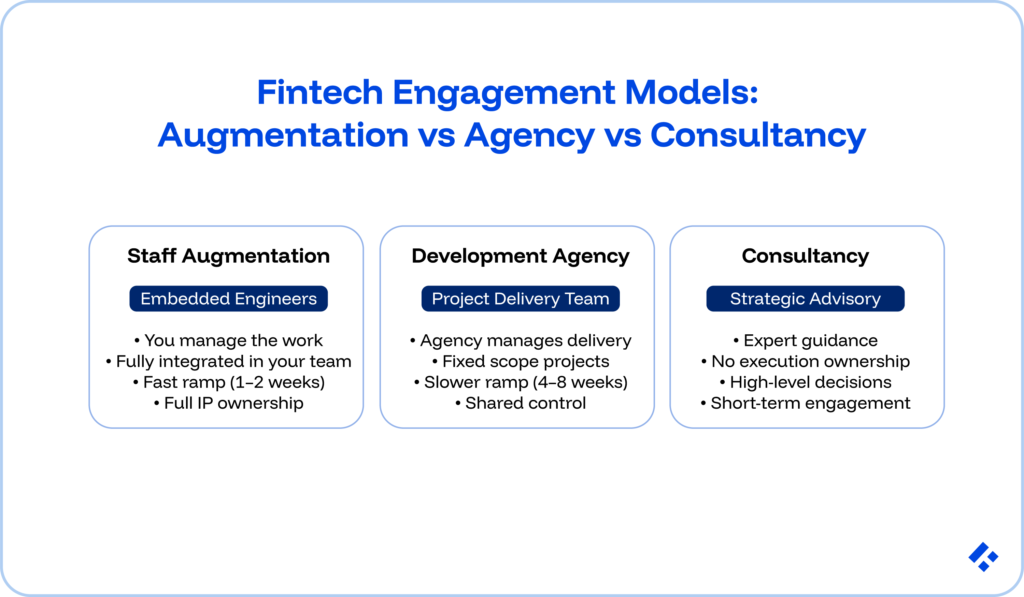
Staff augmentation means individual engineers or small groups provided by a specialist partner who embed directly in your team.
These engineers act as if they are part of your organization. They join your standups and operate under your direction.
The augmentation partner handles everything regarding sourcing, vetting, employment, payroll, and benefits, taking those pressures off your internal resources.
A development agency takes a defined scope and delivers against it.
In other words, you hand over a project spec, and then the agency manages the team internally and delivers an output.
A lot of people like this because you pay for outcomes, not individuals.
In fintech, we often see this in instances where a third-party team is building a KYC onboarding flow or a mobile banking feature from requirements you've written.
The agency owns the team selection, internal scheduling, QA, and finally, delivery. You own the brief and the acceptance criteria.
A consultancy provides strategic or technical advisory services to solve a defined problem.
You’re usually talking with one or a handful of developers who are there to diagnose the cause of issues and come up with solutions.
Their primary value comes from expertise and perspective, not raw execution capacity, since these developers have likely worked on a multitude of products in the financial services sector.
In fintech, this looks like bringing in a Big Four compliance team to map your SOC 2 control framework, or an architecture firm to assess your payment infrastructure before a Series B.
Let’s look at the core differences between these models, focusing on the factors that are relevant for fintech specifically
| Factor | Staff Augmentation | Development Agency | Consultancy |
| Who manages the work | You (client) | Agency internally | Shared / Consultant-led |
| Who owns the IP | You (client) | Clarify in the contract — risk of ambiguity | You (client) — but verify |
| Daily integration | Fully embedded in your team | Separate team, regular check-ins | Ad-hoc — meetings and deliverables |
| Billing model | Time-and-materials (hourly/monthly per dev) | Fixed-price or T&M per project | Retainer or fixed-fee engagement |
| Cost per senior engineer-equivalent/month | $7,000–$14,000 | $12,000–$25,000+ | $15,000–$50,000+ (partner rates) |
| Ramp time to productivity | 1–2 weeks | 4–8 weeks (discovery + handoff) | 2–4 weeks (assessment phase) |
| Compliance documentation risk | Low — you control code and docs | Medium — depends on agency standards | Low for advice, high if they implement |
| Best for | Execution capacity, skill gaps, and sprint continuity | Defined projects with stable requirements | Architecture, strategy, regulatory guidance |
Dev agencies need to factor in project management overhead, as well as things like discovery phases. The result is that they charge $12,000–$25,000 or more per month per developer-equivalent. There may also be fees associated with changing scopes.
Staff augmentation on LATAM nearshore rates typically runs considerably less on a total cost basis for engagements over six months, because you're paying for talent access rather than agency overhead.
Some US companies see savings at around 60-65% when working through LATAM nearshore arrangements, at roughly 60–65% compared to domestic senior engineering hires.
When you hire these developers through Trio, you’ll see rates between $40 and $90, depending on seniority and specific skill set.
Related Reading: Trio vs Arc for Fintech Developers
Fintech codebases contain payment logic, fraud detection algorithms, and even proprietary risk models that, if poorly assigned in a contract, can create real IP disputes at acquisition or audit time.
This is further complicated when working with international firms or developers who might be subject to different laws.
Staff augmentation contracts tend to be clean by default. You direct the work, and you own the output.
Agency and consultancy contracts require explicit IP assignment clauses. Many template agreements use language like "will assign" or "agrees to assign" that may not actually convey present ownership under US contract law.
We always recommend that you double-check the vendor's standard agreement and address these present-tense assignment clauses.
When an agency builds a feature on your behalf, the audit trail of decisions lives inside their environment rather than yours.
For a SOC 2 audit or PCI DSS assessment, that creates a documentation retrieval problem you'll only discover when a questionnaire lands in your inbox.
Staff augmentation sidesteps this problem because augmented staff work inside your environment and follow your processes.
Related Reading: In-House vs Staff Augmentation for Fintech
There are a couple of different reasons why staff augmentation might be the best option for you.
Agencies get a bad reputation in some engineering circles, often because they get deployed for the wrong jobs. There are legitimate scenarios where a development agency makes sense.
Related Reading: Fintech Recruiting Agency Alternatives
Consultancies serve a real function that neither staff augmentation nor agencies can replicate, but only if you hire the right consultancy for the right problem.
If you are struggling to make a decision, consider these situations with their recommended models. While there is nuance to each situation, this is a good place to start.
| Your Situation | Recommended Model |
| Strong internal tech lead, skill gap, sprint pressure | Staff augmentation |
| No internal technical PM/lead, discrete project with fixed scope | Development agency |
| Pre-audit, architectural decision point, or regulatory gap | Consultancy |
| Compliance sprint with active roadmap running in parallel | Staff augmentation |
| Series A, post-funding, scaling fast with proven product | Staff augmentation (nearshore for cost) |
| Pre-Seed/Seed, no product yet, need to build v1 | Development agency (or co-founder CTO) |
| Post-Series B, preparing for SOC 2 or FedRAMP | Consultancy + staff augmentation in parallel |
| Backlog overflow, team at capacity, known tech debt | Staff augmentation |
| Major platform migration (core banking, payment rails) | Consultancy for strategy, augmentation for execution |
The most common and expensive mistake we see fintech leaders make all the time is using a consultancy to solve an execution problem or an agency to solve a talent problem.
A consultancy that identifies fourteen architectural gaps has done its job. Asking them to fix those gaps means paying advisory rates for execution work.
Similarly, hiring a development agency when your actual problem is that your existing team can't ship fast enough adds another coordination layer on top of the existing bottleneck.
Ranges can vary incredibly, depending on your requirements. For the sake of a reasonable cost comparison, let’s assume you need three additional senior engineers for six months to ship a payments feature, integrate a KYC vendor, and close a compliance sprint.
In most cases, you’ll probably need a mixture of all the models at different times.
You can probably consider a consultancy first, when you're about to make an irreversible decision related to something like your payment architecture or a core banking platform selection.
Doing this means you get the strategy right before spending on execution
When that’s done, you can move on to staff augmentation for execution. We’ve seen this work well here because your direction has been established.
Augmented engineers work in your sprint, under your technical lead, at your pace.
Finally, you can reach out to an agency for discrete side projects when your core team needs to stay focused on your primary roadmap.
A well-scoped white-label feature for an enterprise client, a marketing data pipeline, a specific API integration that doesn't touch your core product. Instead, these can run in parallel without pulling your main team off the critical path.
For the majority of growth-stage fintechs with an existing engineering team and an active product roadmap, staff augmentation functions as the default right answer for external engineering support.
Staff aug keeps your IP ownership clean, supports an audit-friendly code environment, integrates directly into your sprint without a vendor management layer, and delivers senior fintech talent at nearshore rates that run 40–65% below US market cost.
Trio places pre-vetted, compliance-ready fintech engineers directly into your team in 3–5 days.
Reach out to compare options.
The core difference between staff augmentation and a development agency comes down to control and IP ownership. With staff augmentation, you manage the engineers directly, and you own everything they build from day one. With a development agency, the vendor manages the team internally and delivers against a scope you've agreed on, and ownership can vary.
A fintech should use a consultancy when the problem requires expertise rather than execution capacity. If the problem is that your team can't ship fast enough, staff augmentation is the right solution.
Generally, yes, staff augmentation is often substantially cheaper than hiring a development agency for fintechs.
When you use a fintech development agency, IP ownership can vary, depending on the specific contract. Many standard agency agreements don't include explicit present-tense IP assignment clauses, which means ownership can remain ambiguous until a lawyer surfaces the question during due diligence.