

Hire by Technology
SERVICES


Boutique dev shops are a great option if you need senior talent, a defined process, and confidence that someone else will handle your delivery.
But the trade-off is things like scope change fees, IP ambiguities, compliance documentation gaps, and vendor PMs. Negative experiences here often tend to drive the switch to staff augmentation.
The issue isn't that boutique shops fail outright, but rather that their model optimizes for delivery ownership, which is the wrong axis for a CTO who already knows what to build and needs people to help build it.
Staff augmentation, where you add external talent onto your team, who work with you in ways very similar to what in-house development talent might, is often the better solution.
Let’s take a look at the detailed differences between boutique dev shops vs staff augmentation, what you need to consider when deciding between the two, and what a switch involves when you are working in compliance-heavy industries like fintech and other parts of financial services.
A lot of people confuse outsourcing and dev shops. The reality is that they are quite different, and you need to be aware of what you are getting into before signing any contracts.
A boutique development firm typically runs 10 to 50 engineers of their own. The engineers work for them; they manage them.
Usually, the boutique nature of these dev shops means their talent pool is senior-heavy across multiple disciplines (frontend, backend, sometimes design and QA in one shop). They also focus purely on project-based delivery.
In practice, this means that, when you approach them, you define a specific set of outcomes. They then have to own execution.
The best boutique dev shops have a polished discovery and scoping process.
You definitely pay for this, though, as we have seen the costs sit at around $12,000 to $25,000 per engineer-equivalent per month, usually project-priced at a fixed or time-and-materials rate that already bundles PM overhead, process, and vendor margin.
If you are working in a particularly niche part of the fintech sector, costs could be exponentially higher.
The boutique shop's defining characteristic is that a vendor PM sits between you and the engineers. Communication flows through an intermediary. Architecture decisions get made inside the vendor team, then reported out.
For a lot of fintechs, CTOs start off by working with boutique dev shops instead of immediately jumping into staff augmentation. There are a lot of reasons for this.
This section carries most of the analytical weight, because these aren't hypothetical risks. They're what we consistently hear from fintech CTOs who've run post-mortems on boutique shop engagements.
Related Reading: In-House Development vs Outsourcing for Fintech
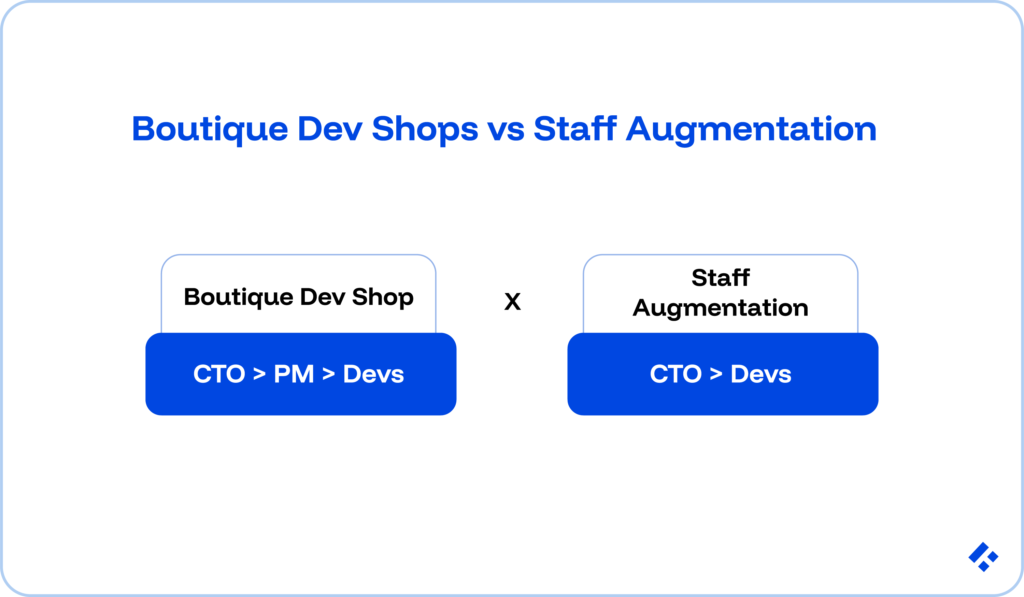
Staff augmentation, in many ways, can be seen as the inverse of boutique dev shops. It comes with its own set of issues, but in many cases, it provides what CTOs actually want long-term.
Related Reading: In-House Development vs Staff Augmentation for Fintech
We’ve already briefly addressed the numbers, but if cost is your primary consideration, as it is for most early-stage fintechs, it’s important that you have a thorough understanding of everything that goes into the pricing behind boutique dev shops and staff augmentation.
Here is what the different might look like practically, if you were getting the engineers, wholly dedicated to your project, over a 6-month period.
| Model | Base Cost | Discovery/Setup | Scope Changes Est. | Total |
| Boutique dev shop | $72,000–$150,000 | $20,000–$40,000 | $15,000–$30,000 | $107,000–$220,000 |
| Staff augmentation (LATAM nearshore) | $126,000–$252,000 | $0 | $0 | $126,000–$252,000 |
At first glance, boutique shops actually look like they might be the cheaper option.
But you need to remember that this cost assumes there are no scope changes, no discovery overruns, and a clean handoff at contract end. All three of these are so rare in the fintech industry that you can write off the chances of them happening entirely.
Also, think about the later costs that come along with remediating compliance gaps when architecture decisions from an outsourced team weren't documented.
Three scenarios exist where a boutique dev shop likely serves the situation better than staff augmentation. Acknowledging them honestly matters because an analysis that never credits the competition reads more like marketing than synthesis.
If no CTO exists, you don’t have someone like a VP of Engineering, and there is no one else who can meaningfully direct an engineering team, a boutique shop provides the project management layer that the situation requires.
Staff augmentation without internal leadership doesn’t work. Engineers arrive ready to execute, but the direction they need to execute against isn't coming from anywhere.
A good pathway for most is to start with a boutique shop to get the work done, with a plan to hire that technical leadership, or internalize knowledge before the engagement ends, or the next project development cycle starts from scratch.
An MVP with a fixed feature set, a white-label integration with a known API surface, a UI rebuild from an existing design system, and similar circumstances where requirements won't evolve are genuinely good fits for dev shops.
When the scope change carries a low probability, the scope change fee risk drops accordingly.
The only time we have ever seen this in the fintech industry is for non-core builds, marketing sites, or internal admin tooling that sits away from the payment stack.
A customer-facing marketing web app, an internal analytics dashboard, and an investor reporting tool don't touch payment data, KYC flows, or audit-sensitive systems.
Getting a dev shop involved here reduces the IP and compliance documentation concerns substantially.
Related Reading: Staff Augmentation vs Agency vs Consultancy
The consensus from fintech engineering leaders who have worked with both models comes back to the same conclusion:
Use a boutique dev shop when delivery ownership matters more than direct control, and when internal technical leadership capacity doesn't yet exist. Then switch to staff augmentation as soon as you can.
Fintech staff augmentation, and specifically the embedded, nearshore LATAM model that places engineers directly in your sprint at 40 to 60 percent below US rates, solves for the control, continuity, and compliance documentation requirements.
For fintech teams that already carry that technical leadership and need to scale a dedicated fintech engineering team, book a decision call.
The core difference between a boutique dev shop and staff augmentation is that boutique shops route communication through a vendor PM, while staff augmentation embeds developers directly in your team under your direction.
CTOs prefer staff augmentation over boutique dev shops primarily because it removes the intermediary layer and puts architecture decisions back in their hands. The vendor PM structure that boutique shops depend on creates latency, which causes issues in compliance audits.
A boutique dev shop makes more sense than staff augmentation when no internal technical leadership exists to direct developers, when project scope stays genuinely stable, or when the deliverable doesn't interact with compliance-sensitive systems.
Boutique dev shop costs typically run $12,000 to $25,000 per month per engineer-equivalent before discovery fees and scope change billing, while staff augmentation in LATAM nearshore markets through a company like Trio runs $7,000 to $14,000 per month at a transparent per-engineer rate.
IP ownership through a boutique dev shop depends on the specific contract terms and often remains ambiguous for code developed before milestone payments are complete. That ambiguity typically requires legal review before the process moves forward, whereas staff augmentation assigns IP ownership cleanly to the client from the first day of work.
Staff augmentation without a CTO or equivalent technical lead tends to produce poor outcomes because augmented developers need someone to direct their work against your architecture and roadmap. Without that leadership in place, a boutique dev shop likely fits you a bit better.