

 Read Client Stories





 Alex Kugell
 Key Takeaways
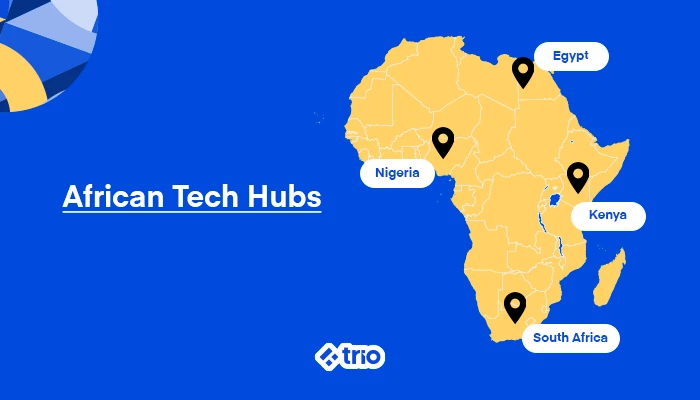
- South Africa, Nigeria, Kenya, and Egypt lead the continent’s tech ecosystems, but each carries a different cost profile, talent mix, and fintech specialism. Matching the right country to your specific requirements typically produces better outcomes than hiring based on availability alone.
- Africa’s fintech ecosystem has produced engineers with genuine production experience in mobile money, payment APIs, cross-border rails, and digital lending.
- Nigeria and Kenya, in particular, have built some of the most sophisticated payment infrastructures in the world, with companies like Paystack, Flutterwave, and M-Pesa training large numbers of engineers in the domain problems that fintech products actually face.
- Platforms like Andela, Tunga, and LinkedIn can help you source candidates. For fintech-specific hiring, dedicated staffing services with domain vetting, like Trio, reduce the risk of landing a capable engineer who still needs months of financial domain orientation.
- Vetting matters more than geography. A rigorous screening process covering portfolio review, technical assessments, and domain-specific competency checks likely does more to protect delivery quality.
- Time zone gaps are real but manageable. Most African markets align well with European working hours. US East Coast teams typically get a two-to-four-hour morning overlap with South Africa and Nigeria.
No matter how prepared you are in terms of funding and business plan, none of it matters without a development team that can actually build what you’re envisioning.
Africa has quietly grown into one of the more compelling sources of engineering talent globally.
South Africa, Nigeria, Kenya, and Egypt each carry different cost profiles, talent mixes, and fintech depth.
For companies building payment infrastructure, lending platforms, or compliance-heavy financial products, the distinctions between them matter more than most generic hiring guides let on.
This guide covers how to find and hire developers from Africa, what to expect by country, and how to approach the process differently if your product operates in a regulated financial context.
If you’re ready to start the hiring process, Trio can match you with pre-vetted fintech engineers in days.
Why Consider Hiring Software Developers in Africa?
Africa has become a serious tech hiring destination, and the numbers support that.
The continent’s “Big Four” fintech hubs, which include Nigeria, South Africa, Kenya, and Egypt, accounted for 76% of total African tech funding in 2026.
Nigeria alone captured 35% of that investment, with fintech contributing nearly 19% of the country’s GDP. These aren’t abstract metrics: they reflect ecosystems that have been hiring, training, and stress-testing engineers on real financial infrastructure for years.
South Africa accounts for more than 120,000 professional developers, making it the largest single developer talent pool on the continent and a logical starting point for many international companies.
But it helps to think carefully about which country you’re hiring from rather than treating the continent as a single market.
Developers in South Africa tend to have deeper exposure to international clients and enterprise-grade projects, though their rate expectations may reflect that.
Developers from Nigeria and Kenya often bring strong startup and fintech experience, particularly in mobile-first development, payment API integration, and the compliance challenges that come with building in emerging-market financial contexts.
Egypt has a growing software engineering community with strong enterprise and backend depth, and rates that sit below South Africa’s.
Overall, the match between country and product type matters.
A fintech building cross-border payment rails has a stronger case for sourcing from Lagos or Nairobi. A company that needs enterprise-grade backend engineers for an established product may find South Africa or Egypt a better fit.
Africa’s Fintech Ecosystem: Why It Produces Strong Financial Engineers
Africa’s fintech sector grew to serve populations that traditional banking couldn’t reach.
That origin shaped the engineers it trained. Building for mobile money, thin credit files, unreliable connectivity, and fragmented cross-border payment rails produces a different kind of fintech engineer than building for well-served Western markets.
Nigeria has become the continent’s fintech capital.
Paystack (acquired by Stripe in 2020) and Flutterwave built developer-friendly payment APIs that turned complex bank-transfer and card-processing infrastructure into clean REST integrations, training a generation of Nigerian engineers in production-grade payment systems.
Nigeria’s instant payments infrastructure processed over $1 trillion in transactions in 2024. Engineers from this ecosystem understand payment idempotency, reconciliation edge cases, and high-volume transaction processing from direct production experience.
Kenya pioneered mobile money with M-Pesa. Safaricom’s Daraja API, launched in 2017, opened that network to third-party developers, producing engineers who have built payment integrations, automated reconciliation systems, and real-time transaction confirmation flows on top of mobile money rails.
The country’s digital payments market carries a projected 14.1% CAGR through 2028. Nairobi’s “Silicon Savannah” reputation reflects a genuine engineering community, not just a marketing label.
South Africa has a highly developed financial sector and some of LATAM’s most mature fintech regulations, including POPIA for data protection, an Intergovernmental Fintech Working Group running regulatory sandboxes, and a growing open banking framework.
This means that engineers from the South African ecosystem often have experience with compliance-aware development and enterprise financial systems, which transfers well to international regulated products.
Egypt contributes strong backend and systems engineering talent, with a growing number of fintech-focused engineers working across payments, digital lending, and infrastructure layers.
Advantages of Hiring African Software Developers
There are several reasons you may want to hire developers from African countries, even though you may have a more limited time-zone overlap.
Cost-effectiveness without the quality trade-off
African developers offer high-quality engineering at a significant cost reduction compared to Western markets because of lower costs of living.
Depending on country and seniority, hourly rates generally run between $25 and $75, with South Africa sitting toward the higher end of that range and Nigeria and Kenya offering more competitive pricing for comparable skill levels.
Fintech domain depth
Africa’s fintech ecosystem has produced engineers with genuine production experience in payment systems, mobile money integration, KYC onboarding, and financial-inclusion infrastructure.
If you are building fintech products, that domain experience reduces ramp-up time and lowers the risk of compliance missteps that a general developer might not anticipate.
English proficiency
English operates as a working language across South Africa, Nigeria, Kenya, and Ghana, which meaningfully reduces the communication overhead that affects other offshore regions.
In South Africa specifically, many developers are native English speakers. This matters more in practice than it might sound, since asynchronous communication quality in a remote team correlates closely with written English fluency.
Diverse perspectives
Working with engineers who have built financial products for underbanked populations, unreliable infrastructure, and complex multi-currency environments tends to produce more resilient system design than building purely for well-served markets.
That perspective can be genuinely valuable for US and EU fintechs expanding into new markets or building for underserved segments.
How to Hire the Best Developers in Africa
Getting the hiring process right tends to come down to two early decisions.
First, you need to consider what hiring model you want (remote, dedicated team, or staffing platform. Then you are going to need to figure out where you’re going to source candidates.
Getting clear on both before starting the process increases your chances considerably.
Where to Find Top Software Developers in Africa
Dedicated staffing services
For fintech specifically, dedicated staffing services with domain vetting reduce a significant risk. You have a far higher chance of landing a technically capable engineer who still needs months of financial domain orientation before contributing safely in a regulated environment.
Trio focuses exclusively on fintech engineering, which means the African developers Trio presents have been vetted for financial domain competencies like payment idempotency, KYC/AML state machine design, and PCI DSS scope awareness.
Since these developers are already vetted, they just need to be selected based on your requirements, and can be placed in as little as 3-5 days.
Talent marketplaces
- Andela connects companies with pre-vetted African engineers across multiple countries and handles much of the operational complexity around contracts and onboarding.
- OfferZen operates as South Africa’s largest tech talent marketplace, with 1,000+ actively job-seeking candidates. Employers typically make hires within 30 days.
- Arc suits companies looking for remote South African and global engineers across full-time, contract, or freelance engagements.
- Tunga specialises in African tech talent for longer-term dedicated engagements rather than one-off projects.
Direct sourcing
- LinkedIn works well for South Africa, Nigeria, and Kenya directly. Filtering by location and skill set, combined with job posts for inbound candidates, can build a solid pipeline for mid-to-senior roles.
- Jobberman and Fuzu serve as regional job boards with strong coverage in Nigeria and East Africa, respectively.
- GitHub and Stack Overflow Jobs let you evaluate candidates based on actual code contributions.
Related Reading: In-House vs Outsourcing Software Development
How to Vet African Software Developers
Vetting matters more than sourcing. A rigorous screening process does more to protect delivery quality than any geography-based assumption.
Start with a portfolio review, examining previous work for projects comparable to yours.
If you’re in fintech, you need to look specifically for evidence of financial domain experience, not just general web or mobile work.
Rules that a payment rail in Nigeria navigates differ considerably from those that a WealthTech app in Australia faces. A developer who has built KYC onboarding flows in Lagos has solved problems that a developer with only e-commerce experience hasn’t encountered.
Video interviews help assess communication skills and technical knowledge. This also gives you a sense of how the candidate interacts with your team and fits your working culture.
For fintech specifically, ask domain-specific questions: how they’d handle a failed payment retry, whether they’d store a monetary amount as a FLOAT, how they’d design a KYC state machine.
These questions quickly separate engineers with production fintech experience from those who know the vocabulary.
Coding tests and practical assessments evaluate proficiency more reliably than interview performance alone. Reference checks from previous international clients add further signal.
If you’re hiring from the US, pay particular attention to asynchronous communication quality during the vetting process.
In a remote engagement with partial time zone overlap, the ability to explain clearly in writing matters a lot. Developers will need to be descriptive in Slack, in pull request comments, and in async updates.
Fintech-Specific Hiring Considerations by Country
We have already mentioned several differences between the different countries in Africa, but it is important to consider them very carefully for financial applications specifically.
- Nigeria: Best match for fintech companies building payment infrastructure, API-driven financial services, or products that need to integrate with African payment rails.
- Kenya: Best match for fintech companies working with mobile money, financial inclusion infrastructure, or East African markets.
- South Africa: Best match for fintech companies that need compliance-aware engineers with enterprise financial systems experience, or those working with mature regulatory frameworks.
- Egypt: Best match for companies that need strong backend and systems engineering at competitive rates. The fintech engineering community is growing, though it’s less established than in Nigeria or Kenya for payments-specific domain depth.
Building a Dedicated Software Development Team in Africa
Building a dedicated team rather than placing individual contractors can produce better outcomes when you need long-term product ownership rather than feature delivery.
Engineers who know they’re working as a unit, long-term, build differently. In our experience, there is a greater attention to documentation, system design, and the kind of knowledge transfer that keeps a codebase maintainable.
For fintech products specifically, team continuity matters more than in other domains since engineers who have built a payment system together understand its edge cases.
Onboarding a replacement into a payments codebase takes longer than in most other product categories because the failure modes are less obvious and the stakes of getting it wrong are higher.
Managing Time Zone Differences Effectively
South Africa (UTC+2), Nigeria (UTC+1), and Kenya (UTC+3) all fall within a window that overlaps reasonably well with European working hours.
US East Coast teams typically get a two-to-four-hour morning overlap, which works for most async-first teams when expectations are set clearly from day one. West Coast US teams will find the overlap tighter and may need to adjust sprint rituals accordingly.
Setting communication norms from the start makes the difference between time zone gaps being manageable and being a persistent friction point.
That means establishing clear overlap hours for synchronous calls, defining what requires a real-time discussion versus an async update, and agreeing on escalation paths for production incidents.
Tools like Slack, Linear, and Loom work well for async-heavy collaboration. Regular sprint rituals help maintain alignment and surface blockers before they compound.
Conclusion
Hiring developers from Africa offers genuine advantages, including cost savings, growing fintech domain depth, strong English proficiency in key markets, and perspectives shaped by building financial infrastructure for underserved populations.
If you are building payment products, lending platforms, or compliance-heavy financial services, Africa’s fintech engineering talent pool may be more directly relevant than a general developer search would suggest.
The quality of the outcome depends heavily on how you source, vet, and structure the engagement. Trio can match you with pre-vetted African fintech engineers in days.