Hire by Technology
SERVICES


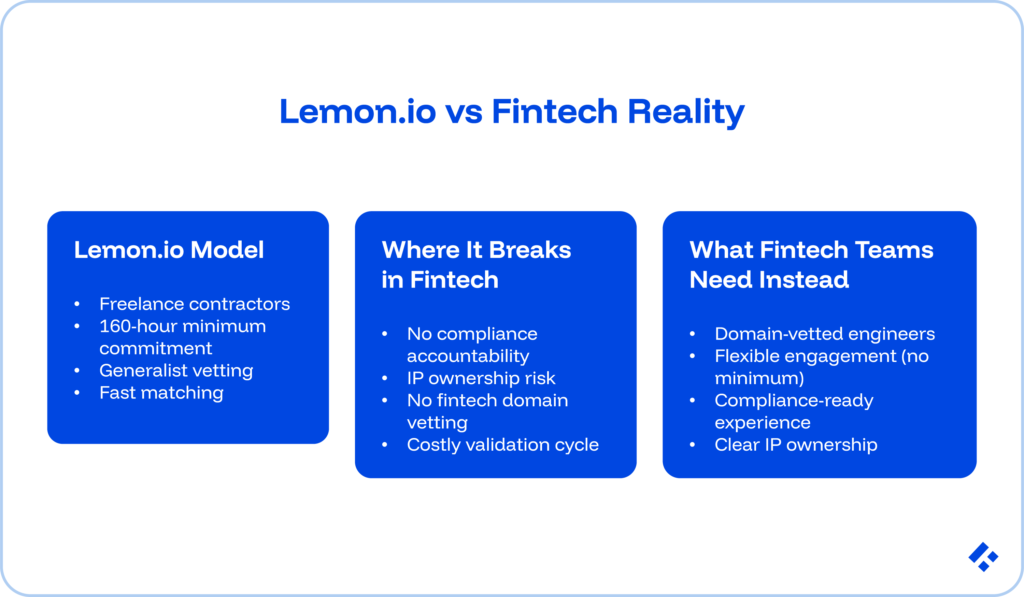
Lemon.io works well as a general startup engineering platform. It is suitable for many different instances of software development, but there are also certain characteristics that create specific risks for fintech startups specifically.
The freelance contractor model creates compliance accountability and IP ownership gaps that regulated financial products can't accept, and the 160-hour minimum commitment forces significant exposure before you are able to assess a developer’s compliance-awareness and fit.
This could be particularly detrimental when you consider that their vetting process doesn't cover fintech domain competencies like PCI DSS scope, KYC architecture, or payment idempotency.
Fortunately, there are some Lemon.io alternatives for fintech startups that can be considered instead:
Let’s go into the four alternatives, addressing each of them for fintech contexts, and offer a decision framework for the common scenarios of fintech founders. We will also take a deeper look at the disadvantages of Lemon.io so that you can make an informed decision.
Lemon's core product offering is developer matching, which is completed within 24 to 48 hours.
This makes it quite attractive as it is far faster than most curated platforms and dramatically faster than a direct hiring process.
Their developer pool, which is primarily made up of Eastern European engineers with 5+ years of commercial experience, has been refined based on strong software engineering training and high English proficiency.
Three characteristics define what Lemon does best:
Lemon.io's constraints are more like deliberate design choices that serve general startups well and create specific friction for fintech startups. Understanding each one precisely tends to be more useful than treating them as generic limitations.
The three constraints:
Lemon.io places independent contractors. This means they are not Lemon’s employees, and they do not take any responsibility for them. They are not your employees either.
Instead, think of the relationship like working with business entities or individual contractors.
This works well for general startups, but in a fintech context, the freelance contractor model creates three specific problems:
Compliance accountability is the biggest one.
When a regulatory examiner or banking partner asks about the engineering controls on your payment system, they're asking your organization, but a freelance developer who wrote your PCI DSS-scope payment integration carries no compliance accountability obligation.
Even if you just need information in the future, you may not be able to reach them again.
IP ownership is another potential issue since it defaults to the contractor in most jurisdictions without an explicit written assignment.
Instead of just relying on Lemon's standard contracts, which include work-for-hire provisions, you need to consider specifics like whether or not the IP vests immediately upon creation or at payment.
Finally, you need to think about institutional knowledge fragmentation, since the developers who leave take their frame of reference with them.
Unlike a staff-augmented engineer committed to a longer engagement, a Lemon.io contractor carries no structural obligation to document the compliance reasoning behind architectural decisions.
Before a Lemon.io engagement begins, you need to commit to at least 160 hours of work. That’s roughly one calendar month at full-time pace, plus a security deposit.
From Lemon's perspective, this is quite reasonable as it protects developers from low-commitment clients and ensures the platform's matchmaking investment gets recovered.
For a general startup, 160 hours provides a reasonable trial window to assess technical velocity and team compatibility.
For a fintech startup, 160 hours creates enough time for significant architectural decisions that may not surface compliance issues until a security review or QSA engagement weeks later.
Lemon.io's vetting process covers CV review, soft skills, English proficiency assessment, and a live coding session conducted by a senior developer from the Lemon team.
This means that, if you hire one of their engineers, you are basically guaranteed to get someone who can write clean code and integrate well into small teams.
But what they do not assess are the five competencies that determine whether an engineer can safely work on compliance-sensitive fintech systems:
We have identified four Lemon alternatives that address these three constraints to varying degrees.
No platform except Trio addresses all three, but different platforms address different subsets, making some more useful depending on which constraint matters most to your situation.
Contractor model:
Trio's engineers work as Trio's full-time employees placed into client engagements.
This eliminates the compliance accountability gap (Trio engineers operate under Trio's employment obligations and the client engagement agreement), the IP ownership ambiguity (all custom code becomes client-owned from creation, committed to client repositories), and the institutional knowledge fragmentation risk.
Trio also carries replacement commitments.
Commitment structure:
Trio operated under monthly contracts where developers are paid by the hour. This means you can place a Trio engineer, assess compliance domain fit within the first two weeks, and make a go/no-go decision before the first invoice.
Fintech domain vetting:
Trio pre-vets for all five fintech domain competencies like monetary precision, payment idempotency, PCI DSS scope management, KYC/AML state machine design, and regulatory framework awareness.
Evaluators carry production fintech backgrounds, so they are able to assess incoming developers thoroughly.
Placement timeline:
You can expect as little as 48 hours between your initial consultation and your first handful of vetted profiles. Onboarding largely depends on your review speed, but expect around 3-5 days.
Pricing:
Costs reflect the LATAM nearshore specialist rate of about $40 to $80/hr ($7,000 to $14,000/month), depending on your specific requirements.
This is less than Lemon.io's Eastern European freelance benchmark for equivalent experience.
There are also no hidden costs like placement fees.
Contractor model:
Toptal places freelancers and independent contractors, similar to Lemon.io.
The compliance, accountability, and IP ownership dynamics remain structurally similar, but Toptal's contract terms tend to be more enterprise-grade and more explicitly address work-for-hire provisions.
Commitment structure:
Toptal offers a two-week risk-free trial before commitment, with no minimum hours requirement after the trial.
This means that you can assess compliance domain fit in a controlled window before locking in, which makes this meaningfully more fintech-friendly than Lemon's 160-hour floor.
Fintech domain vetting:
Toptal's five-stage vetting produces genuinely rigorous general engineering quality.
But, just like with Lemon, regulatory awareness and complexities around factors like monetary precision, idempotency, PCI DSS scope, and KYC architecture aren’t assessed as part of the screening process.
Best for fintech when:
Budget allows, the engagement is short and well-defined, and the fintech has enough internal domain expertise to assess compliance fit during the two-week trial.
When it doesn't work:
When fintech domain pre-vetting matters, or when the 2 to 3x premium over LATAM nearshore rates isn't justified.
Contractor model:
Arc.dev matches both freelancers and full-time remote developers. For freelance engagements, the contractor dynamics are pretty similar to what you can expect to see at Lemon.io and Toptal.
For full-time remote hires, the model shifts toward dedicated engagement with stronger continuity expectations.
Commitment structure:
The firm’s 72-hour matching for freelance roles carries no minimum commitment comparable to Lemon's 160-hour floor.
Higher flexibility here reduces pre-commitment assessment risk.
Fintech domain vetting:
Arc.dev's AI-powered matching doesn't assess fintech domain competencies.
This means that you get all the same structural gaps that you do with Lemon.io and Toptal.
Best for fintech when:
A fast freelance match is needed for a general engineering task without compliance-sensitive domain requirements, and there's strong internal leadership to screen for domain fit.
When it doesn't work:
Any compliance-sensitive role where domain pre-vetting would eliminate the ramp cost that you would need to commit to if you end up hiring a generalist.
Contractor model:
Andela places developers through its Talent Cloud model. The hiring process is managed more like employment than pure freelancing, with Andela handling payroll and compliance obligations.
This takes care of some of the compliance accountability gaps in the pure freelance model.
Commitment structure:
Andela's 12-month minimum contract creates an even worse problem than Lemon's 160-hour floor.
The trial window before full commitment essentially disappears. If a developer isn’t the right person, you are stuck with them, or have to pay more to let them go and replace them.
Fintech domain vetting:
Andela's vetting covers general engineering quality across its African and global talent pool.
But, like many of the other Lemon alternatives, it doesn’t systematically assess fintech domain competencies.
Best for fintech when:
A scaling fintech that needs a long-term dedicated engineer for general backend development and has the domain expertise internally to onboard the engineer to compliance-specific requirements.
When it doesn't work:
Short-to-medium term engagements, compliance-deadline-driven capacity spikes, or roles requiring fintech domain pre-vetting.
| Platform | Freelance/Contractor Risk | Minimum Commitment | Fintech Domain Vetting | Est. Rate |
| Lemon.io | Freelance contractors | 160 hrs (~1 month) | Not assessed | $50-$100/hr |
| Toptal | Freelance contractors | 2-week risk-free trial | Not assessed | $150-$250/hr |
| Arc.dev | Freelance + full-time | None for freelance | Not assessed | $80-$150/hr |
| Andela | Managed (not freelance) | 12-month minimum | Not assessed | $60-$100/hr |
| Trio | Full-time employees | Monthly, no floor | Not assessed | $40-$80/hr |
Lemon.io's three constraints for fintech are real but not universal. There are fintech-adjacent scenarios where Lemon's speed, startup orientation, and Eastern European talent pool genuinely work:
Lemon.io works for fintech when the scope stays clearly separated from compliance-sensitive systems. But if you are dealing with systems that are heavily regulated or require industry-specific knowledge, Trio is going to be the best alternative.
At Trio, every engagement starts with a consultation, because we hand-pick developers based on your specific needs.
To get started today and place your first developers within 3-5 days, book a decision call.
Lemon.io is generally good for general startup engineering, but not for fintech startups. The freelance contractor model introduces gaps in compliance accountability and IP ownership. The 160-hour minimum commits you before assessing domain fit. And vetting doesn't cover fintech competencies like PCI DSS scope or KYC state machine design.
The best Lemon.io alternative for fintech startups is Trio, a fintech-specific outsourcing and staff augmentation firm that hand-picks developers from their pre-vetted pool, so you are more likely to hire the right person immediately.
Lemon's vetting covers CV review, a soft-skills interview, and a live coding session, which produces strong generalist engineers, but it doesn't assess fintech domain competencies such as monetary precision, idempotency, PCI DSS scope, KYC architecture, or regulatory awareness.
Trio places pre-vetted LATAM fintech engineers at $40 to $80/hr, which sits below Lemon.io's estimated $50 to $100/hr for Eastern European freelancers, with the added benefit of fintech domain vetting.
The 160-hour minimum at Lemon.io actually becomes a problem when compliance domain gaps, such as incorrect monetary data types or weak KYC design, only surface after code review or a QSA engagement, meaning you've committed significant spend before discovering the fit issue.