

Andela’s generalist talent pool and AI-powered matching work well for general software engineering. But, for fintech specifically, it might not be a good choice.
Andela does not pre-vet for financial engineering disciplines like KYC/AML state machine design, payment rail protocols, double-entry ledger integrity, fraud ML training-serving skew, or FAPI security profiles. Placing a generalist in any of these roles could lead to costly mistakes.
Outside of fintech, Andela’s vetting process works well, including coding assessments, problem-solving evaluations, English proficiency tests, and even attention to cultural fit.
Let’s look at how Trio’s domain expertise makes it a good Andela alternative for fintech engineering, where the gap sits, and what failures generalist hiring creates in financial technology.
Key Takeaways
- Andela works well for general engineering roles like frontend, DevOps, mobile, and standard backend.
- Andela’s vetting process screens for coding quality, communication, and problem-solving.
- The 12-month minimum contract compounds the domain vetting gap, creating production risk.
- Trio’s pre-vetted LATAM developers are suitable for KYC/AML, payments, ledger, fraud ML, and financial data engineering, and can be placed in 3 to 5 days, with no minimum contract term.
What Andela Does Well, and Where it Doesn’t in Fintech
Andela does several things genuinely well.
Its talent pool spans 150,000+ engineers across Africa, Latin America, Asia, and Eastern Europe. The company has an extensive vetting process that filters for coding quality and communication.
It also boasts an AI matching engine called the Talent Decision Engine. This engine surfaces candidates quickly for standard software engineering profiles, drastically decreasing hiring time compared to conventional methods.
If you want to hire a React frontend engineer, a Node.js backend developer, or a DevOps engineer to manage cloud infrastructure, Andela is a great option, and most of the complaints we can see in client reviews tend to be about friction and pricing, not incorrect placement.
But this model doesn’t necessarily work well for financial domain engineering roles.
As we already mentioned, Andela’s vetting process optimizes for general engineering competence. These qualities matter in fintech too, but they’re table stakes, not differentiators.
The differentiators for fintech engineering roles are domain-specific.
Does the engineer understand what happens in a KYC verification when the identity check returns “inconclusive”? Can they describe the difference between a soft and hard ACH return code? Do they know why double-entry bookkeeping must be enforced at the database constraint level rather than the application layer?
Andela’s vetting doesn’t systematically screen for any of these competencies.
Related Reading: Contract Developers vs Full-Time Engineers
The Five Fintech Domain Gaps That Andela’s Vetting Doesn’t Cover
Andela’s engineers are definitely high quality, but placing an Andela engineer into a role requiring fintech domain competency is not going to produce reliable results. Let’s look at the gaps Andela doesn’t cover, which create these fintech inconsistencies.
Gap 1: KYC/AML State Machine Design
KYC/AML engineering requires building identity verification workflows as stateful systems with defined legal states, required transitions, and specific engineering responses at each state.
A qualified KYC/AML developer can describe the identity verification lifecycle in full. They can set up document submission, liveness checks, database screening, risk scoring, enhanced due diligence, and the approval/rejection/pending/suspended branches.
These developers also know what happens architecturally when a verification enters each state.
They understand BSA record-keeping requirements (5-year minimum retention), the distinction between customer due diligence and enhanced due diligence, and how SAR filing pipelines get built into the system.
A generalist placed into this role might build a verification workflow with illegal state transitions that pass all tests and fail in production under regulatory examination.
Gap 2: Payment Rail Protocols and Idempotency
Payment engineering requires knowledge of specific network protocols that don’t exist in general software development.
This includes NACHA fixed-width file formats for ACH, ISO 20022 XML message schemas for FedNow/RTP/Fedwire, card scheme authorization validity periods, and the idempotency implementation patterns that prevent double-charges.
In production, this knowledge gap produces double-charges, failed reconciliation, and declined legitimate transactions due to misconfigured authorization flows. Each of these issues carries direct revenue and regulatory consequences.
Gap 3: Double-Entry Ledger Integrity
Ledger engineering for fintech requires enforcing the double-entry accounting invariant, where every credit has a corresponding debit of equal value. This needs to happen at the database constraint level.
A qualified ledger engineer knows that enforcing this in application code (a balance check before every write) is insufficient because concurrent transactions can bypass application-layer checks.
Synapse Financial’s $90M+ reconciliation failure in 2024 was attributed in part to ledger integrity gaps of exactly this kind.
Gap 4: Fraud ML Training-Serving Skew
Fraud detection engineering requires building ML systems for adversarial, imbalanced, and temporally sensitive financial fraud data.
Training-serving skew, which is where feature values available at training time differ from those available at inference time, represents the most common silent failure mode in production fraud detection systems.
A qualified fraud detection engineer designs the feature store specifically to prevent this: features computed identically in both training and serving pipelines, with explicit contracts enforced by schema validation.
A general ML engineer placed into a fraud detection role might produce a model that performs well in offline evaluation and silently degrades in production as fraud patterns evolve.
Gap 5: Financial Data Precision and Audit Trail Architecture
Financial data engineering requires fixed-precision decimal types for all monetary amounts (never floating-point), immutable raw data zones that preserve source records regardless of source system corrections, and audit trails.
Andela doesn’t evaluate things like DECIMAL vs. FLOAT discipline for monetary amounts, PCI DSS cardholder data isolation from analytics workloads, or reconciliation pipeline architecture.
The Andela Pain Points That Compound the Problem
Even setting aside domain vetting, Andela has some pain points that you strongly need to consider before hiring.
The 12-month minimum contract
Andela’s standard engagement requires a 12-month minimum commitment.
For a fintech company, discovering that an engineer lacks the domain knowledge the role requires, absorbing a contract termination cost might be a risk you just cannot justify.
In general software development, a technically competent generalist can often grow into domain knowledge over time.
In regulated fintech engineering, the domain knowledge gap (KYC state machine design, payment idempotency, ledger integrity) tends to create production risk during that growth period.
Opaque AI matching
Andela’s Talent Decision Engine automates matching across a pool of 150,000+ engineers.
From what we have been able to garner from client reviews, the matching is quite opaque.
A role description goes in, candidates arrive, and the rationale for why they were selected stays inside the algorithm.
2 to 4 week wait times
Andela’s typical time-to-profile runs 2 to 4 weeks.
If your fintech is operating under regulatory deadlines like a Section 1033 compliance date, a DORA implementation timeline, or a PCI DSS audit remediation schedule, you probably have a hard deadline to fill engineering capacity gaps that this timeline may not accommodate.
Pricing at $6,000 to $14,000 per month
Andela’s pricing sits at or near the top of the nearshore and global staffing market.
For general engineering placements, this reflects platform fee, vetting infrastructure, and ongoing support.
For a fintech domain specialist role where the vetting didn’t screen for the relevant domain competencies, paying these higher rates for what turns out to be a generalist placement compounds the original problem.
What Fintech-Specific Staffing Actually Looks Like: A Framework for Evaluation
When evaluating any staffing partner for fintech engineering roles, whether that platform is Andela, Toptal, lemon.io, CloudDevs, arc.dev, gun.io, or Trio, there are four questions you can ask to help determine whether the platform can actually deliver for regulated financial engineering.
- Question 1: Does the vetting process include fintech domain evaluation, not just general engineering assessment?
- Question 2: Do the evaluators have fintech domain experience?
- Question 3: What is the contract minimum, and what happens if the domain fit is wrong?
- Question 4: Does the time-to-placement fit within the regulatory deadline?
How Trio Fills the Fintech Engineering Staffing Gap
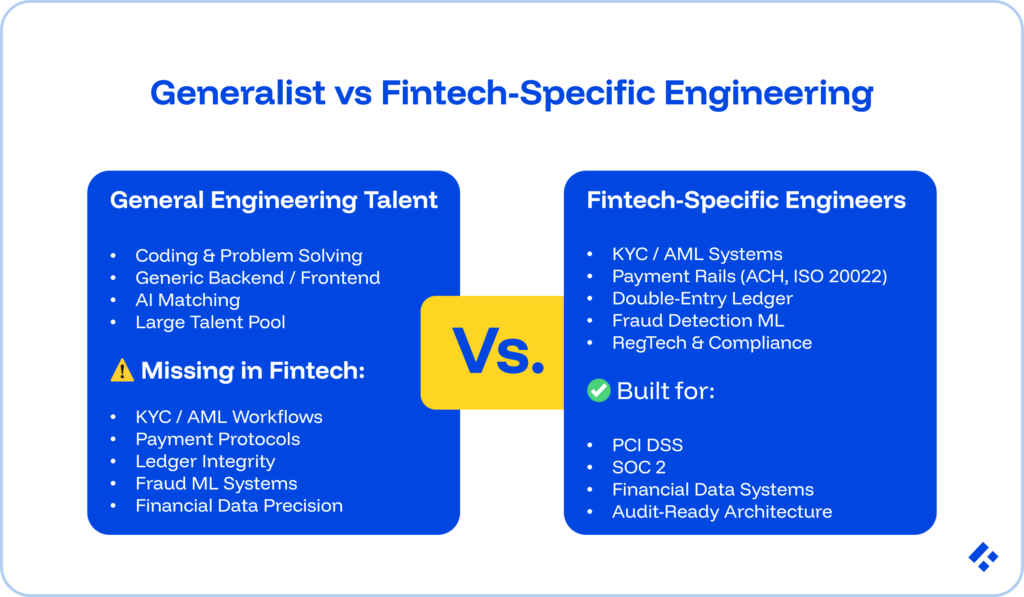
Trio’s model addresses the specific structural gap that generalist hiring firms create.
This is done by operating exclusively in fintech engineering staffing, which means the entire vetting infrastructure is designed for fintech domain competencies rather than general engineering, with fintech listed as one vertical among many.
Trio maintains a pre-vetted bench of LATAM engineers across the disciplines fintech engineering specifically requires, including:
- KYC/AML systems
- Payment rail engineering (ACH/NACHA, FedNow/RTP, ISO 20022, card scheme integration)
- Double-entry ledger infrastructure
- Fraud detection ML
- RegTech systems (DORA, BCBS 239, PSD2/PSD3)
- Open banking (FAPI, consent lifecycle)
- Financial data engineering (decimal precision, audit trails, PCI DSS isolation, reconciliation pipelines).
Since the experienced developers are already on-hand and pre-vetted for financial technology, the placement timeline is 3 to 5 days.
Pricing is incredibly cost-effective for the fintech industry, at $40 to $80 per hour ($7,000 to $14,000 per month). This is facilitated by the LATAM location of the developers, which allows you to get high-quality talent at affordable rates without a decrease in quality.
In terms of the contract model, there is no 12-month minimum. Instead, engineers are hired through models like staff augmentation and are paid hourly.
Related Reading: Best Nearshore Dev Partners for Fintech
Andela vs. Trio for Fintech Engineering: Direct Comparison
The comparison below focuses on fintech engineering staffing specifically. This fintech domain summary of Andela vs Trio can be used to help you in your decision-making process.
| Dimension | Andela | Trio |
| Talent pool size | 150,000+ engineers, global | Pre-vetted LATAM bench, fintech-specific |
| Domain pre-vetting | General engineering assessment; domain as search filter | Fintech domain evaluation: KYC/AML, payments, ledger, fraud ML, RegTech, open banking, data |
| Vetting evaluators | General engineering evaluators | Domain-experienced fintech engineering evaluators |
| Time to profiles | 2 to 4 weeks | 3 to 5 days |
| Pricing | $6,000 to $14,000/month | $7,000 to $14,000/month ($40 to $80/hr) |
| Contract minimum | 12 months (standard) | No minimum |
| Trial/replacement policy | No standard trial; replacement varies | Replacement available if placement doesn’t meet the brief |
| Geographic model | Africa, LATAM, Asia, Eastern Europe | LATAM nearshore (US timezone overlap) |
| Fintech regulatory literacy in vetting | Not systematically evaluated | Evaluated across BSA, PCI DSS, PSD2, DORA, NACHA, ISO 20022 |
| Retention rate | Not publicly reported | 95% |
| Best fit | General software engineering at scale; non-regulated tech roles | Fintech engineering roles requiring domain pre-vetting in regulated financial disciplines |
The Specific Fintech Engineering Roles Where Andela’s Generalist Model Leaves the Most Risk
Not every fintech engineering role requires fintech domain pre-vetting. The risk concentrates in roles that directly touch regulated systems, financial data integrity, or compliance obligations.
High domain-dependency roles where a generalist placement creates specific engineering risk include:
- KYC/AML engineers (identity verification state machines, SAR filing, BSA record-keeping, EDD workflows)
- Payment engineers (ACH/NACHA, FedNow/RTP, card scheme authorization, idempotency)
- Ledger engineers (double-entry integrity, reconciliation, financial atomicity)
- Fraud detection engineers (ML for adversarial financial data, training-serving skew, dual-latency constraints)
- RegTech engineers (DORA, BCBS 239, PSD2/PSD3, regulatory reporting automation)
- Open banking engineers (FAPI security profiles, consent lifecycle, bank connectivity)
- Fintech data engineers (DECIMAL precision, PCI DSS isolation, audit trail architecture, reconciliation pipelines)
Lower domain-dependency roles where general engineering quality is the primary variable, and Andela’s scale and vetting process remain competitive:
- Frontend engineers (React, Vue) building financial product UIs
- DevOps and SRE engineers managing cloud infrastructure
- Mobile engineers building consumer-facing apps over existing APIs
- QA/test engineers running automated test suites against stable interfaces
Final Thoughts
Andela is a great option for general hiring, but if you are looking to fill fintech-specific roles, then you are subjecting yourself to additional risks.
In these instances, Trio is a great Andela alternative thanks to fintech-specific expertise.
If you are ready to hire fintech developers through Trio, book a decision call.
Frequently Asked Questions
Is Andela good for fintech companies?
Andela works well for fintech companies hiring general software engineering roles. It creates specific placement risk for regulated financial engineering roles where domain pre-vetting is the operative variable.
What do Andela alternatives for fintech engineering actually look like?
A genuine Andela alternative for fintech engineering is a staffing partner that vets specifically for fintech domain competencies. Trio is a great example of an Andela alternative that specializes in financial technology, placing developers in 3-5 days.
Why is Andela’s 12-month minimum a bigger problem in fintech than in other sectors?
In general software development, a technically competent generalist can typically grow into domain knowledge over a 12-month engagement. In regulated fintech roles, the domain knowledge gap creates production risk during that same period.
How does Trio’s fintech pre-vetting differ from Andela’s vetting process?
Trio’s pre-vetting differs from Andela’s as it evaluates candidates against fintech domain competencies in their specific specialty, while Andela evaluates coding quality, problem-solving, and communication.