

Hire by Technology
SERVICES


Both a recruiting agency and a staff augmentation partner help you get engineering talent, but the way in which they do that, the cost structure, the timeline, and the relationship that you end up with differ in ways that matter a lot.
This is even more true in industries like FinTech and any other part of financial services, where mistakes leading up to regulatory deadlines can cause serious issues.
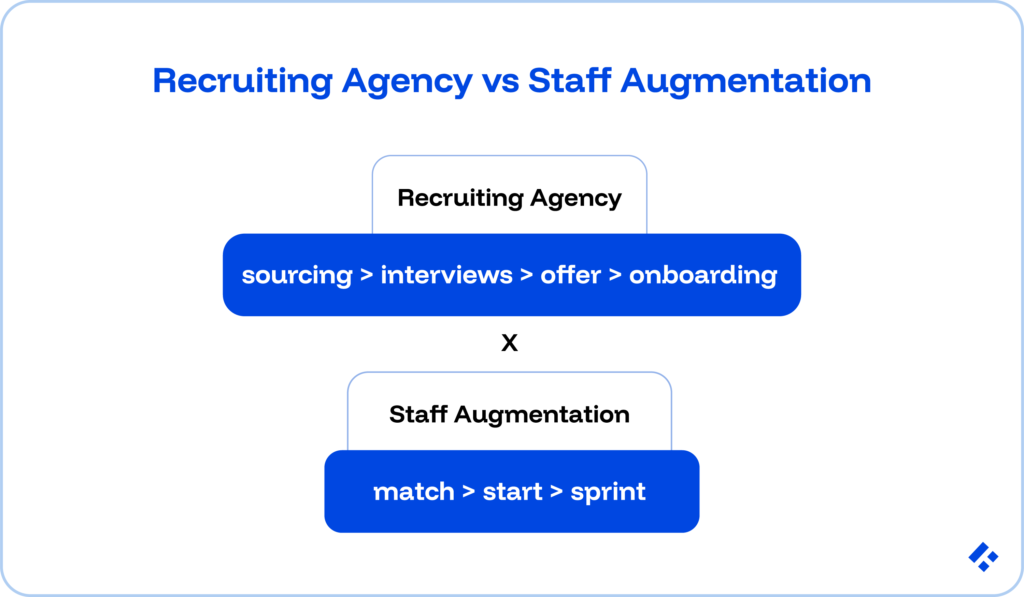
Recruiting agencies work as brokers for permanent employment. They find someone, you hire them onto your payroll. You pay a one-time placement fee, and then the agency steps out of the picture entirely, and you deal with the employee in-house.
Staff augmentation involves pre-vetted engineers joining your sprint in days, staying on the provider's payroll, and working under your direction for as long as you need. The developers are employed by the staff augmentation firm, and you contract the firm.
What a lot of our clients like in both these models is that they own the IP and control all of the work.
Let’s take a deeper look at the differences between the two for FinTech teams specifically. If you decide you are ready to get started with staff augmentation, reach out to compare options.
Staffing agencies and recruiting agencies are sometimes treated as the same thing, but they are very different and entirely separate from staff augmentation. Let’s start by clarifying the differences so you don’t choose the wrong model.
In FinTech specifically, it’s important that you carefully consider the mechanism of each model. The talent pool for engineers with genuine PCI DSS, KYC/AML, or payments infrastructure experience is already slow, and salaries run high.
Making the wrong choice wastes time and resources and forces you to restart the hiring process entirely in most cases, placing you behind in a rapidly evolving industry.
For a lot of smaller companies, budget pressures are high, or tech leadership has to justify staffing decisions to someone like a CFO to justify a staffing decision.
The upfront fee is the biggest cost differentiator, but it's important to consider the rest of the hiring cycle as well, including vacancy time, loaded compensation, and what happens when a hire doesn't work out.
The total first-year cost of a recruiting agency hire ends up coming to roughly $213,000–$223,000. And that is before you count management requirements or things like time spent on onboarding.
The total for about 12 months with a single senior FinTech engineer is approximately $124,800.
Let’s look at a more direct comparison for the same developer, hired through different models, for a 6-month-long period.
| Model | Time to Start | One-Time Fees | Monthly Cost | 6-Month Total |
| Recruiting agency (perm hire) | 3–6 months search | $25,800 placement fee | $18,750 (loaded salary) | $139,300+ (plus vacancy gap) |
| Staff augmentation (LATAM nearshore) | 3–5 days | $0 | $10,400 | $62,400 |
One thing we need to remember is that these values assume that the hire works out. While staff augmentation allows you to replace a developer almost instantly, the same is not true for a recruiting agency.
If they leave in month four, or underperform and require a managed exit, the real cost climbs considerably higher.
Even if the cost math were neutral, which it definitely is not, the timeline difference alone tends to decide the question for teams managing short-term delivery commitments.
The recruiting agency timeline for a senior FinTech role looks roughly like this:
All of that brings the total realistic timeline to 12–22 weeks if there are no false starts, like a candidate who declines the offer after four weeks of process, or a failed technical screen deep into the pipeline.
From what we have seen, in FinTech specifically, where the talent pool for compliance-ready engineers is so small, and the requirements for senior positions are so high, false starts appear frequently.
The staff augmentation timeline looks quite different:
If you are dealing with something like a compliance deadline in 10 weeks, or trying to meet the requirements of a potential acquisition, a recruiting agency, or even traditional hiring, just isn’t an option.
As we have already mentioned a couple of times, FinTech engineering carries requirements that make the staffing agency vs staff augmentation decision meaningfully different from hiring, say, a mid-level web developer.
A recruiting agency's job is to present you with a bunch of candidates who match the job description.
These agencies are not fintech-specific in most cases. Their recruiters usually aren't FinTech engineers themselves. They're relationship-driven sourcers who match resumes to job requirements.
They cannot credibly evaluate actual hands-on experience with PCI DSS implementation, idempotent payment logic, or KYC onboarding flow architecture. That gap typically only surfaces after the hire joins your payroll.
Staff augmentation providers specializing in FinTech vet for domain fluency, not just technical stack.
For example, engineers in Trio's bench carry demonstrable history with payment rails, compliance-sensitive codebases, and regulated financial systems. We have people with the right skills on our team to be able to evaluate candidates thoroughly in all the ways that matter.
This is not only critical to prevent long-term issues related to compliance and security that are perhaps missed until an audit, but also in terms of ramp time. Developers who are familiar with the industry just need to learn the specifics of your product, not start from scratch.
Related Reading: In-House vs Staff Augmentation for Fintech
When a recruiting agency places a permanent hire, the compliance knowledge that the engineer accumulates belongs to them personally.
If the person that you hired ends up leaving after a year, which definitely is not abnormal in competitive FinTech markets, that knowledge leaves with them. If they made architecture decisions and no one is quite sure why, you could create gaps that show up at audit time.
Augmented engineers work with the idea that it is not permanent. They integrate into your systems and record decisions with the knowledge that they won’t be around to answer questions. The audit trail remains yours.
A recruiting agency hire represents a 12–24 month commitment before you even know if you have made the right decision. If FinTech requirements shift, you don’t have the flexibility to adapt quickly.
Staff augmentation scales to your roadmap. Engineers join for a compliance sprint in a couple of days. When you don’t need them anymore later, you reduce team size, knowing you can scale back up for the next product cycle, all without HR events.
Recruiting agencies are definitely right for certain scenarios. You should consider them if you are:
As a simple test, think about whether you're hiring someone to anchor your company for 3+ years, and the timeline isn't a bottleneck. In these cases, recruiting agencies are a viable fit.
Related Reading: Fintech Recruiting Agency Alternatives
| Your Situation | Better Model |
| Need an engineer in your sprint within 2 weeks | Staff augmentation |
| Building a permanent CTO or VP Eng role | Recruiting agency (executive search) |
| Compliance deadline in 10 weeks | Staff augmentation |
| Hiring a 5-year founding architect | Recruiting agency |
| Need 3 senior FinTech engineers for 6 months | Staff augmentation |
| Backfilling attrition on an active product team | Staff augmentation |
| Building institutional knowledge for the core platform | Recruiting agency for 1–2 leadership roles + augmentation for execution |
| Post-funding team scale-up (10+ engineers) | Staff augmentation (nearshore LATAM for cost) |
| Niche permanent hire: DeFi engineer, compliance tech lead | Specialist FinTech recruiting agency |
| Need engineers contributing to the current sprint by Monday | Staff augmentation, specifically Trio |
You do not have to choose only one model. A great strategy is to use a recruiting agency for core, long-term roles, and then use staff augmentation to take advantage of the flexibility that the model provides to scale teams up and down.
For the majority of FinTech engineering roles, staff augmentation is probably the better option thanks to the lower overall costs, the shorter timeline, the domain vetting you get through a partner like Trio, and the flexibility that matches how FinTech roadmaps actually work.
Recruiting agencies earn their fees for permanent, strategic placements where cultural fit, long-term commitment, and institutional investment are key. These are great for your core roles, but only if you have the time to spare in the recruiting process.
Trio places pre-vetted, compliance-ready FinTech engineers in your sprint within 3–5 days. If you are ready to start the staff augmentation process, book a decision call.
The primary difference between a recruiting agency and staff augmentation is that a recruiting agency finds permanent hires for your payroll and collects a placement fee (15–25% of first-year salary) when a hire is made. Staff augmentation embeds pre-vetted engineers in your team on a monthly rate, with no placement fee, no employment overhead, and flexible duration.
Staff augmentation tends to be cheaper than a recruiting agency for most FinTech engineering roles. If you use a recruiting agency, you pay market rates for the developer, have to provide benefits, and pay a one-time recruiting fee. For staff augmentation, you often pay hourly, with no additional fees or overhead.
Hiring through a recruiting agency typically takes 3–6 months for FinTech-specialist roles, largely due to the narrow talent pool for compliance-ready engineers. Staff augmentation can place an engineer in your sprint within 3–5 days, because the provider keeps pre-vetted developers on hand.
You should use a recruiting agency for permanent, strategic roles requiring multi-year commitment and cultural integration, like CTO, VP Engineering, principal architect, or founding engineer. For execution capacity, specialist sprints, compliance build-outs, or scalable team growth where speed and flexibility matter, staff augmentation will probably be the better option.
No, staff augmentation does not replace recruiting agencies entirely. Instead of seeing it as an either/or choice, let recruiting agencies handle the 2–5 permanent leadership roles that carry 5+ year horizons, and use staff augmentation to cover the engineering execution capacity.