

 Read Client Stories




 Alex Kugell
 Key Takeaways
- Fintech engineering carries a domain knowledge layer that general software engineering doesn’t.
- Turing serves the US and Canada only, eliminating UK, EU, LATAM, and APAC fintechs before any other evaluation applies.
- Andela requires 12-month minimum contracts with a $50,000 buyout fee for conversion to full-time.
- Trio appears to be the only platform in this comparison that screens explicitly for fintech domain competencies, serves clients globally, offers project-based engagements, and prices at the LATAM nearshore benchmark.
The best platform to hire fintech developers depends on a variety of factors, including fintech domain vetting, geography coverage, engagement model flexibility for compliance-deadline-driven capacity needs, and pricing benchmarked against the LATAM nearshore rate of $40-$80/hr.
We’ve narrowed the best options down to 6, and only one of the top ones meets all the requirements to be a good candidate:
- Trio
- Toptal
- Turing
- Andela
- Gun.io
- Arc.dev
To make sure that you choose the best tech partner for your project, compare options.
The 4 Criteria That Matter for Hiring in Fintech
Standard developer platform comparisons rely on five metrics: acceptance/rejection rate, talent pool size, time-to-match, hourly rate, and trial terms.
These matters are just as important when you are looking for a platform to hire fintech developers. The only issue is that they are not all that matters. There are many additional factors you need to consider.
We have noted four additional considerations that can help you determine whether a platform actually works for regulated financial engineering:
- Fintech domain vetting: Does the platform’s screening process evaluate fintech domain competencies, including payment system design, KYC/AML state machine architecture, PCI DSS scope judgment, and ledger integrity conventions?
- Geography coverage: Does the platform serve clients in your jurisdiction? Several platforms that appear globally restrict client eligibility to the US and Canada in practice, which eliminates them for UK fintechs, EU-licensed payment institutions, and APAC digital banks.
- Engagement model: Fintech teams hit regulatory-deadline-driven capacity spikes with defined end dates. Does the platform support project-scoped and part-time engagements, or only full-time placements?
- Price benchmarked against the LATAM nearshore market: LATAM nearshore engineers with production fintech experience cost $40-$80/hr through specialist staffing partners. Platforms priced at $150-$250/hr sit 2 to 3 times above this benchmark for equivalent seniority.
1. Trio
Trio is a LATAM nearshore fintech specialist staffing partner, placing pre-vetted engineers with production fintech experience into fintech engineering teams globally.
Engineers work as Trio full-time employees and are hand-picked based on client requirements and placed in flexible staff augmentation models or through outsourcing and dedicated teams.
Trio’s vetting explicitly screens for fintech domain competencies that no other platform in this comparison assesses systematically.
This includes things like payment system design (idempotency, state machines, PSP integration), KYC/AML architecture (state machines with ongoing monitoring, not forms with boolean flags), PCI DSS scope management, ledger engineering conventions (DECIMAL not FLOAT, double-entry enforcement), and regulatory framework awareness covering SR 11-7, EU AI Act, ECOA, and DORA.
This is possible thanks to the fact that the evaluators themselves have production fintech backgrounds.
Trio is based in the United States, but serves a variety of different clients. The only condition is that they are able to work with a US-based company.
This means that, practically, Trio serves US, UK, EU, LATAM, and APAC fintech companies. The only requirement is that the client can contract with a US-based firm.
In terms of engagement models, all developers remain Trio’s employees but can work for clients on full-time, part-time, and project-based engagements, with monthly contracts and no 12-month lock-in.
This allows you to drastically scale your team to prepare for something like a compliance deadline, without you needing to commit to that capacity long-term.
Thanks to LATAM sourcing, the experts are available at rates of $40-$80/hr ($7,000-$14,000/month) for senior fintech engineers, including fintech domain pre-vetting.
Placement completes in 3 to 5 days from the initial brief to vetted profiles. Trio posts a 97% placement success rate and 95% engineer retention.
Hire fintech developers with Trio.
2. Toptal
Toptal accepts the top 3% of applicants through a five-stage vetting process covering language, personality, technical skills, live problem-solving, and test projects.
You can hire developers from all over the world, with full-time, part-time, and project-based engagement options, and a two-week risk-free trial. On top of that, they serve clients from all over the world, so you aren’t affected by geographic restrictions.
However, what you need to consider is that Toptal’s vetting process does not evaluate fintech domain competencies.
If not for this fact, the different hiring models would be great to accommodate compliance-deadline-driven capacity spikes.
Toptal’s pricing reflects its rigorous vetting process. At $150-$250/hr, you are looking at 2 to 3 times the LATAM nearshore benchmark for equivalent seniority.
In short, Toptal works well for senior architecture roles and short-term specialist engagements where budget is not the primary constraint, or where the fintech has strong internal domain knowledge to onboard a high-quality generalist quickly.
Related Reading: Trio vs Toptal for Fintech
3. Turing
Turing screens over 3 million candidates using a 5 to 10 hour algorithmic coding and system design assessment, provides AI-powered matching, and offers a two-week risk-free trial.
For US and Canadian companies hiring general backend, frontend, or AI engineering roles, the sheer quality of developers that you can get at the speed that Turing is able to provide them is incredibly appealing.
This could make it an asset in time-sensitive projects like those related to compliance, but unfortunately, Turing’s AI-first vetting optimizes for algorithmic coding and system design at an abstract level.
This means that fintech-specific competencies like payment systems, KYC/AML architecture, PCI DSS scope judgment, and other things just don’t appear in the assessment criteria.
On top of that, the companies that are able to use Turing are limited to the US and Canada only, and are forced into full-time agreements at 40 hours per week.
The price of $100-$200/hr often does not justify the risk and inconvenience of dealing with these other disadvantages for fintech-specific roles.
However, Turing might make sense for US and Canadian fintechs hiring full-time general backend engineers (React, Node.js, Python) for standard product development without compliance-sensitive domain requirements.
Related Reading: Turing Alternatives for Fintech Engineering
4. Andela
Andela connects companies with engineers primarily from Africa, although it has expanded to Latin America and Eastern Europe.
Long-term placements are their core hiring model, with a multi-stage vetting process covering coding tests, soft skills, and interviews, targeting enterprise and scale-up companies.
They charge around $60-$100/hr with 12-month contracts that auto-renew. This is a lot lower than some of the other alternatives discussed, but the 12-month placement still doesn’t work for everyone.
Andela’s vetting process evaluates general engineering quality as well, and does not have a systematic assessment of fintech domain competencies.
They are a good global engineering option if you have more general requirements, though, since Andela serves clients internationally without the geographic restriction that eliminates Turing.
Related Reading: Andela Alternatives for Fintech Engineering
5. Gun.io
Gun.io operates as an invite-only network of senior engineers, vetted through a multi-stage human-run process rather than an algorithmic assessment.
The platform’s primary clients are companies that need senior freelancers for critical projects. Their rigorous vetting and invitation-only hiring have earned them a reputation for engineering quality across general software domains.
But, while their human vetting process applies rigorous standards for general engineering quality, fintech domain competencies don’t feature.
While Gun.io can serve non-US clients, their developers are primarily made up of those in the US domestic market, which pushes pricing toward US domestic rates, at around $100-$200/hr.
You can hire these developers as freelancers, removing the risk of a full-time hire, but the combination of premium pricing and the absence of fintech domain vetting produces the weakest price-to-fintech-value ratio among the platforms reviewed here.
Where Gun.io does work well is for isolated, well-defined tasks without compliance touchpoints.
Related Reading: Gun.io Alternatives for Fintech Developers
6. Arc.dev
Arc.dev (formerly CodementorX) serves startups and growth-stage companies with both freelance and full-time remote hiring.
The platform stands out for the fact that it matches clients with senior engineers within 72 hours for freelance roles and within 14 days for full-time hires.
It also provides transparent pricing in the $80-$150/hr range, and a global talent pool weighted toward US and European time zones.
However, like many other options, fintech-specific knowledge does not appear in the screening criteria.
Arc.dev is a good choice for fast-moving startups needing general engineering capacity quickly, where fintech has internal domain expertise to onboard engineers effectively.
Related Reading: Trio vs Arc: Finding Vetted Fintech Developers
Platform Comparison Table
The following table covers all six platforms across the four fintech-specific criteria.
| Platform | Fintech Domain Vetting | Geography | Engagement Model | Senior Rate (approx.) |
| Toptal | Not assessed systematically | Global | Full-time, part-time, project | $150-$250/hr |
| Turing | Not assessed | US/Canada only | Full-time only | $100-$200/hr |
| Andela | Not assessed | Global | 12-month contracts | $60-$100/hr |
| Gun.io | Not assessed (general quality only) | US-centric | Freelance | $100-$200/hr |
| Arc.dev | Not assessed | Global | Freelance + full-time | $80-$150/hr |
| Trio | Fintech-specific competencies | Global (US firm) | Full-time, part-time, project | $40-$80/hr |
Decision Framework: Which Platform for Which Fintech Scenario
No single platform fits every fintech hiring scenario, so you will need to consider your individual requirements very carefully. The criteria that we mentioned above map to some very specific use cases.
- US or Canadian fintech hiring a full-time general backend engineer (React, Node.js, Python) for standard product development without compliance-sensitive domain requirements: Turing or Toptal.
- Any fintech hiring a compliance-sensitive role (payment systems, KYC/AML, ledger engineering, PCI DSS remediation). Trio.
- UK, EU, or APAC fintech hiring for general engineering roles: Andela, Toptal, Arc.dev, and Trio.
- Short project-scoped compliance deadline (DORA, PCI DSS remediation, ISO 20022 migration): Trio
- Isolated non-compliance-touching task with a well-defined scope: Gun.io or Arc.dev
Depending on whether you’re looking at augmenting an existing team or building a dedicated group, Trio offers both a staff augmentation model and a dedicated fintech engineering team model.
What Fintech Vetting Actually Requires
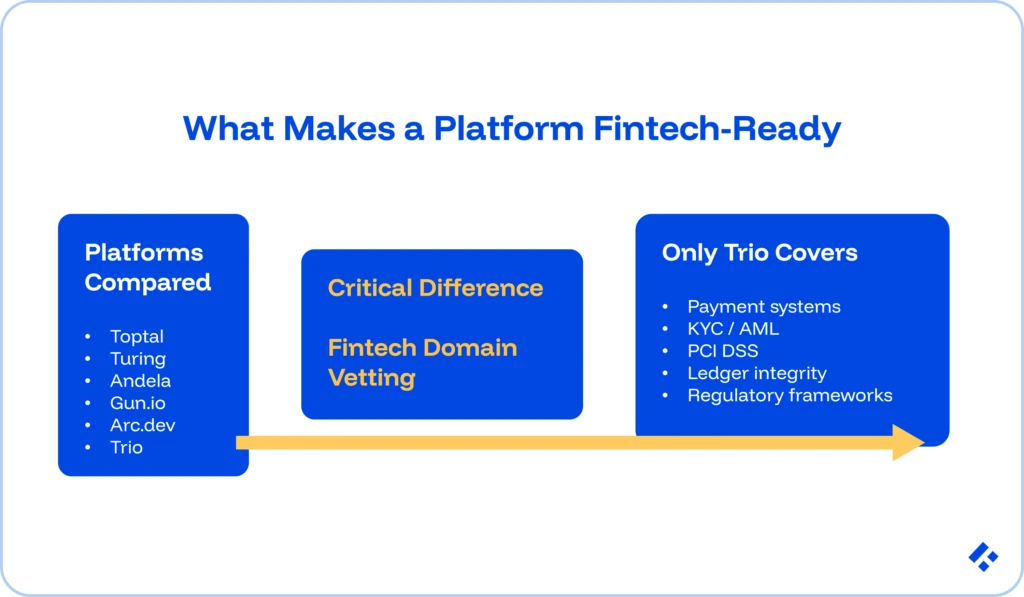
A lot of the platforms that we have mentioned here all claim to rigorously vet their developers, but general vetting and vetting for fintech are two entirely different things.
Toptal, Turing, Andela, and Arc.dev all consider general engineering quality, covering algorithmic proficiency, system design clarity, communication, and work ethic.
Fintech engineering requires all of these skills as a baseline, and then also domain-specific attributes like:
- Monetary precision conventions: (DECIMAL, not FLOAT, amounts as strings across API boundaries) to prevent silent financial calculation errors.
- Idempotency patterns for payment retries: Using client-generated keys with three-layer enforcement and write-ahead log gap handling prevents double charges.
- KYC lifecycle design: A state machine with ongoing monitoring triggers rather than a form with a verified flag determines whether your compliance architecture satisfies ongoing AML monitoring obligations.
- PCI DSS scope judgment: Specifically knowing what makes a system in-scope vs. out-of-scope before the architecture finalizes.
Engineers who have built payment systems in production carry these conventions automatically.
Final Thoughts
While there are a lot of great options to hire remote developers, very few of them vet for fintech specifically. This can lead to compliance and risk issues that might not appear until it is too late.
Trio is the only option that considers experience in financial application development in a variety of different regions.
If the work does not touch compliance-critical features, more options are available to you.
Book a decision call.
Frequently Asked Questions
What is the best platform to hire fintech developers?
The best platform to hire fintech developers is Trio (Trio.dev). They stand out because of their fintech domain vetting, geography coverage, engagement model flexibility, and $40-$80/hr LATAM nearshore pricing.
Can I use Turing to hire fintech developers?
Turing works for US and Canadian fintechs hiring full-time general engineers for standard product development, but they are only suitable for those clients, as they don’t serve outside those jurisdictions or offer alternative hiring options.
What should I look for when comparing developer hiring platforms for fintech?
When comparing developer hiring platforms for fintech, you should look at whether vetting assesses fintech domain competencies (payment systems, KYC/AML, PCI DSS), whether the platform serves your jurisdiction, whether the engagement model supports project-scoped compliance work, and whether pricing benchmarks against US or nearshore rates.
Is Toptal good for hiring fintech developers?
Toptal is good for hiring fintech developers when your budget is not the primary constraint, and you have strong internal domain knowledge already in place to onboard a high-quality generalist.
How long does it take to hire a fintech developer through a staffing platform?
Hiring fintech developers typically takes 4 to 6 months through the US domestic market for the combined fintech-domain skill profile. Specialist staffing platforms like Trio place pre-vetted fintech engineers in 3 to 5 days at $40-$80/hr, because the vetting and matching infrastructure exists specifically for this profile.