

 Read Client Stories




 Alex Kugell
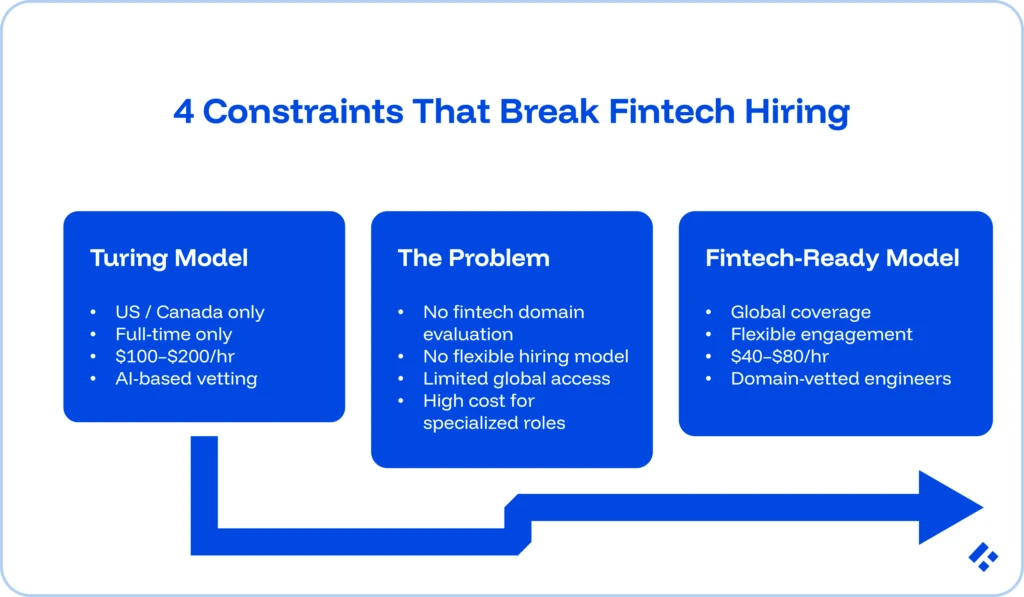
Turing serves US and Canadian clients only, places full-time engineers exclusively, prices at $100–$200/hr, and uses AI-first matching without fintech domain evaluation. While Turing has earned a genuine reputation for engineering quality, for fintech engineering teams, each of these constraints adds friction or eliminates eligibility entirely.
The company has over 3 million candidates screened across 140+ countries, a 97% engagement success rate, a two-week risk-free trial, and AI-powered matching that genuinely delivers for US technology companies hiring standard backend, frontend, or AI engineering roles.
This model is not ideal for fintech, where use cases shift regularly and Fintech-specific expertise (which Turing does not screen for) is absolutely critical. Let’s take a deeper look at where Turing works well, and where it doesn’t, as well as the best Turing alternatives for fintech engineering.
If you are ready for reliable fintech hiring, request talent.
Key Takeaways
- Turing’s US/Canada-only restriction removes it from consideration for UK, EU, LATAM, and APAC fintech companies before any other factor applies.
- The full-time-only engagement model conflicts with the compliance-deadline-driven capacity spikes that characterize fintech engineering.
- At $100–$200/hr, Turing prices are roughly double the LATAM nearshore benchmark for engineers with equivalent production fintech experience.
- AI-first matching optimized for algorithmic coding doesn’t evaluate fintech domain competencies. The gap tends to stay invisible until a payment retry scenario or KYC state transition surfaces in production.
What Turing Does Well and Where the Model Starts to Break
The vetting process Turing runs, which includes 5 to 10 hours of algorithmic coding challenges, system design evaluation, and English proficiency assessment, produces engineers who perform very well under normal circumstances that involve general engineering tasks.
Developers in the top 1% of a screened pool of 3+ million candidates tend to write clean code, navigate complex system design questions, and integrate into distributed teams without much friction.
A lot of the client reviews that we have seen for React, Node.js, Python, and DevOps roles are largely positive.
The 3–5 business day shortlist timeline competes with even the fastest freelance developer platforms. If that were not enough of a reason for some companies to use Turing, the two-week trial period reduces the commitment risk that comes with any new hire.
None of that stops being true when you move into fintech.
But, while Turing’s hiring model is great, fintech engineering teams carry four characteristics that each map to a structural constraint in that model.
Constraint 1: Geography
Turing serves US and Canadian clients only.
UK fintechs, EU-licensed payment institutions, APAC digital banks, LATAM fintech scaleups, and anyone else outside of those regions can’t use the platform regardless of budget, role type, or willingness to work within Turing’s other constraints.
This constraint also catches some US-headquartered fintechs that have raised international capital, opened UK or EU subsidiaries, and distributed engineering across London or Dublin.
LATAM nearshore platforms don’t carry this restriction. Trio’s model covers US, UK, EU, LATAM, and APAC fintech companies that are able to deal with a US firm, placing engineers with timezone overlap for both US and European working hours.
Constraint 2: Engagement Model
Turing places full-time developers who work 40 hours a week. They have no part-time options, no sprint contracts, and no project-based staffing models.
Fintech engineering teams often experience instances like regulatory timelines that create capacity spikes with hard edges. A team building toward a DORA compliance date, a Section 1033 implementation, or a PCI DSS remediation schedule needs specific engineering capacity for a specific window only.
This is also the reason why Turing’s two-week trial period matters less in fintech than in general engineering contexts. The trial reduces the risk of a quality mismatch, but the minimum commitment that follows the trial still runs full-time and indefinitely.
Constraint 3: Pricing
Turing’s developer rates run $100–$200/hr, which reflects the platform’s overhead, vetting infrastructure, and global talent pool quality.
For a US company benchmarking against a senior domestic hire at $180,000+ annually, this could create real savings.
But when you compare it to Trio’s LATAM engineers with production fintech experience, who sit in the $40–$80/hr range through LATAM nearshore staffing, you’re looking at 40 to 60 percent below Turing’s range.
And, since the engineers are guaranteed to be fintech specialists, the savings do not come at the cost of quality.
Constraint 4: AI-First Matching
Turing’s vetting runs primarily through automated assessment. The 5–10 hour process covers algorithmic coding, system design, and English proficiency, scored by machine before human review enters later stages.
The fintech limitation appears at the level of what the AI gets optimized to evaluate. Algorithmic challenges test data structure and algorithm proficiency. System design questions probe architectural thinking at an abstract level.
At Trio, we have the resources to be able to evaluate fintech developers on what matters. This is facilitated by the fintech experience of those doing the assessment.
When All Four Constraints Stack
Each constraint applies independently. For a specific but common fintech scenario, they compound in a way that makes Turing not just difficult but unavailable.
Consider a UK-licensed payment institution building FedNow/SEPA Instant rails integration alongside a DORA-compliant incident response system.
In this instance, the company might have three roles to fill.
They might need a payment rail engineer for a 6-month ISO 20022 migration project, a RegTech engineer to build DORA reporting infrastructure before a regulatory deadline, and a senior fintech data engineer to build a PCI DSS-isolated analytics pipeline.
Against Turing specifically:
- The company is UK-based. Turing is geographically unavailable.
- Two of the three roles are project-scoped. The full-time-only model conflicts directly with the actual hiring need.
- The ISO 20022 migration requires payment rail domain knowledge. Turing’s AI vetting doesn’t assess it.
- Three engineers at $100–$200/hr run $50,000–$100,000/month, more than double the LATAM nearshore equivalent for the same seniority level.
What to Look for in a Turing Alternative for Fintech
When evaluating alternatives like Toptal, arc.dev, Andela, lemon.io, or Trio, the criteria that matter track directly against Turing’s documented gaps rather than general developer marketplace rankings.
- Geography coverage: Several platforms that present as global carry US-centric client restrictions in practice. For UK, EU, or APAC fintech companies, confirming explicit coverage matters before evaluating any other dimension.
- Engagement flexibility: Freelance developer marketplaces like Upwork and Fiverr offer hourly flexibility but lack the structured pre-vetting and the team-embedding model that regulated fintech development requires
- Fintech domain evaluation: Genuine fintech domain pre-vetting requires evaluators with production fintech backgrounds evaluating role-specific knowledge.
- LATAM pricing as a benchmark. $40–$80/hr for pre-vetted LATAM engineers with production fintech backgrounds represents the relevant market rate for fintech-specialized staffing.
How Trio Addresses Each Constraint
At Trio, we specialize in Fintech staff augmentation and outsourcing. Taking our industry into account, we have optimized our hiring models to suit the industry and ensure that our clients get the most out of every engagement.
Related Reading: How to Choose a Reliable Tech Partner
Geography
At Trio, our fintech staff augmentation hiring model serves fintech companies across the US, UK, EU, LATAM, and APAC.
Our company is based in the United States, so as long as you are able to work with a US-based firm, you are able to hire developers from Trio.
African and LATAM-based engineers maintain timezone overlap with both US and European working hours, giving UK and EU fintechs the same collaboration advantage as US clients.
We take care of all the legalities of international hiring on our side, so your business relationship stays simple.
Engagement flexibility
Full-time placements, part-time engagements, and project-based staffing are all available. You pay for developers hourly, and keep them for as long as you need them.
In other words, if you need something like a RegTech engineer for a 6-month DORA compliance build, you are able to get a Trio engineer on your team for only that period of time, rather than a permanent headcount addition.
This also gives you the ability to scale your team up drastically when you need additional support.
Pricing
At Trio, our rates for senior fintech developers range from $40–$80/hr ($7,000–$14,000/month), depending on your exact requirements.
These low rates are largely facilitated by the lower cost of living in nearshore and offshore locations.
All our developers are experts in their fields, and hand-picked based on what you need, so the decreased cost does not come with a decrease in quality.
Fintech domain evaluation
Since we already have many fintech experts on hand, we have the in-house resources to ensure our pre-vetting assesses fintech domain competence.
Our talent pool is also only made up of senior developers who have production experience in fintech products similar to your own. That production experience is a major factor we consider before we even select initial portfolios for you.
Placement timeline
We try to get our clients a handful of portfolios to start considering within 48 hours. Total placement timelines take 3–5 days from brief to profiles, covering fintech domain specialist roles that Turing’s platform would surface as algorithmically strong generalists.
Since you are guaranteed experts with past experience, onboarding happens rapidly. Developers don’t need to learn a whole new industry; they just need to figure out your project’s specifics before they can start meaningfully contributing.
Turing vs. Trio for Fintech Engineering: Direct Comparison
| Dimension | Turing | Trio |
| Client geography | US and Canada only | Global (US, UK, EU, LATAM, APAC) |
| Engagement model | Full-time only (40 hrs/week) | Full-time, part-time, project-based |
| Developer pricing | $100–$200/hr | $40–$80/hr ($7K–$14K/month) |
| Vetting approach | AI-first: algorithmic coding, system design, English proficiency | Human domain evaluation: fintech-specific competencies per discipline |
| Fintech domain evaluation | Not systematically assessed | KYC/AML, payments, ledger, fraud ML, RegTech, open banking, data engineering |
| Time to profiles | 3–5 business days | 3–5 days |
| Trial/risk mitigation | 2-week risk-free trial | Replacement available if placement doesn’t meet the brief |
| Contract flexibility | Full-time commitment required | Flexible, scales to project need |
| Geographic timezone overlap | Global (varies by engineer) | LATAM, with US Eastern + European overlap |
| Retention rate | 97% engagement success rate (self-reported) | 95% (Trio-reported) |
| Best fit | Full-time general software engineering for US/Canadian companies | Fintech domain specialist, engineering, global clients, flexible engagement |
Fintech Engineering Roles Where the Constraints Hit Hardest
Not every fintech hiring need suffers equally. There are some instances where you might be able to get away with hiring Turing developers, and other times where hiring through a company like Trio is essential.
Highest Turing constraint impact:
- European and UK fintechs are hiring for any engineering role.
- Compliance-deadline-driven roles (RegTech, DORA, BCBS 239, Section 1033)
- Payment rail engineers (NACHA, ISO 20022, FedNow/RTP)
- KYC/AML engineers, since state machine design and BSA requirements don’t appear in the algorithmic assessment.
- Fraud detection ML engineers, as training-serving skew, class imbalance, and concept drift are not covered in general ML evaluation.
- Fintech data engineers require DECIMAL precision, PCI DSS isolation, and reconciliation pipeline architecture.
Lower Turing constraint impact:
- US/Canadian fintechs hiring general backend engineers (React, Node.js, Python) for standard product development.
- Frontend engineers building financial product UIs where the domain exposure stays limited.
- DevOps and SRE engineers managing cloud infrastructure who aren’t touching regulated data systems directly.
If you are in that second group, then Turing’s scale, shortlist speed, and 2-week trial make it a reasonable option.
Final Thoughts
Turing is a great option for generalist hiring if you are able to afford their higher rates. Their algorithmic system facilitates rapid hiring, allowing you to scale your team quickly.
However, if you are hiring for financial application development specifically, you need engineers with several skillsets that Turing does not screen for. Trio is a great option in these instances, as you get fintech talent, placed in 3-5 days.
If you are ready to hire senior fintech developers, book a discovery call.
Frequently Asked Questions
Does Turing work for fintech companies?
Turing works for US and Canadian fintech companies hiring full-time general software engineers with expertise in things like React, Node.js, Python backend, DevOps, and similar roles. The AI-first vetting doesn’t evaluate fintech domain competencies, which means there is an elevated risk when you are hiring regulated domain roles.
What are the main alternatives to Turing for fintech engineering?
The main Turing alternatives for fintech engineering combine global geographic coverage, flexible engagement models, fintech domain pre-vetting, and LATAM nearshore pricing. Trio addresses all four constraints directly.
Why does Turing only serve US and Canadian companies?
Turing’s compliance infrastructure, payroll management, and contractor classification framework are structured around US and Canadian employment law. The platform hasn’t expanded client eligibility beyond North America yet.
How does Turing’s $100–$200/hr pricing compare to LATAM nearshore alternatives?
LATAM nearshore staffing platforms with fintech domain vetting at Trio place engineers at $40–$80/hr ($7,000–$14,000/month), roughly 40–60% below Turing’s range. That differential doesn’t come with a decrease in quality.
Can project-based or part-time fintech engineers receive the same domain pre-vetting as full-time hires?
Yes, at Trio, project-based or part-time fintech engineers receive the same pre-vetting as full-time hires, since they are all Trio’s full-time employees; the only difference is your engagement model.