


 Read Client Stories




 Lace Brunsden

 Key Takeaways
- Embedded B2B payments bring payment into software businesses already use.
- Payment convenience and financing solve different customer needs.
- Customer demand, full costs, and responsibilities determine business fit.
- A useful first step is understanding one real customer payment journey.
Embedded B2B payments let businesses make or receive payments inside the software they already use to work with other businesses.
For a software company, they may be worth exploring when paying an invoice, settling a supplier bill, or completing a marketplace purchase naturally belongs in the product.
The business opportunity starts with making that task easier, then weighing the cost and responsibility of offering it.
Let's take a look at everything you need to know about embedded B2B payments, including what they are and why they matter.
Trio's fintech engineers build and integrate embedded B2B payment flows for software platforms, from provider evaluation through checkout and reconciliation.
What are embedded B2B payments?
A payment is embedded when payment functionality becomes part of a broader software experience. A customer might review an invoice and pay it within an accounting platform, for example, instead of leaving the product to arrange a separate transfer.
Payabli describes embedded B2B payments in terms of bringing payment acceptance and payables into a SaaS product.
“Embedded” describes where the payment fits into the experience. It does not identify the payment method.
A product could offer card payments, bank payments, or several options, depending on its customers and provider.
The useful question for a founder is therefore specific: which business task becomes easier when the customer can pay within the product?
Adding a payment button without answering that question can create another feature to support without solving a meaningful customer problem.
How embedded B2B payments work
At a high level, the software brings together the business transaction and a payment service.
The customer sees the purchase, invoice, or bill in context, chooses an available payment option, and authorizes the payment. A payment provider handles the financial processing according to the service arrangement.
That means your software company still needs a clear agreement about who supports customers, handles payment problems, and explains payment status.
Offering payments inside a product does not make those responsibilities disappear. Completing the payment experience and receiving the money are different events.
For example, Stripe describes ACH Direct Debit as a delayed-notification method. Authorization and account verification are required, and payments can fail or be disputed.
It is essential that you understand those conditions before treating an apparently completed payment as available cash.
B2B payment use cases
The strongest starting point we see for B2B payments is an existing money-related task. These three use cases put the payment close to the information someone needs to decide whether to pay.
Invoicing: A customer reviews an invoice and pays within the same product. The potential value is fewer handoffs between understanding the bill and arranging payment.
Supplier payments: A business reviews a supplier bill and initiates payment from the software used to manage purchases or expenses. The fit depends on who has authority to approve and pay.
B2B marketplaces: A buyer places an order and pays within the marketplace. The platform needs to understand how sellers receive their money and who handles payment questions.
These are possible product designs, but they don't necessarily promise faster collection or lower operating costs. Instead, each needs to be tested against the way the intended customers actually buy, approve spending, and manage cash.
A hypothetical example: payments inside maintenance software
Imagine a software company serving commercial maintenance contractors. Its customers already use the product to schedule work and send invoices to business clients.
Those clients currently receive an invoice, open their bank portal, and arrange payment separately.
An embedded payment option could let the client review the invoice and pay from the same screen. That is a clear convenience hypothesis. The invoice provides the reason to pay, and the product provides a way to act.
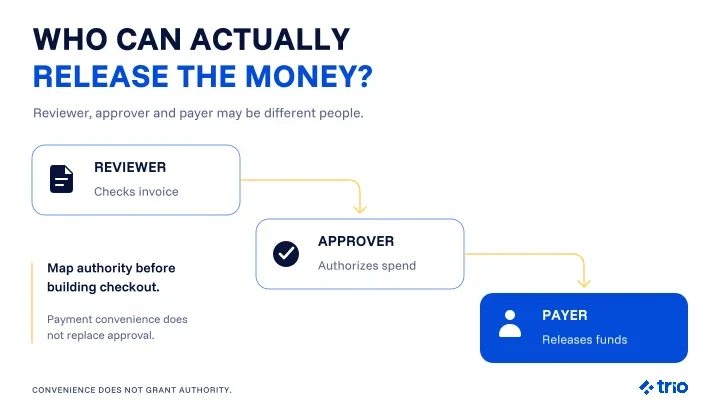
But suppose many clients require their finance department to approve invoices in a separate purchasing system. The person viewing the invoice may have no authority to pay it.
In that case, a polished checkout alone would do little to resolve the actual obstacle.
Start with the person who controls the payment. Before investing, establish who reviews the bill, who approves it and who releases the money. Those may be three different people.
Embedded payments benefits and trade-offs
Convenience is the clearest starting benefit. Keeping a payment beside its invoice or order can make the customer journey easier to follow. Whether that translates into better collection, stronger product retention, or less administrative work remains a hypothesis until the business measures it.
Revenue needs its own business case. If a provider offers a revenue-sharing arrangement, evaluate it against processing charges, support work, commercial commitments, and the cost of maintaining the feature. Payment volume alone does not tell you whether the arrangement is worthwhile.
Payment choice affects the experience. A bank-payment option should not be described as automatically instant. Nacha explains that Pay by Bank can use credit transfers or direct debits, with timing dependent on how the payment is made.
Support becomes part of the product promise. Decide how a customer gets help when a payment is delayed, disputed, or sent in error. A convenient payment experience loses value if the customer cannot find someone responsible for resolving a problem.
Embedded payments and lending solve different problems
Embedded payments help a business move money within a software experience, while lending or financing gives a buyer access to credit or time to repay.
We recommend that these are evaluated as separate capabilities.
For example, allowing a customer to pay an invoice by bank transfer does not itself finance the purchase.
Offering a lending product alongside that invoice introduces a different commercial proposition, with separate questions about eligibility, terms,s and responsibility.
Keep the initial product decision focused.
If customers struggle to make payments, investigate the payment experience. If they cannot afford to pay when required, investigate whether financing addresses that need and whether it belongs in your business.
How to evaluate embedded payments providers
One of the best ways we have found to evaluate embedded payments providers is to compare candidates against the same customer scenario.
A proposal for paying supplier bills is difficult to assess beside one designed mainly for accepting customer payments.
Customer fit: Does the service support the businesses, countries, currencies, and payment methods your intended customers need?
Money movement: When can the recipient use the money, and what happens if the payment fails, is disputed, or needs to be refunded?
Commercial terms: What are the processing charges, minimum commitments,s and additional fees? How would they affect a realistic customer transaction?
Responsibility: Who handles customer support, payment disputes, and relevant compliance obligations? Ask for a clear division of responsibilities.
Room to change: What would happen if you needed to add another payment method or move to another provider?
Ask each provider to walk through the same ordinary transaction and a customer refund. This keeps the discussion grounded in the service your customers would receive, rather than a long list of capabilities they may never use.
When embedded payments may not fit
It might be best to consider postponing the investment when customers rarely pay within your workflow, when their purchasing rules require another system, or when the expected value cannot justify provider and support costs.
Often, a working external payment process may already meet their needs.
A useful next step is to choose one customer payment journey to investigate.
Speak with the payer and the recipient, identify the friction, and compare that problem with what a provider can actually support.
If bank payments are central to that journey, explore how Pay by Bank works.
Once the business case is clear, assessing the fintech developers you may need becomes a more focused decision.
Trio's engineers design and integrate embedded B2B payment systems for software platforms, from provider evaluation through checkout, reconciliation, and ongoing support.
To see if we have the right people for you, request a consult.