


 Read Client Stories




 Alex Kugell

 Key Takeaways
- A mature scoring engine returns a decision in tens of milliseconds, inside an authorisation window that is typically well under one second.
- Detection and prevention are two halves of one job, with detection identifying the risk, and prevention acting on it before the transaction completes.
- With SEPA Instant, FedNow, Pix, UPI and Faster Payments, there is no clearing delay to buy an investigator time.
- Speed without accuracy costs more than the fraud it stops, since a false decline turns away a paying customer.
- Retrospective analysis, model retraining and portfolio reporting are still viable use cases for batches.
- Running dozens of features and model calls inside a sub-second budget is a streaming and in-memory data problem first.
Fraud doesn’t wait in fintech, and even a few seconds of delay can mean chargebacks, regulatory calls, or an angry customer wondering why their account was emptied overnight.
All of this means that real-time fraud detection and prevention have moved from nice-to-have to absolutely essential.
On instant payment rails, funds settle in seconds and cannot be clawed back, which means that traditional fraud checks that run later that night essentially just turn into reports.
Let’s look at how these systems actually work, what makes them effective, and where fintech builders tend to get it wrong.
If you need experts on your team to help you prevent fraud, whether you want to build a real-time fraud detection system of your own or you just want to implement a series of holistic best practices through the development process, we can help.
Our expert fintech developers, including specialist fraud detection engineers, are available through staff augmentation and outsourcing, so you can get access to the right skills in the most cost-effective way possible.
Real-Time Fraud Detection at a Glance
| Question | Short answer |
| What is it? | Scoring every transaction as it happens and acting on the result (approve, challenge, or block) before money moves. |
| How fast is “real time”? | Tens of milliseconds for the scoring call; the full authorisation window is typically under one second. |
| Detection or prevention? | Detection flags the risk. Prevention acts on it. In a real-time system, both happen in the same fraction of a second. |
| Why now? | Instant payment rails settle irreversibly in seconds, so post-hoc review can’t recover the money. |
| Core technologies | Stream processing, supervised and unsupervised machine learning, behavioural analytics, device intelligence, entity profiling. |
| Biggest mistake | Optimising for catch rate alone, which drives false declines that cost more than the fraud prevented. |
| Who needs it? | Issuers, acquirers, PSPs, neobanks, wallets, lenders, marketplaces and any platform moving money on instant rails. |
Understanding Real-Time Fraud Detection
Real-time fraud detection is the practice of analysing transactions, logins and behavioural signals the moment they occur, scoring the risk in milliseconds, and acting on that score before the transaction completes.
At its core, it’s about spotting and stopping fraudulent behavior as it happens, not hours or days later when the damage is already done.
What Counts as “Real Time”? The Latency Budget
This is where most explanations get vague, so it’s worth being specific. “Real time” is a budget measured in milliseconds, not a general commitment to being fast.
A payment rail allows a fixed authorisation window, typically well under one second end to end.
Your fraud score is only one call inside that window, competing with network hops, the issuer’s own processing, and downstream settlement logic. Mature scoring engines therefore target a decision in tens of milliseconds, leaving the rest of the budget free.
Hitting that target while evaluating dozens of features and multiple model calls is the core engineering challenge, and it’s why in-memory data stores and streaming architecture matter as much as model quality.
For example, a model that is 2% more accurate but takes 400ms might actually be the wrong model.
On the other end of the scale, in legacy batch environments, fraudulent charges may go undetected for 12 to 48 hours, or longer if reviews only run on business days.
During that window, a fraudster with stolen card details can run transactions across dozens of merchants before a single flag is raised.
Detection vs. Prevention: Not the Same Thing
These two terms get used interchangeably, but they describe different steps.
- Detection is the scoring and pattern-recognition step that identifies a risky transaction or entity.
- Prevention is the decision that follows: block it, challenge it with step-up authentication, or stall settlement while an analyst looks.
A system can detect perfectly and prevent nothing, which is exactly what batch review does. In a real-time system, the two collapse into the same fraction of a second.
When you’re evaluating a platform, we recommend that you ask about both separately.
What Is Real-Time Fraud?
Real-time fraud covers any kind of fraudulent transaction that unfolds the moment a user acts: card testing, synthetic identities, account takeovers, or phishing-triggered transfers.
These events move fast, especially as technology evolves, and detection systems have to move faster.
Real-time systems look at live transaction data and make immediate judgments, approve, hold, or flag, before money or credentials change hands.
Why Real-Time Detection Matters More in 2026
Two things changed in recent years that make real-time detection matter more than ever before, and they compound each other.
- Money got faster: Instant payment schemes (SEPA Instant, FedNow, Pix, UPI, and Faster Payments) settle funds in seconds. Once those funds land in a receiving account, they are gone.
- Losses kept climbing: Global card fraud losses reached $33.41 billion in 2024 and are projected to hit $41.06 billion by 2030. In the European Economic Area, the joint EBA–ECB report put payment fraud at €4.2 billion in 2024.
That same EBA–ECB report mentions that card payment fraud was 17 times higher when the recipient sat outside the EEA, where strong customer authentication isn’t legally required.
The upside is measurable too. The U.S. Department of the Treasury reported preventing and recovering over $4 billion in fraud in fiscal 2024, attributing the improvement to enhanced real-time detection processes.
The Importance of Immediate Detection
Once a fraudulent payment goes through, getting the money back can be incredibly difficult.
Detecting fraud at the exact moment it occurs dramatically reduces losses and keeps customers’ trust intact.
Real-time systems watch for anomalies like odd spending patterns or mismatched IPs while keeping the user experience smooth enough that genuine customers barely notice.
Traditional Fraud Detection vs. Modern Real-Time Systems
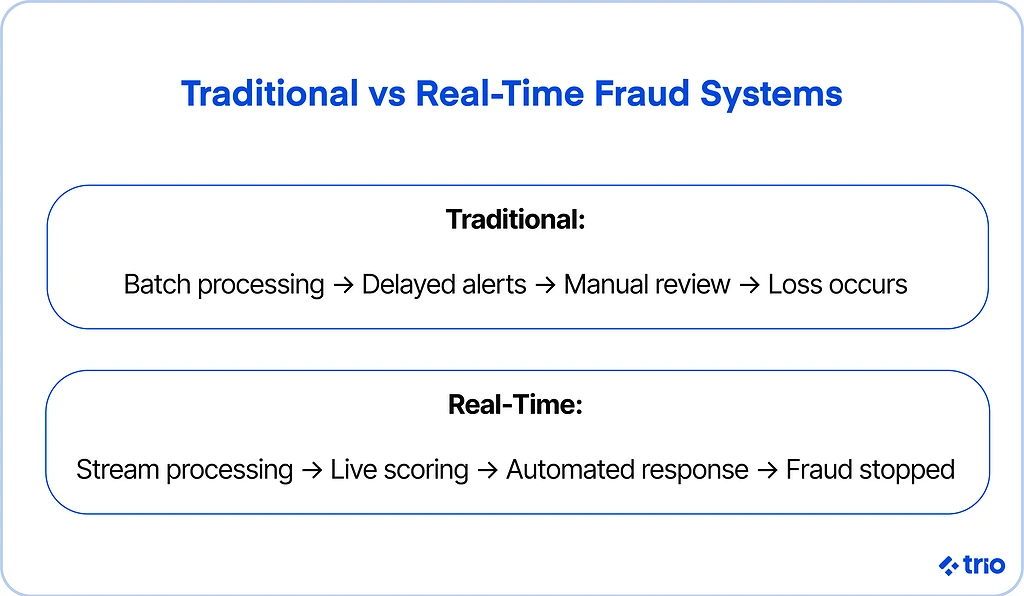
As we have already mentioned, older fraud tools were built for batch jobs and nightly audits.
Modern systems, in contrast, rely on stream processing, event-driven architecture, and machine learning.
| Factor | Real-time detection | Batch review |
| When it runs | At the moment of the transaction | Hourly, nightly, or later |
| Can it block a payment? | Yes, before funds move | No, the payment has already completed |
| Instant payment coverage | Effective; acts inside the settlement window | Ineffective; funds are already dispersed |
| False decline control | Tunable per transaction with live context | Blunt, applied after the damage is done |
| Analyst workload | Automated triage; humans handle edge cases | Backlogs of already-settled cases |
| Data requirements | Streaming pipelines, in-memory state, sub-second feature lookup | Scheduled ETL into a warehouse |
| Best used for | Authorisation decisions, APP and card fraud, ATO | Trend analysis, model retraining, regulatory reporting |
Batch processing still has a job. It’s the right tool for retrospective analysis, model retraining and portfolio reporting. What it cannot do is stop a transaction that has already settled.
Core Components of Fraud Detection Systems
Behind every instant decision lies a network of moving parts, data pipelines, risk engines, alerts, and integrations, all tuned for speed and precision.
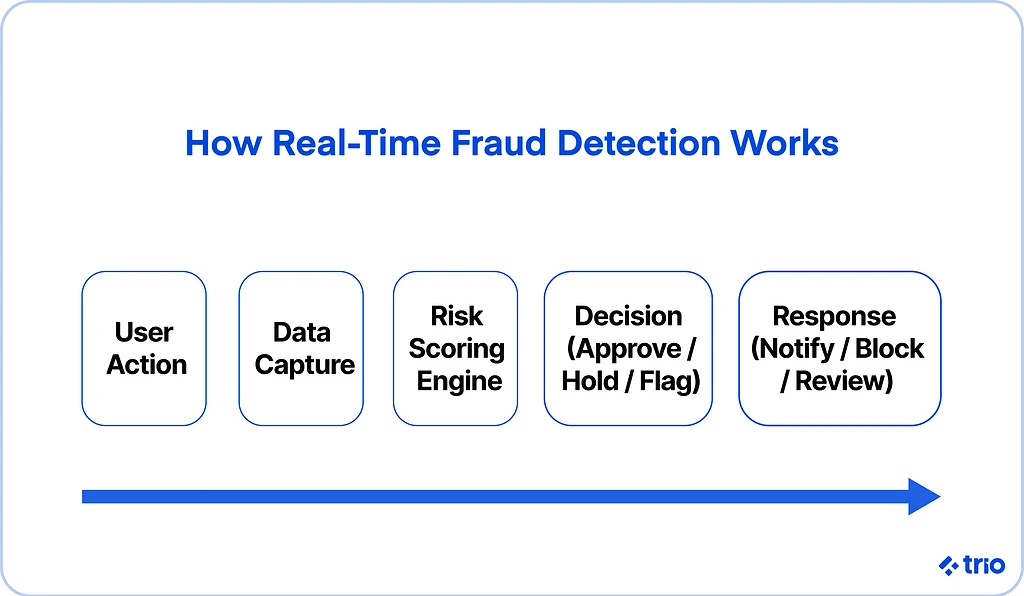
The Five-Step Scoring Pipeline
Nearly every real-time fraud system, regardless of vendor, runs the same five steps:
- Ingest the event: The transaction arrives via API or streaming connection the moment it’s initiated, carrying amount, card or account, merchant, device, and IP.
- Enrich with context: The system pulls in history and behavioural signals: prior transactions for this account, velocity, counterparties, peer-group norms, device and location patterns.
- Score the risk: Supervised models match the transaction against known fraud patterns while unsupervised models flag anomalies never seen before, producing a single risk score.
- Decide and act: The score maps to an action, approving low-risk transactions, triggering dynamic 3DS or strong customer authentication for medium risk, and blocking high risk automatically.
- Learn from the outcome: Confirmed fraud and confirmed-genuine transactions feed back into the models, so accuracy compounds instead of decaying.
Transaction Data Ingestion and Processing
Fraud detection lives or dies by data quality.
Systems pull information from payment gateways, devices, networks, and behavioral signals, often processing thousands of events per second.
Frameworks like Apache Kafka or Tinybird help teams manage these data streams without lag or loss.
Risk Scoring and Decision Engines
Every transaction gets a risk score. That score might come from a simple rule (something like, “too many failed logins in a minute”) or from a trained model crunching hundreds of variables.
Tools such as Amazon Fraud Detector or homegrown engines combine static rules with predictive modeling to make those split-second calls.
The best engines that we have encountered support customer-level profiling alongside transaction-level scoring.
For example, a customer who routinely travels internationally should not be scored the same way as one who has never transacted abroad, and a system that can’t tell the difference will either miss fraud or generate false declines.
Pre-Authorisation vs. Post-Authorisation Scoring
Where the score lands in the payment message flow determines what it can actually do, and this distinction rarely comes up in vendor conversations until it’s too late.
- Pre-authorisation scoring runs before the transaction is approved, so a high-risk payment can be declined before any money is committed. This is the tightest latency budget and the highest-value moment to act.
- Post-authorisation scoring runs just after approval. It still catches fraud early enough to stall settlement, freeze funds, or open an investigation before losses crystallise, but the money has been committed.
The thing most people overlook is that a strong system needs to support both, as well as additional batch scoring for portfolio-wide sweeps.
When you’re evaluating platforms to integrate, you should ask explicitly which one you’re getting.
Alerting and Response Mechanisms
Good systems route high-risk cases straight to human review, auto-freeze accounts showing suspicious activity, or trigger step-up verification.
Our developers have found that the trick is to keep thresholds smart enough to catch real issues without drowning analysts in false alarms.
Case management is incredibly essential. When an alert fires, a case should be created automatically and pre-populated with transaction details, device information, IP, behavioural patterns, risk score, alert reason codes, and account history.
By providing an analyst with all of this information, you can resolve cases in minutes instead of days.
We have seen a lot of success with tiered thresholds rather than a single cutoff.
High-confidence scores trigger automatic blocks. Mid-range scores trigger a customer challenge or analyst review. Low scores pass through and are logged for pattern analysis.
Integration with Payment and Banking Infrastructure
Fraud tools sit between payment processors, core banking systems, and KYC/AML platforms.
When integration is done right, risk signals can stop a transaction before it clears the network, not after.
Real-Time Fraud Prevention Strategies
Stopping fraud in real time is largely about strategy. The smartest systems blend automation with human oversight and continuously learn from new patterns.
Rule-Based vs. Machine Learning Approaches
Rules still have their place, of course. They’re transparent and easy to audit, but you need to keep in mind that they age fast since fraudsters keep evolving their methods.
Machine learning models fill that gap by finding patterns that humans might overlook, though they need careful tuning and solid data to stay reliable.
In practice, you want both. Rules give you instant deployment, while models give you coverage of the patterns nobody has written a rule for yet.
Within machine learning, however, there’s a further split worth understanding.
Supervised learning recognises known fraud patterns from labelled historical data. Unsupervised learning flags anomalies that have never been seen before.
Behavioral Analytics and Pattern Recognition
Behavioral analytics profiles users over time, including information like where they log in from, how they type, and how quickly they navigate checkout screens.
Once that baseline exists, even small anomalies like a new device or an unusual transaction size can raise early warnings.
Identity Verification and Multi-Factor Authentication
Simple passwords don’t stand a chance anymore, so adding identity verification and MFA has quickly become essential to cut off many attacks before they start.
When combined with behavioral analytics, it creates a layered defense that catches both synthetic and stolen identities.
Device fingerprinting sits alongside these.
This is where analysing device and browser characteristics helps recognise returning legitimate users as much as it helps spot suspicious ones.
Consortium and Networked Data
A model that has only ever seen one company’s transactions has no way to recognise a fraud pattern the first time it appears in that portfolio, even though the same card, device or mule ring may have already hit a dozen other institutions.
Mule networks and APP scam rings routinely operate across multiple institutions simultaneously, deliberately staying under the detection threshold at any single one.
Closing that gap requires visibility beyond your own data, which is where consortium datasets, shared fraud databases, or vendors whose models learn across their whole customer base come into play.
Balancing Security with Customer Experience
There’s a very fine line between protection and frustration. Too many authentication steps or false declines, and customers start leaving.
One Experian survey found that 67% of consumers are willing to abandon a digital transaction if authentication feels too complex. For most fintechs, that churn is a larger line item than the fraud it prevents.
You don’t necessarily have to make fraud completely impossible. You just need to make it unprofitable while keeping genuine users happy.
The Types of Fraud Real-Time Systems Stop
| Fraud type | Why speed decides the outcome |
| Card-not-present (CNP) fraud | Stolen card details are tested and cashed out in minutes. Real-time velocity and IP checks catch the card-testing spike before the large purchases land. |
| Account takeover (ATO) | A hijacked account looks trusted. Only a live behavioural baseline flags the sudden new payee or out-of-pattern transfer in time. |
| Authorised push payment (APP) fraud | The victim authorises the payment themselves and funds hit a mule account in seconds. Only real-time monitoring of the receiving side can freeze them before dispersal. |
| Money mule networks | Mule accounts receive and move funds instantly. Network analysis has to map the cluster live, before layering completes. |
| Synthetic identity fraud | Fabricated identities build clean histories over months, then bust out. Entity profiling over time catches the behavioural discontinuity. |
| Merchant bust-out | A merchant builds a clean record then floods the system with stolen-card volume over a weekend. Entity monitoring flags the anomaly before settlement releases. |
| Insider and enterprise fraud | Irregular admin actions, privilege escalations and bulk data exports only look wrong against a live baseline of normal internal behaviour. |
Authorised Push Payment Fraud: The Hardest Case
APP fraud deserves its own treatment because it breaks the assumptions most fraud systems are built on.
In APP fraud, the victim is deceived into willingly transferring money to a fraudster. Think of things like romance scams, impersonation scams posing as a bank or government agency, and fake invoice fraud targeting businesses.
Since the victim initiates the payment and authenticates it correctly, every transaction-level check on the sending side passes cleanly.
The issue is still that, once an authorised push payment executes on an instant rail, it’s typically irrevocable. So detection has to work differently, on two levels:
- Risk-score the receiving account. Is it newly opened? Does it appear on a fraud consortium blacklist? Has it been associated with past scam activity? What does its inflow-to-outflow ratio look like against its peer group?
- Screen the beneficiary in real time against known mule account registries, sanctions lists, PEP databases, and adverse media.
When a payment is flagged, the most effective intervention is often friction rather than a block.
Our developers have helped companies employ tools like a real-time warning telling the customer the recipient has been associated with reported scams and asking them to confirm.
Building a Real-Time Fraud Prevention System
Building a fraud detection platform requires a well-planned architecture, with thoughtful design across data flow, monitoring, and decision logic.
Data Architecture for Real-Time Detection
A strong data architecture pulls from multiple sources (transactions, devices, IPs, and behavior) and unifies them in milliseconds.
That may sound straightforward, but building low-latency data pipelines that stay consistent under load is a constant balancing act between speed and accuracy.
The specific constraint that we often notice catches teams out is feature freshness.
A velocity feature like “transactions from this card in the last 60 seconds” is useless if it’s computed from a warehouse table refreshed every five minutes.
A far better approach is for real-time features to be maintained in memory as events arrive.
Stream Processing and Event Monitoring
Most modern fraud systems rely on stream processors like Kafka, Flink, or AWS Kinesis.
They let teams monitor events as they happen, apply rules instantly, and push suspicious activity to the right workflow without delay.
Visualizing Analytics and Risk Dashboards
Real-time dashboards that visualize anomaly spikes, model performance, and alert history help analysts fine-tune rules and understand where fraud is slipping through.
The Metrics That Actually Matter
Dashboards are only as good as what you choose to put on them. These are the numbers a real-time fraud programme should be reporting:
- Fraud loss rate (basis points of volume): the headline number, but meaningless alone.
- False positive rate: how many legitimate transactions you blocked. Track this next to the loss rate, always.
- Approval rate: the commercial counterweight. A rising approval rate with a flat loss rate is the sign of a system that’s genuinely improving.
- Decision latency (p95 and p99, not the mean): the tail is what breaks the authorisation window.
- Alert-to-action time: how long between an alert firing and something happening.
- Fraud dwell time: the gap between an unauthorised party first touching an account and being detected. Real-time scoring should drive this from hours to seconds.
- Analyst cases per FTE per day: the operational efficiency measure that tells you whether your case tooling is working.
Example Frameworks and Tools
Many fintechs mix and match, using tools like Tinybird for fast stream handling, AWS Fraud Detector for ML-driven scoring, and the Elastic Stack for visualization.
What matters most is interoperability and low latency.
Moving from Batch to Real Time: A Practical Sequence
If you’re migrating an existing programme rather than building fresh, the order matters a great deal:
- Audit your current detection gaps: Map the timeline of recent fraud cases. Identify where detection lagged and how much additional loss resulted from that delay. This tells you which fraud types to prioritise.
- Start with the highest-impact flows: Outgoing wires, instant payments and account logins. These are where delayed detection causes irreversible harm.
- Run new models in shadow mode first: Operate new rules and models in parallel with the existing system, logging decisions without enforcing them, for at least two weeks. Compare shadow output against confirmed fraud before you activate anything.
- Design for latency from day one: Anything adding more than a few hundred milliseconds degrades the customer experience. Retrofitting latency is much harder than designing for it.
- Define automated response playbooks: Specify which scores trigger automatic declines, which trigger customer challenges, and which require analyst review.
- Give analysts decision authority: In a real-time environment, analysts need the ability to freeze accounts, initiate filings, and notify customers from inside the case interface.
The Role of Artificial Intelligence and Machine Learning
AI and machine learning have shifted fraud detection from rule-following to pattern-seeking. But they’re not magic.
The reality is that AI and ML are only as good as the data and monitoring behind them.
How Machine Learning Models Improve Detection Accuracy
Machine learning models spot connections that rule sets miss.
A model might notice that a legitimate customer’s behavior slowly changes as they get older, while a fraudster’s profile shifts instantly.
These subtle differences help the system detect fraud with fewer mistakes.
Continuous Model Training with Live Transaction Data
Fraud patterns change fast as fraudsters experiment and try new methods to get around existing detection solutions.
This means that models trained on last month’s data can already be outdated.
Continuous learning pipelines, fed by live transaction data, keep systems aligned with what’s happening in the real world rather than just what happened last quarter.
The operational requirement this creates is a labelling loop, where confirmed fraud and confirmed-genuine outcomes have to find their way back into training data reliably and quickly.
Teams that skip this end up with models that were excellent at launch and mediocre a year later, usually without noticing until a loss spike forces an investigation.
False Positives, Friction and the Cost of Getting It Wrong
False positives are, unfortunately, the hidden tax of fraud prevention, and they’re the reason “catch rate” is a dangerous metric to optimise alone.
Each wrongly blocked payment chips away at customer satisfaction, giving off an impression of unreliability.
How to Reduce False Declines Without Weakening Security
False declines rise when a system blocks bluntly on static rules without enough context about the customer. Three things reliably bring them down:
- Richer context: Score the transaction against the account’s own history and its peer group.
- Risk-based authentication: Apply step-up friction only to medium-risk transactions rather than to everyone.
- Feedback loops: Every confirmed false positive should be a training signal.
Cost and Scalability
Real-time systems can get expensive, especially as transaction volumes scale.
Cloud-native tools have eased the burden somewhat, but small fintechs often face tough choices about what to automate first.
Usage-based pricing has changed this calculus considerably: several vendors now charge per transaction with no setup fee, which puts network-effect models within reach of companies that could never have afforded a traditional enterprise deployment.
Customer Trust and Transparency
Communicating clearly about fraud prevention, why a transaction was flagged, and what’s being done to protect users builds credibility even when security measures are invisible.
Compliance, Liability, and Who Pays
The regulatory picture around real-time fraud has shifted substantially, and liability is moving toward institutions that fail to apply adequate real-time controls. This is now a board-level driver for investment.
Where Liability Sits
- Unauthorised transactions: In the U.S., Regulation E covers unauthorised electronic fund transfers and requires provisional credit within 10 business days while the investigation continues. Banks generally reimburse.
- Authorised transactions (APP fraud): Historically, institutions could decline responsibility because the customer authorised the payment. That’s changing, with the UK Payment Systems Regulator now mandating reimbursement of APP scam victims.
- Card fraud: Liability depends on which party had appropriate security in place. Under card network rules, it can shift based on whether the merchant or issuer applied required controls such as 3D Secure.
The practical implication for most is that institutions with documented real-time risk scoring, watchlist screening, and case management are meaningfully better positioned to defend a liability claim, because they can demonstrate that controls were operating and that they acted promptly when a flag was raised.
Data Privacy and Regulatory Compliance
Fintechs of all sizes need to navigate regional privacy laws like GDPR and PCI DSS while still analyzing huge volumes of data.
The best systems are transparent about how they use data and give customers a sense that their safety and privacy aren’t in conflict.
These regulations change and vary a great deal from place to place, so you need to ensure that you stay on top of the different developments and remain compliant.
In the EU, PSD2’s strong customer authentication requirements are already in force, and the incoming PSD3/PSR package extends fraud-prevention obligations further.
Delayed detection also creates a secondary compliance exposure.
What to Look for in a Real-Time Fraud Detection Platform
Whether you’re buying or building, these are the criteria that separate a system that works from one that demos well:
- Sub-second scoring, pre-authorisation: Confirm the decision lands inside the authorisation window, and that it can run pre-auth rather than only after the fact.
- Networked or consortium data: Ask whether models learn only from your data or from a wider network. Shared context is what catches first-seen fraud.
- Event and entity coverage: Strong systems score both the individual transaction and the behaviour of the merchant or account over time.
- Rules plus ML, both under your control: You want instant rule deployment for known threats alongside models for emerging ones, and the ability to change both without an engineering release.
- False decline management: Check that friction is tuned by risk level rather than applied uniformly.
- Case management built in: Auto-created, pre-populated cases with severity routing. Not a ticket in a separate system.
- Explainability: Every decision should come with reason codes an analyst and a regulator can both follow.
- Integration timeline measured in weeks: Enterprise tools that take 5 to 14 months leave you exposed for most of a year.
- AML coverage on the same data: For money movement, continuous monitoring should extend to laundering and mule activity, not just card fraud.
The Skills Gap: Who Builds These Systems
Real-time fraud detection sits at an awkward intersection that requires skills in data engineering, applied machine learning, payments domain knowledge, and regulatory literacy.
The people with all four are genuinely scarce.
This is the specific gap Trio fills.
Our fraud detection engineers have built and maintained these systems inside regulated financial institutions, and we can typically put the right people in front of you within days rather than the months a conventional hiring process takes.
Conclusion
Fraud prevention in fintech is a race that never really ends. Since it is practically impossible to build the perfect system, the goal is to build one that learns, adapts, and protects customers in real time.
The decisive constraint is no longer whether you can detect fraud — it’s whether the decision lands before the money does. On instant rails, that window is measured in milliseconds, and everything else follows from designing for it.
With the right mix of data architecture, machine learning, and human judgment, fintechs can stop most fraudulent activity before it becomes a headline.
To do this, you need the right skills. Since we specialize in fintech development here at Trio, we have a variety of niche talent on hand and could connect you with the right people in as little as a few days, taking the pressure off your hiring resources.
To find out more about how you can hire expert fintech developers with Trio, request a consult!