

Hire by Technology
SERVICES


Outsourcing software development to Colombia has many benefits. U.S. companies are increasingly turning to Colombia for access to highly skilled developers, cost savings, and the convenience of working in shared time zones.
But how do you outsource developers in Colombia reliably, especially for complex financial services where hiring risks are incredibly high?
Let’s look at six easy steps you can follow to increase your chances of connecting with the right fintech developers in Colombia. We have been assisting companies with similar processes, resulting in a 97% placement success rate since 2019.
If you want to augment your staff with a single developer, outsource your entire project, or need help building a dedicated team, we can assist you.
One of the most significant advantages of outsourcing in Colombia is the ability to scale quickly with reliable talent.
But, in order to maximize the value in software outsourcing and minimize potential risks, it is essential to follow a transparent hiring process.
Here are the steps you need to take to ensure the successful outsourcing of developers in Colombia, especially in industries like financial services.
Before you start looking at any outsourcing partners, you need to clarify your project requirements.
A basic list of the skills, technologies, and seniority levels you need.
The more specific your brief, the faster the shortlist becomes useful. "A senior Node.js engineer with experience in payment processing APIs and familiarity with SOC 2 environments" gives a partner something to work with. "A backend developer" does not.
Companies typically select between:
No single option is better than any other. It’s important to consider what resources you have available and what you actually need.
Staff augmentation means you get skilled talent that you can direct on a daily basis as if they were employees. It’s very flexible, but you need to be able to manage. Dedicated teams are similar.
Project outsourcing is a great option if you know what you want but don’t have the skills or resources to be hands-on. But once you sign the contract, everything is pretty much set in stone.
You can find Colombian developers through local agencies, outsourcing firms, or specialized partners like Trio that pre-vet candidates and manage compliance in software development.
If you go through any of these options, make sure that you check their track record for successful placement. Also, try to get a talent source that considers very specific skills, like how Trio is a fintech and financial services specialist.
If you go through a general freelancing platform or online marketplace, you’ll get a bunch of developers in different niches, and you'll have to spend far more time evaluating them carefully.
Make sure to evaluate portfolios, conduct technical interviews, coding assessments, and cultural fit checks.
We look for engineers who can talk through their decisions, flag tradeoffs, and show evidence of ownership in past work related to app development.
Look for developers with prior international experience and strong communication skills, as these attributes are essential for successful real-time collaboration.
This is more than just basic English proficiency. If you are outsourcing developers in Colombia, they will probably be working remotely, which adds additional complexity to your considerations.
This can be a very time-consuming process, and any mistakes could result in a significant financial loss.
At Trio, we've already built a strong network of Colombian developers so that you can hire software talent much faster, onboarding in as little as 3-5 days.
Ensure you're working with clear contracts that cover intellectual property rights, confidentiality, and compliance with both Colombian and U.S. labor laws.
You should also think about a few Colombian employment obligations before you hire software developers in Colombia specifically.
Contracts for software developers should address the probationary period, which runs a maximum of two months under Colombian law.
Employers of Colombian developers contribute to pension, healthcare, labor risk insurance, and family welfare funds, which add roughly 21 to 27 percent above base salary, making it an attractive option for companies looking to hire top talent.
A 13th-month salary applies as well, split into two payments in June and December. For employees with more than a year of service, a 30-day notice period applies on termination.
If you are a smaller business, you may not have the resources for this, which is why we take care of everything, providing you with a singular price.
The time-zone alignment between Colombia and the U.S. enables teams to work in real-time, reducing onboarding friction.
This means you can utilize agile frameworks, hold regular stand-ups, and leverage collaboration tools like Slack, Jira, or GitHub to ensure seamless integration.
Getting developers with industry experience means onboarding time is a lot shorter, since the developers just need to familiarize themselves with your code, not the entire industry.
That alignment is the primary reason Trio’s developers are able to contribute so quickly.
Businesses in the United States often turn to South America for outsourcing software development for a myriad of reasons.
At Trio, we don't just have industry experience and the software knowledge that comes with it; we also have strong connections with South American developers, including those from Chile, Brazil, and Argentina, whom we have connected with many companies in the past.
Colombian developers are of equal or higher quality when compared to developers in other regions. However, working with South American developers allows businesses based in the United States to work within familiar time zones.
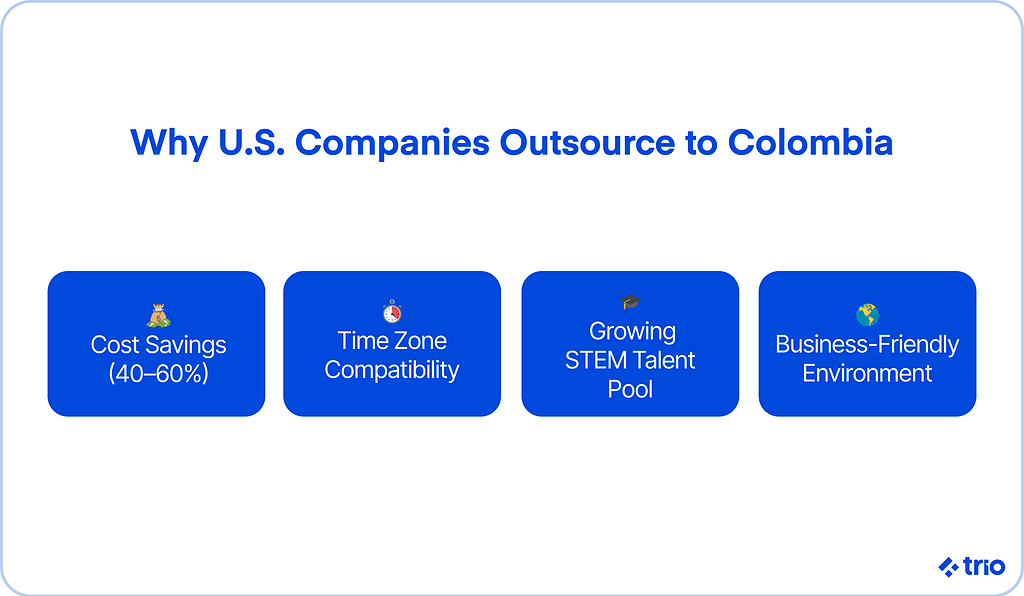
Let's take a look at a few of the other reasons why U.S. companies choose to outsource developers in Colombia:
Cost reduction is usually the main reason companies outsource. Hiring software engineers outside the United States is almost always cheaper than hiring them domestically.
Outsourcing to Colombian developers also means significantly lowering overhead employment costs. We've noticed savings of more than 50% at times. You'll save on recruitment, training, and any obligations related to having long-term staff, like the kind we mentioned above.
After accounting for Colombia's payroll obligations, costs per year tend to look roughly like this:
| Seniority Level | Fully Burdened Annual Cost |
| Junior Developer | ~$38,000 |
| Mid-level Developer | ~$57,000 |
| Senior Developer | ~$80,000 |
For context, equivalent U.S. roles typically run $85,000 to $165,000.
When you are considering senior fintech experts who could even rise above $200,000 in total compensation.
Colombia's time zones align closely with those of North America, resulting in business hours that are generally similar.
Unlike outsourcing to Africa or Eastern Europe, teams can work in real time with U.S. counterparts, improving communication and speeding up delivery.
You don't need to wait overnight for a reply, and you have more freedom to schedule your video calls.
About 24% of graduates in Colombia have a STEM degree. Some of the universities offer incredible programs, ranking well globally.
This ensures access to skilled developers across all major technologies and frameworks, reinforcing that Colombia is home to a wealth of talent for companies looking to enhance their capabilities.
Small and medium-sized businesses (SMBs) often lack the necessary tools to initiate projects from scratch.
By outsourcing Colombian developers, you'll have everything you need to start your next project, and by working with a fintech-specific agency, you guarantee the developers are familiar with the industry.
The government has invested heavily in a range of areas, including digital infrastructure and education.
This makes it a great environment for international business, specifically.
Colombia attracts many global corporations that want to leverage the benefits that remote engineers have to offer. Many talented developers have worked with international organizations on projects, learning new ideas and skills in the process.
Colombian developers will more likely than not already have the competence to work with businesses like yours and understand what's required in your regional market.
These engineers are not only technically skilled but also eager to engage with U.S. companies.
High English proficiency and cultural similarities make integration into U.S. teams smooth and effective.
Additionally, outsourcing to Colombian developers is a faster alternative to hiring full-time in-house staff. Finding, selecting, and hiring a developer independently can be time-consuming and resource-intensive, but development services in Colombia can simplify this process.
The Colombian talent pool covers a wide range of software development specializations. Most companies start with full-stack, backend, frontend, or QA engineers. But the market has matured enough to support more specialized hiring across several growing areas.
Some teams start by hiring a single developer, then expand into a dedicated team once collaboration patterns settle. Others build out an entire engineering function in Colombia from the start, when long-term velocity matters more than experimentation.
If hiring from another country were easy, everyone would be doing it. Luckily, being aware of several challenges upfront allows you to prepare proactively and avoid many issues entirely in custom software projects.
English proficiency among senior developers in Bogotá and Medellín tends to be genuinely functional.
That said, you are going to encounter a lot of variation, and the gap shows up most in fast-paced technical discussions or planning calls.
The best way to evaluate spoken communication is to do so directly during the interview process, which gives a more accurate picture than relying on a written test or cover message.
Demand for experienced engineers all over the world is high, and you might struggle with locating talent with very specific skills, particularly at the senior level in fintech and cloud.
Moving slowly through an interview process often means losing a candidate to another offer.
Building urgency into your evaluation timeline matters more here than in some other markets. You can also approach an external agency like Trio to help you mitigate the competitive nature of the hiring market.
Bogotá and Medellín have well-developed broadband connectivity that supports remote work reliably.
While infrastructure is always growing, it is difficult to guarantee it outside those hubs, especially if you aren’t personally familiar with the location.
When evaluating candidates who work remotely, it tends to be worth asking about their home setup directly to ensure effective real-time collaboration.
Colombia's labor framework includes obligations that differ meaningfully from U.S. employment structures.
Hiring directly without local guidance puts you at risk of serious compliance issues.
Securing your talent through an established firm with a proven track record of successful placements in Colombia offers considerably reduced risk.
Protecting intellectual property requires deliberate attention at the outset.
Colombian law provides frameworks for IP ownership, but the specific language in employment or contractor agreements still needs to address this clearly.
A well-drafted NDA and IP assignment agreement removes ambiguity before it becomes a problem.
The last thing you want is for there to be an issue with the ownership of a fintech app growing in popularity.
Hiring developers from Colombia can be extremely beneficial, especially if you are a smaller company trying to cut costs. Time-zone alignment makes it a strategic nearshore outsourcing destination for software development in the world.
At Trio, we specialize in connecting companies with top Colombian software engineers who have been pre-vetted for their real-world fintech experience, technical expertise, communication skills, and cultural fit.
Whether you need one developer or a whole dedicated team, our model ensures predictable costs and faster scaling.
Talk to us.
Colombian developers do speak English, especially in the tech sector, but fluency varies a lot, which is why Trio's screening process includes a verbal communication component rather than relying on written assessments alone.
Colombia is a safe option for outsourcing software development when working with partners in major hubs like Bogotá and Medellín, where the infrastructure is reliable.
The types of developers available in Colombia include frontend, backend, full-stack, mobile, QA, DevOps, cloud, data engineering, and fintech specialists, along with a growing number of AI and ML engineers.
Trio's process can deliver a curated shortlist within 48 to 72 hours of a discovery call, with developers often starting within the same week a selection gets made.
Legal obligations to consider when hiring in Colombia include a maximum two-month probationary period, a 30-day notice period for employees with over a year of service, a 13th-month salary split between June and December, and employer contributions to pension, healthcare, and labor funds.