


 Read Client Stories





 Lace Brunsden

 Key Takeaways
- A senior Philippine engineer bills around $30 to $40 an hour, roughly $60,000 to $80,000 a year all in, against $200,000 or more for the US equivalent.
- English is the strongest reason to look. The Philippines ranks 28th of 123 countries on the 2025 EF index, well ahead of India, Brazil and Colombia.
- Where Philippine law applies, employee-created and commissioned work calls for different rights evidence; employment or payment alone does not establish buyer ownership.
- A foreign-data exception requires a fact-specific assessment and does not remove continuing security responsibilities.
- Keep unresolved rights and production-access questions visible, with named reviewers and clear consequences for the proposal.
- Manila sits 12 to 13 hours ahead of US Eastern, so overlap comes from a vendor putting its own people on a shifted schedule rather than from geography.
Software outsourcing means contracting an external provider to perform agreed development work. A Philippine provider, for example, might propose individual engineers, a dedicated team, or a managed project.
Those arrangements need different levels of internal direction, so compare what each vendor will do before comparing its price.
While outsourcing is often popular because of the potential cost savings, there are more factors to consider when evaluating software development outsourcing in the Philippines.
At Trio, we provide nearshore developers from LATAM, as well as offshore developers from Africa. These developers are pre-vetted and guaranteed to have experience on international teams, mitigating many of the downsides of outsourcing.
What Philippine development costs, and what you get for it
Rates are usually the reason why the Philippines is a popular outsourcing destination.
Vendors quote roughly $30 to $40 an hour for a senior engineer, which lands around $60,000 to $80,000 a year all-in.
This needs to be compared against a senior US hire at $200,000 or more once benefits and overhead are counted. In other words, it's a saving of 50 to 70 percent.
The pool behind those rates is large.
The Philippine IT and business process industry reports a workforce of around 1.9 million people and roughly $40 billion in annual revenue, and its industry association expects more than a million new tech jobs by 2028, including about 150,000 developer roles.
Most of that 1.9 million does business process work rather than software engineering, so the developer-specific pool is a fraction of the headline.
English is the real strength.
On the 2025 EF English Proficiency Index, the Philippines scores 569 and ranks 28th of 123 countries, inside the high proficiency band.
Manila on its own scores 603, which is in the very high band.
For comparison, India scores 484, Brazil 482, and Colombia 480, all of them in the low band, while Argentina reaches 575.
If written and spoken English is the thing that has gone wrong for you before, this is a market where it usually does not, although it's always a good idea to evaluate candidates individually.
The time zone is the real cost.
Manila runs on UTC+8 and does not observe daylight saving. That puts it 12 hours ahead of US Eastern during the US summer and 13 hours ahead in winter, and 15 to 16 hours ahead of the Pacific coast.
You need to take into account that a normal Manila working day finishes about when most of the US wakes up.
Vendors solve this by shifting their own people rather than yours.
A team that starts in the Philippine afternoon buys you three or four hours of live overlap at the beginning of your day. It works, and it is also part of why attrition in Philippine outsourcing has historically run near 30 percent a year in the call center sector.
To make sure you are covering the right times, it's a good idea to ask a vendor which shift the named engineers actually work, how long they have worked it, and what your overlap looks like when one of them leaves.
If your project needs a full working day of overlap, incident response inside US business hours, or a lot of unplanned conversation, a better vendor does not change that arithmetic.
That is the point at which a nearshore option in Latin America, sitting within an hour or two of US time zones, is answering a different question than price is.
When Philippine vendors deserve a shortlist
A Philippine vendor deserves consideration when its actual proposal addresses a defined gap: development capacity, a relevant skill or responsibility for managing an agreed build.
Make sure that you assess that proposal against your available leadership, collaboration needs, and intended use of the finished product.
For example, a founder who has an engineering lead but cannot recruit additional developers can evaluate external capacity.
A founder without anyone able to review technical decisions needs a proposal that explicitly includes technical leadership and delivery management. Adding developers alone leaves that gap.
It's also recommended to treat cost, communication, and availability as vendor-specific questions. Request the proposed team, included work, actual schedules, and exclusions.
A country label cannot establish that a particular team will meet your requirements, and a lower quoted rate does not establish a lower total project cost.
Choose the delivery arrangement before comparing proposals
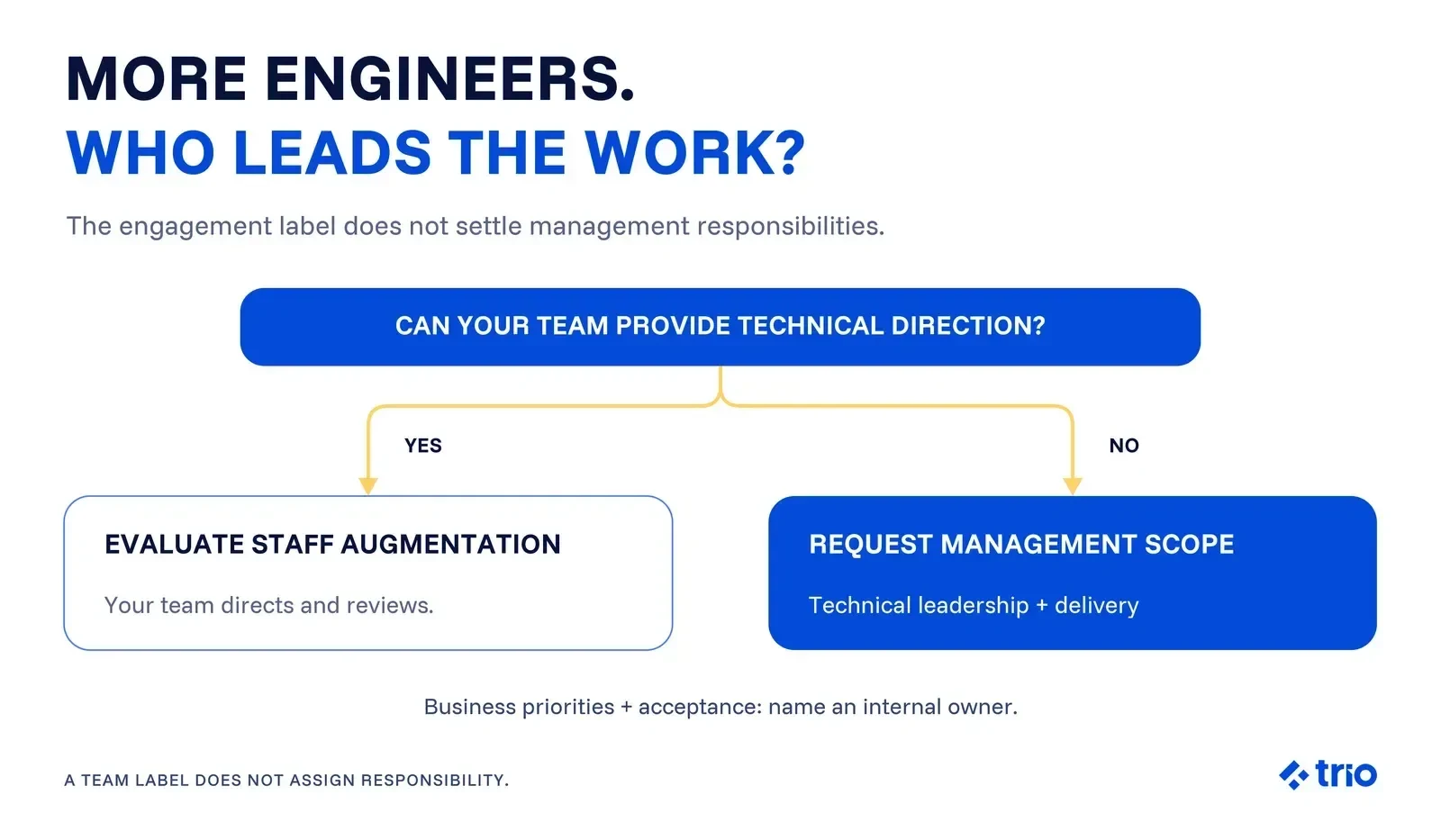
For Philippines software development outsourcing, distinguish the people being supplied from the management being contracted.
Use the following working definitions to question proposals, then confirm the responsibilities in each agreement.
Staff augmentation: External engineers join work directed by your team. Evaluate this arrangement when you can provide technical direction, priorities, and review.
Dedicated team: A group works on your product, but the label leaves management open. Establish who plans the work, reviews technical choices, and handles delivery problems.
Managed project: The provider takes responsibility for organizing an agreed scope. Specify the promised outputs, acceptance process, treatment of changes, and decisions that still require your approval.
If requirements will evolve, ask how each arrangement handles reprioritization and its effect on estimates. If the scope appears stable, still agree how exceptions and newly discovered work will be handled.
Keep a named person inside your company responsible for business priorities and accepting the result.
Related Reading: IT Outsourcing Guide
Check who created the software and what rights can transfer
Section 172 of the Philippine Intellectual Property Code lists computer programs among the works protected by copyright.
That makes the rights behind a custom software delivery a substantive procurement question rather than a formality to settle at signature.
Creator status changes the evidence to request.
Where Philippine law applies, Section 178.3 of the Intellectual Property Code distinguishes work produced through regularly assigned employment duties from work outside those duties, with qualifications for contrary agreements.
Employee involvement therefore calls for a review of the relevant duties and agreements. It does not establish that the buyer owns the resulting copyright. The Intellectual Property Code, dated June 6, 1997, provides the statutory framework.
Commissioned work also requires a different analysis.
In a September 7, 2020 decision, the Philippine Supreme Court explained that copyright in commissioned work generally belongs to the creator under Section 178.4, while discussing written agreements transferring those rights.
The case concerned badge designs, so it illustrates the distinction rather than determining a software buyer’s ownership.
Practically, we recommend that you identify the actual contributors and request evidence supporting the vendor’s ability to grant your intended rights. If you need to modify, maintain, or transfer the product, have the proposed terms reviewed against those uses.
Payment receipts and repository delivery aren't enough to answer the copyright question on their own.
Separate possession of the code from evidence of the rights you need. A vendor’s employment arrangements may help explain its rights, but the proposed transfer to your company still needs review.
Assess data access before accepting an exemption claim
A proposal could involve development data, production troubleshooting, or both.
You need to ask what information contributors will access, where processing will occur, and whether additional processors will participate. These facts are all critical when assessing the proposed arrangement.
A claimed foreign-data exception needs a documented basis.
Philippine National Privacy Commission Advisory Opinion No. 2024-019, dated December 26, 2024, addresses a Philippine processor handling US-bank data and a proposed US SEC inspection.
It describes conditions involving collection from foreign-jurisdiction residents, compliance with the relevant foreign privacy law, and processing in the Philippines, and also explains that exemptions are not absolute and that security responsibilities continue.
You need to keep in mind that that fact-specific opinion does not establish blanket permission for a software vendor to access US customer data.
In other words, if a vendor invokes an exception, request the collection and processing facts, its supporting assessment, and the safeguards it proposes.
Where the Philippine outsourcing provisions apply, Section 44 of the Data Privacy Act’s implementing rules addresses processing particulars, including geographic location, as well as instructions, confidentiality, security, and additional processors.
The rules also contain scope and exception qualifications.
It's a good idea to use them to inform a project-specific review rather than assuming identical obligations for every US-data engagement.
Preparing a decision-ready shortlist brief
We always find it's best to keep a brief short enough to use in a proposal discussion, but specific enough to reveal a missing answer.
Record the evidence, its reviewer, and the effect of any unresolved issue.
Project outcome and acceptance: Name the business owner and describe what a usable delivery must accomplish. Compare each proposal against the same outcome; clarify material exclusions before treating prices as comparable.
Delivery leadership: Request named responsibility for technical direction, planning, review, and escalation. If your company cannot supply a responsibility, establish whether the vendor explicitly includes it.
Working arrangements: Request actual schedules for the proposed team, including who can make decisions during shared hours. Clarify coverage when schedules change or the usual contact is absent.
Creator status and rights: Identify contributors and request relevant employment or commissioning documentation and proposed transfer terms for review. Keep the rights assessment open until the evidence supports the intended arrangement.
Data and access: Separate development fixtures from production personal data. Record processing locations, additional processors, safeguards and the basis for any exception claim. Leave unresolved production access outside the proposed scope.
Commercial scope and continuity: Compare included management, review, support, change handling and exit arrangements. Request clarification where a low price depends on work your team would have to supply.
Open questions: Give every material unknown an owner and required evidence. Mark the proposal as awaiting clarification when the missing answer could change the shortlist decision.
Related Reading: Software Development Partner Guide
Decide what advances and what needs clarification.
Once you have been able to evaluate each proposal, you can classify it as ready for further evaluation, awaiting specific evidence, or unsuitable for your stated constraints.
Advancement means the proposal merits the next review. It doesn't guarantee that ownership, privacy, or delivery questions have received legal or operational clearance.
Resolve material rights and access questions with the appropriate reviewers, then compare the remaining delivery and commercial terms.
If you are also considering broader software outsourcing options, you can bring the same brief to that conversation so scope, retained management, and required evidence remain concrete.
At Trio, we make the process of nearshore and offshore outsourcing simple. You contract with a US-based firm; we handle everything else.
Talk to us.