


 Read Client Stories





 Alex Kugell
 Key Takeaways
- Most LATAM jurisdictions apply primacía de la realidad: the reality of the work prevails over what the contract says, and the presumption runs against the hiring company when facts are ambiguous, the opposite of the US default.
- Engineering work is structurally very difficult to classify as contracting, because the legal tests turn on subordination and integration, and normal engineering management (standups, ticket assignment, code review, company equipment) supplies exactly that evidence.
- Reclassification is usually retroactive, which means that you’ll have aditional costs outside the fine, such as back contributions, benefits, and interest.
- Enforcement triggers have changed materially in Mexico thanks to the SIQAL portal, launched in September 2025.
- A genuinely scoped, deliverable-based engagement with real contractor independence still holds up.
Across Latin America, the contract label doesn’t decide worker status. This is a trap that many companies hiring for the first time fall into.
Instead, the contract label is often determined by the daily reality of the developer.
Many jurisdictions even presume employment when the facts are ambiguous, which is the reverse of the US default.
For engineering teams, especially those in financial software development companies, this matters a great deal because the way you manage engineers is close to the legal definition of subordination.
Let’s go over everything that you need to know about hiring engineers abroad, so you can understand what the right option is for you: contractor vs EOR. We’ll also go over the costs of misclassification.
If you aren’t sure, Trio has been connecting companies with senior fintech developers for several years. We can help you find the right people and ensure that your hiring models are legally sound.
The Contract Label Decides Nothing
Labor courts across Brazil, Mexico, Colombia, and Argentina have a way of dealing with agreements that can be summarized as primacía de la realidad.
Essentially, in the eyes of the governments, the reality of the working relationship prevails over whatever the contract says.
This often surprises some US companies that we work with since it’s the opposite of what they are used to.
Most LATAM jurisdictions default to employee status where classification is ambiguous, the opposite of the US default.
In Mexico specifically, Article 21 of the Federal Labor Law (LFT) presumes an employment relationship exists the moment someone performs personal, subordinated work, and the burden falls on the engaging company to prove otherwise.
Another thing that catches people off guard is that classification gets judged after the fact, case by case, on how the work actually ran, so you only find out when it’s contested.
An honoraria or services agreement acts as evidence of intent. Misclassification usually occurs due to drift.
Why Engineering Is the Hardest Category to Classify
The legal tests across the region focus on things like subordination, integration, and economic dependence.
Do they take tickets from your backlog, attend your standup, work inside your repository, follow your coding standards, have their pull requests reviewed by your tech lead, and use hardware you provided them?
Every item on that list is evidence of subordination.
- Mexico applies a subordination test: if you control when and how the work happens, it’s employment.
- Brazil applies a four-part test under the CLT (personal service, habituality, payment, and subordination).
- Argentina evaluates technical, economic, and legal dependence under Ley 20.744.
- Colombia and other regional jurisdictions apply broadly comparable substance-based tests of their own.
None of this means engineering can never be contracted. You just need to be careful to make sure that your agreement actually holds up, with scoped deliverables, the contractor controlling their own method and schedule, multiple clients, and their own tools.
What Reclassification Costs
The reason that reclassification can be so expensive is that it is retroactive.
The relevant authorities will reassess the entire period the person worked as a contractor, and you owe what an employee would have received across that whole period, plus contributions, plus interest.
The fine itself is probably going to be the least of your concerns.
Mexico is probably one of the strictest regions here. Social security (IMSS) can reclaim contributions for up to five years under Article 297 of the Social Security Law (LSS), with fines under LSS Article 304 reported at 40-100% of the omitted amount.
Once you start adding things like INFONAVIT housing-fund contributions and the accrued statutory benefits that were never paid, like the 13th-month aguinaldo, vacation premium, and the mandatory 10% profit-sharing (PTU), things can get very expensive, very quickly.
Outside of the financial loss, in serious cases, misclassification tied to unremitted withheld tax can be treated as fraud under Articles 108-109 of the Federal Tax Code, carrying potential criminal exposure of up to nine years.
Brazil triggers backdated INSS and FGTS contributions on reclassification, and from what we have seen, the legal system seems to be very worker-favorable.
Brazilian courts have also pierced the corporate veil in some rulings to hold foreign parent companies directly liable; the US entity isn’t automatically insulated just by being the parent rather than the direct employer.
What Actually Triggers It
A worker complaint is probably the most common trigger, and usually happens when there is bad blood after a termination, a dispute, or an unpaid invoice.
Some things have changed in the last couple of years that have increased the number of cases as well.
Mexico’s SIQAL portal, launched by the STPS in September 2025, now lets workers report suspected misclassification anonymously.
Proactive inspection has changed too, going beyond document review to include on-site or virtual interviews with workers about their actual daily working reality.
There’s also been a lot of cross-agency data sharing, specifically between tax, social security, and labor authorities.
When a Contractor Is a Contractor
Contractors are still a great option, as long as they provide scoped, deliverable-based work with a defined end.
They also need genuine economic independence, with multiple real clients, and their own tools and equipment.
A specialist engaged to deliver a defined integration over eight weeks, working their own hours alongside other clients, will pass all the legalities required for them to be a contractor.
In general, keep in mind that contractors only tend to suit early-stage MVP work and non-core tasks.
The Three Ways Out
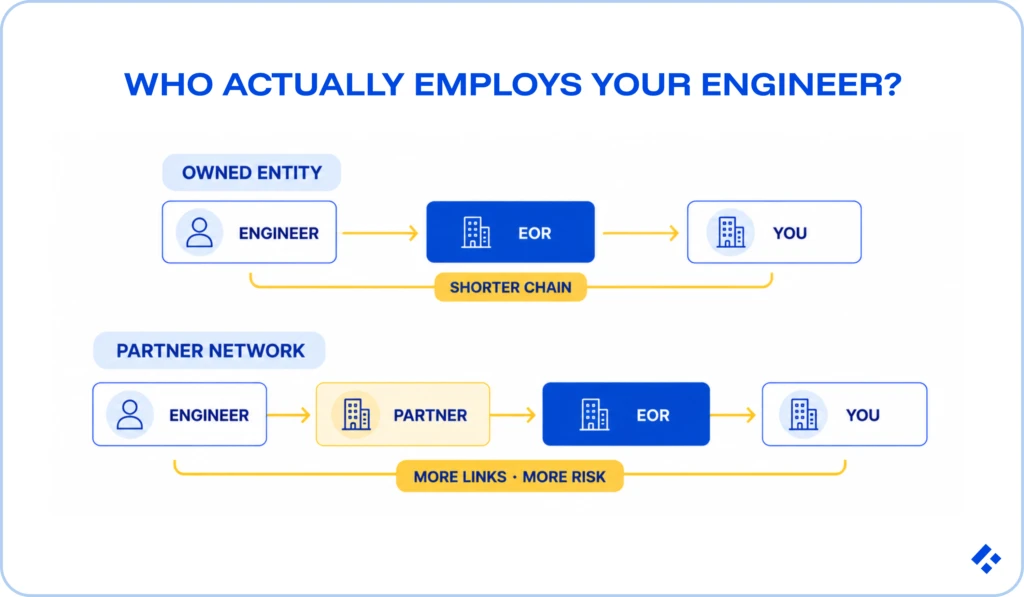
- Convert to employment via EOR: The person becomes a properly employed worker of the EOR’s local entity. Retrospective liability from that earlier period isn’t automatically absorbed unless the agreement says so explicitly. Ask specifically whether the provider’s indemnification covers pre-conversion exposure.
- Engage through a staff augmentation provider: The engineer is employed by the provider directly, and you buy their services rather than employing anyone yourself. This removes the classification question structurally.
- Set up a local entity and employ directly: This makes sense above roughly 8-12 people per country by common industry benchmarks.
All three fix the situation going forward, but you may still need to deal with retrospective issues.
The prior period needs a deliberate answer from counsel. Ultimately, the less exposure, and the shorter the period of exposure, the better.
At the same time, it’s important that you double-check factors like IP chains, since these can be weaker in some alternative engagements than direct employment.
At Trio, we offer a variety of hiring options, including IT staff augmentation, dedicated teams, and many more. Our many years of fintech experience mean that we have refined the process and contracts for a variety of nearshore LATAM locations.