

Hire by Technology
SERVICES


Many companies are leveraging Africa's growing talent pool to speed up their web development at a fraction of what the same work costs in the US or Western Europe.
If you are thinking of hiring offshore developers for staff augmentation, building a dedicated development team, or a full outsourcing arrangement, African countries offer high-quality developers across web development, mobile app development, and software solutions.
Rates vary incredibly across the continent, but there are major cost savings available all over.
You can hire individual developers through platforms like Upwork, engage a South African web development company through Clutch or GoodFirms, or work with a managed partner like Trio.
We vet candidates specifically for your domain and handle the matching process on your behalf.
Let's look at the African web development landscape in 2026, which countries lead, what cost-effective web development actually looks like across different project types, and how to evaluate your options.
If you want to hire pre-vetted developers, hand-picked for your project, get pricing.
We’ve seen firsthand how Africa's tech ecosystem has grown faster over the past decade than many international companies anticipated.
African startups raised over $1.42 billion in the first half of 2025 alone, and the infrastructure investment that followed has created a deeper technical talent pipeline than ever before.
The developer pool used to working with international clients is also growing.
Africa's youthful population, growing internet penetration, and expanding STEM education infrastructure appear to be expanding the talent pipeline steadily.
But one of the biggest reasons we see people returning to the region to look at African web development is the massive cost differential.
A senior full-stack developer in South Africa, billing at $50 per hour, compares to $120 to $180 per hour for equivalent US talent.
On a massive, 500-hour web application project, that gap can lead to as much as $35,000 to $65,000 in real savings, which is a significant figure even after accounting for time spent managing a cross-border engagement.
English fluency varies significantly by country, but South Africa specifically operates with English as its primary business language, which removes a friction point that affects some other outsourcing markets.
Nigeria and Kenya both have strong English proficiency in their tech communities, particularly in Lagos and Nairobi, though communication quality varies more at the individual level than it does in South Africa.
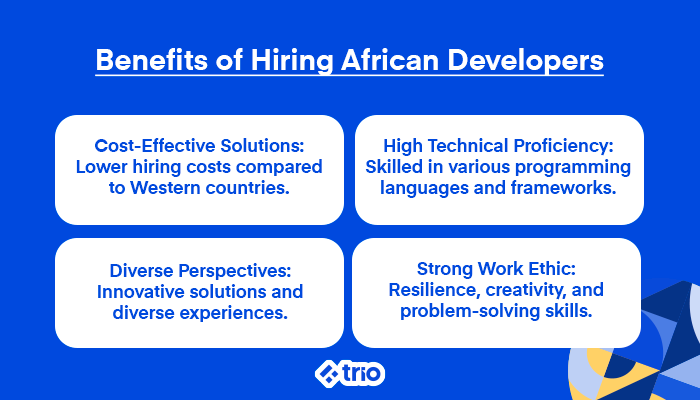
There are 54 internationally recognized countries in Africa, but looking at some of the most popular outsourcing destinations can give you a better idea of the continent as a whole.
South Africa leads the African web development market in terms of technical maturity, English language capability, and the depth of its agency ecosystem.
Cape Town in particular has developed a concentrated community of web development companies, digital agencies, and product-focused engineering firms.
Major companies like Warp Development, Netgen, Futureborn, and a range of Cape Town-based digital agencies appear consistently in Clutch and GoodFirms rankings for quality of output and client satisfaction.
The developers that you will find in the major tech hubs are of an incredible caliber, but also incredibly affordable.
At the entry level, WordPress-based web development for SMEs and startups runs from around R5,000 to R30,000 for standard projects, with agencies like Lamus and Brave Digital well-reviewed for this tier.
Custom web application development using React, Node.js, PHP, and Ruby on Rails commands higher rates from specialist firms and dedicated teams.
If you are hiring individual developers for staff augmentation or more permanent solutions, expect to pay more to get experts on your teams as well, sometimes as high as $100,000 a year for fintech specialists with extensive experience in international markets.
However, the reason these developers can charge so much for international companies specifically is that South Africa tends to offer the best combination of factors in the African market.
These include strong English, time zone alignment with Europe (UTC+2), and a broad enough talent pool to find senior developers with specialized backgrounds.
The 6 to 7 hour gap with the US East Coast creates more friction for US teams than European ones, though afternoon overlap makes daily check-ins workable as long as you plan carefully.
Lagos has become one of Africa's most active technology hubs, with a large and growing web developer community.
The Nigerian market tends to offer lower rates than South Africa, with mid-level web developers typically billing at $25 to $40 per hour for international clients.
You need to be very careful when vetting, though, as the quality range at that rate band varies far more widely than the South African market, where established agencies provide more consistent quality signals through reviews and track records.
Andela, the Nigerian company that has trained and placed thousands of African developers with international companies, helped establish Nigeria's reputation in the global tech talent market.
That reputation now extends beyond Andela-trained developers to a broader community of engineers who have grown up building for international clients.
Fintech has driven significant technical depth in the Nigerian developer market, with a massive payments and financial services startup ecosystem, including companies like Paystack and Flutterwave.
These companies have helped produce engineers with real experience building regulated financial products at scale, which makes Nigeria a particularly attractive option if you are building production financial applications of your own.
Nairobi has built a strong tech community, sometimes called Silicon Savannah, around mobile-first development and fintech.
Kenyan developers have particular depth in mobile app development and web applications built for variable connectivity environments, since designing for limited bandwidth has been a real constraint in many African markets that they have had to deal with.
We have found that this constraint has produced engineers who tend to write leaner, better-optimized code than developers who have only built for high-bandwidth environments.
Rates in Kenya typically run slightly below Nigeria and well below South Africa, with senior web developers billing at $30 to $50 per hour for international engagements.
Just keep in mind that you will be looking at a more limited talent pool if you need senior specialist-level developers, especially compared to South Africa, but mid-level generalist web development in standard stacks is readily available.
Egypt has become a particularly popular outsourcing location for European companies, where Arabic-language or MENA-region market knowledge carries additional value.
Cairo concentrates the majority of Egypt's tech activity, and the country produces a large number of engineering graduates annually.
Rates sit between South African and Kenyan levels, making Egypt a cost-competitive option that often gets overlooked in discussions focused primarily on sub-Saharan Africa.
While outsourcing to external development companies based in Africa is a great option for many parts of web development, making sure that you have a company with expertise in a specific niche or industry is essential to minimize your overall risk.
Here is what web development companies actually offer:
Full custom web application development is one of the highest-value service tiers that we have seen.
This involves using frameworks like React, Vue, Angular on the frontend and Node.js, Python, Ruby on Rails, or PHP on the backend.
For enterprise web applications or fintech products, this tier requires even more significant vetting than usual.
Not every African web development company that lists React or Ruby on Rails in its service offering has senior developers who have built complex, regulated, or high-traffic systems with those stacks.
If you have an existing product or you have a specific framework in mind, ask for specific comparable project examples, with technical details that you can properly evaluate.
Like with essentially all other countries, this represents the highest-volume segment of the African web development market, particularly for SMEs, startups, and businesses building their first professional online presence.
South African agencies dominate the quality tier here, and rates for this work have become highly competitive.
Several Cape Town and Johannesburg-based WordPress development firms have built strong review profiles on Clutch, with project costs averaging below $10,000 for standard business websites.
E-commerce web development in Africa has matured considerably. This can likely be attributed to the regional e-commerce platforms and to international retailers looking to enter African markets.
WooCommerce and Shopify customization work represents the majority of this market, though custom e-commerce applications on PHP or Node.js backends exist at the higher end.
SEO integration has become a standard expectation for e-commerce web development in South Africa, specifically, partly because the competitive landscape for retail online presence has intensified.
Mobile app development is another strong offering, sometimes built adjacent to web development.
The Flutter framework is one example that has gained notable traction in the South African market, with multiple development firms using it as their primary cross-platform development tool.
We also see React Native being used frequently. Native iOS and Android development exists at the senior specialist level, but you are probably going to be paying a little more for the additional expertise.
The cost savings from African web development only translate into real ROI when the engagement produces reliable output, so it hinges heavily on your ability to vet your software development partner.
Projects that we have seen produce the strongest ROI through African web development:
Projects that tend to require more careful scoping before assuming African web development fits:
We have already discussed baseline salaries above, but on average, after you factor in management overhead, you could be looking at 40%-60% in savings if all goes well.
Cybersecurity has become a major concern in most parts of Africa, driven partly by the growing enforcement of the POPIA (Protection of Personal Information Act), which is like South Africa's equivalent of GDPR.
For US and European companies, there are a couple of questions you need to ask when evaluating any African web development company, or even an individual developer:
There are a couple of best practices that can increase your chances of a successful offshore or nearshore engagement with an African company.
The first thing is to make sure that you very clearly define what you need before you start sourcing.
This includes the industry that your project will fall under, any technologies, the location of your target market, and even specific seniority requirements.
Check Clutch and GoodFirms for verified reviews. If they are available, these can be strong indicators of things like the vetting process, as both of those platforms verify that reviewers are real clients.
You should also ask for a comparable project example, with details about the technical stack, the team size, the timeline, and any complications that arose. This information tells you whether their experience actually maps to what you're trying to build.
Finally, make sure that you build async communication habits from the start. Time zone differences between Africa and the US, particularly the 6 to 7-hour gap with South Africa, create a natural async rhythm.
Hiring African developers for cost-effective web development, mobile development, and more, presents the opportunity for incredible cost savings.
However, you need to be very careful with setting up async communication habits, and ensure that you vet your developers very carefully before bringing them onto your project.
At Trio, we specialize in fintech-focused development, which means the African developers we work with arrive with relevant context around payment systems, compliance requirements, and financial product engineering.
To find out if we have the right developers for your project, book a budget consult.